D-THE NIGHT I BROUGHT DINNER TO MY FIANCÉE, LOST THE FUTURE I HAD PAID FOR, AND FOUND THE LIFE I SHOULD HAVE CHOSEN
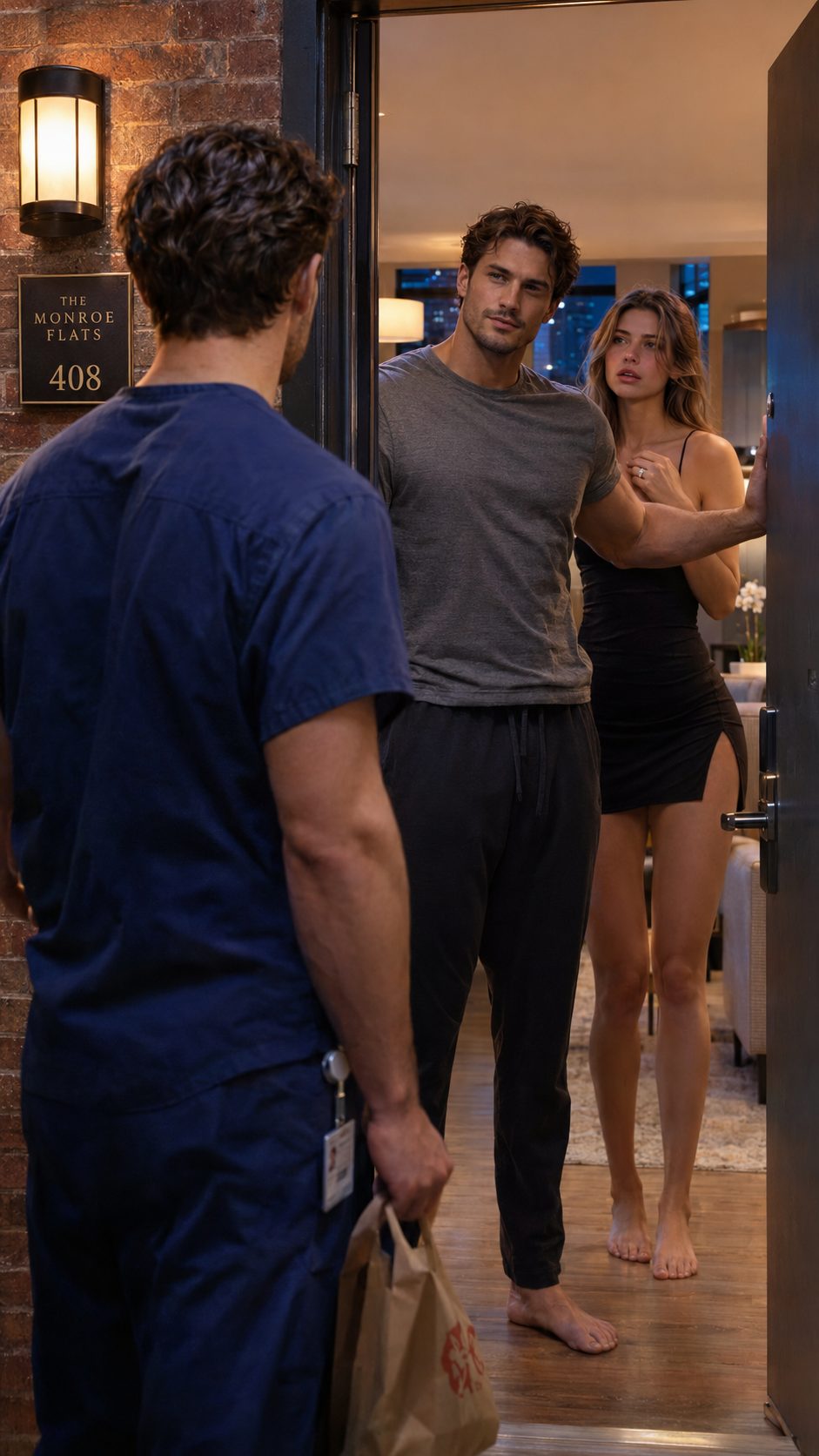
*I thought the worst thing waiting behind Lydia’s apartment door was another man, but the truth was that she had been dismantling our future long before I ever knocked.*
# **CHAPTER 1: THE BAREFOOT MAN AT THE DOOR**
After a fourteen-hour hospital shift, I showed up at my fiancée’s apartment carrying her favorite dinner, only for a barefoot stranger to open the door and ask, “Do you want me to tell her you came by?”
For one stunned second, I honestly thought I had the wrong apartment.
Then Lydia appeared behind him.
Her face lost every trace of color.
“Please,” she whispered.
“It’s not what you think.”
My name is Nathan Cole, and twenty minutes earlier I had walked out of St.
Catherine Medical Center exhausted enough to barely feel my own feet.
My scrub jacket was wrinkled, my shoulders ached, and somebody else’s dried coffee had stained one sleeve during a code three hours earlier.
But I still stopped at the Italian place on Euclid Avenue.
Because Lydia loved their mushroom ravioli.
Because she had complained that we had not eaten together in nearly a week.
Because I believed love was not supposed to disappear simply because you were tired.
The cold had hit me outside the hospital doors, and I remember smiling while the American flag snapped above the entrance.
She’s going to be surprised, I thought.
I had no idea how right I was.
Lydia lived at The Monroe Flats on West 25th Street, in a brick building with polished black railings, warm lobby lights, and a doorman named Carl who called me “the fiancé with the food.”
That night, Carl grinned when I walked past.
“Another peace offering?”
“Surprise dinner.”
“Lucky woman.”
I had laughed.
I had a key to Lydia’s apartment.
I did not use it.
I knocked because I wanted to see her smile when she opened the door.
Three knocks.
The lock turned.
And a man I had never seen before stood there.
Not wearing socks.
Not holding shoes.
Barefoot in the comfortable way people were barefoot when they knew where the glasses were kept and which floorboard creaked near the kitchen.
He wore dark lounge pants and a gray T-shirt.
His hair was messy.
His expression was calm.
His eyes moved from the takeout bag in my hand to my hospital badge, then back to my face.
“Do you want me to tell her you came by?” he asked.
I stared at him.
“Where’s Lydia?”
Something shifted in his eyes.
Recognition.
“You’re Nathan.”
My grip tightened on the paper handles.
“And you are?”
He leaned one shoulder against the frame.
Then Lydia’s voice came from somewhere behind him.
“Who is it?”
She appeared.
Loose hair.
Flushed cheeks.
And the engagement ring I had bought her in Chicago shining on her left hand.
The stranger looked at her.
Lydia looked at me.
Nobody moved.
“Please,” she said again.
“It’s not what you think.”
I looked down at his bare feet.
Then at hers.
Then back at her face.
“Then tell me what I’m supposed to think.”
“Nathan, can we talk?”
“We are talking.”
“Not here.”
I gave a short laugh.
“You mean not in front of him?”
The man straightened.
Lydia closed her eyes.
“How long?”
Her eyes opened.
“How long has he been coming here?”
The man looked at Lydia.
“That’s something you should ask her.”
“I just did.”
Lydia stepped closer to the doorway.
“Please don’t do this in the hallway.”
I stared at her.
“You think the hallway is the embarrassing part?”
Her mouth trembled.
I had spent three months paying off the ring on her hand.
I had taken extra shifts.
Missed my sister’s birthday dinner.
Skipped Christmas Eve drinks with my friends.
Worked weekends because Lydia said she wanted our wedding to feel secure.
I had believed secure meant deposits.
Now the word sounded obscene.
I looked at the stranger.
“What’s your name?”
Lydia immediately said, “Nathan, don’t.”
The man’s brows lifted.
I looked back at her.
“Why shouldn’t I know his name?”
“It won’t help.”
“Nothing is helping.”
The man folded his arms.
Lydia’s face hardened.
“Evan, stop.”
He ignored her.
“Evan Mercer.”
The name meant nothing to me.
Then something faint tugged at my memory.
A restaurant receipt Lydia once snatched off her counter.
An old photograph I had seen for half a second when she was scrolling through her phone.
A name she had mentioned years earlier when describing “a mistake from college.”
I looked at her slowly.
“You know him.”
She swallowed.
Evan looked at her.
Then at me.
His calm expression was beginning to fracture.
“Lydia,” he said, “you told me he knew.”
My stomach turned cold.
She snapped her head toward him.
I barely heard my own voice.
“Knew what?”
Neither answered.
“Knew what?”
“Nathan, please come inside.”
I took one step backward instead.
Her eyes filled.
I looked at the apartment behind them.
I had assembled the bookshelf in that living room.
I had installed the curtain rods.
I had spent Sunday mornings on that couch listening to Lydia describe our future as if she had already visited it.
Now another man stood barefoot in the doorway like he belonged there more than I did.
I raised my eyes to Lydia.
“How does he know my name?”
She did not answer.
Evan’s jaw tightened.
He stared at her.
“You said you told him.”
“I said stop.”
I looked between them.
Lydia shook her head.
“Nathan, you’re exhausted.”
I almost smiled.
“Do not make this about my shift.”
“That’s not what I mean.”
“You’ve had fourteen hours to decide what this is about.”
Her eyes flickered.
That was when I understood something important.
This was not a sudden mistake.
There was too much history in the way they argued.
Too many unfinished conversations.
Too much fear.
I put the takeout bag gently on the floor between us.
Lydia stared at it.
“What are you doing?”
“Dinner’s getting cold.”
“I don’t want it anymore.”
Her face crumpled.
I reached toward her left hand.
She instinctively pulled it back.
That hurt more than I expected.
I looked at the diamond.
“Keep the ring on tonight.”
She stared at me.
“Because tomorrow I want it back.”
Evan looked away.
Lydia whispered, “Please don’t leave.”
“I’m already gone.”
Behind me, I heard her step into the hallway.
I kept walking.
Then Evan said something that stopped me.
Not loudly.
Not cruelly.
Almost with disbelief.
“You really don’t know, do you?”
I turned around.
Lydia grabbed his arm.
“Evan, shut up.”
His eyes stayed on me.
And for the first time that night, he did not look confident.
He looked sorry.
I felt every muscle in my body go rigid.
“Know what?”
Lydia shook her head violently.
Evan looked at her.
Then back at me.
“You should ask her what happened to your wedding venue.”
And suddenly the barefoot man in my fiancée’s doorway was no longer the worst thing that had happened to me that night.
# **CHAPTER 2: THE WEDDING THAT NO LONGER EXISTED**
I did not sleep.
I drove home with the radio off and Lydia’s words repeating in my head.
It’s not what you think.
As if betrayal came with alternate interpretations.
As if bare feet could be explained by grammar.
My apartment was fifteen minutes from hers and looked exactly as I had left it that morning.
One coffee mug in the sink.
Clean laundry on a chair.
A framed photograph of Lydia and me in Chicago sitting on the bookshelf.
That photograph had been taken an hour after I bought her engagement ring.
She was laughing.
I was holding her around the waist.
Behind us, Michigan Avenue glowed with Christmas lights.
I turned the frame facedown.
At 11:26 p.m., Lydia called.
I watched the phone vibrate until it stopped.
Then again.
Then again.
At midnight, a text arrived.
PLEASE LET ME EXPLAIN.
EVAN WASN’T SUPPOSED TO BE THERE TONIGHT.
I stared at that sentence for a long time.
Not: Nothing happened.
Not: You misunderstood.
He wasn’t supposed to be there.
I typed one question.
WHAT HAPPENED TO THE VENUE?
Three dots appeared.
Disappeared.
Appeared again.
Then nothing.
That silence told me more than a paragraph could have.
I opened my email.
Our wedding was supposed to happen the following May at Hawthorne House, an old restored estate outside Cleveland.
Lydia had found it.
She had fallen in love with the white ceremony room, the gardens, the tall windows.
“It feels like us,” she had said.
I had never understood how a building could feel like two people, but I loved the way she looked when she stood inside it.
The deposit had been twelve thousand dollars.
I had transferred Lydia my half.
Then another four thousand when she told me the venue required an additional seasonal hold.
I searched my inbox.
The original confirmation was there.
But nothing recent.
No catering updates.
No payment reminders.
No planning schedule.
I found the venue coordinator’s number and almost called at midnight before stopping myself.
Instead, I sat on the kitchen floor with my back against a cabinet until morning.
At , I called Hawthorne House.
A woman named Melissa answered.
“Good morning, Hawthorne House Events.”
“My name is Nathan Cole.”
I hesitated.
“My fiancée and I have a wedding booked for May eighteenth.”
Keyboard clicks.
“What was your fiancée’s name?”
“Lydia Warren.”
More typing.
Then silence.
“I’m sorry, but I don’t have an active reservation under either name.”
My throat tightened.
“Could you check again?”
“We paid a deposit.”
“I see the original booking.”
“It was canceled.”
I gripped the countertop.
“August seventh.”
August seventh.
Three months earlier.
I remembered that day.
I had worked a double shift because Lydia told me the florist wanted an additional deposit.
I had transferred her twenty-eight hundred dollars during my lunch break.
“Who canceled it?”
“The primary contact.”
My voice became very quiet.
“Was the deposit refunded?”
There was a pause.
“I’m not permitted to discuss the financial details without the account holder.”
“I paid half of it.”
“I understand.”
Another pause.
Then her voice softened.
“The refund was processed to the original card on file.”
I closed my eyes.
Lydia’s card.
“Thank you.”
“I’m sorry.”
I ended the call.
For the first time since the apartment door opened, I felt something hotter than grief.
Not because she had fallen in love with someone else.
People failed.
Feelings changed.
Relationships ended.
But she had looked me in the face for three months after canceling our wedding and let me keep working extra shifts to pay for a future she already knew did not exist.
At seven, I showered.
At seven-thirty, I drove back to the hospital.
I should not have gone.
I knew that.
But staying home meant thinking.
And thinking meant imagining Lydia and Evan behind that door after I left.
I made it through rounds by becoming mechanical.
At ten-fifteen, someone placed a coffee beside my keyboard.
“You look terrible.”
I glanced up.
Claire Bennett stood beside me in navy scrubs, her dark hair pulled into a loose knot.
Claire was an emergency medicine physician two years younger than me and one of the few people at St.
Catherine who could insult you while sounding medically concerned.
“Thank you,” I said.
“You’re welcome.”
She studied me.
“When did you last sleep?”
“It’s Thursday.”
“I’m aware of the calendar.”
Claire leaned against the workstation.
“What happened?”
“You’re holding your pen upside down.”
I looked down.
She was right.
“Long night.”
“Hospital long or life long?”
I did not answer.
Claire’s expression changed.
She did not push.
That was one thing I had always liked about her.
She could recognize a boundary without treating it as an invitation to climb over.
“Drink the coffee,” she said.
“Clinical recommendation.”
She walked away.
My phone buzzed.
I ignored it.
A minute later, another message arrived.
I HAVE YOUR RING.
I’LL GIVE IT BACK.
BUT YOU NEED TO LET ME EXPLAIN THE MONEY.
I stared at the screen.
Claire returned to the desk for a chart and noticed my face.
“Do I need to break someone’s kneecaps?”
Despite everything, I laughed.
I’m a terrible fighter.”
She looked at the phone but did not try to read it.
“Do you need five minutes?”
“I need three months back.”
Claire’s expression softened.
This time I said it.
“Lydia canceled our wedding in August.”
Her eyes widened.
“And didn’t tell you?”
“She also had another man in her apartment last night.”
Claire stopped breathing for half a second.
Then she quietly pulled out the chair beside me.
“What do you need?”
It was such a simple question.
Not What happened?
Not Are you okay?
What do you need?
I swallowed.
“I don’t know.”
“That’s allowed.”
My phone buzzed again.
This time the message was from a number I did not recognize.
NATHAN, THIS IS EVAN.
I stared at it.
A second message appeared.
I’M NOT ASKING YOU TO TRUST ME.
THEN A THIRD.
BUT THERE ARE THINGS LYDIA LIED TO BOTH OF US ABOUT.
I felt my pulse begin to pound.
Claire watched my face.
“What is it?”
I read the final message.
MEET ME WITHOUT HER.
AND BRING YOUR BANK STATEMENTS.
# **CHAPTER 3: THE MONEY I THOUGHT WAS OUR FUTURE**
I did not meet Evan immediately.
Maybe that surprised him.
It surprised me too.
Twenty-four hours earlier, I would have crossed Cleveland in the middle of the night if I believed someone had information about Lydia.
Now every new truth felt like a blade being offered handle-first.
You still had to choose whether to pick it up.
I finished my shift.
I went home.
I printed eighteen months of bank statements.
That was when the pattern became visible.
Transfers to Lydia.
Each one had a reason attached in my memory.
Photographer.
Furniture deposit.
Honeymoon flights.
I added them.
Twenty-seven thousand four hundred dollars.
That did not include the ring.
Or dinners.
Or weekend trips.
Or the rent I had occasionally covered when Lydia said freelance interior-design clients were paying late.
I stared at the total until the numbers stopped looking real.
At six-thirty, I texted Evan.
His answer came immediately.
THE DINER ON CLIFTON.
I arrived ten minutes early.
He was already there.
Shoes this time.
That stupid detail almost made me laugh.
He stood when I approached.
I did not shake his hand.
“Sit,” I said.
I took the booth opposite him.
For a moment we just looked at each other.
Without Lydia between us, he seemed different.
Less arrogant.
More tired.
“You knew who I was,” I said.
“She showed me pictures.”
“Months ago.”
I placed my folder on the table.
“And what did she say?”
Evan rubbed his jaw.
“That you were her ex.”
The word landed strangely.
“Her ex-fiancé?”
He looked uncomfortable.
“She told me you’d never actually made it to the engagement.”
I almost smiled.
“That ring on her finger cost me eleven thousand dollars.”
“I know that now.”
“You saw it.”
“She told me she still wore it because she hadn’t figured out how to give it back.”
I leaned against the booth.
“How long?”
“Since June.”
I closed my eyes briefly.
Five months.
“Did you sleep with her?”
He did not look away.
The honesty was brutal.
But somehow less insulting than another lie.
“How many times?”
“I don’t know.”
He exhaled.
“Enough that the number won’t help you.”
My hands tightened under the table.
For several seconds neither of us spoke.
Then I asked, “What do bank statements have to do with you?”
Evan leaned forward.
“Because she asked me for money too.”
That stopped me.
“How much?”
“About fourteen thousand.”
“For what?”
“She said she was trying to pay off debt before starting over.”
“With you?”
“That’s what I thought.”
I laughed without humor.
“So I was financing the wedding and you were financing the escape.”
His face tightened.
“Apparently.”
A waitress came over.
Neither of us ordered food.
Coffee only.
When she walked away, Evan said, “In August, Lydia told me she’d finally ended things with you.”
“The same month she canceled the venue.”
“She didn’t end anything.”
“She was sleeping at my apartment twice a week.”
He stared at the table.
“I thought she was tying up the lease.”
“She doesn’t share a lease with me.”
His head came up.
“Then where did she say you lived?”
“Lakewood.”
“She told me you were still sharing an apartment because you were refusing to move out.”
I stared at him.
It would have been funny if it had happened to strangers.
“She has her own apartment.”
“I know that now.”
The waitress brought coffee.
Neither of us touched it.
Evan reached into his jacket and placed several printed pages on the table.
“What’s this?”
“Messages.”
Lydia: Nathan finally signed everything.
Lydia: I hate that he keeps making this harder.
Lydia: I just want to be done.
Lydia: Once the money situation is settled, I can leave Cleveland without anything hanging over me.
I looked up.
“Leave Cleveland?”
Evan nodded.
“She wanted to move to Chicago.”
My skin went cold.
The city where I had bought her ring.
Two months away.
“She told you that?”
“We looked at apartments.”
I pushed the pages away.
“She was planning to move?”
“With you.”
“And marry me in May?”
“I don’t think she was planning to marry you.”
His voice was careful.
I looked at him.
“Then what was she planning?”
“That’s what I started wondering.”
He opened his phone and pulled up a screenshot.
A bank transfer.
Recipient: Lydia Warren.
“Sent three weeks ago,” he said.
“Security deposit and moving costs.”
I almost stood.
Then stopped.
“She told me she needed four thousand for our caterer that same week.”
Evan swore quietly.
For the first time, neither of us looked at the other like rivals.
We looked like two men staring at the same fire from opposite sides.
I opened my folder.
We compared dates.
My transfers.
His transfers.
Her explanations.
The lies overlapped so neatly it was almost impressive.
Then I noticed a payment in my account history I did not recognize.
A recurring transfer.
Three months in a row.
To an account ending in 4431.
“I didn’t make these.”
Evan leaned closer.
“Joint account?”
“You share passwords?”
I felt sick.
Lydia knew my banking password.
I had given it to her once when I was driving and needed her to pay the venue.
I changed it later.
Or thought I had.
I opened my bank app.
The transfers were listed under an authorized recurring instruction created in July.
Total: $3,600.
“Jesus Christ.”
Evan looked at me.
“These came out automatically.”
“You didn’t authorize them?”
He sat back.
“You need to call your bank.”
I already was.
By nine-thirty, my cards were frozen, passwords changed, fraud review opened.
The bank could not tell me who owned the destination account until an investigation was complete.
But I already knew.
At 10:02, Lydia called.
This time I answered.
Her voice cracked immediately.
“Where are you?”
“With Evan.”
“You what?”
“He showed me the messages.”
“Nathan, listen to me.”
“I’m listening.”
“It isn’t what he’s making it look like.”
I looked across the booth.
Evan heard enough to roll his eyes.
I said, “Did you set up recurring transfers from my checking account?”
Her silence lasted too long.
“I was going to put it back.”
Something inside me became very still.
“You stole from me.”
“What do you call taking money without permission?”
“I was desperate.”
“For what?”
“I can explain.”
“You’ve said that for twenty-four hours.”
“Nathan, please come over.”
“Tell me now.”
Her breathing became uneven.
“Because you’ll hate me.”
I closed my eyes.
“I already don’t know you.”
She started crying.
“Nathan, I made mistakes.”
“An affair is a mistake if you kiss somebody once and spend the rest of the night vomiting from guilt.”
I lowered my voice.
“This was scheduling.”
“This was budgeting.”
“This was months.”
The word cracked through the phone.
Evan looked away.
Then Lydia whispered:
“There’s something you don’t understand about the money.”
I opened my eyes.
She sniffed.
“I didn’t spend all of it.”
“Where is it?”
“I can’t tell you over the phone.”
“Then text me.”
“I need you to see something.”
My jaw tightened.
Then she said:
“The storage unit.”
“What storage unit?”
Another silence.
“The one in your name.”
# **CHAPTER 4: EVERYTHING SHE HAD PACKED BEFORE I KNEW WE WERE OVER**
The storage facility sat near the industrial edge of Tremont, behind a tire shop and a row of warehouses.
I had never been there.
Yet Unit 317 was registered under my name.
The bank called the next morning to confirm that Lydia had been listed as an authorized user on one of my old shared financial profiles from when we applied for a mortgage preapproval the previous year.
I had forgotten to remove her.
She had not forgotten.
By noon, I had changed every password I owned.
At three, Lydia texted me the gate code.
She asked to meet me there.
I told her no.
She came anyway.
I saw her car as soon as I turned into the lot.
She was standing beside the storage building wearing jeans, a cream coat, and no makeup.
For the first time since I had known her, Lydia looked smaller than the image she normally carried into a room.
I parked twenty feet away.
She approached slowly.
“Where’s my ring?”
She flinched.
“In my bag.”
“Give it to me.”
Her hand trembled as she opened her purse.
The diamond flashed once before she placed it in my palm.
I closed my fingers around it.
Three months of emergency-room nights.
Eleven thousand dollars.
A promise reduced to something small enough to disappear inside my fist.
“I’m sorry,” she whispered.
“Open the unit.”
We walked inside.
Metal corridors.
Fluorescent lights.
Concrete floors.
The place smelled like dust and cardboard.
At Unit 317, Lydia entered a code.
The door rolled upward.
I expected furniture.
Instead, I saw boxes.
Each carefully labeled.
WINTER CLOTHES.
My chest tightened.
Near the back were two suitcases.
A folded rug.
Small appliances.
Boxes from Lydia’s apartment.
She had been moving out piece by piece.
“You were leaving.”
She stared at the floor.
“With Evan.”
“I thought I was.”
“When were you planning to tell me?”
Her eyes filled.
“I don’t know.”
I laughed softly.
“You had a date for Chicago.”
“He told you?”
She folded her arms across herself.
“January twenty-third.”
The precision made something twist in my stomach.
“Apparently everyone had a schedule except me.”
“That isn’t fair.”
I turned toward her.
“I know what I did was wrong.”
“You canceled our wedding in August.”
“You kept taking money.”
“I was going to repay it.”
“You used my bank account.”
“I panicked.”
“About what?”
She looked around the unit.
“That is not an answer.”
“No, it’s the truth.”
“Then give me the rest of it.”
She wiped her cheek.
“I was terrified.”
“Then what?”
“Of marrying you.”
The words hit differently than I expected.
Not because they hurt.
Because part of me recognized them.
For months Lydia had become restless whenever I talked about the wedding.
I had interpreted it as stress.
Maybe because I wanted to.
“You could have said that.”
“Every time I told you that you were never home.”
“That wasn’t saying you didn’t want to marry me.”
“I didn’t know how to say it.”
“So you slept with someone else?”
Her face tightened.
“It wasn’t supposed to happen.”
“That line again.”
“I met Evan for coffee.”
“You met your ex-boyfriend for coffee.”
“And forgot to mention it.”
“How many coffees before he stopped wearing shoes?”
She looked away.
I hated the cruelty in my voice.
But I did not take it back.
Lydia whispered, “I felt invisible.”
I stared at her.
“I was working extra shifts because you asked for money.”
“You told me you wanted security.”
“So I worked.”
“And every time you worked more, I saw you less.”
My voice rose.
“Because every time I saw you, there was another bill!”
She flinched.
The hallway echoed.
I lowered my voice.
“You built a problem and then punished me for solving it.”
She began to cry.
“No, I don’t think you do.”
I pointed at the boxes.
“You had months to tell me.”
“I was ashamed.”
“You were organized.”
She closed her eyes.
That landed.
I walked deeper into the unit.
On top of a box marked DOCUMENTS was a folder.
Inside were apartment listings from Chicago.
Moving estimates.
Budget sheets.
A printed lease application with Evan’s name and Lydia’s.
And another sheet.
A spreadsheet.
My transfers.
Evan’s transfers.
Refund from Hawthorne House.
Everything categorized.
My stomach dropped.
She did not answer.
I held up the paper.
“What is this?”
She stared at it.
“Why did you make a spreadsheet?”
“I needed to track what I owed.”
There were columns.
TOTAL AVAILABLE.
At the bottom, highlighted:
I felt dizzy.
“You had almost fifty thousand dollars.”
“Not anymore.”
“Where is it?”
“Some was used for debt.”
“What debt?”
“My mother’s.”
I stared at her.
Lydia’s mother, Susan, had closed her boutique the previous year.
I knew business had been difficult.
I did not know Lydia had been supporting her.
“How much?”
“Twenty-one thousand.”
“With our wedding money?”
“She was going to lose the house.”
“You could have told me.”
“She begged me not to.”
“So instead you stole from me.”
“I thought I could replace it.”
“With Evan’s money?”
She said nothing.
I understood.
“You were taking from both of us.”
“I was trying to fix everything.”
I shook my head.
“You were trying to avoid consequences.”
She covered her mouth.
I walked toward the door.
“Nathan, wait.”
“There is one thing I need to know.”
She looked up.
“Did you ever plan to marry me after August seventh?”
Her answer did not come.
That was enough.
I stepped into the corridor.
I kept walking.
Then she said something that made me stop.
“I loved you.”
I looked over my shoulder.
Past tense.
She heard it too.
Her face broke.
I nodded once.
“Thank you for finally telling the truth.”
That night, Claire found me sitting alone in the hospital cafeteria long after my shift had ended.
She carried two vending-machine sandwiches.
“I’m not hungry.”
“Neither am I.”
She sat anyway.
For ten minutes, she said nothing.
Finally I asked, “Have you ever discovered your whole life was already over and you were just the last person to hear about it?”
Claire stared at the unopened sandwich.
I looked at her.
She rarely spoke about her personal life.
She nodded.
“Three years ago.”
“What happened?”
“My husband left.”
“I didn’t know you were married.”
“Most people here don’t.”
“What happened?”
She gave me a sad smile.
“He decided he wanted a different life.”
“Did he cheat?”
For some reason, that almost sounded worse.
“He just stopped choosing me.”
We sat quietly.
Then she looked at me.
“You know what the hardest part was?”
“Realizing someone leaving doesn’t mean every year before that was fake.”
I thought of Chicago.
Sunday mornings.
Lydia laughing into my shoulder.
“Some of it feels fake.”
Claire pushed one sandwich toward me.
“But you don’t have to decide tonight what every memory means.”
I looked at her.
For the first time in days, I felt something besides rage.
Not happiness.
Not relief.
Just the strange comfort of being near someone who did not need anything from me.
My phone buzzed.
A message from the bank.
FRAUD INVESTIGATION UPDATE AVAILABLE.
I opened it.
The recurring transfers had gone to an account controlled by Lydia.
That part was expected.
The second line was not.
ADDITIONAL LINKED TRANSFERS IDENTIFIED: $18,000.
My hands went cold.
Claire saw my face.
I looked at the screen.
The eighteen thousand dollars had not gone to Lydia.
They had gone directly to Hawthorne House.
Three weeks after she supposedly canceled our wedding.
# **CHAPTER 5: THE SECOND RESERVATION**
The next morning I called Hawthorne House again.
Melissa answered.
When I gave my name, she remembered me.
“I need you to check something.”
“All right.”
“My bank says eighteen thousand dollars was transferred to Hawthorne House in September.”
“That wouldn’t be connected to your canceled reservation.”
“Then what was it connected to?”
“I’m not sure I’m authorized—”
“It came from my account.”
More typing.
Then a pause.
A long one.
Cole, do you know an Evan Mercer?”
My stomach tightened.
“There is another reservation.”
I gripped the phone.
“For what?”
“A private event.”
“January twenty-fifth.”
Two days after Lydia’s planned move to Chicago.
“Whose names?”
Another pause.
“I can only tell you that Mr.
Mercer is listed as one of the primary contacts.”
I sat down.
“And Lydia?”
Melissa did not answer.
She did not need to.
I hung up and called Evan.
He answered immediately.
“There’s a reservation at Hawthorne House.”
“For January twenty-fifth.”
More silence.
“What are you talking about?”
“You’re listed on it.”
“That’s impossible.”
“You didn’t book an event there?”
“Did Lydia?”
“I don’t know.”
“You were planning to marry her?”
The answer came too fast to be fake.
“At least not then,” he added.
“What does that mean?”
“We talked about a future.”
“Specific future?”
Living together.
Maybe marriage later.”
“You never gave her eighteen thousand dollars for an event?”
I closed my eyes.
“Then she used my account.”
“To book something under my name?”
“Looks like it.”
An hour later we met outside Hawthorne House.
I almost hated how normal the place looked.
White walls.
Bare autumn trees.
A fountain drained for winter.
A venue where Lydia and I had once stood together imagining our families dancing beneath strings of lights.
Melissa met us in the lobby.
She looked uncomfortable.
“I asked my manager what I could disclose given the disputed payment.”
She placed a folder on the desk.
“The January reservation was booked online.”
“By Lydia?”
“And why is Evan listed?”
Evan leaned forward.
“For what?”
Melissa opened the form.
Her expression changed slightly.
“A wedding.”
None of us spoke.
Evan stared at her.
“A wedding.”
My ears began ringing.
“Between Lydia and Evan?”
Melissa nodded carefully.
“That is how the form was submitted.”
Evan stepped away from the desk.
I looked at him.
He genuinely had not known.
Melissa continued.
“The deposit came from an account under your name, Mr.
It sounded ugly in the quiet lobby.
“So my fiancée canceled our wedding, then used my money to book her wedding to the man she was cheating with.”
Evan turned.
“She never asked me to marry her.”
Melissa quietly closed the folder.
“I’m going to give you both a moment.”
Evan paced toward the windows.
“This makes no sense.”
“It makes perfect sense.”
“No, it doesn’t.”
“She was planning ahead.”
“For a wedding I didn’t know existed?”
I stared at him.
Then suddenly something clicked.
“Maybe it wasn’t for you.”
He stopped.
“She used your name.”
“I don’t know.”
We both looked toward the desk.
The paperwork.
I called Lydia.
She did not answer.
On the third call, she picked up.
Her voice was exhausted.
“I’m at Hawthorne House.”
Evan watched me.
I said, “January twenty-fifth.”
Lydia inhaled sharply.
“Were you planning to marry Evan?”
Evan mouthed, What?
“Then why did you book a wedding?”
“It wasn’t—”
“Do not say it wasn’t what I think.”
She started crying.
“I can explain.”
“It was my mother’s idea.”
I almost laughed.
“Your mother booked you a wedding to your affair partner using my bank account?”
“Then explain.”
“My mother didn’t know about you and Evan.”
“She knew about you, obviously.”
“Then what didn’t she know?”
“That I was leaving you.”
I looked at Evan.
He looked as confused as I felt.
Lydia continued rapidly.
“She thought we were moving the wedding earlier.”
“You told your mother you and I were getting married in January?”
“But Evan’s name is on the reservation.”
“I used his name because I couldn’t use yours.”
“Because I knew the payment might be traced.”
The stupidity and calculation of it left me speechless.
“You used the name of the man you were sleeping with to hide a wedding reservation from the man whose money you stole?”
Her voice cracked.
Evan covered his face.
I closed my eyes.
“What was the January wedding for?”
“My mother.”
I opened my eyes.
“She’s sick.”
The anger in me paused.
“What do you mean?”
Everything went quiet.
“She found out in July.”
I leaned against the desk.
“What kind?”
“Pancreatic.”
My voice dropped.
“How long?”
“They don’t know.”
I thought of Susan.
A loud woman with red glasses who had hugged me the first Christmas Lydia brought me home.
“Why didn’t you tell me?”
“She didn’t want people to know.”
“I’m not people.”
“No, apparently I am.”
Lydia began crying harder.
“She wanted to see me married.”
I understood then.
Not forgiveness.
Not justification.
But the shape of the disaster.
Lydia’s mother had become sick.
Lydia panicked.
She took money to save her mother’s house.
She moved our wedding earlier to give Susan what she wanted.
Then somewhere inside that panic, Lydia also decided she did not want to marry me.
Instead of stopping, she created another lie.
Then another.
Then another.
Until nobody could tell which future was real.
“What were you going to do?”
“I don’t know.”
“You had a wedding scheduled for January.”
“You were moving to Chicago two days before it.”
“You were sleeping with Evan.”
“You were still wearing my ring.”
Her scream broke into sobs.
“I didn’t know how to stop any of it!”
I looked at Evan.
His face had gone pale.
Lydia whispered:
“I kept thinking I had one more week to fix everything.”
I answered quietly.
“You had five months.”
She said nothing.
Then another voice appeared faintly behind her.
I recognized Susan.
My anger changed shape again.
“Is your mother there?”
“Put her on.”
Then Susan’s voice became clearer.
“Give me the phone.”
Muffled argument.
A moment later:
“Hi, Susan.”
She sounded tired.
“I’m sorry.”
“You don’t need to apologize.”
“Yes, I do.”
“For what?”
“For raising a daughter who thought she had to lie to save me.”
My eyes closed.
“You didn’t make her do this.”
Susan coughed.
“But I let her believe my fear was more important than her honesty.”
Lydia cried somewhere nearby.
Susan continued.
“I told her I wanted to see her married before I died.”
My throat tightened.
“I didn’t tell her to marry someone she didn’t love.”
I looked down.
For all my rage, that sentence hurt most.
Someone she didn’t love.
Susan inhaled slowly.
“Nathan, she did love you.”
“But not enough to tell me the truth.”
Susan went quiet.
Then she said, “No.”
It was the first honest answer anyone in that family had given me.
I ended the call a few minutes later.
Evan and I stood in silence.
Finally he said, “I’m done.”
“With what?”
“With her.”
I looked at him.
He laughed bitterly.
“I spent five months believing I was the man she chose.”
His eyes met mine.
“You spent five months believing the same thing.”
There was nothing to say to that.
Outside, as we crossed the parking lot, my phone rang again.
I answered.
Her voice was tense.
“Where are you?”
“Hawthorne House.”
“You need to come to St.
Catherine.”
My chest tightened.
“It’s Lydia.”
I stopped walking.
“What happened?”
Claire took one breath.
“She collapsed in the hospital lobby.”
# **CHAPTER 6: THE THINGS WE OWE AND THE THINGS WE DON’T**
Lydia had not come to the hospital for herself.
She had been bringing her mother to an oncology appointment when she fainted beside the information desk.
Dehydration.
Exhaustion.
A panic attack severe enough that someone thought she was having a cardiac event.
By the time I arrived, she was awake.
I did not go into her room.
I stood outside the glass doors of observation and watched from the hallway.
Claire came beside me.
“You don’t have to see her.”
“She’s medically fine.”
“You’re allowed to leave.”
Claire glanced at me.
“You’ve said that three times.”
“I’m trying to believe it.”
Through the glass, Lydia lay beneath a thin blanket while Susan sat nearby wearing a knit cap and holding her daughter’s hand.
The sight punched through my anger.
Not because Lydia suddenly deserved forgiveness.
Because pain was still pain even when the person experiencing it had hurt you.
“I should go in,” I said.
Claire did not agree.
She did not disagree.
“What do you want to happen if you do?”
I looked at her.
“You’re a doctor, Nathan.”
She nodded toward the room.
“You know not to perform a procedure without knowing the goal.”
Despite myself, I smiled faintly.
“That’s annoyingly logical.”
“I work hard at it.”
I looked through the glass again.
“I don’t want her to think I came because we’re fixing this.”
“Then tell her that.”
“I don’t want to hurt her mother.”
“You don’t control every consequence.”
That sentence stayed with me.
Lydia saw me immediately.
Susan started to stand.
“Don’t,” I said.
She remained seated.
Lydia’s eyes were swollen.
“You came.”
“Claire called.”
Hope moved across her face.
I hated seeing it.
So I ended it quickly.
“I’m not here to reconcile.”
The hope disappeared.
Susan looked down.
Lydia nodded.
“No, I need you to actually know.”
“I’ll cooperate with the bank investigation.”
She flinched.
“I’ll pay everything back.”
“I already started transferring what’s left.”
“The ring too.”
“You returned it.”
She nodded.
Then she said, “I’m sorry.”
I sat in the chair by the wall, not beside the bed.
“I believe you’re sorry.”
Her eyes filled again.
“But being sorry doesn’t restore trust.”
“Stop saying that when you keep hoping I’ll change my answer.”
That landed hard.
Susan squeezed Lydia’s hand.
Lydia looked at me.
“I did love you.”
“I loved you too.”
I held her gaze.
She looked away.
Something inside me broke quietly.
Not dramatically.
No shouting.
Just the final acknowledgment that the relationship was now past tense on both sides.
Susan whispered, “Nathan, I am so sorry.”
I looked at her.
“You’re sick.”
“That doesn’t erase what happened.”
“It also doesn’t excuse what she did.”
Lydia closed her eyes.
For the first time, nobody was trying to make the story prettier.
That helped.
I left twenty minutes later.
Claire was waiting near the elevators.
“Clean break.”
“That’s usually better than an infected one.”
“You can turn anything into a medical metaphor.”
“It’s a gift.”
The elevator arrived.
We stepped inside.
For three floors, neither of us spoke.
Then Claire said, “You’re shaking.”
I looked at my hands.
She was right.
“I think I’m tired.”
“You’ve been tired for years.”
The words were quiet.
I looked at her.
“What does that mean?”
She hesitated.
Then shrugged.
Claire stared at the elevator doors.
“You were always working.”
“Everyone here is always working.”
“Not like you.”
“I had a wedding to pay for.”
“I mean before that.”
She sighed.
“Nathan, I’ve known you six years.”
The elevator stopped.
The doors opened.
Neither of us moved.
Claire pressed CLOSE.
“You kept picking up shifts before Lydia asked you to.”
“That’s what doctors do.”
“That’s what you do.”
I crossed my arms.
“Is this where you tell me I’m emotionally unavailable?”
She looked directly at me.
“This is where I tell you that you have spent most of your adult life proving your value by being useful.”
I stared at her.
“That sounds like therapy.”
“I go to therapy.”
She almost smiled.
Then her expression softened.
“When your father got sick, you became useful.”
I looked away.
She remembered.
My father had suffered a stroke during my second year of residency.
I paid bills.
Handled appointments.
Helped my mother.
When he died, I worked more.
Claire continued.
“When Lydia wanted security, you became useful.”
“That’s not fair.”
“I’m not blaming you.”
“It sounds like you are.”
“I’m saying maybe you thought showing up exhausted with dinner was the same thing as being present.”
That hurt because it contained truth.
I stared at the floor numbers.
“Are you saying I caused this?”
Her answer was immediate.
“Her cheating was her choice.”
“Then what are you saying?”
“That you can learn something from a disaster without taking responsibility for causing it.”
The elevator doors opened again.
This time Claire stepped out.
I followed.
At the parking garage, she turned toward me.
“You need time.”
“For what?”
“To become a person who isn’t solving everyone.”
I smiled faintly.
“And what do I do instead?”
“I don’t know.”
She lifted one shoulder.
“Be inconvenient.”
“Need things.”
“Terrifying.”
She began walking toward her car.
She looked back.
“Thank you.”
“For insulting your personality?”
“For not telling me Lydia never deserved me.”
Claire studied me for a second.
“She did deserve you.”
I was surprised.
She continued.
“Until she chose not to.”
Then she walked away.
Three weeks passed.
Lydia returned nineteen thousand dollars.
The bank restored twelve thousand more.
Her mother sold the boutique property to cover some remaining debt.
I declined to press criminal charges once every disputed dollar was repaid.
Not for Lydia.
For myself.
I did not want another year of my life organized around what she had done.
Evan disappeared from the story almost completely.
He sent one final message.
I’M SORRY FOR MY PART IN THIS.
I answered:
Then I deleted his number.
By December, the ring had been sold.
I used part of the money to pay off debt.
I put the rest into savings.
I canceled every extra shift I had volunteered for after Christmas.
The scheduler called me.
“Are you dying?”
“Then why are you saying no?”
I looked at Claire’s empty workstation across the ER.
“Trying something new.”
That evening, I walked into the staff lounge.
Claire was eating soup while reading a journal article.
I sat across from her.
She looked up.
“You’re not working tonight.”
“Then why are you here?”
“I was leaving.”
She waited.
I realized I had no script.
No problem to solve.
No favor to offer.
“Would you like to have dinner with me?”
Claire went completely still.
“As friends?”
I opened my mouth.
She smiled slightly.
“Interesting.”
“You don’t know.”
She returned to her article.
“Is that a yes?”
My stomach dropped.
Then she added:
“Ask me again when you know why you’re asking.”
And for the first time since Lydia opened that apartment door, uncertainty did not feel like something I had to fix immediately.
# **CHAPTER 7: LEARNING NOT TO RUN TOWARD EMPTY SPACES**
January came quietly.
For years I had measured time in shifts.
This month became different.
I started running again.
Not metaphorically.
Actually running.
Three miles around Edgewater Park on mornings when the lake wind was cruel enough to make me question every life decision that had brought me outside.
I called my mother without folding laundry at the same time.
I visited my sister in Columbus and stayed the entire weekend instead of driving home for an extra Sunday shift.
I bought groceries that required cooking.
I began seeing a therapist named Dr.
Graham who had the unsettling habit of remaining silent long enough that I eventually answered questions I had been trying to avoid.
“Why did Lydia’s betrayal surprise you so deeply?” she asked one afternoon.
“Because I trusted her.”
“That’s part of it.”
She waited longer.
Finally I said, “Because I thought effort guaranteed outcomes.”
She nodded.
There it was.
If I worked enough, I could make my father better.
If I paid enough, I could make Lydia feel secure.
If I showed up enough, love would stay.
Life had been trying to teach me otherwise for years.
I had called it unfairness.
Maybe it was simply reality.
Claire and I remained friends.
There were coffees.
Walks from the hospital to the parking garage.
One disastrous attempt at making Thai food in my apartment after Claire informed me restaurant takeout did not count as cooking.
She stood beside my stove watching smoke rise from a pan.
“You murdered the basil.”
“It died bravely.”
“This is why you’re single.”
I looked at her.
“So we’re making those jokes now?”
Her cheeks colored.
“Apparently.”
It was the first time the possibility between us stopped being abstract.
But neither of us moved toward it.
That mattered.
I did not want Claire to become medicine for Lydia.
Claire did not want to become anyone’s recovery plan.
So we waited without calling it waiting.
On January twenty-third, I received a message from Lydia.
The date struck me immediately.
The day she had once planned to move to Chicago.
Her message contained only six words.
MOM DOESN’T HAVE MUCH TIME.
I stared at it.
SHE ASKED IF YOU’D VISIT.
I went the next afternoon.
Susan was at home under hospice care.
The house smelled like cinnamon candles and medication.
Lydia opened the door.
For a second, we simply looked at each other.
She had cut her hair shorter.
She looked thinner.
“You came.”
“She asked.”
No accusation.
Progress, perhaps.
Susan was in a hospital bed near the living-room windows.
She smiled when I entered.
“My favorite doctor.”
“You always said your oncologist was your favorite.”
I pulled a chair close.
“For once, Lydia isn’t responsible.”
Susan laughed weakly.
From the kitchen doorway, Lydia smiled through tears.
Susan took my hand.
“You look better.”
“I sleep now.”
“Miraculous.”
We talked for nearly an hour.
Not about money.
Not about weddings.
About ordinary things.
My mother’s garden.
Hospital food.
The Browns.
A terrible vacation Susan once took to Florida.
Then Lydia left the room to make tea.
Susan watched her go.
“She’s different.”
I said nothing.
Susan continued.
“She sees someone.”
My shoulders tightened.
“A therapist.”
Susan noticed.
“You thought I meant a man.”
“I didn’t know what you meant.”
“She’s done with men for a while.”
“That’s probably wise.”
Susan smiled.
“She talks about you.”
I looked toward the window.
“I’d rather she didn’t.”
“Not like that.”
Susan squeezed my hand weakly.
“She says losing you was the first consequence she could not talk her way around.”
I swallowed.
“I’m sorry she had to learn that.”
“So is she.”
A few minutes passed.
Then Susan said, “Do you still hate her?”
I thought carefully.
“Do you forgive her?”
“That’s harder.”
“You don’t have to.”
I looked at her.
Susan’s eyes were clear.
“Forgiveness isn’t a deathbed obligation, Nathan.”
Something loosened in my chest.
“Thank you.”
“I do have one selfish request.”
“Don’t let this make you suspicious of everyone.”
I smiled faintly.
“Claire would agree with you.”
Susan’s eyebrows lifted.
I immediately regretted saying the name.
Susan smiled wider.
“There’s a Claire?”
“That sounded like a yes.”
“She’s a friend.”
“You are dying and still gossiping.”
“Especially now.”
From the doorway, Lydia appeared carrying tea.
“What did I miss?”
“Claire,” Susan said.
Lydia looked at me.
Something passed through her face.
Pain, perhaps.
But then she nodded.
“I hope she’s good to you.”
The sentence stunned me.
Months earlier, Lydia might have asked questions.
Might have compared.
Might have tried to reopen something.
Instead she handed me a cup.
“I mean that.”
“Nothing’s happened.”
“Maybe something will.”
I looked at her.
“I don’t know.”
She smiled sadly.
“You always hated not knowing.”
“Working on it.”
Susan died six days later.
I attended the funeral.
I stood near the back.
When Lydia hugged me afterward, it lasted three seconds.
“Thank you for coming,” she said.
“I’m sorry.”
Then she released me.
And that was the first moment I understood forgiveness might not look like reconciliation.
It might simply be the absence of a desire to punish.
That night, Claire found me outside the hospital after my shift.
“You okay?”
She studied me.
“Actual yeah?”
“Actual yeah.”
We started walking toward the garage.
Snow fell lightly beneath the streetlights.
Halfway there, I stopped.
Claire turned.
“I know why.”
She frowned.
“Why what?”
She remembered immediately.
Her expression changed.
I stepped closer.
“I don’t want you because Lydia left an empty space.”
Claire stayed silent.
“I don’t want you because you helped me through the worst few months of my life.”
Still silence.
“I want dinner with you because when something ridiculous happens at work, you’re the person I want to tell.”
Her eyes softened.
“Because you make me laugh when I’m trying not to.”
I took a breath.
“And because I keep finding reasons to walk slower when we reach the parking garage.”
Claire looked down.
Then back up.
“That’s inconvenient.”
“You told me to practice.”
She smiled.
“So I did.”
“Dinner,” she said.
My heart kicked hard.
“One dinner.”
“Tomorrow?”
She laughed.
“Slow down, Cole.”
I lifted both hands.
Practicing uncertainty.”
“Very poorly.”
She started walking again.
I followed.
Then she reached back without looking and took my hand.
My phone vibrated in my pocket.
For once, I did not check it.
# **CHAPTER 8: THE LIFE THAT WASN’T IN THE PLAN**
One year after I knocked on Lydia’s door with two containers of pasta, I returned to The Monroe Flats.
Not for Lydia.
Carl, the doorman, had retired, and the hospital staff had organized a small dinner at a restaurant across the street.
I arrived early.
The building stood exactly as I remembered it.
Brick walls.
Black railings.
Warm lobby lights.
For several seconds, I stood on the sidewalk and watched strangers come and go.
I expected pain.
What I felt instead was distance.
Not indifference.
Some places hold versions of you long after you have stopped being that person.
The Monroe Flats held the man who thought love meant arriving exhausted with dinner.
I did not hate him.
He had been doing his best.
He just did not yet understand that love was not proved by depletion.
“You planning to stand out here all night?”
Claire was approaching in a dark green coat, her hair loose around her shoulders.
We had been together for eight months.
Painfully slowly, according to my sister.
There had been no dramatic declarations.
No instant merging of lives.
Claire kept her apartment.
I kept mine.
We learned one another in ordinary increments.
What she ordered when anxious.
How I became quiet when angry.
That she needed an hour alone after difficult shifts.
That I still had a reflex to solve problems nobody had asked me to solve.
Sometimes she caught me doing it.
“I am complaining,” she would say.
“I am not requesting intervention.”
I was getting better.
Claire looked up at the building.
“This is the place?”
“The famous doorway?”
“Fourth floor.”
She studied me.
“Want to go inside?”
She linked her arm through mine.
We entered the restaurant instead.
Halfway through dinner, my phone buzzed.
Unknown number.
I ignored it.
Then another message.
NATHAN, IT’S LYDIA.
Claire noticed.
“You okay?”
I showed her.
“Do you want privacy?”
I opened the message.
I’M MOVING TOMORROW.
I heard Claire talking to someone beside her, but the restaurant seemed to recede.
Another message arrived.
NOT CHICAGO.
I FOUND YOUR OLD KEY TO MY APARTMENT WHILE PACKING.
I stared at the screen.
Claire waited.
Finally I typed:
GOOD LUCK, LYDIA.
Her response came several minutes later.
I’M SORRY FOR EVERYTHING.
I considered saying I forgive you.
But forgiveness had become too important to use as a farewell decoration.
So I wrote:
I HOPE YOU BUILD SOMETHING HONEST.
Three dots appeared.
That was the last conversation Lydia and I ever had.
No dramatic reunion.
No revenge.
No final confession revealing she had secretly loved me more than anyone.
Life rarely ends chapters that neatly.
She moved west.
Evan eventually sent me a wedding announcement.
Not his own.
His sister’s.
He had accidentally left me on an old group-contact list.
Under different circumstances, it might have been funny.
I never saw him again.
The bank investigation closed.
Every dollar was returned.
Hawthorne House refunded most of the January event deposit after Susan died.
The engagement ring became part of the down payment on a small townhouse I bought the following spring.
Not for a marriage.
Not for a future girlfriend.
The first night I slept there, Claire arrived carrying two containers of pasta.
I opened the door.
She stood on the porch grinning.
“You look confused.”
I looked down at the bag.
“What is this?”
“You bought Italian?”
Her smile faded slightly.
“I thought it might be weird.”
“In a good way.”
She stepped inside.
I took the bag.
“Mushroom ravioli?”
“Absolutely not.”
“You have trauma associated with mushroom ravioli.”
“That is not a clinical diagnosis.”
“I’m expanding the field.”
We ate on the floor because my dining table had not arrived.
Halfway through dinner, Claire looked around.
“You happy?”
I thought about the question.
A year earlier, I would have answered quickly.
Something useful.
Now I let the silence exist.
“I think so.”
Claire nodded.
“Good answer.”
“What’s yours?”
“I think so too.”
We ate another few bites.
Then she said, “You know we don’t have to get married.”
I almost choked.
She started laughing.
“I mean ever.”
“You nearly killed me.”
“That would be embarrassing professionally.”
I put down my fork.
“Why are you bringing this up?”
She became serious.
“Because sometimes I see you watching me like you’re waiting for the next requirement.”
I stared at her.
“What requirement?”
“The thing you have to accomplish so I’ll stay.”
My chest tightened.
Claire reached for my hand.
“There isn’t one.”
I looked down at our fingers.
I started to say yes.
Then stopped.
“Most days.”
“That’s enough.”
The room became quiet.
Rain tapped against the new windows.
Cardboard boxes surrounded us.
Nothing was finished.
Nothing was certain.
And for once, unfinished did not frighten me.
Two years later, I asked Claire to marry me.
Not in Chicago.
Not in a restaurant.
Not beneath strings of lights at some carefully chosen venue.
I asked her in our kitchen while she stood barefoot on cold tile complaining that I had bought the wrong coffee.
I had the ring in my pocket for six weeks.
I kept waiting for the perfect moment.
Then I realized the old version of me would have treated perfection like another problem to solve.
So I interrupted her mid-sentence.
“Marry me.”
She stared.
I held out the ring.
Her mouth opened.
Then closed.
“I had a speech.”
“Where is it?”
“Forgot it.”
She laughed.
I started laughing too.
Then she began crying.
“Is that a yes?”
“You haven’t actually asked properly.”
“I said marry me.”
“That sounded like an instruction.”
I dropped to one knee.
She covered her mouth.
“Claire Bennett, will you marry me?”
She crouched down until we were eye level.
“No, I just enjoy kneeling on tile.”
I slipped the ring onto her finger.
She looked at it.
Then at me.
“You okay?”
I knew why she asked.
Once, a ring had represented everything I thought effort could guarantee.
This one felt different.
It was not payment.
It was not proof.
It was simply a promise made by two people who understood promises could be broken and chose to make one anyway.
“Yeah,” I said.
“Actual yeah?”
“Actual yeah.”
Our wedding was small.
My mother cried.
My sister drank too much champagne.
Half the emergency department attended.
We did not book Hawthorne House.
We never even considered it.
And on the night before the ceremony, Claire and I broke tradition and ate dinner together.
“You’re supposed to stay somewhere else,” she reminded me.
“You’re ruining the suspense.”
“I’ve had enough suspense.”
She laughed.
After dinner, I walked her to the door of the hotel suite where she was staying with her sister.
She kissed me.
Then stepped inside.
Before closing the door, she looked down at my shoes.
“You’re wearing shoes.”
I stared at her.
Then I started laughing so hard I had to lean against the wall.
Claire looked confused for a moment.
Then she understood.
“Bare feet.”
“The universe has jokes.”
She pulled me toward her by the front of my shirt.
“Listen carefully.”
“I’m listening.”
“Tomorrow, when I open the door, there will be no barefoot stranger.”
“No secret wedding cancellation.”
“Excellent.”
“No stolen money.”
“Strong start.”
“And no one is moving to Chicago.”
“What will there be?”
She touched my face.
The answer was simple.
No grand promise.
No guarantee.
Just a person standing in front of me, telling the truth.
And finally, I understood that was what security had always been.
Not venues.
Not exhausting yourself trying to become impossible to leave.
Security was knowing the person beside you had every opportunity to lie and chose honesty instead.
The next afternoon, Claire walked toward me beneath white flowers and soft autumn light.
I did not think about Lydia.
I did not think about Evan.
I did not think about the twenty-seven thousand dollars, the canceled venue, the storage unit, or the dinner bag I had once left cooling on a hallway floor.
I thought about the man I had been that night.
Still believing he could save a future simply by working harder for it.
If I could have spoken to him, I would not have told him everything would be okay.
He would not have believed me.
Instead, I would have told him something simpler.
Put down the dinner.
Walk away from the door.
There is a life waiting for you that you will never have to earn by destroying yourself.
You just cannot see it yet.
Claire reached me.
She smiled.
“You ready?”
For years, that question would have made me search for everything that could go wrong.
Now I looked at her.
At our families.
At the imperfect future neither of us could guarantee.
And I said the only honest thing I knew.
Not because I was certain.
Because this time, I was present.
✓ Lynn R. Adams
*I thought the worst thing waiting behind Lydia’s apartment door was another man, but the truth was that she had been dismantling our future long before I ever knocked.* # **CHAPTER 1: THE BAREFOOT M…