D-THE LIGHT THAT CAUGHT THEIR LIES: MY WIFE’S CAMPFIRE BETRAYAL, THE SECRET RECORDING, AND THE NIGHT THEY TRIED TO STEAL EVERYTHING
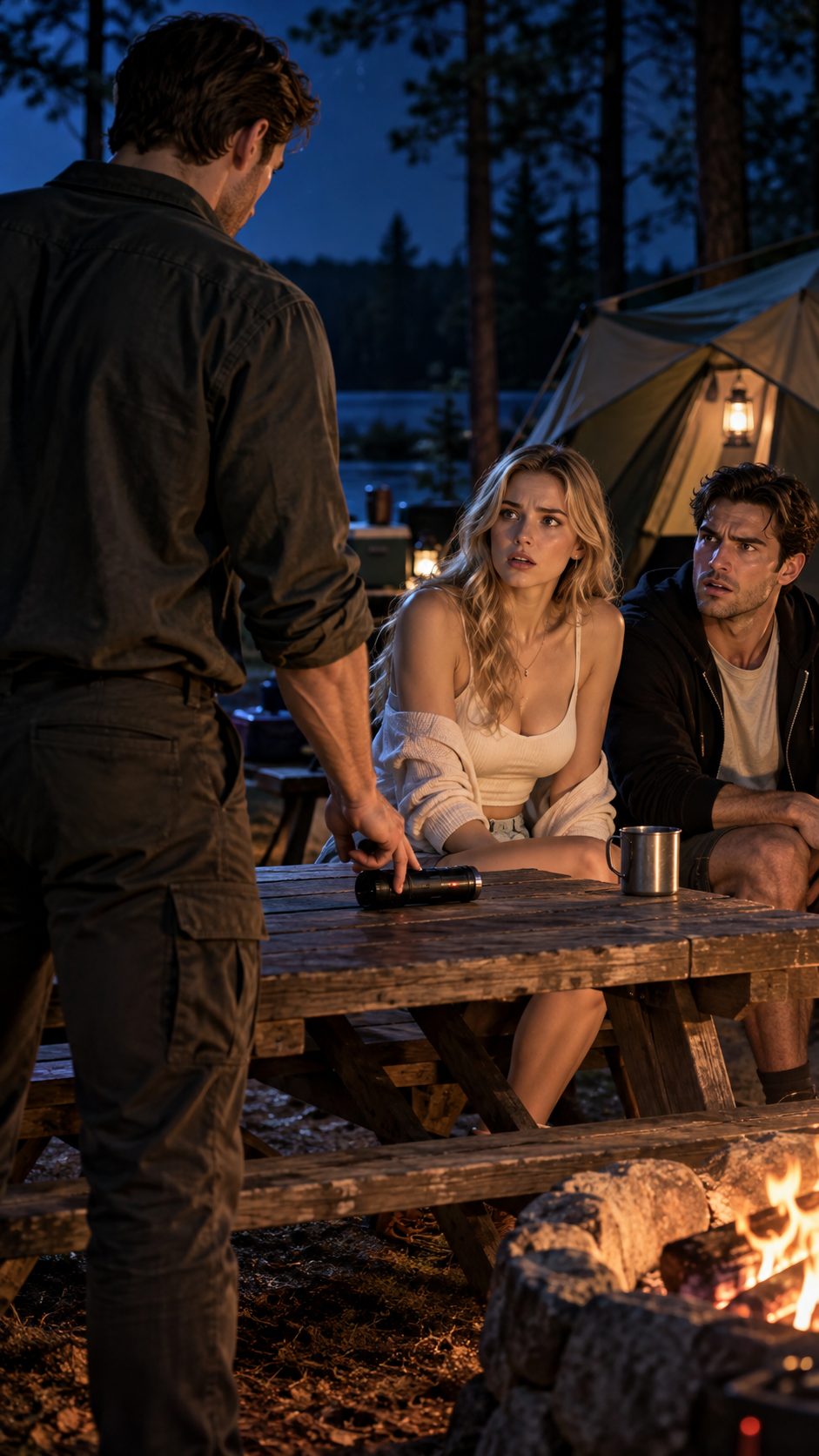
She thought one kiss would destroy my marriage.
She never imagined the flashlight beside my feet would expose a conspiracy far bigger than infidelity.
**CHAPTER 1: THE KISS BESIDE THE CAMPFIRE**
My wife kissed another man in front of me, smiled as though she had done nothing wrong, and waited for me to lose my mind.
What Natalie didn’t know was that the flashlight beside my boot had been recording her conversations for hours.
And what neither she nor Marcus understood was that their little performance wasn’t the most dangerous part of the night.
The real danger was scheduled for exactly a.m.
My name is Daniel Mercer, and until that weekend, I believed the worst thing a marriage could suffer was infidelity.
I was thirty-four years old, owned half of a small architectural restoration company in North Carolina, and had spent seven years building a life with Natalie.
We weren’t perfect, but I thought we were honest.
That illusion had survived arguments about money, missed anniversaries, and the long evenings when I worked late while Natalie complained that our marriage had become predictable.
It hadn’t survived Marcus.
Marcus Bennett had been Natalie’s closest friend since college.
He was handsome in a carefully rehearsed way, always charming when other people watched and strangely dismissive whenever we were alone.
He came to our dinners, remembered Natalie’s favorite wine, and treated our home as though he had a permanent invitation.
Whenever I mentioned boundaries, Natalie acted offended.
“He’s my best friend, Daniel.
Not every relationship between a man and a woman is romantic.”
I wanted to believe her.
Then she suggested the camping trip.
“Well, Marcus could come too.”
I looked up from my coffee.
“You’re inviting Marcus on our anniversary weekend?”
“Don’t make it weird.”
“I thought we needed time together.”
And getting away with a friend doesn’t change that.”
The argument lasted an hour.
Eventually, I agreed, partly because I was exhausted and partly because I had already begun wondering what Natalie and Marcus were trying so hard to hide.
We drove into the North Carolina mountains on a Saturday afternoon.
Natalie had chosen an isolated campground off a narrow state road, surrounded by tall pine trees and patches of thick mountain laurel.
A wooden picnic table stood beside our campsite.
An old-fashioned lantern hung near the firepit.
Farther down the road, a small ranger office displayed an American flag beside its entrance.
It should have been beautiful.
Instead, the moment we arrived, I noticed Marcus studying the position of my tent.
He asked where I planned to keep my truck keys.
Natalie checked her phone four times before we even unloaded our supplies.
And when I walked toward the ranger office to collect firewood, their conversation stopped.
By sunset, something inside me had gone cold.
I kept my flashlight nearby, its small recorder running.
I had purchased it months earlier while documenting damage inside abandoned buildings for restoration projects.
The recorder had helped me preserve inspection notes when my hands were occupied.
That weekend, I had brought it because of my growing suspicions about Natalie and Marcus.
I wasn’t proud of that decision.
But by the time the fire was burning, I was grateful for it.
Natalie handed Marcus coffee before offering any to me.
She leaned against him while they examined photographs on his phone.
At dinner, Marcus reached over and straightened her jacket collar.
Natalie smiled.
“You always notice the little things.”
Marcus looked directly at me.
“Somebody has to.”
I said nothing.
My silence seemed to irritate them more than an argument would have.
As darkness settled over the campground, Natalie moved her chair closer to Marcus.
The firelight made her face glow.
I remembered watching that same face on our wedding day, when she had promised to choose me even when life became difficult.
Marcus whispered something into her ear.
She laughed softly.
Then she turned toward me.
And kissed him.
It wasn’t a playful peck.
She held the kiss long enough to make certain I understood exactly what she was doing.
When she pulled away, she was smiling.
“It’s just a close friendship,” she said.
“Surely you’re not going to take it personally, are you?”
Marcus leaned backward, looking satisfied.
“Some men make everything dramatic.”
For one second, I wanted to overturn the chair.
I wanted to demand an explanation so loudly that every camper within a mile would hear us.
Instead, I studied Marcus.
He wasn’t embarrassed.
He wasn’t apologetic.
He was waiting for me to explode.
“Seriously?”
Natalie rolled her eyes.
“Oh, don’t start.”
“Relax, man,” Marcus added.
Something about the exchange felt rehearsed.
I reached down, lifted the flashlight beside my boot, and slowly turned it in my hand.
Then I smiled.
Make yourselves comfortable.”
Natalie’s expression flickered.
Marcus frowned.
They exchanged a glance so brief that I might have missed it on any other night.
But I had already heard enough.
Earlier, while they believed I was occupied near the edge of camp, my flashlight had recorded Natalie whispering, “Push him harder.”
Marcus had asked, “What if he doesn’t react?”
And Natalie had replied, “Then we wait until one-thirty.”
At that moment, I understood that the kiss was bait.
I didn’t yet know what they planned to do at one-thirty.
But I knew I couldn’t give them the reaction they wanted.
At eleven, I excused myself and entered my tent.
Natalie barely looked up.
Marcus offered a cheerful goodnight.
I lay fully dressed inside my sleeping bag, staring at the tent ceiling while the fire faded outside.
At a.m., footsteps approached.
They stopped beside my tent.
Someone stood there for several seconds before moving away.
At , Natalie spoke.
Her voice was frighteningly calm.
“Are you awake?”
I didn’t answer immediately.
“Daniel, come outside.
We need to talk.”
I checked my watch.
Four minutes.
I reached for the flashlight and listened to the quiet movement beyond the canvas.
When the clock reached exactly a.m., I opened the tent.
Natalie stood beside the picnic table.
Marcus was a few feet behind her.
Neither looked surprised to see me.
I walked past them, placed the flashlight on the table, and pressed play.
Natalie stared at the device.
“What are you doing?”
The speaker crackled.
First came her voice.
“Push him harder.”
Then Marcus.
“What if he doesn’t react?”
Natalie looked toward him.
“Then we wait until one-thirty.”
Marcus stepped forward.
“Turn that off.”
I ignored him.
Another voice emerged from the speaker.
A man’s voice.
One I knew almost as well as my own.
And before he finished his first sentence, Natalie turned deathly pale.
**CHAPTER 2: THE THIRD VOICE IN THE DARK**
“If he takes the bait, get it on video.
If he doesn’t, we get the key at one-thirty.”
The voice came through the flashlight speaker with unmistakable clarity.
Ethan Vale.
My business partner.
The man who had helped me build Mercer & Vale Restoration from a struggling two-person company into a respected architectural firm.
The man who had attended my wedding.
The man I trusted to make decisions when I was away.
I stared at Natalie.
She opened her mouth, but nothing came out.
Marcus moved toward the flashlight.
“That’s enough.”
“Don’t touch it,” I said.
He stopped.
Ethan’s recorded voice continued.
“The original documents are in Daniel’s truck.
Once we have the key, everything else becomes easy.”
A long silence followed.
I felt something inside my chest collapse.
For weeks, I had believed my wife was hiding an affair.
Now I was standing in the dark with two people who had been discussing my property, my keys, and some plan involving my closest professional partner.
“What documents?”
Natalie shook her head.
“Daniel, please.”
“What documents?”
Marcus folded his arms.
“You’re misunderstanding what you heard.”
“Then explain it.”
He glanced at Natalie.
She stared at the picnic table.
“Ethan was only trying to help,” she whispered.
“Help whom?”
Nobody answered.
I picked up the flashlight.
“You wanted me angry tonight.
You wanted me to do something you could record.”
Marcus’s expression hardened.
“Don’t flatter yourself.”
I looked toward his phone.
“Where were you planning to put the video?”
His hand moved instinctively toward his jacket pocket.
That was answer enough.
Natalie stepped between us.
“Daniel, can we talk privately?”
“We’re talking now.”
“Not like this.”
“Like what?
With the truth included?”
Her eyes filled with tears.
For a moment, I almost reached for her.
Seven years of marriage had trained me to respond when Natalie cried.
But then I remembered how deliberately she had kissed Marcus.
How carefully she had watched me afterward.
I kept my hands at my sides.
“Tell me what Ethan wants.”
Natalie hesitated.
Marcus spoke first.
“There’s a business transaction.
You’re making it more complicated than necessary.”
I looked at him.
“You’re not part of my business.”
“Maybe I know more about it than you think.”
His confidence returned too quickly.
That frightened me more than his earlier smirk.
I had expected shame.
Instead, I was hearing the language of a negotiation.
“What transaction?”
I repeated.
Natalie lowered her voice.
“The land.”
My father’s land.
Pine Hollow Ridge.
The wooded property outside Asheville that my father had left me three years earlier.
It contained nearly two hundred acres of pine forest, an abandoned mill foundation, and a narrow creek that my father had spent his final years protecting.
A development company had approached us repeatedly about purchasing access across the property.
I had refused.
It wasn’t simply an investment.
It was the last place where I could still imagine hearing my father’s voice.
I stared at my wife.
“You brought me here because of Pine Hollow?”
“Not exactly.”
“Then why?”
She rubbed her forehead.
“Because you wouldn’t listen to Ethan.”
I almost laughed.
“To the man who has apparently been planning something behind my back?”
Marcus took another step toward me.
“Look, Daniel.
Nobody wants trouble.”
“Then why did you arrange one?”
He had no answer.
A vehicle passed somewhere beyond the campground, its headlights briefly sweeping through the distant trees.
Natalie’s eyes followed the light.
“Are you expecting someone?”
She answered too quickly.
I looked from her to Marcus.
“Is Ethan here?”
Marcus’s jaw tightened.
“Go back to your tent.”
I didn’t move.
“Is he here?”
Before either of them could respond, another beam of light appeared along the path.
A woman wearing a ranger uniform approached from the direction of the office.
“Everything all right over here?”
She was in her early thirties, with dark hair tied beneath a cap and an expression that suggested she had little patience for midnight arguments.
Her name badge read CALDWELL.
I recognized her from earlier that afternoon.
“Yes, ma’am,” Marcus said immediately.
“No,” I answered.
The ranger stopped.
She looked at all three of us.
“What’s happening?”
“My wife and her friend have been discussing how to take property from my truck without my permission.”
Natalie inhaled sharply.
I continued.
“And I have a recording suggesting someone else is involved.”
The ranger’s expression changed.
“Has anyone threatened you?”
“Not directly.”
“Has anyone entered your vehicle?”
“I don’t know.”
She nodded toward the parking area.
“Let’s make sure nothing’s been disturbed.”
Marcus protested.
“This is a marital disagreement.”
The ranger looked at him.
“Then you shouldn’t object to everyone remaining calm while he checks his vehicle.”
I followed her along the gravel path.
My truck stood beneath a pine tree near the campsite entrance.
The doors were locked.
But when I directed my flashlight through the passenger window, I noticed something on the seat.
A folded sheet of paper.
I knew I hadn’t left it there.
The ranger asked whether I could open the vehicle.
I used the spare key from my pocket.
The paper contained a printed authorization form.
At the top were the words:
PINE HOLLOW RIDGE ACCESS AND DEVELOPMENT OPTION.
Below that was my name.
And beneath my name was a signature that looked disturbingly similar to mine.
I turned toward Natalie.
“Where did this come from?”
She stared at the page.
“I don’t know.”
“There’s my signature on it.”
Marcus looked away.
The ranger leaned closer without touching the document.
“Sir, is that your signature?”
The answer came immediately.
“No, it isn’t.”
I unfolded the second page.
A small paragraph described permission for a commercial access corridor through Pine Hollow Ridge.
The arrangement would give another company the right to begin preliminary development work.
I felt sick.
My father had spent decades refusing exactly that kind of proposal.
The ranger studied my face.
“Do you have an attorney?”
“Not for this.”
“You should call one as soon as possible.”
I looked toward the trees.
The night seemed suddenly enormous.
Somewhere out there was a man I had trusted with my business, my finances, and my family’s legacy.
And he was no longer merely stealing my confidence.
He was trying to steal the one thing my father had asked me to protect.
Then Natalie’s phone vibrated.
She looked down.
I saw only two words on the illuminated screen.
ETHAN CALLING.
**CHAPTER 3: THE PROPERTY MY FATHER REFUSED TO SELL**
Natalie silenced her phone before the second vibration.
I watched her thumb move across the screen.
“Answer it,” I said.
“Daniel, not here.”
“Because you’re upset.”
I looked at the document in my hand.
“You arranged for my signature to appear on an agreement I never signed, and you’re worried that I’m upset?”
The ranger remained beside my truck, quietly observing.
Natalie swallowed.
“Ethan said there was a way to solve everything.”
“What needed solving?”
She looked at Marcus.
He offered nothing.
I had never seen my wife look so completely uncertain of the man standing beside her.
“Go on,” I said.
Natalie’s voice trembled.
“The company has been losing money.”
“That’s not true.”
“Ethan told me it was.”
“He handles most of the financial reporting, but I review the accounts.”
“Then maybe he didn’t tell you everything.”
I stared at her.
A terrible possibility entered my mind.
Ethan had been our financial manager since we founded the company.
I handled design, restoration, and clients.
He handled contracts, loans, payroll, and relationships with investors.
For years, I had considered that division of responsibility practical.
Now it seemed like a door I had left unlocked.
The ranger interrupted gently.
Mercer, I recommend you stop discussing the document until you’ve spoken with an attorney.”
She gave me the contact information for the county sheriff’s office and explained how to preserve the recording without altering the original file.
I thanked her.
Marcus looked annoyed.
“Are we seriously involving the authorities over a misunderstanding?”
The ranger turned toward him.
“A document containing an allegedly forged signature isn’t something I can dismiss as a misunderstanding.”
I photographed the papers, secured them in my truck, and returned to the campsite to collect my belongings.
Natalie followed.
“Where are you going?”
“You’re leaving me here?”
“Marcus drove his own car.”
She looked hurt.
It would have been convincing if I hadn’t watched her kiss him only hours earlier.
“Daniel, please don’t do this.”
I stopped beside the tent.
“Throw away seven years because of one mistake.”
I stared at her.
“Which mistake?
The kiss, the recording, the forged paperwork, or bringing me into the woods so someone could take my keys?”
Her mouth opened.
No answer came.
I folded the tent without speaking again.
By dawn, I was driving east through the mountains with my phone beside me and my father’s land documents locked in the truck.
At a.m., I called Ruth Sloane.
Ruth was an attorney in Asheville who had handled my father’s estate.
She was sharp, practical, and rarely impressed by dramatic stories.
But when I told her what had happened, her tone changed.
“Don’t sign anything,” she said.
“I wasn’t planning to.”
“Don’t confront Ethan alone.”
“Because if this agreement has been submitted anywhere, you’re dealing with more than a marital dispute.”
She asked me to bring the document and recording to her office.
Then she asked a question that made my stomach tighten.
“Daniel, does Ethan have access to your digital signature files?”
I gripped the steering wheel.
“Some of them.”
“Does he know where you keep the original survey?”
“Then we need to act quickly.”
I reached Asheville shortly after nine.
The city was beginning to wake as I parked outside Ruth’s office.
She met me wearing jeans and a dark cardigan, carrying two cups of coffee.
“You look terrible,” she said.
“I had an eventful anniversary.”
She didn’t smile.
Inside, I explained everything from the first suspicious conversations to the recording beside the campfire.
Ruth listened without interruption.
Then she studied the agreement.
“This is a preliminary access option,” she said.
“Meaning whoever prepared it wants to claim you’ve agreed to give a developer access rights over a portion of Pine Hollow.”
“I never agreed.”
“I believe you.”
She examined the copied signature.
“But someone may be trying to establish a paper trail suggesting otherwise.”
She placed the document on her desk.
“Why is Pine Hollow so valuable to them?”
I looked out the window.
For a moment, I was seventeen again, following my father through the forest.
He had been a carpenter before he became a restoration contractor.
He purchased Pine Hollow when it was nearly worthless, then spent years clearing fallen trees, restoring the old mill foundation, and protecting the creek from careless development.
When I was young, he taught me to identify trees by their bark and measure distances by the sound of running water.
The land was where he explained the difference between owning something and caring for it.
“One day,” he told me, “people will offer you a lot of money for this place.”
“How much?”
He laughed.
“Enough to make you forget why it matters.”
Then he placed his hand on my shoulder.
“Promise me you won’t.”
When he died, the property became mine.
It also became a problem for people who saw only its commercial potential.
A proposed private development lay on the opposite side of the ridge.
The easiest access route crossed my father’s land.
Without that corridor, the project would become considerably more expensive.
I explained this to Ruth.
She listened carefully.
“Who represents the developer?”
“Crescent Development Group.”
“And Ethan has spoken with them?”
“Several times.”
“With your knowledge?”
“At first.”
I remembered the arguments.
Ethan had insisted selling access rights would fund expansion of our restoration company.
I had refused repeatedly.
Eventually, he’d stopped bringing it up.
I had mistaken his silence for acceptance.
Ruth made two calls.
The first was to a county records contact.
The second was to a title attorney.
Then she returned to her desk.
“I want a full review of your company accounts.”
“Do you think Ethan has been stealing?”
“I think we shouldn’t assume anything until we have evidence.”
She glanced at the window.
“And I want someone to independently verify the survey and access route.”
“I know someone who could help.”
A name came to mind.
Mara Bennett.
No relation to Marcus.
Mara was an environmental mapping specialist who had worked with my father during his final years.
I hadn’t spoken to her in almost two years.
She knew Pine Hollow better than anyone outside my family.
Ruth nodded.
“Call her.”
Before I could reach for my phone, Ruth’s computer sounded.
She opened a message from her title contact.
Her expression tightened.
I looked up.
She turned the monitor toward me.
The forged option agreement had already been submitted for recording.
And the submission date was Friday.
A full day before Natalie kissed Marcus beside our campfire.
— **CHAPTER 4: THE WOMAN WHO REMEMBERED THE CREEK**
I called Mara Bennett from the parking lot outside Ruth’s office.
She answered on the fourth ring.
“Daniel Mercer?”
Her voice carried the same quiet confidence I remembered.
“Hi, Mara.”
“That’s unexpected.
Everything okay?”
I looked at the unsigned copy of the agreement resting on my passenger seat.
“Not really.”
There was a brief pause.
“Is it Pine Hollow?”
I closed my eyes.
“How did you know?”
“Your father always said you’d call me when somebody finally tried to take that ridge.”
The words hit harder than I expected.
Mara had known my father during the final five years of his life.
She was an environmental surveyor specializing in historic landscapes, streams, and conservation planning.
She had spent countless weekends mapping Pine Hollow with him, documenting old boundaries and identifying places vulnerable to erosion.
I remembered her as a serious young woman with dark hair, watchful green eyes, and an unfortunate habit of correcting my measurements.
We had never been especially close.
But my father adored her.
“Come to the property,” she said after I explained the situation.
“Bring whatever documents you have.”
“I can be there in an hour.”
“I’ll be waiting.”
The drive to Pine Hollow was familiar enough that I barely needed directions.
The road narrowed as it climbed through the foothills.
Morning sunlight fell across old fences and wildflowers.
When I reached the gate, Mara was standing beside a dusty gray SUV with a rolled map under one arm.
She wore hiking boots, faded jeans, and a dark blue jacket.
Her hair was tied carelessly behind her head.
For a moment, the sight of her made the last twenty-four hours feel less impossible.
Then she noticed my expression.
“You look like you’ve been through something.”
“My wife kissed another man in front of me.”
Mara blinked.
“That’s one hell of an opening sentence.”
“Unfortunately, it gets worse.”
I told her everything as we walked along the gravel track toward the old mill.
She interrupted only twice.
The first time was when I mentioned Ethan.
“He was always too interested in the land,” she said.
“You knew that?”
“Your father noticed it.”
“He never told me.”
“He probably hoped you’d notice yourself.”
The second interruption came when I described the forged access agreement.
Mara stopped walking.
“Do you have the survey?”
I handed her the copy Ruth had provided.
She unfolded it against the hood of an old utility vehicle parked beside the mill.
Her eyes moved quickly across the property lines.
“Interesting.”
“This isn’t the route they originally proposed.”
She pointed toward a narrow strip marked in red.
“The first developer wanted access along the western boundary.
This route cuts through the eastern watershed.”
“Why would they change it?”
“Because it’s shorter.”
“By how much?”
“Enough to save a developer millions in grading, retaining walls, and construction costs.”
I stared at the map.
The marked corridor passed dangerously close to the creek.
Mara traced its path with one finger.
“Your father spent years restoring this watershed.”
“Then you know what heavy construction could do here.”
A road might not destroy the entire forest.
But it could change drainage patterns, damage the creek, and open the surrounding property to development my father had always resisted.
Mara folded the map.
“Someone wants the fastest route, not the safest one.”
I leaned against the vehicle.
“And apparently my wife was willing to help them get it.”
Mara said nothing.
Her silence was oddly comforting.
Most people would have rushed to tell me I deserved better.
Others would have offered dramatic suggestions for revenge.
Mara simply waited until I could breathe normally.
Then she asked, “What do you need from me?”
“An independent report.
Something Ruth can use.”
“I’ll do it.”
“I’ll pay whatever your normal rate is.”
I looked at her.
“Your father taught me half of what I know about this place.”
“That doesn’t mean you should work for free.”
A faint smile appeared.
Then we won’t argue about it.”
We spent the next three hours walking the proposed corridor.
Mara photographed erosion channels, checked old boundary markers, and compared the new measurements against maps she had stored in her tablet.
I followed her through the forest, grateful for work that required concentration.
Near the creek, she stopped beside a moss-covered stone.
“Do you remember this?”
A small carved arrow pointed toward the water.
“My father put that there.”
Mara crouched beside me.
“He used to bring volunteers down here every spring to clear rubbish and repair the footbridge.”
I remembered those weekends.
I remembered my father laughing when I complained about mosquitoes.
I remembered how he always stayed until the last person had gone home.
“He believed this place belonged to more than whoever held the deed,” Mara said.
I looked at her.
“You sound like him.”
“That’s probably because I listened.”
For the first time since the camping trip, I smiled without forcing it.
Then my phone rang.
I stared at his name.
Mara stood.
“Are you going to answer?”
“I think I have to.”
I accepted the call.
Where the hell have you been?”
His familiar voice sounded almost cheerful.
I felt physically ill.
“Listen, Natalie called me.
She said you two had a terrible fight.”
I looked at Mara.
Apparently Marcus got involved.
Look, marriages are complicated, but don’t let this ruin your weekend.”
I said nothing.
Ethan continued.
“Actually, while I’ve got you, there’s a business matter we should discuss.”
“Would that involve Pine Hollow?”
Then he laughed nervously.
“What’s that supposed to mean?”
“Exactly what I asked.”
“Daniel, I think we need to meet.”
“Because you’re about to make a serious financial mistake.”
I looked at the creek.
“I thought the biggest mistake was trusting you.”
His tone changed.
“Be careful.”
“Is that a warning?”
“It’s advice from someone who’s spent years keeping your company alive.”
“You mean our company.”
Another silence.
Then he spoke with icy precision.
“You don’t understand how much money is involved.”
“Then explain it.”
“Not over the phone.”
The connection ended.
Mara studied my face.
“That didn’t sound encouraging.”
We returned to the mill in silence.
My phone vibrated again.
This time it was Ruth.
“Daniel, we’ve found something in the company accounts.”
I stopped walking.
“An incoming payment from Crescent Development.
Four hundred and twenty-five thousand dollars.”
I gripped the phone.
“For what?”
“According to the description, consulting and preliminary access coordination.”
“We don’t provide those services.”
Ruth hesitated.
“And Daniel, the payment was received three months ago.”
Three months.
Long before the camping trip.
Long before Natalie kissed Marcus.
I stared across the forest my father had loved.
And finally understood that while I had been trying to save my marriage, Ethan had already begun selling my inheritance.
**CHAPTER 5: THE SIGNATURE THAT WASN’T MINE**
By Monday morning, my life had divided into two separate disasters.
The first was my marriage.
The second was the possibility that everything I had built with Ethan was collapsing from the inside.
Ruth had arranged an emergency meeting with a forensic accountant named Peter Lawson.
He arrived carrying a laptop, two notebooks, and the expression of a man accustomed to discovering financial disasters.
We sat around Ruth’s conference table.
I placed the forged agreement in the center.
Peter examined it carefully.
“Have you ever signed an authorization resembling this?”
“Did you give Ethan permission to negotiate an access agreement?”
“Did you authorize Crescent Development to make payments to your company?”
“Absolutely not.”
He nodded and opened his laptop.
“Then we start with the records.”
For the next two hours, Peter guided us through transactions I had never seen.
The four-hundred-and-twenty-five-thousand-dollar payment wasn’t the only suspicious item.
There were consultancy invoices with vague descriptions.
Transfers into an unfamiliar account.
Expenses charged to projects that had supposedly been completed months earlier.
I watched columns of numbers appear on the screen.
Each one represented a decision Ethan had made without my knowledge.
“How much is missing?”
Peter didn’t look up.
“Too early to say.”
“Give me your best estimate.”
“Potentially several hundred thousand dollars.”
I leaned back.
The office suddenly felt too small.
Ruth placed a glass of water in front of me.
“Daniel, we need you focused.”
“I’m trying.”
Because anger won’t help us verify these transactions.”
I looked at the agreement.
“Can we prove the signature was forged?”
“Possibly,” Peter said.
“But it won’t be as simple as comparing handwriting.”
He explained that the document appeared to contain a digitally reproduced signature.
Someone may have copied it from one of my legitimate business files.
The company used electronic document systems for restoration permits and client approvals.
Ethan had administrative access.
That access had once made him indispensable.
Now it made him dangerous.
“There’s also a notarial acknowledgment attached to the submitted paperwork,” Ruth said.
I stared at her.
“Someone notarized a signature I never made?”
“That’s what we need to investigate.”
She explained that the seal could have been misused, copied, or fraudulently applied.
But we needed the official records before drawing conclusions.
I rubbed my temples.
“What happens now?”
“We notify the developer formally that you dispute the agreement.
We seek emergency protection against construction or transfer, preserve the financial records, and cooperate with the authorities.”
“And Ethan?”
“We don’t warn him about every piece of evidence we have.”
Then my phone vibrated.
I hadn’t spoken to her since the campground.
Her messages had filled my screen all Sunday.
Please come home.
We need to talk.
You don’t understand what happened.
Marcus doesn’t mean anything to me.
That last message had almost made me throw the phone across the room.
Now another appeared.
Ethan says you’re going to destroy the company.
Please don’t make this worse.
I showed Ruth.
She read it silently.
“Don’t argue with her over text,” she advised.
“I don’t want to argue with her at all.”
“Then don’t.”
That afternoon, I drove to the house Natalie and I had shared for seven years.
Her car was in the driveway.
So was Marcus’s.
I stopped before reaching the garage.
For a few seconds, I sat motionless, staring at the familiar front porch.
I had painted its railing myself the summer after we got married.
Natalie had stood beside me drinking lemonade and laughing because I had gotten paint on my nose.
That memory seemed to belong to somebody else.
I entered through the front door.
Natalie appeared from the kitchen.
She looked exhausted.
Her hair was tied into a loose knot, and she wore one of my old sweatshirts.
For one brief instant, I saw the woman I had loved.
Then Marcus stepped into the hallway.
I looked at him.
“Why are you here?”
Natalie answered quickly.
“He was helping me.”
“With what?”
“Everything.”
Marcus folded his arms.
“We’ve been worried about you.”
I almost laughed.
“That’s touching.”
Natalie approached.
“Please, can we sit down?”
I looked at the wedding photograph hanging above the mantel.
Our smiles were enormous.
I wondered when they had become lies.
“Did you know Ethan was receiving money from Crescent?”
Natalie’s expression changed.
“Yes or no?”
“I knew there was an agreement.”
“What agreement?”
“Something about using the land to protect the company.”
“Protect it from what?”
She looked toward Marcus.
I followed her gaze.
“Stop looking at him every time I ask you a question.”
Marcus stepped forward.
“Don’t talk to her like that.”
I turned slowly.
“This is my house.”
“And she’s your wife.”
“Then perhaps you should have remembered that before kissing her.”
His face reddened.
Natalie began crying.
“Stop it, both of you.”
I took a breath.
“I came for my personal documents and clothes.
I’m not discussing anything else without legal advice.”
I walked upstairs.
Natalie followed me to the bedroom doorway.
“Daniel, I never wanted you hurt.”
I opened a drawer.
“Did you know about the plan to record me losing my temper?”
She said nothing.
Her tears fell faster.
“Marcus said it would make you listen.”
I stared at her.
“Listen to what?”
“That you couldn’t keep controlling everything.”
I almost couldn’t recognize her voice.
“Refusing to sell my father’s land isn’t controlling you.”
“Ethan said you were risking our future.”
“Then Ethan should have spoken to me.”
“He tried.”
“And when I refused, you decided to betray me?”
Natalie covered her mouth.
I closed the suitcase.
“I loved you,” I said quietly.
She shook her head.
“Don’t say it like it’s over.”
I looked at her.
“I don’t know what it is anymore.”
I left without another word.
By evening, Ruth called with a new discovery.
A land-access contractor had submitted preliminary work notices referencing the disputed agreement.
Survey crews were expected to visit Pine Hollow.
I drove toward the property immediately.
When I reached the entrance, I stopped.
A new steel chain crossed the gate.
Someone had replaced my padlock.
And attached to the chain was a professionally printed notice.
AUTHORIZED DEVELOPMENT ACCESS — CRESCENT DEVELOPMENT GROUP.
I read it twice.
Then I looked beyond the gate.
Fresh orange survey flags stretched into the trees.
Someone had already begun marking a road through my father’s forest.
**CHAPTER 6: THE FOREST THAT REFUSED TO FORGET**
I stood beside the locked gate for nearly ten minutes.
The new chain was thick.
The orange survey flags fluttered in the breeze beyond it.
Nothing had been cut.
No bulldozers had arrived.
Yet the violation felt enormous.
Someone had entered my property, changed the lock, and begun treating my father’s land as though it belonged to them.
I called Ruth.
“Someone’s changed the gate.”
“Don’t cut the chain.”
It’s my property.”
“Because we’re disputing the agreement in court, and I don’t want anyone manufacturing another incident.”
I looked at the lock.
I remembered Marcus watching me beside the campfire, waiting for the moment I lost control.
The resemblance was unmistakable.
“Do you think they’re trying to provoke me again?”
“I think we should assume every reaction matters until this is resolved.”
Ruth contacted the sheriff’s office to document the access dispute.
Then she told me to photograph everything and leave the gate untouched.
I followed her instructions.
A few minutes later, Mara arrived.
She stepped out of her SUV carrying a camera and a canvas field bag.
“I came as soon as I got your message.”
I pointed toward the chain.
“Apparently, I’m no longer allowed on my own land.”
She examined the notice.
“That isn’t how ownership works.”
“It seems to be how Ethan thinks it works.”
Mara photographed the lock, the printed notice, and the visible flags.
Then she walked along the fence until she found a gap that allowed us to view the marked route from the public roadside.
“This isn’t the alignment I measured yesterday.”
I joined her.
“What changed?”
She raised her camera.
“Look at the orange markers.”
They crossed an uneven patch of ground leading toward the creek.
Mara zoomed in.
“Those stakes mark a much wider corridor than the agreement describes.”
“How much wider?”
“I can’t be certain without measurements, but enough to concern me.”
I stared at the trees.
The thought of heavy machinery moving through them made my stomach twist.
“Why would they need that much space?”
“Construction equipment.
Possibly utilities.”
I rubbed my forehead.
“They’re acting like approval is already guaranteed.”
“Or they’re trying to make the work look inevitable.”
She lowered the camera.
“Your father used to say that was how developers won arguments before anyone realized there was an argument to have.”
I smiled faintly.
“He had an opinion about everything.”
“Usually several.”
We shared a brief laugh.
It was the first genuinely ordinary moment I’d experienced since Saturday.
A deputy arrived soon afterward and recorded the condition of the gate.
He explained that disputed civil access rights could become complicated, but unauthorized entry and damage would be documented.
He also advised us not to confront any workers ourselves.
Once he left, Mara and I drove around the property to an older public trail overlooking the ridge.
From there, we could see the canopy stretching across the hillside.
The forest looked unchanged.
That made the threat feel more painful.
Mara unpacked two sandwiches from her bag.
“Eat something.”
“I’m not hungry.”
“When did you last eat?”
I tried to remember.
She raised an eyebrow.
“That’s what I thought.”
I accepted a sandwich.
We sat on a fallen log overlooking the valley.
After several minutes, Mara asked, “How are you doing?”
I stared at the food in my hands.
“Which answer do you want?”
“The one that’s true.”
I considered lying.
Then I surprised myself.
“I keep replaying the kiss.”
Mara remained silent.
“I know the land is more important right now.
I know Ethan may have committed fraud.
I know there are lawyers and accounts and documents to worry about.”
I swallowed.
“But every time I close my eyes, I see Natalie looking directly at me while she kisses Marcus.”
Mara looked toward the trees.
“That doesn’t make you weak.”
“It makes me feel ridiculous.”
“Because even after everything, part of me wants her to explain it in a way that makes sense.”
Mara turned toward me.
“Sometimes there isn’t an explanation that makes betrayal hurt less.”
I looked at her.
“Have you been through something like this?”
She hesitated.
“Not exactly.”
Then she smiled sadly.
“I was engaged once.”
I hadn’t known.
“What happened?”
“He kept promising that after one more promotion, one more move, one more successful year, there would finally be room for the life we planned.”
“Eventually, I realized he was building a future that didn’t include me.”
She watched a hawk circle above the valley.
“Walking away was harder than staying unhappy.”
I understood that sentence more than I wanted to.
We finished eating without speaking.
For the first time, the silence didn’t feel threatening.
It felt like somewhere I could rest.
Later that afternoon, Mara took me to the county historical archive.
She wanted to compare the proposed road corridor against older property maps.
The building smelled of paper, dust, and polished wood.
A clerk brought us records dating back nearly a century.
Mara examined each one with patient concentration.
I watched her trace faded lines with a gloved finger.
She seemed entirely absorbed in the work.
There was nothing theatrical about her concern.
She wasn’t trying to impress me.
She was trying to understand the land.
That simple sincerity unsettled me.
I had forgotten what it felt like to be around someone who didn’t seem to want something from me.
After almost two hours, Mara stopped turning pages.
I leaned closer.
She pointed at a faded notation near the creek.
“Your father’s property includes an old mill-water-right boundary.”
“I know about the mill.”
“No, look.”
She placed the modern survey beside the historical map.
The proposed road corridor crossed a watercourse whose historic alignment had apparently been omitted from the developer’s supporting survey.
“That doesn’t automatically stop a road,” she said.
“But it changes what they need to disclose and investigate.”
I studied the maps.
“Could it help Ruth?”
“Potentially, yes.
Especially alongside the current drainage and environmental records.”
She photographed the notation.
Then she looked at me with sudden seriousness.
“There’s something else.”
“This map was updated in the county archive seven months ago.”
Mara pointed toward a handwritten reference number.
The update had been requested by Mercer & Vale Restoration.
My company.
I hadn’t requested it.
And the initials beside the reference number belonged to Ethan Vale.
He had been studying my father’s property long before Natalie suggested our camping trip.
— **CHAPTER 7: THE PRICE OF KEEPING A SECRET**
Natalie asked to see me on Wednesday.
She didn’t call.
She didn’t leave another emotional voicemail.
Instead, she sent a short message.
I need to tell you what happened.
I won’t ask you to forgive me.
Please let me explain.
I read it three times.
Then I forwarded it to Ruth.
She called immediately.
“Don’t meet her alone.”
“Do you think she’ll hurt me?”
I think there’s too much at stake for an undocumented conversation.”
Ruth arranged for Natalie to come to her office the following afternoon.
She also explained that any discussion involving potential criminal conduct or personal liability would need careful handling.
Natalie agreed to the meeting.
When she arrived, she looked different.
Not because of her clothes or hair.
Because the confidence that had always surrounded her was gone.
She wore a plain gray sweater and carried a small handbag against her chest.
For seven years, I had known every version of my wife’s smile.
That afternoon, she didn’t smile once.
Ruth greeted her politely.
“Would you like an attorney present?”
Natalie shook her head.
“I just want Daniel to hear me.”
Ruth explained the importance of independent legal advice.
Natalie listened, then agreed that she would not sign statements or make legal commitments during the meeting.
We sat across from one another.
The distance between us felt much greater than the conference table.
“Start with Marcus,” I said.
Natalie lowered her eyes.
“I didn’t plan to fall for him.”
The words struck like a physical blow.
I had expected excuses.
Not that sentence.
“How long?”
She twisted the strap of her handbag.
“Four months.”
I looked away.
Four months.
While I had been renovating our kitchen, planning our anniversary, and wondering why she seemed distant, Natalie had been building another relationship.
“Was it an affair?”
She nodded.
“Not just friendship?”
I almost laughed at the cruelty of the answer.
At the campsite, she had mocked me for questioning their closeness.
Now she was admitting that every suspicion had been justified.
“Why didn’t you leave?”
Natalie began crying.
“Because I still loved you.”
I shook my head.
“That wasn’t love.”
“I know how it sounds.”
“No, Natalie.
I don’t think you do.”
She wiped her face.
“I was lonely.”
“So was I.”
“You were always working.”
“To build the future we talked about.”
“That was your future.”
I looked at her carefully.
“Then why didn’t you tell me ours had changed?”
She stared at the table.
“I was afraid.”
“Of being honest?”
“Of losing everything.”
Finally, she began explaining the money.
Almost a year earlier, she had tried to launch an online interior design business.
I remembered the idea.
She had spoken enthusiastically about creating curated room designs for clients who couldn’t afford full-service decorators.
I had encouraged her.
What I hadn’t known was that she had invested far more money than we discussed.
Marcus had offered to help finance the project.
When the business struggled, he advanced her additional funds.
Eventually, she owed him more than thirty-eight thousand dollars.
“Why didn’t you tell me?”
“Because I thought I could fix it.”
“With Marcus?”
She nodded.
Then Ethan became involved.
He had learned about her debt through Marcus.
He offered a solution.
If Natalie could convince me to approve the Pine Hollow access agreement, Ethan would arrange for her debt to disappear.
“And you believed him?”
“He showed me the numbers.”
“Numbers from a deal he had no authority to make.”
“I didn’t know that then.”
I leaned forward.
“When did you find out?”
Natalie hesitated.
“Before the camping trip.”
The room became very quiet.
Ruth closed her notebook.
I stared at my wife.
“So you knew.”
“I knew he wanted the agreement completed.”
“You knew he was using my signature.”
“He said the paperwork was already prepared and that you were being unreasonable.”
“Did he tell you it was forged?”
Her silence lasted several seconds.
“He said you’d never sign willingly.”
I felt something cold settle inside me.
“And the kiss?”
Natalie covered her mouth.
Marcus had suggested it.
He believed humiliating me in front of witnesses would provoke an angry reaction.
He intended to record it on his phone.
A video showing me shouting, threatening, or behaving aggressively could then be used to portray me as unstable during any dispute over the land agreement.
I stared at her.
“You agreed to do that to your husband?”
Natalie nodded through tears.
“And when I didn’t react?”
“Marcus was supposed to get your truck key while you slept.”
“At one-thirty.”
“Ethan was waiting?”
“Near the campground entrance.”
I remembered the headlights passing through the trees.
Natalie continued.
Ethan planned to obtain documents and files from my truck that might make the disputed agreement appear more credible.
If I woke up and caught them, Marcus’s phone would be ready.
The plan relied on either my silence or my anger.
I sat back.
For several moments, I couldn’t speak.
Natalie reached across the table.
“Daniel, I know what I did was terrible.”
I moved my hand away.
She began crying harder.
“I don’t expect you to forgive me.”
“Then why are you telling me this now?”
She looked up.
“Because Ethan lied to all of us.”
I shook my head.
“Don’t make him responsible for your choices.”
“You kissed Marcus because you wanted to hurt me.”
She lowered her head.
“You helped them because you wanted money.”
“And you kept lying because you thought I would eventually give up.”
Tears slid down her face.
For the first time, she wasn’t defending herself.
And somehow that hurt more.
Ruth arranged for Natalie to receive independent legal advice about providing a formal statement.
Natalie looked at me.
“Is there any chance for us?”
I considered the question.
Seven years.
A shared home.
Hundreds of ordinary mornings.
The future I had believed we were building.
Then I remembered the kiss beside the campfire.
“Not the way we were,” I said.
I walked out.
Mara was waiting outside the building.
She had come to deliver her completed preliminary mapping report.
One look at my face told her the meeting had been difficult.
She didn’t ask for details.
Instead, she handed me a bottle of water.
“Want to walk?”
We walked through the city for almost an hour.
She didn’t touch me.
She didn’t offer promises.
She simply stayed beside me.
When we reached my truck, I realized that her quiet presence had made the day bearable.
Then my phone rang.
“Daniel, we have a problem.”
“What happened?”
“Someone has sent Crescent’s attorneys a video from the campground.”
I closed my eyes.
“Most likely.”
“The recording shows the whole night?”
Ruth paused.
“It shows only a few seconds of you confronting Natalie, without what happened before.”
I looked toward Mara.
“And they’re claiming it proves I’m unstable?”
“That’s exactly what they’re trying to do.”
**CHAPTER 8: THE HEARING AT NINE**
The emergency hearing began at nine on Friday morning.
I arrived at the courthouse with Ruth and Peter.
Mara was already waiting near the entrance.
She wore a navy blouse beneath a simple jacket and held a folder containing her survey findings.
When she saw me, she approached.
“How are you holding up?”
“Like a man who hasn’t slept properly in a week.”
“Then let’s make sure this week means something.”
I smiled weakly.
Inside, the courtroom was smaller than I expected.
There were polished wooden benches, a raised judicial desk, and tall windows through which morning sunlight entered in narrow rectangles.
Ethan sat beside an attorney near the front.
He wore an expensive charcoal suit.
His hair was carefully styled.
He looked exactly like the man who had confidently negotiated contracts beside me for nearly a decade.
For one absurd second, I expected him to turn around and ask whether I wanted coffee.
Instead, he avoided my eyes.
Across the aisle sat representatives from Crescent Development.
Marcus was near the back of the courtroom.
Natalie arrived separately.
She sat alone.
When she saw me, she looked down.
Ruth leaned toward me.
“Remember, today is about preventing immediate harm while the evidence is examined.
We’re not resolving every accusation.”
The judge entered.
The hearing began.
Crescent’s attorney argued that the company had relied on documents representing a legitimate agreement.
He explained that substantial planning expenses had already been incurred.
Delaying the project, he claimed, would cause financial harm.
Ruth stood.
“Your Honor, my client disputes ever authorizing the agreement.”
She presented the document containing my apparent signature.
Then she introduced my sworn statement.
She explained that the signature appeared to have been copied from earlier business records and that Ethan had access to those records.
The developer’s attorney objected to conclusions that had not yet been established.
The judge acknowledged the dispute.
Sloane, what independent evidence supports your client’s position?”
Ruth presented the financial records.
She explained that a substantial payment from Crescent had entered Mercer & Vale Restoration without my approval.
Peter had identified subsequent transfers requiring further investigation.
The judge examined the documents.
Then Ruth addressed the campsite.
Mercer was subjected to an apparent attempt to provoke an emotional confrontation immediately before others planned to access his vehicle.”
Crescent’s attorney stood.
“We have a video suggesting the opposite.”
He requested permission to present it.
The judge allowed the short recording to be considered within the limited scope of the hearing.
My stomach tightened.
The video showed me standing near Natalie at the campground.
My expression was angry.
My voice sounded sharper than I remembered.
“You knew what you were doing,” I said in the recording.
Then it ended.
No earlier conversation.
No flashlight recording.
Just one isolated moment that made me look furious.
The attorney turned toward the judge.
“This is the state of mind of the person now disputing the agreement.”
Ruth stood immediately.
“Your Honor, the video is incomplete.”
The judge looked at her.
“Can you establish that?”
Ruth introduced the unedited audio file preserved from the flashlight and the ranger’s contemporaneous account of the incident.
The recording played.
Natalie’s voice filled the courtroom.
“Push him harder.”
Marcus followed.
“What if he doesn’t react?”
Then Natalie.
“Then we wait until one-thirty.”
I watched Ethan.
For the first time that morning, his composed expression faltered.
Then his recorded voice emerged.
“If he takes the bait, get it on video.
If he doesn’t, we get the key at one-thirty.”
The courtroom fell silent.
Ruth allowed the recording to finish.
Then she spoke.
“These statements suggest that the confrontation was planned and that the purpose was to obtain Mr.
Mercer’s property without his consent.”
The judge turned toward Ethan’s attorney.
“Does your client dispute that this is his voice?”
The attorney rose slowly.
“We would need an opportunity to verify the recording.”
“Of course,” the judge replied.
“But that does not eliminate its immediate relevance.”
Next came Mara.
She explained the discrepancies between the submitted survey and the historic property records.
She spoke clearly, identifying the old watercourse, the proposed access corridor, and the field observations she had documented.
She avoided exaggeration.
She didn’t claim the development was automatically unlawful.
Instead, she explained that the maps appeared incomplete and that any construction could affect areas not properly evaluated.
The judge asked several questions.
Mara answered each without hesitation.
I watched her from my seat.
Her confidence came from preparation, not performance.
When she finished, she glanced toward me.
I nodded in gratitude.
Then Ruth addressed the change of locks and survey flags at Pine Hollow.
The deputy’s report and photographs confirmed that access restrictions had appeared while ownership and authorization remained disputed.
The judge studied the materials carefully.
Finally, he looked at both attorneys.
“I am concerned about the risk of irreversible changes to the property before the authenticity and scope of these documents can be determined.”
I felt my shoulders loosen slightly.
He ordered temporary restrictions preventing further land disturbance under the disputed agreement while the matter proceeded.
It wasn’t a final victory.
But the trees would remain standing.
At least for now.
Outside the courtroom, Ruth exhaled.
“That’s the protection we needed.”
I shook her hand.
“Thank you.”
“Don’t celebrate yet.
We still have a great deal to prove.”
Mara joined us.
“Your father would have liked that hearing,” she said.
“Because the judge actually listened to the maps.”
For one brief moment, hope returned.
Then Ruth’s phone rang.
She answered, listened, and moved away from us.
When she returned, her expression had changed.
“Crescent’s attorneys have produced another document.”
“What kind?”
“An email authorizing Ethan to negotiate the development agreement.”
“I never sent anything like that.”
Ruth studied me.
“According to the records they’ve supplied, it came from your company email account.”
“Thursday evening.
Two days before the camping trip.”
I felt the ground shift beneath me.
“That’s impossible.”
Ruth looked at the printout.
“The message includes your name, your professional signature, and instructions that appear to approve the transaction.”
I stared at her.
For a moment, nobody spoke.
Then I asked the question I dreaded.
“If someone can make an email look like it came from me, how do I prove what I never wrote?”
— **CHAPTER 9: THE LAST KEY TO THE TRUTH**
I spent the weekend wondering whether Ethan had managed to turn my own identity against me.
The email looked convincing.
It contained my name.
My usual professional signature.
Even the familiar sentence I used at the end of important business messages.
Please confirm receipt and proceed only after written approval.
Except the message itself supposedly provided that approval.
I read it repeatedly until the words blurred.
On Monday morning, Ruth introduced me to a digital forensic examiner named Adrian Cole.
He was younger than I expected, with glasses, an untidy beard, and a habit of explaining technical concepts using painfully ordinary comparisons.
“An email account is like a house,” he told me.
“If someone enters with a valid key, the system may record a legitimate entry even when the person using the key isn’t the owner.”
“So someone had my password?”
But that’s not the only way.”
He examined the account records.
Mercer & Vale used a shared business administration system.
Ethan had been granted broad management privileges years earlier.
Those privileges allowed him to supervise archived mailboxes, maintain employee access, and manage certain automated document services.
At the time, the arrangement had seemed harmless.
Now Adrian was examining whether it had allowed someone to send a message in my name.
“There’s something interesting here,” he said.
He turned his monitor toward me.
The disputed email had been sent at p.m. on Thursday.
I remembered that evening.
I had been giving a presentation at a community restoration workshop nearly forty miles from our office.
I even remembered Natalie texting me during the presentation.
She had asked when I would be home.
“Can we verify where I was?”
“Certainly.”
The workshop organizer had photographs, a registration record, and a recording of my presentation.
But Adrian cautioned that my location alone wouldn’t settle the matter.
“People send messages remotely all the time.”
He continued tracing the account activity.
Then he stopped.
“Now this matters.”
The email had passed through a company-managed sending service configured under Ethan’s administrative credentials.
The audit records showed changes to that service shortly before the disputed message was sent.
A separate document log showed that the attached agreement had been uploaded from a workstation assigned to Ethan.
Adrian looked at me.
“This doesn’t automatically prove every element of fraud.”
“But it gives your attorney independent evidence that the message and attachment were handled through systems under Ethan’s control.”
I felt something release in my chest.
For days, my existence had seemed reduced to a collection of documents I didn’t recognize.
Now there was something concrete.
Not an accusation.
Not an emotional reaction.
Ruth obtained the examiner’s report and began coordinating further preservation requests.
The notarial acknowledgment produced another problem for Ethan.
The notary whose seal appeared on the agreement stated that she had never witnessed me sign it.
Her records contained no corresponding appointment.
The seal image appeared to have been copied from an earlier legitimate transaction.
When Ruth told me, I sat quietly for almost a minute.
Then I asked, “How did Ethan think he’d get away with all this?”
She sighed.
“People sometimes mistake access for authority.
They assume that because they can control a system, they can control the truth.”
The following weeks were exhausting.
Crescent’s attorneys reviewed the new evidence and eventually suspended their reliance on the disputed agreement.
The company agreed not to proceed with the planned access work while the document’s legitimacy was investigated.
The temporary court restrictions remained in place.
Further financial reviews revealed that Ethan had concealed serious cash-flow problems at Mercer & Vale.
Several clients had delayed payments.
He had borrowed against anticipated revenue and shifted funds between company accounts to cover obligations.
The payment from Crescent had temporarily hidden part of the crisis.
But it came with expectations he couldn’t fulfill without access to Pine Hollow.
My refusal to sell hadn’t created the company’s problems.
It had prevented Ethan from using my inheritance to conceal them.
When Ruth explained that conclusion, I felt strangely empty.
For months, Ethan had told me I was stubborn.
He had accused me of caring more about trees than employees.
He had made me feel responsible for every financial worry at the firm.
All the while, he had been hiding the decisions that made the money necessary.
A formal investigation into the disputed transactions and documents followed.
I cooperated fully.
I also began the painful process of separating my professional life from the company I had helped create.
There was no dramatic moment when every problem disappeared.
There were accountants, attorneys, client notices, and difficult conversations with employees who deserved better than the uncertainty Ethan had caused.
I spent long evenings explaining that their work still mattered even if our partnership could not survive.
Some were angry.
Others were frightened.
A few offered to follow me if I started again.
Their loyalty nearly broke my heart.
One afternoon, Ethan requested a meeting through our attorneys.
It took place in a conference room with both sides represented.
He looked older.
The confidence I remembered had become something brittle.
For several minutes, we discussed financial records and company obligations.
Then he looked directly at me.
“You always thought you were better than me.”
I stared at him.
“Is that what this was about?”
“You got the recognition.
Your father had the land.
Clients wanted your name on their projects.”
“We built the company together.”
“You built the story.
I kept the lights on.”
I shook my head.
“Then you should have told me we were in trouble.”
“You would have refused the deal.”
“Because it was my father’s land.”
“Because you never understood the price of keeping this company alive.”
I leaned forward.
“The price wasn’t yours to set.”
His expression hardened.
“You were willing to let everything collapse.”
I was willing to face the truth.”
For the first time, he looked away.
I continued.
“You didn’t have to steal from me, Ethan.
You could have told me the numbers.
We could have reduced expenses, changed our plans, sold equipment, or accepted that the business had become something we couldn’t afford.”
He said nothing.
“You chose a shortcut because you didn’t want me to see you failing.”
His jaw tightened.
“You’re not innocent in everything.”
“I never claimed to be.”
“But I didn’t forge your name, arrange a trap for you, or try to take something your father left you.”
That ended the conversation.
Over the next several months, the disputed access arrangement was formally abandoned, and the relevant authorities continued examining the financial and document allegations.
I didn’t know what consequences Ethan would ultimately face.
I stopped trying to predict them.
My marriage was already ending.
The business I had once loved was being dismantled.
And although Pine Hollow was finally safe from the proposed road, I had no idea what my life was supposed to look like afterward.
One evening, I drove to the old mill.
Mara was there, reviewing photographs of the creek.
She looked up as I approached.
“Long day?”
“Long year.”
She smiled gently.
I sat beside her on the wooden steps.
For a while, we listened to the water.
Then I asked, “What happens when you save the thing you were fighting for, but lose everything you thought was waiting for you afterward?”
Mara considered the question.
“Maybe you don’t have to know yet.”
I looked at her.
“That sounds suspiciously optimistic.”
“Not optimistic.
She turned toward the forest.
“Your father didn’t restore this place in one summer.”
“He planted trees he knew he might never see fully grown.”
I followed her gaze.
Young pines rose between the older trunks.
My father had planted some of them himself.
Mara stood and offered me her hand.
There’s something I want to show you.”
I accepted her hand.
And for the first time in months, I followed someone without wondering what they intended to take from me.
**CHAPTER 10: AFTER THE FIRE, A DIFFERENT KIND OF LOVE**
Eight months after the camping trip, I returned to Pine Hollow carrying the same black flashlight.
It no longer recorded anything.
I had disabled that function after the original files were preserved and reviewed.
The flashlight was just a flashlight again.
A simple object designed to make darkness easier to navigate.
I liked that.
The forest was changing with the season.
New leaves had appeared along the creek.
Wildflowers grew beside the old trail.
The repaired wooden footbridge crossed the water where my father had once taught me to skip stones.
For the first time in years, Pine Hollow felt less like a responsibility and more like a home.
A great deal had happened since the hearing.
The dissolution of Mercer & Vale Restoration was nearly complete.
The investigations involving Ethan were still moving through their proper processes.
Crescent had abandoned its attempt to obtain access through the disputed agreement.
My father’s property remained mine, without the commercial corridor that had threatened it.
But legal victories didn’t erase emotional damage.
Natalie and I had finalized our divorce.
The process had been quieter than I expected.
There had been difficult negotiations about the house and our shared finances.
There had been paperwork, professional advice, and several conversations neither of us wanted to have.
But there had been no children forced to choose sides.
No dramatic public confrontation.
No final attempt to humiliate one another.
By the end, we were simply two people who could no longer make a marriage out of what remained.
I had moved into a small house closer to the mountains.
Natalie stayed in Asheville.
I hadn’t spoken to Marcus since the investigation began.
I didn’t need to.
One afternoon, shortly after the divorce became final, Natalie had asked to meet me.
We chose a quiet coffee shop.
She arrived before I did.
When I entered, she stood awkwardly beside the table.
“Hi, Daniel.”
For a moment, neither of us knew how to behave.
Then we sat.
She looked healthier than she had during our last conversation.
Still tired.
But no longer frantic.
“I heard the land is safe,” she said.
“I’m glad.”
She turned her coffee cup between her hands.
“I’ve been working again.”
“That’s good.”
“I’m trying to rebuild the design business properly.
Smaller projects.
No borrowing money I can’t repay.”
I looked at her.
“I hope it works.”
She swallowed.
“There’s something I need you to know.”
“I didn’t come here to ask for another chance.”
“I came because I spent a long time convincing myself that what happened was everybody else’s fault.”
Her voice trembled.
“Marcus made me feel special.
Ethan made me afraid.
You were busy.
The business was failing.
There was always somebody to blame.”
She looked directly at me.
“But I made those choices.”
I said nothing.
“I kissed Marcus because I wanted to hurt you.”
Hearing her admit it again still hurt.
But it no longer felt like something that could destroy me.
Natalie continued.
“I knew you loved me.
I used that against you.”
Tears filled her eyes.
“And I’m sorry.”
I watched her carefully.
Once, those words would have been enough to make me reach across the table.
Now I understood that forgiveness and reconciliation weren’t the same thing.
“I appreciate you saying that,” I answered.
She wiped her cheeks.
“Do you hate me?”
I thought about it.
I remembered our wedding.
The mornings we made pancakes together.
The arguments about paint colors.
The laughter.
The way she’d smiled at Marcus beside the campfire.
“No,” I said.
She looked surprised.
“I don’t hate you.”
“Then what do you feel?”
I took a breath.
“Sad about what we lost.
Grateful for what was real.
And certain that I can’t go back.”
Natalie began crying quietly.
I let the silence remain between us.
There was nothing left to win.
Eventually, she nodded.
“I hope you’re happy someday.”
We said goodbye outside the café.
When she walked away, I didn’t follow.
I didn’t stand there wishing she would turn around.
I simply returned to my truck.
And for the first time, leaving felt like something I had chosen rather than something forced upon me.
Life moved forward slowly after that.
I established a smaller restoration practice with two former colleagues.
We accepted fewer projects and worked more carefully.
I handled the financial decisions openly with an independent accountant.
I learned to ask questions I had once been embarrassed to ask.
The company was less impressive on paper.
But it was honest.
At Pine Hollow, I began working with a regional land trust to create a conservation arrangement protecting the creek, historic mill area, and much of the surrounding forest.
Mara helped prepare the maps and environmental documentation.
It was a voluntary decision.
Nobody pressured me.
Nobody forged my signature.
Nobody told me that protecting the land would make me weak.
When the final agreement was ready, I signed it myself.
My father would have appreciated the simplicity of that moment.
Mara and I had grown closer during those months.
There had been no sudden declaration of love.
No dramatic kiss while my divorce was unresolved.
We spent time together because we enjoyed each other’s company.
Sometimes we worked until sunset, discussing boundaries and conservation plans.
Sometimes we ate dinner at a small restaurant in town.
Sometimes we walked beside the creek without discussing anything important.
She learned that I hated mushrooms but loved terrible detective novels.
I learned that she sang quietly while reviewing maps and always carried extra batteries.
She understood when I needed silence.
I understood when she needed space.
Neither of us pretended that affection could repair every old wound.
One evening, after the divorce was final, I invited her to dinner.
Not to discuss surveying.
Not to review legal documents.
Just dinner.
Mara raised an eyebrow.
“Are you asking me on an actual date, Daniel Mercer?”
“I think I am.”
“It’s about time.”
And when she smiled back, something warm and unfamiliar stirred in my chest.
Not the desperate hope I’d once felt when trying to save my marriage.
Something quieter.
A feeling that didn’t require me to ignore what I knew.
Months later, we stood together beside the restored footbridge at Pine Hollow.
The sun was sinking behind the ridge.
I carried the flashlight because we had stayed longer than expected.
Mara looked at it.
“Is that the famous one?”
“The very same.”
She smiled.
“Strange that something so ordinary changed so much.”
“It didn’t change anything on its own.”
“What did?”
I looked toward the creek.
“The truth.
And finally being willing to hear it.”
Mara moved closer.
Her hand brushed mine.
I took it gently.
For a moment, we simply stood together.
Then she looked up.
“Do you ever regret going on that camping trip?”
I considered the question.
The humiliation.
The recording.
Everything that followed.
“I regret what Natalie chose to do,” I said.
“I regret trusting Ethan with things I should have protected more carefully.”
“But I don’t regret finding out.”
Mara squeezed my hand.
I turned toward her.
“And I don’t regret where it brought me.”
Her eyes softened.
I leaned closer.
She met me halfway.
Our first kiss was gentle, unhurried, and nothing like the kiss that had ended my marriage.
It wasn’t intended to wound anyone.
It wasn’t a performance.
There was no audience.
Only two people standing beside a creek, choosing to be there.
When we separated, Mara smiled.
“Ready to head back?”
“In a minute.”
I looked around the forest.
The trees stood tall against the fading sky.
The old mill rested quietly beyond the water.
Somewhere in the distance, a bird called from the ridge.
I thought of my father.
Of his hands guiding mine as I learned to use a carpenter’s level.
Of the promises I’d made beside this same creek.
For years, I’d believed keeping those promises meant holding tightly to everything I loved.
Now I understood that some things could only be protected by letting others go.
I switched on the flashlight.
A clean beam of white light spread across the trail.
Mara slipped her hand into mine.
We began walking.
That night beside the campfire, Natalie had wanted me to lose control.
Marcus had wanted a recording he could use against me.
Ethan had wanted my father’s land.
And all three had believed that my anger would make their plan succeed.
But at exactly a.m., I had chosen to listen instead of explode.
That decision had exposed their scheme.
It had cost me a marriage, a business partnership, and the life I thought I would always have.
But it had also given me something I hadn’t realized was missing.
The freedom to choose who deserved my trust.
For a long time, I had called what happened that night my revenge.
Eventually, I stopped using that word.
Revenge would have meant making them suffer because I had suffered.
What I had done was protect the truth, defend my father’s legacy, and refuse to become the man they wanted the world to see.
Their choices carried consequences.
Mine gave me a future.
At the end of the trail, I turned off the flashlight.
The porch light of my little mountain house glowed through the trees.
Mara was beside me.
For once, I wasn’t wondering who might betray me next.
I was thinking about dinner, tomorrow’s work, and the long years that might still be waiting for us.
And I finally understood something my father had tried to teach me long ago.
A home isn’t the place you fight hardest to keep.
It’s the place where you no longer have to fight to be loved.
✓ Lynn R. Adams
She thought one kiss would destroy my marriage. She never imagined the flashlight beside my feet would expose a conspiracy far bigger than infidelity. **CHAPTER 1: THE KISS BESIDE THE CAMPFIRE** My…