D-THE CALL AT 9:03: MY WIFE’S SECRET AFFAIR, MY BROTHER’S BETRAYAL, AND THE LIE THAT ALMOST DESTROYED EVERYTHING I LOVED
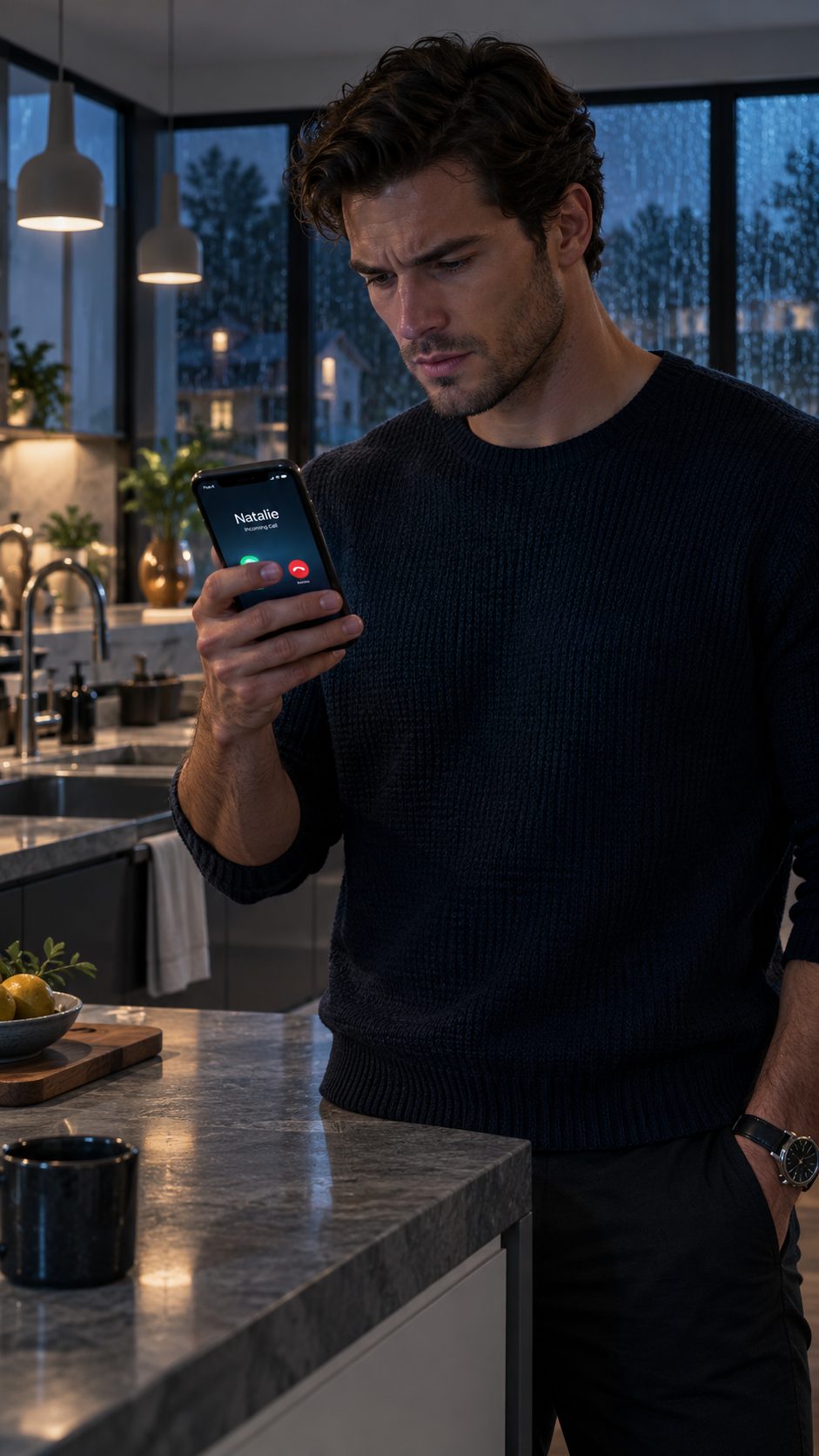
*One mysterious phone call exposed my wife’s betrayal, but the truth behind her affair threatened to take away far more than my marriage.*
**CHAPTER 1: THE SECRET INSIDE HER PURSE**
At p.m., my wife called me, struggling to breathe, and whispered three words that would destroy everything I believed about our marriage.
“How dare you?”
Behind her voice, I heard a man whispering.
Then someone else spoke.
Someone whose voice I knew better than almost anyone else’s.
But to understand why that voice made my blood run cold, you have to understand what happened the night before.
My name is Daniel Mercer.
I was thirty years old, married to a beautiful twenty-year-old woman named Natalie, and living in a modest house outside Charlotte, North Carolina.
Until that Wednesday evening, I thought our greatest problem was that we didn’t spend enough time together.
I was wrong.
It started when Natalie came home from work and dropped her purse beside the kitchen island.
The impact was hard enough to scatter its contents across the tile.
“Sorry, babe,” she called, already heading upstairs.
“Rough day?”
“You have absolutely no idea.”
She disappeared into our bedroom, humming softly as she changed clothes.
I bent down to gather her belongings.
Her lipstick had rolled beneath the refrigerator.
Her office badge lay beside a chair.
A CVS receipt had landed near my shoe.
And beside the receipt was a small white tube.
At first, I barely noticed it.
Then I read the label.
Men’s personal lubricant.
I stared at the words.
I checked them again.
A ridiculous thought crossed my mind.
Maybe it was a promotional sample.
Maybe somebody at work had handed it to her.
Maybe there was an explanation that didn’t involve another man.
But I knew it wasn’t mine.
And I knew Natalie had never mentioned buying anything like it.
Outside, rain tapped against our windows.
The neighbor’s dog barked at a passing car.
Upstairs, my wife continued humming.
Suddenly, I remembered things I’d been trying not to notice.
The late meetings.
The locked phone.
The way she sometimes stepped outside to answer calls.
The showers she took immediately after returning home.
The new perfume she said a coworker had recommended.
And the strange distance between us whenever I reached for her in bed.
I nearly dropped the tube.
“Have you seen my keys?”
I stared toward the ceiling.
“Can you check the kitchen?”
“Already looking.”
My voice sounded perfectly normal.
That frightened me more than anything.
I returned everything to her purse, placing the tube exactly where I’d found it.
When Natalie came downstairs, she was wearing the pale blue sweater I’d bought her for her birthday.
She smiled.
“You’re my hero.”
“For finding your keys?”
“For putting up with me.”
She kissed my cheek.
I wanted to ask her whose hands had touched her.
Instead, I handed her the keys.
Dinner was spaghetti and leftover garlic bread.
Natalie talked about traffic on I-77 and a difficult client at the event-planning company where she worked.
“This guy actually told my manager his time was more valuable than ours,” she complained.
“Sounds charming.”
“He’s unbearable.”
She laughed.
Then she reached across the table.
“Why are you so quiet?”
“You’ve been tired a lot lately.”
“So have you.”
Her smile weakened.
“What does that mean?”
I looked into her eyes.
For one moment, I almost told her what I’d found.
I wanted her to confess without being forced.
I wanted her to look frightened, apologize, and tell me I was wrong.
Instead, she squeezed my hand.
“Are we okay?”
The question hurt more than it should have.
Her fingers loosened around mine.
“I thought we were.”
“So did I.”
She watched me for several seconds before returning to her dinner.
We didn’t speak much afterward.
At bedtime, she curled onto her side and turned away from me.
I lay awake listening to the rain.
At a.m., her breathing finally became slow and steady.
I slipped out of bed.
Downstairs, her purse waited on the kitchen counter.
I opened it and removed the little tube.
Then I went to the drawer where we kept travel toiletries.
Inside was an unused, empty travel container from an old vacation kit.
It had almost the same dimensions, the same pale body, and a similar blue cap.
I found a blank label and carefully folded a small piece of paper beneath it.
On the paper, I wrote:
CALL ME BEFORE YOU LIE AGAIN.
I wasn’t trying to hurt anybody.
The replacement contained nothing dangerous.
It was only a harmless little container carrying a message I wasn’t brave enough to say aloud.
I slipped it into her purse and put everything back precisely where it belonged.
Then I stood alone in the kitchen, staring at the wedding photograph hanging above our breakfast nook.
Natalie looked radiant in that picture.
I looked like the luckiest man alive.
I wondered which one of us had been pretending.
The following morning, she kissed me beside the front door.
“I’ve got a big client dinner tonight.”
“Another one?”
“Unfortunately.”
“What time will you finish?”
She froze for half a second.
“Should I wait up?”
“No, sweetheart.
Get some sleep.”
Then she smiled and walked out.
I spent the entire day at Mercer Custom Woodworks, the carpentry business my father had left to my older brother Caleb and me.
I measured cabinets.
I answered emails.
I ruined a perfectly good piece of walnut because I couldn’t keep my hands steady.
Caleb wasn’t there.
His assistant said he had meetings across town.
I barely registered the information.
By evening, I was back home, sitting at the kitchen island.
At p.m., my phone rang.
I answered immediately.
All I heard was breathing.
A sharp knock sounded in the background.
Then a man whispered something I couldn’t understand.
Natalie spoke to him, her voice shaking.
“No, don’t touch that.”
My fingers tightened around the phone.
She inhaled sharply.
Then she almost screamed.
“How dare you?”
Before I could answer, a man spoke behind her.
“Give me the phone, Natalie.”
My heart stopped.
The voice continued.
“Daniel deserves to hear this from me.”
And suddenly I understood something far worse than the possibility of an affair.
The man standing beside my wife knew exactly who I was.
He knew where I lived.
He knew my family.
And when he said one final sentence, the entire world seemed to disappear beneath my feet.
“He’s my brother, Natalie.”
**CHAPTER 2: THE MAN ON THE OTHER END**
For several seconds, I couldn’t speak.
I recognized the voice.
I’d heard it at every birthday party, every Christmas dinner, and every important moment of my life.
Caleb Mercer.
My older brother.
The man who taught me to ride a bicycle.
The man who stood beside me when our father died.
The man who had served as my best man.
Then my brother exhaled.
“Daniel, listen to me.”
It wasn’t a real laugh.
It was the sound a person makes when something becomes too terrible to understand.
“Tell me I’m wrong.”
“Tell me you’re not standing beside my wife.”
Natalie began crying.
“Daniel, please.”
I closed my eyes.
“Where are you?”
Neither answered.
“Where are you, Natalie?”
“The Hawthorne Hotel,” she whispered.
I knew the place.
A boutique hotel near uptown Charlotte.
Caleb often took business clients there.
My brother spoke again.
“Nobody wanted you to find out like this.”
The sentence struck me harder than a confession.
Nobody wanted me to find out.
Not that it hadn’t happened.
Not that I misunderstood.
Only that I had discovered it.
“How long?”
Natalie whispered, “Daniel—”
“How long?”
Caleb answered.
“Three months.”
Then Natalie said something that made the silence unbearable.
“Almost four.”
I opened my eyes and stared at our wedding photograph.
Caleb stood behind us in that picture.
His hand rested on my shoulder.
He was smiling.
“Four months,” I repeated.
Natalie sobbed.
“I’m sorry.”
“Don’t say that yet.”
“Please let me explain.”
“Explain what?”
I could hear her breathing.
“Explain how you accidentally ended up in a hotel with my brother?”
“It wasn’t supposed to happen.”
“But it did.”
“And you kept doing it.”
I looked at the clock.
Four minutes earlier, I had still been a husband who suspected his wife was cheating.
Now I was a husband whose marriage had collapsed in front of him.
Caleb spoke carefully.
“Let’s talk tomorrow.”
I nearly dropped the phone.
“Tomorrow?”
“This isn’t going to get better over the phone.”
“You’re right.”
“It won’t get better at all.”
“Daniel, you’re angry.”
I surprised myself with how quietly I said it.
“Angry is what I feel when somebody scratches my truck.”
I swallowed.
“I don’t know what this is.”
Natalie whispered my name.
I ended the call.
For a long time, I stood motionless beside the kitchen island.
Then I walked outside.
The rain had stopped.
Across the street, someone had left a porch light burning.
The neighbor’s dog barked once.
Normal things continued happening.
Somehow, that felt offensive.
I called my mother.
She answered on the third ring.
Honey, is everything all right?”
I almost told her.
But she had already buried our father.
I couldn’t bear to make her lose two sons in one night.
“Wrong number,” I said.
She paused.
“You called your own mother by mistake?”
I closed my eyes.
“Something like that.”
“I’ll call tomorrow.”
I hung up before she could hear me break.
At 12:41 a.m., headlights swept across our living room wall.
Natalie had come home.
I heard the front door open.
Then the quiet click of her shoes against the floor.
I sat in the dark.
She switched on the lamp.
Her face looked pale.
Her makeup was smeared beneath her eyes.
She wore a fitted black dress I’d never seen before.
“Where did you get that?”
She looked down.
“The dress.”
“I bought it last month.”
Another detail I’d missed.
She set her purse down carefully.
“Can we talk?”
I pointed toward the couch.
I remained standing.
For a minute, neither of us spoke.
Then she said, “I never meant to hurt you.”
I shook my head.
“Did you ever mean to tell me?”
Her eyes filled again.
“I don’t know.”
That was the first honest thing she’d said.
“Did you love him?”
She stared at her hands.
“I thought I did.”
“I don’t know what anything means anymore.”
I looked away.
Four months of deception had apparently confused her more than it had confused me.
“When did it start?”
“At a company fundraiser in May.”
Caleb had been invited because Mercer Custom Woodworks supplied custom displays for some of Natalie’s events.
“I was upset,” she said.
“About what?”
I turned toward her.
“You were always working.”
“Because we had a mortgage.”
“You wanted to finish school without taking out another loan.”
“You wanted that trip to Savannah.”
“Daniel, please.”
She cried quietly.
“I felt like we were living beside each other instead of together.”
I sat across from her.
“Then you should have told me.”
“No, Natalie.
You hinted.”
She lowered her head.
“You told me you were bored.
You told me we needed more date nights.
You never said our marriage was in trouble.”
“I didn’t know how.”
“So you went to Caleb?”
Her silence answered.
I wanted to shout.
I wanted to throw something.
Instead, I asked the question that had been poisoning me.
“Did he know you were unhappy?”
“Did you tell him?”
“Did he comfort you?”
She nodded.
“Then he kissed you?”
Her shoulders trembled.
I looked toward the kitchen.
My father had taught Caleb and me to build things properly.
Measure twice.
Never hide a mistake beneath a layer of varnish.
Our father would have hated what we’d become.
Natalie moved toward me.
“Daniel, I still love you.”
I stood immediately.
“Don’t use that word tonight.”
“Please don’t make me leave.”
I looked at her for a long moment.
“I won’t make you do anything.”
My voice cracked.
“But I can’t sleep beside you.”
She covered her mouth.
“Where should I go?”
“Your sister’s.”
She nodded slowly.
Then she walked upstairs to pack a bag.
While she was gone, my phone vibrated.
An email had arrived from our business accounting portal.
SUBJECT: URGENT — AUTHORIZATION REQUIRED.
I opened it.
A lender called Piedmont Commercial Finance was requesting confirmation of a loan secured against the Mercer workshop.
The amount made my stomach tighten.
There was only one problem.
I had never borrowed that money.
And beneath the documents was a signature that looked exactly like mine.
**CHAPTER 3: THE SIGNATURE I NEVER WROTE**
I stared at the document until the numbers blurred.
Two hundred and forty thousand dollars.
The loan agreement named both Mercer brothers as guarantors.
It listed the workshop property as collateral.
And it included a signature beneath my printed name.
Daniel Thomas Mercer.
The handwriting was almost perfect.
But it wasn’t mine.
I knew that because my father had taught me something peculiar when I was twelve.
“Never make your signature too easy to copy,” he’d said.
I’d developed a habit of putting a tiny downward hook beneath the final letter of my surname.
It was barely noticeable.
The signature on the loan agreement didn’t have it.
Upstairs, Natalie was still packing.
I opened the attachments.
The original authorization was dated January 18.
Four months before Natalie’s affair supposedly began.
A cold realization settled over me.
My brother hadn’t just betrayed my marriage.
Something else had been happening long before that.
When Natalie came downstairs with her suitcase, I was sitting at the table.
She stopped.
“What happened?”
I turned the laptop toward her.
“Have you seen this?”
She leaned closer.
Her expression changed.
“Where did you get that?”
“It came from the bank.”
She read the heading.
Then she whispered, “Caleb said it was handled.”
“What was handled?”
Her face lost its remaining color.
“Daniel, I didn’t know it was a loan.”
“What did you think it was?”
“Business paperwork.”
“In July, Caleb asked me to send him a copy of your driver’s license.”
My stomach tightened.
“He said he needed updated identification for the company insurance.”
“And you believed him?”
“He’s your brother.”
I almost laughed again.
She began talking quickly.
“He said the original was blurry and the office needed another copy.
I knew where you kept it, so I sent him a scan.”
“Without asking me.”
“Anything else?”
Her eyes flickered away.
“He asked if I knew the password to your business email.”
I felt my pulse in my throat.
“Did you give it to him?”
I searched her face.
“Then what did you give him?”
“Your recovery email address.”
I looked at the screen.
The loan might have begun months before she helped him.
But now my wife had become one more doorway into my private life.
“Go,” I whispered.
She stepped closer.
She picked up her suitcase.
At the door, she turned around.
“Caleb told me the company was in trouble.”
I stared at her.
“He said you were hiding things from me.”
My hands went cold.
“He said you might lose the workshop, and that you didn’t want me to worry.”
I shook my head.
“He told me you were embarrassed about money.”
“That’s a lie.”
“I know that now.”
I looked at the photograph on the wall.
Caleb smiling behind us.
Watching us.
Knowing us.
“Did he use that to get close to you?”
Natalie began crying again.
“At first, I thought he was protecting you.”
Then she opened the door and left.
I didn’t sleep.
At seven the next morning, I drove to the workshop.
Mercer Custom Woodworks occupied an old brick building on the edge of town.
Our father had bought it when he was twenty-six.
He’d built cabinets there for almost forty years.
The smell of walnut dust and machine oil usually made me feel safe.
That morning, it made me sick.
Caleb’s truck was already parked outside.
I walked into his office without knocking.
He looked up from his computer.
I placed the printed loan documents on his desk.
He leaned back.
“Where did you get those?”
“Interesting first question.”
He glanced at the papers.
“It’s complicated.”
“Cash flow got tight.”
“Two hundred and forty thousand dollars tight?”
“We lost the Brookside contract.”
“That was eighteen months ago.”
“And I kept us afloat.”
I stared at him.
“You signed my name.”
Caleb stood.
“Lower your voice.”
“Because the employees don’t need to hear this.”
I stepped closer.
“Did you forge my signature?”
He looked toward the open office door.
“Daniel, listen.”
“Yes or no?”
A long silence followed.
Then he said, “I made a decision.”
It was the nearest thing to a confession I’d ever heard.
I backed away.
He moved around the desk.
“Everything I did was to save this place.”
“You could have told me.”
“You would have said no.”
Caleb rubbed his forehead.
“You’re not seeing the whole picture.”
I looked at him.
“Neither was I when you stood beside me at my wedding.”
His expression hardened.
“Don’t mix the business with Natalie.”
I felt something inside me snap.
“You mixed it when you started sleeping with my wife.”
He looked away.
I had spent the previous night wondering whether there was something I could have done differently.
Now I saw the man who’d helped create the disaster standing in front of me, telling me to separate his betrayals into convenient categories.
I picked up the loan documents.
“I’m getting an attorney.”
Caleb’s eyes widened.
“Don’t do that.”
“Because if the lender reviews everything, we could lose the building.”
I stopped at the doorway.
“How soon?”
He didn’t answer.
He lowered his voice.
“Thirty days.”
The workshop had survived recessions, rising interest rates, and the death of the man who built it.
Now it might be taken from us because of the son he’d trusted to protect it.
As I turned away, Caleb said something that made me stop.
“There’s another document you haven’t seen.”
**CHAPTER 4: THE WOMAN ACROSS THE STREET**
I turned back toward Caleb.
“What other document?”
He stared at the floor.
“The property transfer agreement.”
My mouth went dry.
“What property transfer?”
He hesitated.
“The workshop was going to be sold.”
“A development group.”
I stared at my brother.
The building our father had spent forty years paying for had apparently been offered to strangers without my knowledge.
“We were supposed to finalize it next month.”
I placed my hand against the doorframe.
For a moment, I thought I might collapse.
Caleb came closer.
“Daniel, the sale would cover the loan.”
“And leave us what?”
“Enough to start somewhere else.”
“We can rent.”
I looked around his office.
Our father’s old drafting table stood against the wall.
His measuring tools hung above it.
A photograph of him cutting the ribbon on the workshop’s opening day rested on Caleb’s shelf.
“That place is all we have left of Dad.”
Caleb’s face tightened.
“Dad also left us a business that was barely surviving.”
“He left us a responsibility.”
“And I’ve been carrying it.”
I stared at him.
“By yourself?”
“Most days.”
I wanted to deny it.
But there was a painful truth buried beneath his excuses.
I’d spent years designing and building furniture while Caleb handled invoices, suppliers, and bank meetings.
I’d trusted him to take care of everything I didn’t understand.
That trust had become his hiding place.
I left before I said something I couldn’t take back.
By noon, I’d called three attorneys.
The third, Virginia Cole, agreed to review the documents.
Her office was in a small brick building near downtown Charlotte.
She was in her fifties, with silver-framed glasses and a voice that made complicated things sound manageable.
“Did you sign this?” she asked.
“Did you authorize anyone to sign on your behalf?”
“Did you receive any money from the loan?”
“Not that I know of.”
She studied the paperwork.
“Then we need to preserve everything.”
She explained that a forged signature didn’t automatically mean the bank would immediately release us from the obligation.
There would be an investigation.
There would be questions.
And if money had already been advanced, the situation could become expensive and ugly.
“Don’t confront your brother again without documenting the conversation,” she advised.
“What about the workshop?”
“We’ll notify the lender and request that enforcement and further transactions be paused while the signature is investigated.”
“Will that work?”
“I can’t promise an outcome.”
I appreciated her honesty.
For the first time in two days, someone wasn’t lying to make me feel better.
When I returned home, a brown dog was barking outside the fence across the street.
Its owner was standing beside a flower bed, trying unsuccessfully to persuade it to stop.
I’d seen her before.
Her name was Iris Rowan.
She had moved into the neighborhood six months earlier.
She looked around thirty, with dark blond hair usually tied in a loose bun and the tired expression of someone who worked too much.
“Scout,” she called.
The dog ignored her.
I parked the truck.
Scout barked again.
Iris looked over.
“Sorry about him.”
“It’s fine.”
“He thinks every passing car is a threat to national security.”
Despite myself, I smiled.
She studied my face.
“Rough day?”
“You could say that.”
She nodded.
“Mine involved a contractor who put a window where the refrigerator was supposed to go.”
“That sounds expensive.”
“It was creative.”
I laughed softly.
The sound surprised both of us.
Iris worked as a residential architect.
She’d once mentioned wanting to restore the old porch on her house.
I’d offered to help when I had time.
Neither of us had followed up.
“You look like you could use coffee,” she said.
I glanced toward my empty house.
“Probably.”
“I make terrible coffee.”
“Then why offer?”
“Because I make excellent tea.”
I almost declined.
The last thing I wanted was company.
But something about her casual kindness made refusing feel harder than accepting.
“Tea sounds good.”
She opened her gate.
Scout rushed toward me, sniffed my shoes, and decided I was acceptable.
I followed Iris onto her porch.
We sat on two wooden chairs overlooking the street.
She didn’t ask why I looked exhausted.
She talked about the old houses she loved restoring.
About buildings that appeared beyond saving but weren’t.
About how people sometimes tore things down because repairing them seemed too difficult.
I listened.
Then I surprised myself by saying, “What if something isn’t worth repairing?”
Iris turned toward me.
“Are we still talking about houses?”
I stared into my tea.
She was quiet for a moment.
“Then I think the question is whether both people want to rebuild it.”
I looked up.
“And if only one does?”
“Then one person ends up carrying all the weight.”
The words struck something deep inside me.
She didn’t ask for details.
I didn’t offer them.
When I left, she walked me to the gate.
“You don’t have to explain anything, but you look like you haven’t eaten.”
I smiled faintly.
“Is that an architectural diagnosis?”
“Professional observation.”
Then she handed me a container of leftover chicken soup.
I carried it home.
For the first time since the phone call, I ate an entire meal.
That night, while reviewing bank statements at the kitchen table, I discovered something strange.
The money from the loan hadn’t all gone toward business expenses.
Large transfers had been made to a company called Cedar Ridge Holdings.
I searched the name.
Its registered address led to a private office suite in Charlotte.
And listed beneath the company’s ownership information was a name I recognized immediately.
Caleb Mercer.
My brother hadn’t merely borrowed money behind my back.
He’d been sending it somewhere of his own.
**CHAPTER 5: THE MONEY BEHIND THE LIES**
The next morning, I brought the transfer records to Virginia Cole.
She studied them without speaking.
Then she removed her glasses.
“Do you know what Cedar Ridge Holdings does?”
“Your brother is listed as its managing member.”
“I saw that.”
“Do you know why money borrowed against Mercer Custom Woodworks would be transferred there?”
I shook my head.
She turned the laptop toward me.
“Then that’s one of the first questions we need answered.”
We spent the next two hours reviewing financial statements.
The numbers told a story my brother had never shared.
For months, Mercer Custom Woodworks had been paying suppliers late.
Some employees had been receiving payroll from borrowed funds.
Several customer deposits had been used to cover older projects.
But the largest transfers were going to Cedar Ridge Holdings.
Virginia explained that the records suggested serious financial mismanagement, though we still needed to establish exactly how the borrowed money had been used.
I felt sick.
“Could Caleb go to prison?”
“That depends on the evidence and what investigators establish.”
I looked at the documents.
He was still my brother.
Even after everything, part of me wanted her to say there was a simple solution.
Instead, she asked, “Do you want to protect the business?”
“Then we need to separate protecting the business from protecting Caleb.”
I didn’t answer.
She leaned forward.
“Those are no longer necessarily the same thing.”
On my way home, Natalie called.
I’d ignored her previous messages.
This time, I answered.
“What do you need?”
“I need to tell you something.”
I pulled into an empty parking lot.
“Go ahead.”
“Caleb asked me to keep something for him.”
My pulse quickened.
“An envelope.”
“Last month.”
“What was inside?”
“I didn’t open it.”
I closed my eyes.
I should have asked.”
“Where is it?”
“At my sister’s apartment.”
“Bring it to Virginia Cole’s office.”
There was a pause.
“Who’s Virginia?”
“My attorney.”
Natalie was silent for several seconds.
“Are you divorcing me?”
I looked through the windshield.
A woman was crossing the parking lot with two little children holding her hands.
A week earlier, I would have imagined Natalie and me doing that someday.
Now the thought seemed to belong to another lifetime.
“I don’t know yet.”
She began crying.
“I really do love you.”
“Then help me understand what happened.”
“Everything, Natalie.”
“I promise.”
I wanted to believe her.
But promises had become very small things.
That afternoon, Natalie arrived at Virginia’s office carrying a sealed manila envelope.
She looked exhausted.
Her hair was tied back.
She wore jeans, a white blouse, and no makeup.
For a moment, she looked like the young woman I’d met two years earlier.
Then I remembered where she’d been at p.m.
She sat opposite Virginia and me.
“Caleb told me these were private investor documents,” she said.
Virginia opened the envelope.
Inside were copies of a purchase agreement, financial projections, and a proposed property sale.
The buyer was a development company planning a commercial project.
The documents described the workshop property as available for immediate transfer once certain obligations were satisfied.
My signature appeared again.
I felt my hands shake.
Virginia studied the final page.
“This is a draft agreement, not a completed sale.”
“But it’s serious,” she continued.
“How serious?”
“Serious enough that we need to notify the proposed buyer that you dispute authorization.”
Natalie looked at me.
“I didn’t know.”
I didn’t respond.
She leaned closer.
“Daniel, please believe me about that.”
Virginia asked her a question.
“When did your relationship with Caleb begin?”
Natalie stared at the table.
“And when did he first discuss business problems with you?”
“February.”
I looked up sharply.
Natalie continued.
“He said Daniel was under pressure and didn’t want anyone worrying.”
“Did he ask you to keep those conversations secret?”
She nodded.
Virginia wrote something down.
“Did he tell you why?”
“Because Daniel was proud.”
I stared at my wife.
She had spent months believing she was protecting me by keeping secrets with another man.
A man who had also been lying to her.
Virginia continued questioning her.
Slowly, a pattern emerged.
Caleb had started by presenting himself as a concerned older brother.
Then he’d become someone Natalie confided in.
Then he’d begun telling her things about me that weren’t true.
He said I resented her for not earning enough.
He said I regretted getting married so young.
He said I’d discussed leaving her after our first anniversary.
I felt physically ill.
“I never said those things.”
Natalie lowered her eyes.
“I know that now.”
“Why didn’t you ask me?”
She began crying.
“Because I was afraid you’d say they were true.”
I sat back.
The answer hurt because it was painfully human.
She’d trusted the wrong person with the fears she should have brought to me.
And Caleb had known exactly how to use them.
Virginia ended the meeting after Natalie handed over her messages with Caleb.
Outside, Natalie stopped beside my truck.
“Can I ask you something?”
“Do you hate me?”
I looked at her.
For months, I’d imagined our future together.
Growing old.
A porch swing we’d build ourselves.
Now I didn’t even know how to describe what I felt.
“I hate what you did.”
She nodded through tears.
“That’s fair.”
I opened my truck door.
Then she said, “Daniel, Caleb told me something about the loan.”
“He said it wasn’t the first time he’d used your signature.”
**CHAPTER 6: THE LIES WE INHERITED**
I turned toward Natalie.
“What do you mean, not the first time?”
She wiped her eyes.
“Caleb said you had signed paperwork for him before.”
“I don’t know.”
“What exactly did he say?”
She swallowed.
“He said you gave him permission to handle things because you didn’t want the stress.”
I stared at her.
“And you believed that?”
“At the time.”
My voice hardened.
“Stop saying that.”
She flinched.
“Stop hiding behind what you believed at the time.
Tell me what you saw.”
Natalie nodded quickly.
“He showed me a file with your name on it.”
“What kind of file?”
“Business documents.
Some were older.”
“Before we got married.”
I leaned against the truck.
A realization began forming.
Caleb’s deception might have started long before my marriage.
Long before Natalie.
Long before the hotel.
I drove straight to my mother’s house.
Grace Mercer lived in a small brick ranch about twenty minutes from the workshop.
She loved roses, old country music, and family dinners that lasted too long.
When she opened the door, she knew something was wrong.
“Daniel, what happened?”
I stepped inside.
“Mom, I need to ask you about Caleb.”
Her expression shifted.
“What about him?”
“Has he ever borrowed money against the business without telling me?”
She looked toward the kitchen.
“Come sit down.”
I felt my stomach sink.
We sat at the table where I’d done homework as a child.
She folded her hands.
“Your brother came to me after your father died.”
“He was frightened about keeping the workshop running.”
“What did he ask you for?”
“How much?”
“Forty thousand dollars.”
I stared at her.
She looked ashamed.
“I gave him what I had.”
“Why didn’t you tell me?”
“Because he asked me not to.”
I pushed my chair back.
“Everybody keeps saying that.”
“Caleb asks people to hide something, and everybody does it.”
My mother began crying.
“I thought I was helping.”
I looked away.
The sentence sounded painfully familiar.
Natalie had said almost the same thing.
I returned to the table.
“Did Dad know the business was in trouble?”
She shook her head.
“Not like this.”
“Did Caleb ever ask you to sign anything?”
She hesitated.
My heart started pounding.
She went to her bedroom and returned with a folder.
Inside was a copy of a financial authorization.
It carried my name.
My signature.
And a date eighteen months earlier.
I stared at it.
At that time, I’d been working in Asheville for three weeks, helping repair a historic church.
I hadn’t signed anything in Charlotte.
Not that month.
Not that year.
I took a photograph and called Virginia.
She asked me to bring the original documents to her office the next morning.
“Daniel,” she said before hanging up, “this changes the timeline substantially.”
That evening, I sat on my porch with a glass of water.
Iris was walking Scout.
She stopped at the fence.
“How’s the soup?”
“Better than your coffee, apparently.”
She smiled.
Scout pulled toward me.
I scratched his ears.
Iris looked at the porch steps.
“Your railing’s loose.”
“That would bother me professionally.”
“Everything bothers architects professionally.”
“Only the things that could fall down.”
I looked at the railing.
“Seems like that’s everything lately.”
Her expression softened.
“Want to talk?”
I hesitated.
Then, for the first time, I told someone outside my family what had happened.
Not every detail.
But enough.
I told her about Natalie.
About Caleb.
About the loan.
About the workshop.
She listened without interrupting.
When I finished, I stared at the street.
“You can say it.”
“Say what?”
“That I was an idiot.”
She shook her head.
“Trusting people you love isn’t stupidity.”
“Feels like it.”
“Being deceived isn’t the same as choosing to be blind.”
I looked at her.
“How do you know?”
She was quiet.
Then she said, “My marriage ended three years ago.”
I hadn’t known she was married before.
“He didn’t cheat,” she continued.
“We just became people who stopped listening to each other.”
“I’m sorry.”
She smiled sadly.
“At first, I kept asking what I could have done differently.”
“Eventually I learned that regret doesn’t always mean you made the wrong choice.”
We sat quietly.
The evening air smelled of cut grass and approaching rain.
“I miss who I thought Natalie was,” I admitted.
Iris looked toward the street.
“Maybe part of her was real.”
“How am I supposed to know which part?”
“I don’t think you can answer that tonight.”
For the first time, I didn’t feel pressured to make a decision.
I didn’t have to forgive.
I didn’t have to hate.
I didn’t have to know what tomorrow would look like.
I only had to survive the evening.
As Iris stood to leave, she looked toward my porch railing.
“Let me know when you want help fixing that.”
“I’m a carpenter.”
“And I’m an architect.”
“Sounds like an argument waiting to happen.”
She smiled.
“Probably.”
After she left, I sat outside for another hour.
Then my phone rang.
I considered ignoring it.
Instead, I answered.
“I know you’ve been talking to an attorney.”
“You need to stop.”
His breathing sounded uneven.
“Because there’s something about Dad’s last year you don’t know.”
I gripped the phone.
“What are you talking about?”
Caleb lowered his voice.
“Some of the decisions you think were mine started with him.”
**CHAPTER 7: THE TRUTH ABOUT OUR FATHER**
The next morning, I met Caleb at the workshop.
I brought Virginia with me.
My brother looked surprised when she entered his office.
“Really, Daniel?”
“Anything you want to tell me, you can tell my attorney.”
Caleb glanced between us.
Then he sat down.
Virginia placed a recorder on the desk and asked whether he agreed to the conversation being recorded.
After a long hesitation, he nodded.
“Tell us about your father,” she said.
Caleb rubbed his face.
“Dad knew the business was struggling.”
I stared at him.
“He never told me.”
“Because he didn’t want you worrying.”
“There’s that excuse again.”
Caleb ignored me.
“He took out a small business loan during his last year.”
Virginia asked, “Was it properly authorized?”
“Do you have the records?”
Caleb opened a drawer and removed a folder.
The original loan was for sixty thousand dollars.
Both our father’s signature and Caleb’s appeared on it.
Mine did not.
Virginia reviewed the agreement.
“How does this relate to the later documents?”
Caleb leaned back.
“After Dad died, I couldn’t keep up with payments.”
“Why didn’t you tell your brother?” she asked.
He looked directly at me.
“Because Daniel would’ve wanted to close the shop.”
I stared at him.
never be exactly as they had been.
For a long moment, I didn’t answer.
Then I looked at Iris.
“Sometimes.”
She smiled gently.
“That’s a good start.”
“I don’t wake up angry every morning anymore.”
“That’s even better.”
I leaned against the new porch railing.
“Some days I still feel like everything I knew was taken from me.”
“And other days?”
I thought about the workshop.
About my father’s photograph.
About Scout sleeping beneath the porch.
About the woman standing beside me who had never demanded anything I wasn’t ready to give.
“Other days, I think maybe I’m building something better.”
Iris looked away, but not before I noticed her smile.
Then she grew quiet.
“Daniel, there’s something I should tell you.”
My stomach tightened instinctively.
Old wounds had a way of turning ordinary sentences into warnings.
“What is it?”
“I’ve been offered a restoration project in Raleigh.”
I looked at her.
“That’s great.”
“It’s a big project.
Four months, possibly longer.”
“When would you leave?”
“Next month.”
I nodded slowly.
She studied my expression.
“I haven’t accepted yet.”
“Because I’ve built a life here.”
Something in her voice made me look up.
She continued.
“And because there are people here I’d miss.”
The evening breeze moved through the trees.
For a moment, I wanted to tell her not to go.
I wanted to ask her to stay.
But I’d learned what happened when love became an excuse for controlling someone else’s choices.
“You should take it if it’s what you want,” I said.
Her smile faded slightly.
“Is that what you want?”
I stepped closer.
She blinked.
“I want you here.”
Her breath caught.
“But I don’t want you wondering someday whether you gave up something important because of me.”
She looked into my eyes.
“I care about you, Iris.
More than I’ve admitted.”
Her expression softened.
“I care about you too.”
I reached for her hand.
For the first time, neither of us pretended the gesture meant nothing.
Her fingers closed around mine.
We stood there quietly, looking at the porch we’d repaired together.
Then she whispered, “What happens now?”
I looked toward the house.
For years, I’d believed the most important promises were the ones people made about forever.
Now I understood that sometimes the harder promise was simply to tell the truth.
“We figure it out,” I said.
“Together?”
I squeezed her hand.
“If that’s what you want.”
She smiled through tears.
I leaned closer.
She didn’t pull away.
Our first kiss was gentle, uncertain, and nothing like the dramatic moment I’d once imagined falling in love again would be.
But when she rested her forehead against mine, I felt something I hadn’t experienced in a long time.
Then her phone rang.
She glanced at the screen.
Her smile disappeared.
“Daniel,” she whispered, “I think you need to see this.”
**CHAPTER 10: THE NIGHT I FINALLY STOPPED WAITING**
Iris held her phone between us.
A message from a mutual acquaintance appeared on the screen.
It contained a photograph of the old Mercer workshop.
Beneath it was a local business headline.
MERCER CUSTOM WOODWORKS ANNOUNCES NEW COMMUNITY RESTORATION PROJECT.
I stared at the photograph.
“What is this?”
Iris looked almost embarrassed.
“I was going to tell you tomorrow.”
“Tell me what?”
She smiled nervously.
“I submitted your workshop for a historic restoration partnership.”
“You did what?”
“Not a contract.
Just an introduction.”
She showed me the rest of the message.
A local preservation organization was looking for skilled craftspeople to restore woodwork in several historic homes and public buildings around Charlotte.
They’d reviewed photographs of our past projects.
And they wanted to meet.
I looked at Iris.
“Why didn’t you say anything?”
“Because I didn’t want to get your hopes up before anyone responded.”
I studied the message again.
For months, the workshop had represented everything I was afraid of losing.
Now somebody was interested in what we could build.
I laughed softly.
Iris tilted her head.
“Is that good laughter?”
“The best kind.”
She exhaled.
“Thank goodness.”
I reached for her hand again.
“You know, most people just send flowers.”
“I’m an architect.”
“So I’ve heard.”
“We have terrible romantic instincts.”
“You’re doing fine.”
The meeting happened the following Thursday.
Three representatives from the preservation organization visited the workshop.
They examined our furniture samples, restoration photographs, and some of my father’s old designs.
One of them, an older gentleman named Thomas Bennett, stood for a long time in front of a walnut staircase railing my father had made.
“Your father built this?” he asked.
“Yes, sir.”
Thomas ran his fingers along the carved wood.
“My grandfather used to make things like this.”
“Dad said good woodwork should outlive the person who makes it.”
Thomas smiled.
“Sounds like a wise man.”
By the end of the meeting, we’d been invited to submit proposals for two restoration contracts.
They wouldn’t solve every financial problem.
But they represented stable, legitimate work.
A future we could understand.
A future nobody had to lie to protect.
That afternoon, I called my mother.
For the first time in months, my news made her cry happy tears.
“Your father would be so proud,” she whispered.
I looked around the workshop.
“I hope so.”
“He would.”
I believed her.
Over the next several weeks, Virginia finalized the settlement concerning the disputed financing.
The workshop retained its property under a revised agreement covering the company’s legitimate obligations.
It wasn’t free of debt.
But the unauthorized guarantee was no longer hanging over my head.
Caleb continued cooperating with the investigation into the transactions.
He’d accepted responsibility for the forged documents and transferred funds.
His attorney was negotiating restitution while the legal proceedings continued.
One morning, he sent me a letter.
It wasn’t long.
He didn’t ask me to forgive him.
He didn’t blame Natalie.
He didn’t blame our father.
He wrote about the first cabinet we’d built together when I was fourteen.
I remembered it clearly.
I’d measured one panel incorrectly.
Caleb had laughed, then helped me cut another.
In his letter, he wrote:
I spent years thinking being your older brother meant I could make decisions for both of us.
I convinced myself that keeping you from worrying was the same as protecting you.
Then I started hiding mistakes because I couldn’t bear for you to see me fail.
I destroyed the trust you gave me.
And I know apologizing doesn’t put it back.
I hope one day I can become someone you aren’t ashamed to call your brother.
I read the letter three times.
Then I placed it inside my father’s old desk.
I wasn’t ready to answer.
Maybe someday I would be.
Maybe forgiveness would come in pieces.
Maybe we’d never be close again.
But for the first time, I understood that I could wish Caleb well without pretending his actions hadn’t hurt me.
Natalie and I finalized our divorce that summer.
We met once afterward to exchange the last few things we’d left at each other’s homes.
She brought a small box containing my father’s pocketknife, a photograph album, and the watch I’d worn on our honeymoon.
I brought her grandmother’s bracelet and some books she’d forgotten.
We stood beside our cars in a quiet parking lot.
She looked different.
Not older, exactly.
Just more certain of herself.
“How’s the workshop?” she asked.
“Getting better.”
“I’m glad.”
“How’s work?”
I got promoted.”
“Congratulations.”
“Thank you.”
For a moment, we were simply two people talking.
Then she looked at me.
“Daniel, I wanted to thank you.”
“For what?”
“For never trying to make me suffer the way I made you suffer.”
I thought about the little container I’d placed in her purse.
About the words I’d hidden beneath its label.
CALL ME BEFORE YOU LIE AGAIN.
That night, I’d wanted her to experience the same fear and humiliation I’d felt.
I’d wanted to expose the truth without admitting how badly it had hurt me.
But revenge hadn’t made anything better.
The truth had.
And the choices we’d made afterward had determined what remained.
“I wasn’t always kind,” I admitted.
“You didn’t have to be.”
I looked at her.
“I hope you’re happy someday, Natalie.”
Her eyes filled.
“I hope you are too.”
We said goodbye without hugging.
There was sadness.
There always would be.
But there was no unfinished promise between us.
As I drove away, I realized I wasn’t imagining the life we could have had anymore.
I was thinking about the life still waiting for me.
Iris accepted the Raleigh restoration project.
She spent several days each week there and returned to Charlotte when her schedule allowed.
We talked in the evenings.
Sometimes about important things.
Sometimes about absolutely nothing.
We learned how to disagree without punishing each other.
We learned how to say when something bothered us.
And we learned that trust wasn’t something proven through grand romantic declarations.
It was built in small, ordinary moments.
A returned phone call.
An honest explanation.
A promise kept.
A difficult conversation that neither person avoided.
When her project ended, Iris decided to expand her architecture practice in Charlotte.
She rented a small office near the workshop.
We didn’t rush into living together.
We didn’t talk about marriage.
We simply kept choosing to spend time with each other.
One Friday evening, nearly a year after the call that destroyed my marriage, Iris came over carrying a paper bag.
“Emergency,” she announced.
I looked up from the porch swing I was finishing.
“What happened?”
“Scout ate the corner of my presentation drawings.”
“He’s committed to destroying my career.”
She placed the bag on the table.
“Also, I brought dinner.”
“Obviously.”
“Without pineapple?”
She smiled innocently.
I opened the box.
Everywhere.
I stared at her.
“This relationship may not survive.”
She laughed so hard she had to sit down.
I looked at her sitting on the porch we’d repaired together.
Her hair fell loosely around her shoulders.
Her eyes were bright.
Scout rested at her feet.
Nothing about the moment was extraordinary.
And somehow, it felt like everything.
I sat beside her.
“Do you ever think about how strange all of this is?”
She looked at me.
“What part?”
“That a year ago, I thought my life was over.”
She reached for my hand.
I looked toward the street.
My truck sat in the driveway.
The porch railing was straight.
The workshop had contracts scheduled through winter.
My mother was planning a family dinner.
Caleb was slowly facing the consequences of his choices.
Natalie had begun a life without me.
And I was sitting beside a woman who knew exactly how broken my trust had once been, yet had never asked me to pretend it was easy to give again.
“Now I think my life was changing,” I said.
Iris leaned against my shoulder.
“That’s a better way to look at it.”
We sat together as the evening settled over Charlotte.
At p.m., my phone lit up on the table.
For a fraction of a second, my stomach tightened.
Old memories moved through me.
Natalie’s name on the screen.
Her frightened breathing.
The whisper.
My brother’s voice.
Everything I’d lost.
Then I looked at the phone.
It was a photograph from my mother.
She’d found an old picture of Dad standing outside the workshop with Caleb and me.
We were children.
Our father had his arms around both of us.
All three of us were smiling.
Beneath the photograph, Mom had written:
Your father always said the strongest things were built with patience.
I stared at the message.
Iris noticed my expression.
“Everything okay?”
I turned toward her.
I meant it.
For once, I really meant it.
She squeezed my hand.
Then she rested her head against my shoulder again.
I thought about the man I’d been the night I discovered that tube in Natalie’s purse.
He’d believed that knowing the truth would destroy him.
And for a while, it nearly had.
But the truth hadn’t ended his story.
It had ended the part of his life that could no longer continue.
I no longer needed revenge.
I no longer needed Natalie to explain every lie.
I no longer needed Caleb to become the brother I’d believed he was.
I needed to live honestly.
To protect what mattered.
To forgive myself for trusting the wrong people.
And to recognize that love could return without asking me to forget what I’d survived.
I turned toward Iris.
“Can I tell you something?”
She smiled.
I took her hand.
“I love you.”
She grew still.
Not frightened.
Not uncertain.
Just deeply moved.
For a moment, neither of us spoke.
Then she whispered, “I love you too, Daniel.”
I kissed her gently.
There was no dramatic music.
No shocking phone call.
No secret waiting behind a closed door.
Only the soft evening breeze, Scout sleeping beneath our feet, and the porch swing creaking beneath us.
The following morning, I returned to the workshop.
I unlocked the door and switched on the lights.
Sunlight spilled across the wooden floors.
I walked to my father’s old drafting table.
Beside it stood an unfinished walnut cabinet.
I picked up a pencil.
Measured the wood.
Checked the measurement again.
Then I made the first cut.
Outside, the city was waking up.
Somewhere, people were beginning new jobs, ending relationships, making mistakes, and choosing what to do after the truth changed their lives.
I couldn’t control what other people chose.
I couldn’t undo what had happened.
But I could decide what I built next.
My father used to say that good craftsmanship wasn’t about hiding imperfections.
It was about understanding the material well enough to make something strong despite them.
For years, I’d thought he was only talking about wood.
Now I understood.
That night at had taken away the future I thought I wanted.
But it had also forced me to discover the man I could become without it.
And when I finally looked at my life without anger, without fear, and without the desperate need to make everything look perfect, I realized something.
I hadn’t lost everything.
I’d lost the lies.
And what remained was finally mine.
**THE END**
✓ Lynn R. Adams
*One mysterious phone call exposed my wife’s betrayal, but the truth behind her affair threatened to take away far more than my marriage.* **CHAPTER 1: THE SECRET INSIDE HER PURSE** At p.m., my wife…