D-SHE ASKED FOR OTHER MEN, SO I GAVE HER THE FREEDOM THAT ENDED OUR MARRIAGE
She thought my patience meant I would never leave, but some doors only close once.
The night my wife told me she wanted to date other men, she smiled because she was certain I would still be waiting when she came back.
She was wrong.
My name is Ethan Caldwell, and until that Friday night, I believed my three-year marriage to Lauren was strained, not finished.
We lived in a renovated colonial house on Mercer Street in Princeton, New Jersey, close enough to downtown that we could walk to coffee shops and restaurants on weekends.
From the outside, our life looked settled.
I worked as a financial systems consultant for a pharmaceutical company near New Brunswick, while Lauren managed events for an upscale hotel group operating properties in Princeton, Philadelphia, and Manhattan.
We had no children.
No crushing debt.
No family tragedy hanging over us.
What we had was distance.
For months, Lauren had described our marriage as predictable.
“Our dinners feel exactly the same,” she told me one evening.
“We went somewhere new last Saturday.”
“That’s not what I mean.”
“Then tell me what you mean.”
She rolled her eyes.
“You always want to fix things, Ethan.”
“I thought fixing problems was better than pretending they don’t exist.”
“That is exactly the problem.”
“You turn everything into something that needs a solution.”
I leaned against the kitchen counter.
She stared at me.
“Okay what?”
“I won’t solve it.”
“That sounded sarcastic.”
“It wasn’t.”
“Then what are you doing?”
“Listening.”
She exhaled as though even that irritated her.
“I just want to feel something again.”
I should have understood what she meant.
Instead, I thought she was asking me to save our marriage.
Soon, Lauren began spending more time with a new group of coworkers.
They stayed for drinks after events.
They took weekend trips to Atlantic City.
They posted photos from rooftop bars in Manhattan at two in the morning.
Lauren started coming home with opinions that sounded rehearsed.
“I need to rediscover myself.”
“You’re married, Lauren, not imprisoned.”
“I married too young.”
“You were twenty-seven.”
“That’s still young.”
“You didn’t think so when we got married.”
“People change.”
Another night, she said, “Security isn’t the same as happiness.”
That was when I finally asked the question I had been avoiding.
“Is there someone else?”
She laughed.
Not nervously.
Dismissively.
“You’re insecure.”
“That wasn’t my question.”
“You’re imagining things.”
“I’m asking whether there is another man.”
“And I’m telling you this is exactly why I feel trapped.”
I let the conversation die.
Three days later, I learned I had not imagined anything.
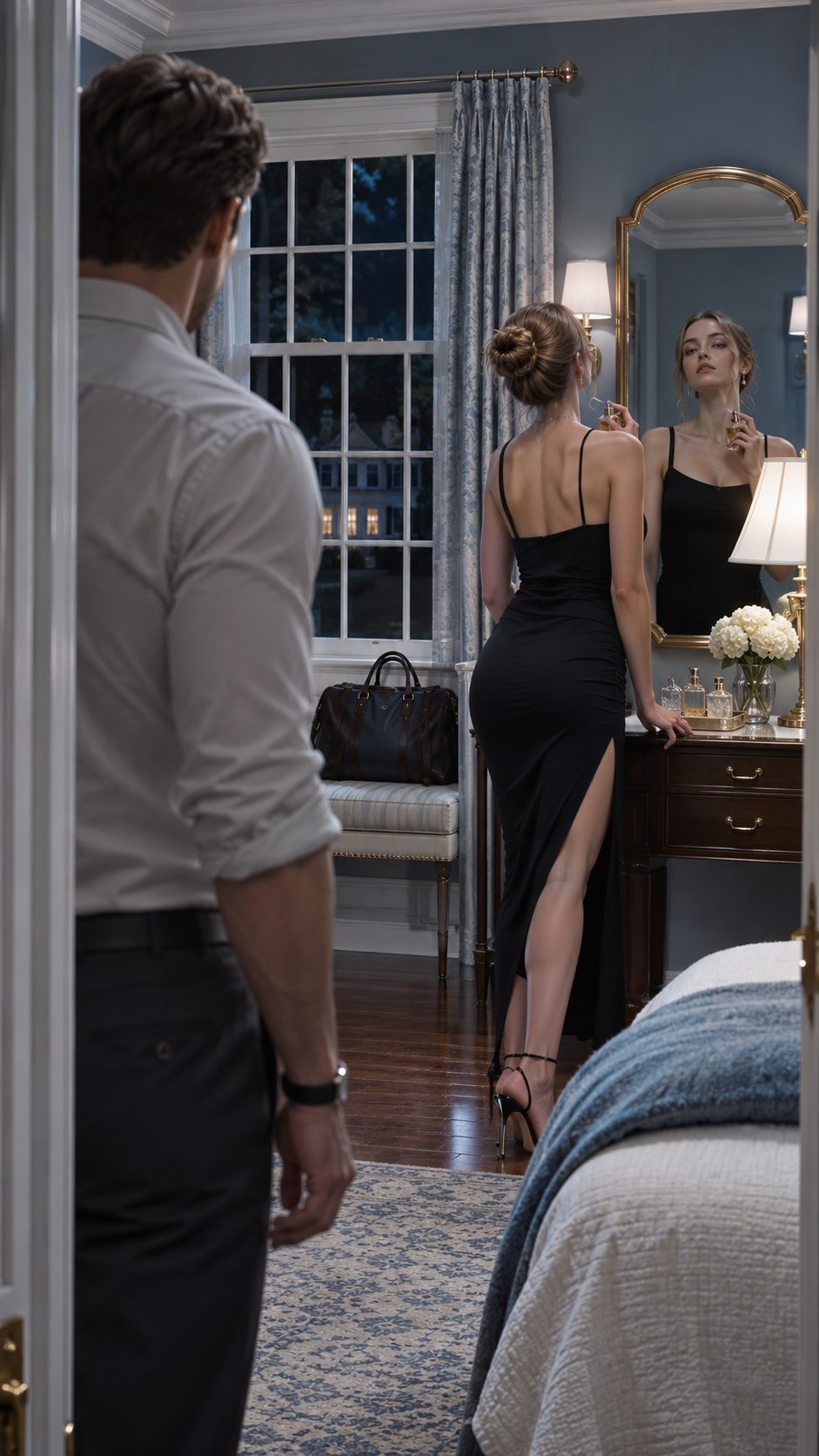
I came home from work on Friday and found Lauren standing in our bedroom wearing a fitted black dress I had never seen before.
A small overnight bag sat on the bench beneath the window.
She was applying perfume when I entered.
“Where are you going?”
She looked at me through the mirror.
“On a date.”
I waited for her to smile.
She didn’t.
“A date with whom?”
“That isn’t the point.”
“It seems like the entire point.”
Lauren turned around and folded her arms.
“I want to try other men, Ethan, and I’m going on a date tonight.”
For several seconds, I simply stared at her.
Then I asked, “Are you ending our marriage?”
“Then explain how dating another man fits into being married to me.”
“I need freedom.”
“While keeping your husband at home?”
“Why do you always make everything sound ugly?”
“Because you’re asking me to pretend adultery is personal growth.”
Her jaw tightened.
“I don’t want labels controlling my life.”
“Marriage is a label now?”
“You know what I mean.”
“No, Lauren.”
I looked at the overnight bag.
“I really don’t.”
She picked it up.
I stepped away from the doorway.
“Go ahead.”
She blinked.
“Go on your date.”
Relief appeared on her face.
Then I finished.
“But the woman who returns won’t be my wife.”
Lauren actually laughed.
“You’re being dramatic.”
“I’m being clear.”
“You’ll calm down.”
“You always forgive me.”
That sentence stayed with me.
Not the confession.
Not the dress.
Not even the overnight bag.
You always forgive me.
She had mistaken patience for weakness.
Lauren walked downstairs.
At the front door, she looked back.
“I’ll call you tomorrow.”
“You won’t need to.”
She smiled almost playfully.
“You’ll be embarrassed about this when I come home.”
“I don’t think I will.”
“Goodnight, Ethan.”
I did not answer.
The door closed.
A few seconds later, headlights swept across the front windows.
I walked into the living room and looked through the curtains.
A silver Mercedes waited at the curb.
Lauren crossed the sidewalk.
The driver stepped out.
Blake Turner.
I recognized him from company events.
Regional partnerships.
Expensive suits.
Perfect teeth.
A man Lauren had once described as “ridiculously confident.”
He opened the passenger door for my wife.
She touched his arm as she climbed inside.
Blake glanced toward our house.
For one brief second, I wondered whether he knew I was watching.
Then the Mercedes disappeared down Mercer Street.
The silence afterward was almost physical.
I went upstairs.
Her perfume still hung in the bedroom air.
I looked at our wedding photograph on the dresser.
Lauren was laughing in it.
I remembered exactly what she had whispered after we cut the cake.
“Whatever happens, promise we don’t become one of those couples who gives up.”
I picked up the photograph.
Then I looked at the empty space where her overnight bag had been.
My phone buzzed.
A message from Lauren.
Don’t stay angry all night.
We’ll talk tomorrow. ❤️
I stared at the heart.
Then I placed my phone face down.
I removed my wedding ring for the first time in three years.
The pale band of skin beneath it looked almost unnatural.
I set the ring beside our photograph.
And somewhere between midnight and one in the morning, I finally understood something Lauren had not.
She had walked out believing she was testing the boundaries of our marriage.
She had no idea she had already crossed the last one.
Lauren did call the next morning.
I watched her name appear on my phone at .
I let it ring.
At , she called again.
At , a message arrived.
Then another.
We need to talk like adults.
I almost laughed.
Instead, I made coffee.
For the first time in years, I sat at the kitchen table without checking whether Lauren wanted cream, whether she had an early meeting, or whether we needed groceries.
The house felt different.
At 10:02, another message appeared.
I’m staying out today.
I think space will be good for both of us.
That one made the decision easy.
I opened my laptop.
The first thing I did was review our joint finances.
Not because I wanted revenge.
Because suddenly I had no idea what Lauren considered acceptable.
The mortgage account was intact.
Utilities were normal.
Our emergency savings had not moved.
But on the joint credit card, several recent charges stood out.
A cocktail lounge in Manhattan.
A boutique hotel in Philadelphia.
A restaurant in Atlantic City.
All nights Lauren had told me she was working late.
I stared at the transactions until the numbers blurred.
One charge went back almost three months.
I heard Lauren’s voice in my head.
You’re insecure.
My hands became very still.
At eleven, I called an attorney.
Her name was Nora Whitman, a family-law specialist recommended years earlier by a coworker who had gone through a divorce.
I almost hung up before the receptionist answered.
Instead, I said, “I need a consultation.”
Nora met me that afternoon.
She was in her early forties, direct without being cold.
After I explained what had happened, she rested her pen on the legal pad.
“Do you want a divorce?”
“I want to know what happens if she comes home Monday and acts like none of this happened.”
“That wasn’t my question.”
I looked at her.
She waited.
Finally, I said, “Yes.”
The word hurt more than I expected.
Nora nodded.
“Then we proceed carefully.”
“I don’t want a war.”
“I don’t want to destroy her.”
“Also good.”
“I just don’t want to wake up six months from now and realize I let her turn me into someone I don’t recognize.”
Nora leaned back.
“Then don’t make decisions based on humiliation.”
“What should I base them on?”
She explained what I should document.
Joint accounts.
Major expenses.
Mortgage records.
She told me not to empty accounts, destroy belongings, threaten Blake, or post anything online.
“Can I change the locks?”
“Can I pack her things?”
“You can organize belongings, but don’t dispose of anything.”
At the door, Nora stopped me.
“People often think filing first means winning.”
She picked up the folder I had signed.
“It means accepting that something has ended before the other person is ready to admit it.”
I drove home with that sentence repeating in my head.
Around five, someone knocked on my office door during a video call.
It was Maya Chen from our analytics team.
She held up two paper cups.
“You look like a man surviving exclusively on bad coffee.”
“I’m fine.”
“That answer sounded convincing.”
I almost smiled.
Maya and I had worked together for four years.
She was smart, observant, and careful about other people’s boundaries.
She placed one coffee on my desk.
“No questions.”
“If you need me to cover Monday’s systems review, I can.”
“You don’t have to.”
She started to leave.
She turned.
“Thank you.”
She gave me a small nod.
“Whatever it is, don’t answer emails angry.”
Then she left.
That night, Lauren finally called from an unknown number.
I answered.
“Why are you ignoring me?” she demanded.
“I’m not ignoring you.”
“You haven’t answered all day.”
“I didn’t have anything to say.”
Then her tone softened.
“Ethan, last night got emotional.”
“For one of us.”
“I know you’re hurt.”
“Where are you?”
“That’s not relevant.”
“Then why did you call?”
“To tell you I’m okay.”
“I didn’t ask.”
She inhaled sharply.
“Why are you acting like this?”
“Like what?”
“You left our house to spend the night with another man.”
“I told you I needed freedom.”
“And I told you what would happen if you walked out.”
“You weren’t serious.”
“You’re angry.”
That silenced her.
I continued.
“I was angry last night.”
“Then what are you now?”
“Done negotiating with myself.”
“You wanted space.”
I looked around the quiet kitchen.
“You have it.”
Her voice dropped.
“Are you saying you want a divorce?”
I could hear traffic behind her.
A car door.
A man’s voice in the distance.
I closed my eyes.
Then I said the word again.
Lauren went completely silent.
When she finally spoke, her voice sounded different.
“You don’t mean that.”
“You can’t decide that in twenty-four hours.”
“You decided something much bigger in one sentence.”
“Ethan, please.”
“I have to go.”
“Don’t hang up.”
“Goodnight, Lauren.”
I ended the call.
My hand was shaking.
I hated that it was shaking.
Then another message arrived.
Not from Lauren.
From an address I did not recognize.
Caldwell, my name is Celeste Turner.
I stared at the screen.
The next line made my stomach drop.
I think our spouses have been lying to both of us.
I did not answer Celeste Turner immediately.
I read her message three times.
Then a fourth.
Finally, I typed:
What do you mean?
Her reply arrived less than a minute later.
Blake says we have been separated for two months.
That is not true.
I sat down.
Another message appeared.
He left our house twelve days ago.
Lauren had told me Blake had been separated from his wife for almost two months.
I remembered exactly where we had been standing when she said it.
Our bedroom.
Her overnight bag in her hand.
Her black dress.
Her expression calm.
He understands what it means to feel trapped.
I called Celeste.
She answered on the second ring.
“I’m sorry.”
Her voice was controlled, but exhausted.
“For what?”
“For contacting you.”
“You didn’t do this.”
She gave a humorless laugh.
“Apparently we married people who are very good at making other people feel responsible for their decisions.”
I walked to the window.
“What do you know?”
“How long?”
“I can’t prove anything physical.”
“I’m not asking for proof.”
“I started noticing her name in February.”
It was October.
My throat tightened.
“February?”
“Messages.”
“Work messages?”
“At first.”
“And later?”
“Not work.”
I said nothing.
Celeste continued.
“I confronted Blake in August.”
“What did he say?”
“That Lauren was a colleague who was having marriage problems.”
I closed my eyes.
“Then two weeks ago he told me he needed space.”
“Lauren started telling me she needed freedom around the same time.”
“I figured.”
“How did you get my number?”
“I found you through Lauren’s emergency contact listing from a company charity event Blake organized.”
“Why contact me now?”
“Because Blake told me last night that Lauren’s marriage was basically over.”
My grip tightened around the phone.
“It wasn’t.”
“I assumed.”
There was silence.
Then Celeste said quietly, “He also told me you knew about them.”
I looked at the dark window.
“I knew as of Friday night.”
“He said you and Lauren had an open arrangement.”
I laughed once.
It sounded ugly.
“I didn’t think so.”
“What are you going to do?”
“I filed this morning.”
“For divorce?”
She hesitated.
“Blake doesn’t know yet.”
I almost said something cruel.
Something about wishing I could see his face.
Instead, I asked, “Are you okay?”
That answer was honest enough to hurt.
“But I will be.”
We spoke for nearly an hour.
Not about revenge.
About timelines.
Dinner reservations.
Conferences.
Hotel events.
The dates lined up too neatly.
The Philadelphia conference Lauren had called “exhausting.”
The Manhattan gala after which she had come home at four in the morning.
The Atlantic City weekend she claimed had been a team retreat.
When we ended the call, Celeste said, “Ethan?”
“Don’t let them make you feel foolish for believing them.”
I stared at my wedding photograph across the room.
“I’m trying.”
After the call, I sat in silence until my phone buzzed.
Can I come home tomorrow?
I did not answer.
A minute later:
I think we need to talk in person.
I miss home.
The distinction mattered.
I packed her clothes that evening.
Not angrily.
That surprised me.
I folded sweaters.
Placed shoes in boxes.
Wrapped her jewelry organizer in a towel so nothing would break.
I found a ticket stub from our first trip to Boston tucked inside one of her handbags.
For a moment, I sat on the bedroom floor holding it.
Lauren had kissed me in the rain outside a tiny Italian restaurant that weekend.
She had laughed when my umbrella broke.
“I like you like this,” she had told me.
“Unplanned.”
I had believed that memory belonged to us permanently.
Now it felt like something from a house I used to live in.
My phone rang.
I hesitated before answering.
“You missed the systems check.”
I looked at the clock.
“I handled it.”
“I’m sorry.”
“Stop apologizing.”
“I should have told you.”
She waited.
“Are you safe?”
The question caught me off guard.
“My marriage is ending.”
Then Maya said, “I’m sorry.”
“Don’t be.”
“You’re allowed to be hurt without pretending you’re above being hurt.”
I sat against the side of the bed.
“My wife is with someone else.”
Maya did not offer advice.
She did not call Lauren names.
She simply said, “That sounds brutal.”
“Do you want company?”
I almost said yes.
Instead, I said, “Not tonight.”
No disappointment.
No pressure.
“Tomorrow?”
“Then maybe.”
After we hung up, I looked at the pile of boxes.
By midnight, Lauren’s side of the closet was empty.
The next morning, Nora called.
“I filed the petition.”
I looked at the wedding ring still sitting beside our photograph.
“How long before she receives it?”
“That depends on service.”
“Can I tell her myself?”
“You can tell her you filed.”
I nodded even though she could not see me.
When the call ended, I picked up my ring.
Then I took a small box from the dresser.
A watch Lauren had given me on our first anniversary had come in it.
I placed my wedding band inside.
For several minutes, I stared at the open box.
Then I took a blank card.
I wrote one sentence.
I read it twice.
Just a sentence.
I slipped the card beneath a ribbon around the box.
Then I carried Lauren’s belongings downstairs.
She had said she would come back when I calmed down.
Instead, I arranged everything neatly beside the front door.
One week after she had left laughing, I was ready for her to return.
But this time, Lauren would not be walking back into the marriage she thought she still controlled.
Lauren returned exactly seven days after she left.
I knew because the doorbell camera sent an alert to my phone.
I was sitting in Nora’s office reviewing preliminary paperwork when the image appeared.
Lauren stood at the front steps.
She wore sunglasses despite the cloudy afternoon.
A small suitcase rolled behind her.
For a second, she simply stared at the boxes.
Then she removed her sunglasses.
Her expression changed.
She stepped closer.
The framed photograph from her office.
Her winter coats in garment bags.
Everything I could reasonably pack without damaging it.
Then she noticed the small gift box sitting on top of the largest suitcase.
I watched through the camera.
Lauren picked it up.
Her mouth curved into a smile.
I knew exactly what she thought.
An apology.
Maybe jewelry.
Maybe the proof she had been expecting all week that I would retreat from the boundary I had set.
She untied the ribbon.
Opened the box.
Saw my wedding ring.
The smile disappeared.
Then she pulled out the card.
Nora looked at me from across the desk.
“You don’t have to watch this.”
On my phone, Lauren unfolded the card.
She read the sentence.
You said you didn’t want labels controlling your life, so I removed the one that said my wife.
Lauren stood completely still.
Then she read it again.
She reached for her phone.
Mine rang immediately.
I answered.
“What the hell is this?”
“Hello, Lauren.”
“What did you do?”
“I packed your things.”
“I can see that.”
“Then why did you ask?”
“You put my belongings outside?”
“They’re protected under the porch.”
“That is not the point.”
“You don’t get to decide I don’t live there.”
“You decided that when you left with an overnight bag.”
“I went away for a week.”
“With Blake.”
That was the first time I had said his name to her.
Lauren’s voice changed.
“Who told you?”
“Does it matter?”
“Celeste contacted you, didn’t she?”
Nora’s eyes lifted at the name.
I looked away.
“So you know she exists.”
“Of course I know she exists.”
“You said they’d been separated for two months.”
“They were.”
I let the word sit.
“They weren’t.”
Lauren said nothing.
I continued.
“He left their house twelve days ago.”
Her breathing sharpened.
“That is between them.”
“It became relevant when you used their marriage to justify what you were doing to ours.”
“You’re twisting this.”
“I’m really not.”
“Let me inside.”
“You can’t keep me out of my own house.”
“I’m not discussing property law on the phone.”
Her voice rose.
“Property law?”
“What happened to you?”
I laughed softly.
“You left.”
“Stop saying it like I abandoned you.”
“You went on a date with another man while married to me.”
“I told you first.”
“That doesn’t make it faithful.”
“I was trying to be honest.”
I stood and walked toward Nora’s office window.
“You were trying to get permission without having to ask for it.”
“That’s not fair.”
“You wanted to keep the house, the husband, the stability, and also have Blake.”
“I never said that.”
“You said you didn’t want to end the marriage.”
“I didn’t.”
Lauren’s voice suddenly softened.
I heard the shift immediately.
The anger disappeared.
This was the voice she used when she wanted to reset an argument.
“Can you please come home?”
“I’m busy.”
“I’m standing outside our house.”
“The doorbell camera.”
Another silence.
I looked at Nora.
She gave no reaction.
“I’m not doing this on the porch.”
“Then let me inside.”
“I filed for divorce.”
Not even breathing.
Finally Lauren whispered, “What?”
“You’re lying.”
“You filed for divorce after one week?”
“I decided after one night.”
Her voice cracked.
For the first time since Friday, she sounded frightened.
“You cannot be serious.”
“We have been married for three years.”
“You loved me.”
I shut my eyes.
“Don’t make me answer that today.”
Lauren began crying.
Quietly at first.
Then angrily.
“You’re punishing me.”
“This is punishment.”
“No, Lauren.”
I looked down at my empty ring finger.
“This is consequence.”
She hung up.
Ten minutes later, another doorbell alert appeared.
Lauren was sitting on one of the boxes.
Her face was in her hands.
I almost left Nora’s office.
Almost drove home.
Almost opened the door.
The old reflex was powerful.
Comfort her.
Make the pain stop.
Then I remembered the sentence.
You always forgive me.
Nora closed the file.
“Are you going home?”
I stared at my phone.
“Because if I do, I’ll start taking responsibility for how she feels.”
Nora nodded.
“That sounds like clarity.”
An hour later, Lauren was gone.
So were the boxes.
That evening, she sent me a single message.
Blake wasn’t worth this.
I read it twice.
Then I typed:
This was never about whether Blake was worth it.
She responded almost immediately.
Then what is it about?
My answer came easily.
Whether I was.
The typing bubble appeared.
Disappeared.
Then vanished for good.
I placed the phone on the table.
Outside, rain began tapping against the windows.
And for the first time since Lauren left, the silence in the house did not feel empty.
It felt like mine.
Blake Turner disappeared from Lauren’s fantasy faster than she expected.
I learned that from Celeste.
Two weeks after Lauren returned to Mercer Street, Celeste called while I was leaving work.
“You might want to sit down.”
“That sentence never leads anywhere good.”
“This might.”
I stopped beside my car.
“What happened?”
“Blake ended things with Lauren.”
I stared across the parking lot.
“How do you know?”
“He called me.”
“To ask if I would reconsider the divorce.”
I almost laughed.
“You’re kidding.”
“What did you say?”
“That I preferred my life without his explanations.”
Despite everything, I smiled.
Celeste continued.
“Apparently Lauren expected them to become an actual couple.”
“And he didn’t?”
“Blake enjoys exits more than destinations.”
That sentence stayed with me.
“What happened between them?”
“She asked him to find a place together.”
“He told her everything was moving too quickly.”
I leaned against my car.
“He helped destroy two marriages and now things are moving too quickly?”
“That was roughly my response.”
For the first time in weeks, the absurdity broke through the pain.
Celeste laughed too.
Not happily.
But genuinely.
Then her voice became serious.
“Ethan, there’s something else.”
“Blake admitted they had kissed before Friday.”
I went still.
“How long before?”
“He said three weeks.”
I looked at the pavement.
Three weeks.
Not a spontaneous date.
Not a wife suddenly deciding she needed freedom.
The conversation in our bedroom had been a formality.
The betrayal had already happened.
“Are you there?”
Celeste asked.
“I’m sorry.”
“I should have known.”
“Her behavior changed.”
“That doesn’t mean you were supposed to become a detective.”
I closed my eyes.
“Did he say anything else?”
“He said they’d been messaging for months.”
I laughed quietly.
“So she lied even when she was pretending to be honest.”
That night, Lauren came to my house.
She did not knock at first.
She stood on the sidewalk for nearly five minutes.
Then the bell rang.
I opened the door but did not invite her inside.
Lauren looked different.
No black dress.
No perfect hair.
She wore jeans, a gray sweater, and almost no makeup.
“Can we talk?”
“We are talking.”
“Not like this.”
“Like what?”
“Like I’m a stranger.”
I almost answered immediately.
Instead, I waited.
She looked down.
“Blake ended it.”
Her head snapped up.
Lauren gave a bitter laugh.
“Of course.”
“Did you come here because Blake ended it?”
“Then why today?”
She looked at me for several seconds.
“I made a mistake.”
“A mistake is forgetting an anniversary.”
“You planned this.”
“I was confused.”
“You kissed him before you ever told me you wanted an open marriage.”
Her face went pale.
There it was.
“You know?”
She looked toward the street.
“It wasn’t supposed to happen.”
“But it did.”
“It was one kiss.”
“And then?”
She said nothing.
“I stopped him.”
“Then why did you spend a week with him?”
Tears filled her eyes.
“Because after that kiss, everything at home felt different.”
“Everything at home felt different because you were comparing your marriage to an affair.”
“It wasn’t an affair yet.”
“That word matters a lot to you.”
She flinched.
“I was unhappy.”
“Then you should have told me.”
“You told me dinner was boring.”
“I told you I felt trapped.”
My voice sharpened.
“You told me you felt trapped after you already had another man making you feel exciting.”
Lauren looked at me.
For once, she had no answer.
I continued more quietly.
“You didn’t give our marriage a fair trial.”
“You compared three years of real life—mortgage payments, work stress, groceries, tired Tuesdays—to secret messages and hotel bars.”
She wiped her cheek.
“And you decided the fantasy meant I was the problem.”
The third time she said it, her voice broke.
I hated that part of me still wanted to hold her.
Three years did not disappear because I signed paperwork.
Love was not a switch.
It was a room slowly losing power.
“Can we start over?”
Lauren asked.
“You didn’t even think about it.”
“I’ve thought about almost nothing else.”
“What if I stop seeing him completely?”
“You already did.”
“What if I leave the hotel group?”
“This isn’t a negotiation.”
“Then tell me what to do.”
I looked at her.
That was the saddest part.
She still believed there was a correct sequence of actions that would return us to the life before Friday.
“There isn’t anything to do.”
“You can’t mean that.”
“We were happy.”
“Sometimes.”
“We loved each other.”
“Then how can you just throw that away?”
I stared at her.
“I didn’t.”
Lauren closed her eyes.
She understood.
Finally, she nodded.
She walked toward her car.
At the curb, she stopped.
“Was there ever a chance you would have forgiven me?”
I considered lying.
Then I decided we had done enough of that.
She turned.
My answer shocked her.
“If you had come home that first night and said you had made the worst decision of your life.”
Her lips parted.
“But you stayed.”
She looked down.
“You chose him again the next morning.”
Then again the next night.
“And every day for a week.”
Lauren stared at the pavement.
“So it wasn’t the date.”
“What was it?”
“You kept choosing the door after you knew what was on the other side.”
She got into her car.
I watched her drive away.
And somehow, saying no when she finally asked to stay hurt more than watching her leave the first time.
Divorce is rarely one dramatic moment.
It is paperwork.
Bank statements.
Questions nobody imagines asking when they are in love.
Who keeps the dining table?
Who takes the framed photograph from Charleston?
Who gets the airline miles?
Who keeps the coffee machine?
The answer to the last question nearly started our only real argument during mediation.
“You don’t even drink espresso,” Lauren said.
“I bought it.”
“Then take it.”
She stared at me.
“That easy?”
“It’s a coffee machine.”
Her expression tightened.
“It’s not about the coffee machine.”
Our mediator looked between us.
“Would you like a break?”
“No,” Lauren said.
“Yes,” I said.
We took one.
In the hallway, Lauren stood beside a vending machine.
“You’re making this look easy.”
“It isn’t.”
“You never call.”
“We’re getting divorced.”
“That doesn’t erase three years.”
She folded her arms.
“Do you miss me?”
The question hit harder than I expected.
Lauren blinked.
I continued before she could misunderstand.
“I miss the person I thought I was married to.”
Her face changed.
“That was cruel.”
“It wasn’t meant to be.”
“But it was.”
“I’m sorry.”
“You’re always so calm now.”
“I’m tired.”
“You used to fight for things.”
“For work.”
“For the house.”
She swallowed.
“Why not now?”
“Because fighting for a marriage requires two people fighting for the same marriage.”
Neither of us spoke after that.
We sold the Mercer Street house in February.
Walking through it empty was worse than I expected.
No pictures.
No curtains.
Only nail holes and faint rectangles where furniture had protected the floor from sunlight.
Lauren came to pick up the last box from the garage.
She stood in the living room doorway.
“Do you remember when we first saw this place?”
“You hated the kitchen.”
“It had green tile.”
“You said it looked like a hospital cafeteria.”
She smiled.
For a few seconds, we were us again.
Then the moment passed.
“I’m moving to Philadelphia,” she said.
“For work?”
“I left the hotel group.”
I had heard rumors.
Blake had transferred to Manhattan after an internal review involving expense reports and conflicts of interest.
No one was fired publicly.
No scandal appeared in the papers.
Life was less cinematic than revenge fantasies.
People simply moved desks and updated LinkedIn profiles.
“What will you do?”
“Event consulting.”
“That suits you.”
“Thank you.”
She looked around.
“I’m trying to get better.”
“I’m glad.”
“I started therapy.”
“That’s good.”
“Do you think people can change?”
“Do you think I can?”
Her eyes filled.
“Do you think you could love the person I become?”
I looked away.
“I hope someone does.”
Lauren nodded slowly.
It was not the answer she wanted.
But it was honest.
After she left, I locked the house for the last time.
Maya was waiting in her car across the street.
I had not asked her to come.
She had simply said, “Nobody should leave their old house for the last time and then eat dinner alone.”
We drove to a small restaurant downtown.
For months, Maya and I had remained careful.
She never asked for details I did not volunteer.
I never used her as a substitute for the intimacy I had lost.
Sometimes we had coffee.
Sometimes dinner after work.
Once, during a snowstorm, we walked six blocks because neither of us could get a rideshare.
Nothing happened.
That was what made it matter.
At dinner, Maya asked, “How does it feel?”
“Like I sold a haunted house.”
She smiled.
“That bad?”
“Not haunted by bad memories.”
“Those are easier.”
She lifted her glass.
“To less complicated real estate.”
Then our eyes met.
Something shifted.
Not dramatically.
No movie music.
No sudden confession.
Just awareness.
Maya looked down first.
Neither of us mentioned it.
That felt right.
On the way home, my phone buzzed.
I almost ignored it.
Then I saw the message.
I found something from our wedding while packing.
I think you should have it.
Attached was a photograph.
A folded letter.
My handwriting.
I recognized it immediately.
I had written it the morning of our wedding.
A letter Lauren was supposed to open on our tenth anniversary.
She had never read it.
Neither had I.
Below the photograph, Lauren wrote:
Do you want me to throw it away?
I stared at the screen.
Maya glanced at me but did not ask.
Finally, I typed:
Send it to me.
Three days later, the envelope arrived.
And what I had written before becoming Lauren’s husband would force me to confront the one question I had avoided since becoming her ex-husband.
I waited two days before opening the letter.
It sat on my kitchen counter in my new apartment, still sealed inside the envelope I had prepared years earlier.
On the front, in my handwriting:
Lauren — Open on our tenth anniversary.
We had made it to three.
I poured coffee.
The paper inside was cream-colored.
My younger self had written by hand because Lauren loved handwritten notes.
The first line nearly destroyed me.
If we are reading this together, then we made it through ten years of becoming different people without forgetting why we chose each other.
For several minutes, I could not continue.
Eventually, I did.
I had written about ordinary mornings.
Burned dinners.
Future arguments.
Children we might have.
Parents getting older.
Careers changing.
I had even written about temptation.
One day, one of us may look at another life and wonder whether it would be easier, more exciting, or more beautiful than ours.
If that happens, I hope we are brave enough to tell each other before we start living it.
I put the letter down.
Sometimes the cruelest thing is discovering that your past self understood the danger better than your present self did.
At the bottom I had written:
I don’t promise to be perfect.
I promise to keep choosing you honestly.
I folded the letter.
Then I cried.
Not dramatically.
Not for hours.
Just enough.
That night, Lauren called.
I answered.
“Did you read it?”
“I did too.”
“You opened it?”
“Before sending it.”
“I’m sorry.”
“For opening it?”
“For failing it.”
I leaned back against the couch.
“It wasn’t a contract.”
“It felt like one.”
“It was something a man wrote on his wedding day.”
“You meant every word.”
“So did I.”
That surprised me.
“I believe you.”
Lauren went silent.
“I thought you hated me.”
“Because hating you would mean carrying you everywhere.”
She exhaled.
“That sounds like something Nora told you.”
My grip tightened slightly.
“What about Maya?”
Lauren gave a small laugh.
“There it is.”
“That pause.”
“There’s nothing to tell.”
“Do you like her?”
I looked toward the window.
Snow fell softly over the street.
The answer felt strange aloud.
Lauren breathed in.
“Are you together?”
“Because I wasn’t ready.”
“I don’t know.”
She was quiet for a long time.
Then she said, “She seems kind.”
“You’ve met her twice.”
“I remember.”
Another silence.
Then Lauren said something I never expected.
“Don’t make her pay for what I did.”
I closed my eyes.
“I’m trying not to.”
“I mean it.”
“I spent months telling myself you were boring.”
“Thank you?”
She laughed through tears.
“I’m serious.”
“Go ahead.”
“You planned things.”
“You remembered everything.”
“You wanted stability.”
“I thought that meant you had stopped being exciting.”
“Now I understand how rare it is for someone to make life feel safe without making you feel small.”
I looked down at the letter.
“I wasn’t perfect.”
“That sounded more like you.”
She laughed again.
This time I did too.
It was the first conversation we had shared in months that did not feel like a negotiation.
When it ended, Lauren said, “Goodbye, Ethan.”
Not goodnight.
I understood.
“Goodbye, Lauren.”
The line disconnected.
A week later, our divorce became final.
I did not feel triumphant.
I did not open champagne.
I went to work.
That evening Maya knocked on my apartment door holding a paper bag.
“I brought Thai food.”
“How did you know?”
“You always order Thai food when something important happens.”
“That is disturbingly observant.”
“I work in analytics.”
I stepped aside.
She entered.
We ate at the kitchen counter because I still had not bought a dining table.
Halfway through dinner, Maya asked, “Do you want me to ask?”
“Because I think you’ll tell me when you want to.”
I looked at her.
“You make this very difficult.”
“Not liking you.”
She stopped with her fork halfway to her mouth.
“That was smooth.”
“It sounded better before I said it.”
“No, it didn’t.”
Then she smiled.
Neither of us moved.
“Ethan,” she said quietly.
“I’m not interested in being your recovery plan.”
“And I’m not interested in competing with someone who isn’t here.”
“And if this happens—”
“If what happens?”
Her eyes narrowed.
“Don’t ruin the moment.”
“If this happens, it happens slowly.”
“Slow sounds good.”
Maya looked at me for a long moment.
Then she reached across the counter and took my hand.
Nothing more.
No declaration.
Just her hand in mine.
And for the first time in a year, the future did not feel like something I needed to control.
It felt like something I might be ready to meet.
A year after Lauren walked out of our bedroom in a black dress, I saw her again.
Not at court.
Not at mediation.
Not by accident.
She emailed me.
I’ll be in Princeton Saturday.
Would you be willing to have coffee?
If the answer is no, I’ll understand.
I showed Maya.
By then, Maya and I had been dating for seven months.
Exactly as promised.
She read the email.
“What do you want to do?”
“I don’t know.”
“That wasn’t what I asked.”
“I think I want to go.”
“Does that bother you?”
“A little.”
“Thank you for admitting that.”
“I contain multitudes.”
Then she became serious.
“But I trust you.”
Those three words meant more than I could explain.
I met Lauren at a café near Nassau Street.
She was already seated.
For one irrational moment, I expected the old version of her.
Perfect hair.
Expensive dress.
Restless energy.
Instead, she wore a navy sweater, jeans, and glasses I had never seen before.
She smiled when I approached.
We ordered coffee.
For several minutes, we spoke about harmless things.
Philadelphia.
The weather.
Mutual acquaintances.
Then Lauren wrapped both hands around her cup.
“I’m seeing someone.”
I felt nothing sharp.
That was how I knew I had healed.
“That’s good.”
“He’s a teacher.”
“Does he know?”
“Everything.”
“He deserves to.”
She smiled faintly.
“He says I over-explain.”
“I probably deserve that.”
She looked at me.
“Not everything has to become punishment.”
Lauren considered that.
“You’ve changed.”
“So have you.”
“Do you mean that?”
She looked down.
“I used to think changing meant becoming someone new.”
“What do you think now?”
“That sometimes it means finally noticing who you already were.”
For a moment, I remembered the card.
You said you didn’t want labels controlling your life, so I removed the one that said my wife.
At the time, I had written it because I needed Lauren to understand that choices had consequences.
Now it felt harsher than I remembered.
“Do you still have the ring?”
She looked surprised.
“Your ring?”
Lauren nodded.
“In a drawer.”
“I don’t know.”
“Sentimental?”
She looked out the window.
“Or evidence.”
“That someone loved me well once.”
I did not know what to say.
She looked back.
“I’m sorry, Ethan.”
“You’ve said that.”
“Then you don’t have to keep saying it.”
“I’m not saying it for forgiveness.”
“Why are you saying it?”
“Because I finally understand what I did.”
She continued.
“I thought commitment meant I was losing possibilities.”
Her voice shook slightly.
“I didn’t understand that choosing one life always means giving up other lives.”
I said nothing.
“And instead of respecting what I had chosen, I treated everything I hadn’t chosen like it must be better.”
“That sounds exhausting.”
She laughed softly.
“I spent so much time afraid I was missing something that I missed what was actually happening.”
I understood.
Not because I agreed with what she had done.
Because I finally understood the fear beneath it.
“Do you forgive me?” she asked.
I looked at her.
Tears appeared instantly.
“Since when?”
“I don’t know.”
“Does Maya know?”
“She doesn’t need permission to let me forgive someone.”
Lauren smiled through tears.
“That sounded like you.”
“The old me or new me?”
We finished our coffee.
Outside, Princeton was busy with Saturday pedestrians.
At the corner, Lauren stopped.
“I should go.”
She hesitated.
“Are you happy?”
I thought about Maya.
Her hand reaching across the counter.
Our first kiss three weeks after the divorce.
The way she left books in my apartment and pretended it was accidental.
The way neither of us said forever because neither of us needed to.
Lauren nodded.
“I’m learning.”
“That sounds better than pretending.”
She laughed.
“Definitely.”
Then she hugged me.
No desperate grip.
No attempt to reclaim something.
Just goodbye.
As she walked away, I realized something I had been wrong about.
The woman who returned one week after that Friday night really had not been my wife.
But not because I had removed a label.
Not because of the card.
Not because of divorce papers.
The woman I had married had already been changing long before she walked out.
The tragedy was that neither of us had admitted it until we became strangers.
That evening, Maya and I walked through downtown Princeton.
She glanced at me.
“How was coffee?”
“That sounds suspiciously mature.”
“I hated every second.”
“She apologized.”
“I forgave her.”
Maya squeezed my hand.
“How do you feel?”
We walked another block.
Then Maya stopped beneath a streetlamp.
“Can I ask one question?”
“If Lauren had asked you today to try again, what would you have said?”
I looked at Maya.
Then toward Mercer Street in the distance.
The old house belonged to another family now.
Another couple had probably chosen paint colors.
Argued about furniture.
Made promises in the kitchen.
Life had continued without asking permission.
I turned back to Maya.
“I would have told her I already learned what happens when you live facing the door behind you.”
Maya smiled.
I took her hand.
“And I’m facing this way now.”
She leaned closer.
This time, I kissed her.
No urgency.
No attempt to prove anything.
Just a kiss beneath a Princeton streetlamp, one year after I had watched another car carry my wife away.
Later that night, I opened the drawer where I kept the wedding letter.
I had not thrown it away.
I never would.
Not because I wanted Lauren back.
Because the man who wrote it had believed love meant choosing someone honestly.
He had been naive about many things.
But not about that.
I folded the letter carefully and placed it back inside.
Then I turned off the light.
The card on Lauren’s luggage had once felt like the ending of our story.
It was only the moment I stopped waiting for someone else to decide what my life was worth.
Lauren had asked for freedom.
In the end, we both got it.
The difference was that she had thought freedom meant keeping every door open.
I learned it sometimes meant having the courage to close one.
And never looking back.
✓ Lynn R. Adams
She thought my patience meant I would never leave, but some doors only close once. The night my wife told me she wanted to date other men, she smiled because she was certain I would still be waiting …