Claire Hale is forced to marry Ethan Thornton, a billionaire heir who has been unconscious for nine months
Part 2: The heir wakes while the household hides its secrets
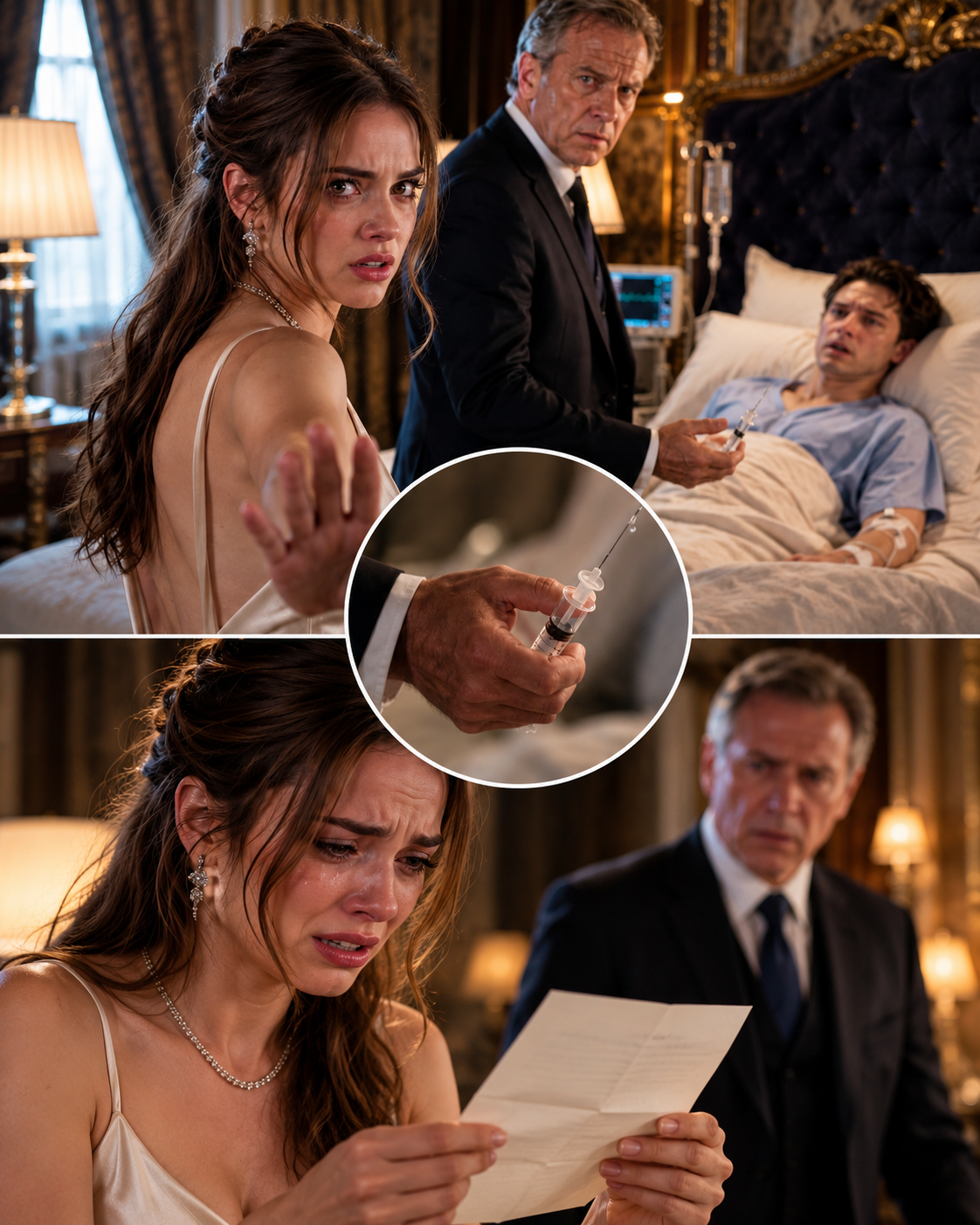
Mara entered with a tray before I could call for help, and Ethan’s eyes had already closed again. I told her he had opened them, but she said emotional stress could make family members imagine responses. I reminded her that I was not his family, and she replied, “You are now.” Then she drew a syringe from the tray and called its contents a mild sedative for neurological agitation. I asked why an unconscious man needed it, and she said abrupt changes could endanger him, though her answer came too quickly to reassure me.
At dinner, only Vivian, Jason, my father, and I sat at the long table. Jason raised his wine and joked that marriage might accomplish what modern medicine could not. Vivian told him not to be vulgar, while my father pressed my wrist beneath the table hard enough to hurt. I asked Jason whether he had visited Ethan after the crash and whether he had been there the night it happened. He said Ethan had been driving alone, then warned me that curiosity was dangerous in that house. My father steered the conversation elsewhere, but his attention had shifted to me.
Later, Robert entered my room without knocking and asked whether Ethan had responded to me. His urgency made my stomach tighten. I said I had only asked Jason about the crash, and my father insisted I was under too much strain to trust what I thought I had seen. When I told him he sounded afraid Ethan might wake, his expression hardened. He kissed my forehead as if I were still a child and told me not to create problems where none existed. For the first time, the gesture made me recoil.
After midnight, I returned to Ethan’s room and admitted I had lied for him. His eyes opened again, and he asked my name as if each word cost him effort. I told him I was Claire, then asked why I should not trust Jason. He remembered a road, an argument, headlights, and Jason’s voice, but could not say whether Jason caused the crash. When footsteps passed the door, Ethan asked me to keep his recovery secret until he could move. I should have called a doctor or the police, but instead I promised to help.
I placed a notepad under his hand and helped him hold a pen. His fingers shook as he wrote four uneven words: “YOUR FATHER WAS THERE.” By morning, I had convinced myself that he might mean my father had visited the hospital afterward. I confronted Robert over breakfast and asked why he had been at the hospital the night Ethan crashed. His coffee cup stopped in midair, and his first response was to ask who had told me. Vivian, seated across from us with a newspaper, said very little was irrelevant when people worked so hard to conceal it.
My father claimed he had gone because he once handled insurance work for a Thornton subsidiary. At two in the morning, he said, he had wanted to be useful. I asked why he had never told me, and he called it irrelevant. When I revealed that Ethan might have remembered his voice, Robert went still before laughing as though the idea were absurd. Vivian ordered him out of the room. Then she asked me to explain exactly what had happened, because, she said, someone had gone to considerable trouble to make sure Ethan did not wake.
Part 3: A hidden medication keeps Ethan trapped inside silence
Vivian brought in Dr. Samuel Levin, the physician who had treated Ethan before the family board replaced him. Dr. Levin examined Ethan for nearly an hour, asking questions and requesting small movements that Ethan managed inconsistently. At last he turned to Vivian and said, “He is conscious.” He explained that Ethan’s awareness might have returned gradually and that sedatives could have obscured it. Vivian ordered Mara not to medicate him again without Dr. Levin’s approval, and Mara warned that sudden changes could endanger his condition.
For several days, we kept Ethan’s recovery secret from everyone outside the room. I slept on a couch beside his bed while his voice returned one short phrase at a time. He remembered cold hands, nighttime conversations, and people discussing his shares as if he were furniture. He recalled Jason saying that a transfer would happen after the wedding, though he could not explain what transfer meant. When I asked whether he remembered my father, Ethan said Robert had asked if he could hear him, then told someone, “Not yet. Let him sleep.”
Mara tried to give Ethan another sedative, but he told her to get out. She claimed he was not medically competent to refuse treatment, and I stepped between her and the IV line. Dr. Levin had not approved the injection, so I wrapped the syringe and gave it to him for testing. The laboratory found a dose nearly four times stronger than the amount listed on Ethan’s chart. Vivian dismissed Mara immediately, but the nurse had vanished before security reached her quarters. Her clothes remained behind; her passport, papers, and car were gone.
Jason had approved the agency that placed Mara, which made Ethan’s warning hard to ignore. He told me he knew nothing about the excessive doses and wanted to know who had chosen her. That evening, Ethan tried to stand with Dr. Levin nearby and me holding his waist. He managed three trembling seconds before his knees failed, and we fell back onto the bed. He thanked me for speaking to him when everyone else treated him as if he could hear nothing. I admitted that he was my husband, even if he had been a stranger, and he said those things were not mutually exclusive.
Jason found me in the library later that night and asked whether Ethan was awake. I refused to answer, but Jason told me he knew Mara had disappeared and Dr. Levin had been visiting through a service entrance. Then he showed me an old photograph from a Thornton corporate dinner. My father stood at its edge, younger but unmistakable, and the caption identified him as Robert Mercer, a former financial controller at Thornton Logistics. Jason said my father had managed millions before money vanished and two witnesses changed their stories. He also said I should ask Robert why he had changed his name.
Jason admitted he had been on the mountain road the night Ethan crashed, though he denied causing the accident. Before I could press him, a crash sounded upstairs. I ran to Ethan’s room and found my father standing over him with a syringe in his hand. Robert shouted that he had found it beside the bed, while Jason seized his wrist and asked what he had been removing it from. Ethan, exhausted but alert, lifted one shaking hand and told them to stop. Security arrived, and the police found a key card to Ethan’s private elevator in Robert’s pocket, along with a list of medication times.
Part 4: A sewing box leads Claire toward her mother’s truth
The syringe contained the same sedative Mara had tried to administer, but my father insisted he had only found it. He claimed someone had planted the medication schedule in his pocket and looked toward Jason as if the accusation might settle everything. Police questioned us for hours but did not arrest Robert because no one could prove he had injected Ethan. Jason, however, was taken away after officers found his fingerprints on medication packages in Mara’s abandoned room. As they led him through the hall, he shouted that I should go to Yonkers, find my mother’s sewing box, and look for “Blue Heron.”
The next morning, I drove to the small rental house where I had grown up. My mother’s photograph still stood on the mantel, and the bedroom closet still held the dark wooden sewing box painted with roses. Beneath its removable tray, I found an envelope taped to the bottom, my name written across it. Inside lay a brass key and a note telling me that if something had happened, I should not accept my father’s first explanation—or his second. The note directed me to Locker 317 at Grand Central Station and warned me to bring someone I trusted, but not Robert.
Ethan insisted on coming with me, despite his weakness, and Vivian sent Dr. Levin and a driver. At Grand Central, commuters moved beneath the painted constellations while we found the locker and turned the brass key. Inside sat a metal case filled with bank statements, company ledgers, photographs, and a digital recorder. My mother’s note said to listen before believing anyone. Her voice came through the static, saying she had found money moving through Thornton Logistics and a shell company called Blue Heron Consulting. She said my father had started the accounts years earlier and had continued moving funds after leaving the company.
My mother said Jason had been helping her investigate and that Ethan had begun looking into the same accounts. Then she explained the trust’s survivorship clause: if Ethan died after marrying, his spouse would inherit controlling shares, but if the spouse died within thirty days, the estate would pass to her next of kin. “If Robert chooses you,” she warned, “run.” The recording ended, and I felt the station tilt around me. A photograph slipped from the case; it showed a woman in a wheelchair outside a neurological residence, with my mother’s unmistakable profile. The date proved it had been taken seven months after her funeral.
At the same moment, Vivian called to say Jason had been released because his fingerprints could have come from months earlier. We met him in a private office, where he explained that my mother had survived a crash two years before and Vivian had hidden her under another name. Jason had pulled Ethan from the wreck on the mountain road after a black SUV forced his car through the barrier. He had stayed silent because he was gathering evidence and did not know which family members were compromised. He admitted he had followed Ethan that night, but denied causing the crash.
The case also contained records from Saint Agnes Neurological Residence and monthly reports about a patient under another name. Mara’s signature appeared at the bottom of each page. I realized she had been treating my mother as well as Ethan. That night, Ethan stood alone on the terrace, leaning heavily on his cane, and told me he remembered my voice from before the accident. We kissed, carefully and without pretending the circumstances were simple. He promised to annul the marriage when this was over, because he wanted me to have a choice. I told him to ask me again when we were both free to answer.
Part 5: The woman declared dead opens her eyes again
At Saint Agnes, my mother lay in a quiet room with silver in her dark hair and a scar above her left eyebrow. I recognized her before the doctor finished introducing us. I took her hand and told her I was there, and after several seconds her finger moved. Her eyelids opened, and a tear slid into her hair. “Claire,” she whispered, but the next word she managed was “Vivian,” leaving me unsure whether she meant to trust her or fear her.
I found Vivian alone in the small chapel and demanded to know why she had let me believe my mother was dead. She explained that Robert had arranged a substituted body before Vivian understood what he intended. My mother had brought her evidence that Robert was moving money through dormant Thornton accounts and planning to exploit Ethan’s trust. Vivian said she had contacted the police, but records disappeared from evidence within two days. When Robert arrived at the hospital asking questions, Vivian moved my mother under another name and let him believe his lie had succeeded.
I told Vivian that my mother had been too impaired to make such a choice, but she said Margaret had communicated enough to insist that I remain outside the investigation. That explanation did not erase the years I had mourned alone. Vivian admitted that she had spent most of her life believing family protection justified silence, deception, and sacrifice. I told her she was no better than the people she claimed to oppose. She did not argue, and her failure to defend herself left my anger with nowhere to hide.
Back in my mother’s room, Ethan helped her communicate through a letter board, moving from row to row while she blinked at the letters she wanted. The first sentence took twenty minutes: “ROBERT CAUSED BOTH CRASHES.” The next read, “MARA KEPT ETHAN ASLEEP.” Then, slowly, she spelled, “WEDDING MADE CLAIRE THE BRIDGE.” My father had not stumbled into debt; he had built it around me, knowing I would sacrifice myself to save him. He had chosen my compassion as carefully as someone chooses a key.
Ethan said we needed Robert to confess because the records and my mother’s condition could be challenged in court. I told them my father believed I still wanted his approval and would explain anything as an act of love. Ethan objected, but I reminded him that he could not decide for me. I had spent too much of my life being told what sacrifices were necessary. Vivian arranged for Ethan to announce his recovery and intended trust changes at an upcoming board meeting. My father heard the news and came to the estate, expecting the daughter who had always forgiven him.
Part 6: A confession turns a family home into a trap
Robert entered the library with tears in his eyes and opened his arms, but I did not move toward him. He blamed Jason for filling my head with accusations and claimed my mother had become obsessed with conspiracies. When I told him I had seen her, color drained from his face before grief appeared. He asked who told me, and I said I had seen her myself. Then he asked what recordings she had left, revealing that he knew there were recordings before I had mentioned them.
I asked whether he caused Ethan’s crash, whether he had hired Mara, and whether he had paid Blue Heron Consulting. He said he had taken what the Thorntons owed him and accused my mother of betraying him. When I asked about her crash, he said she had been supposed to leave the records and walk away. Then he admitted Ethan had been “a complication” and said the crash had not been arranged personally. His silence after I asked whether he had ordered it told me more than another denial could have.
My father noticed the wire beneath my collar and tore it free. The lights went out at the same instant, and a gunshot exploded in the hallway. Robert seized my arm, dragged me through a hidden service door beside the fireplace, and pressed a weapon against my ribs. He said we were going to finish what my mother started. The passage led through the mansion walls and down toward a boathouse by the river, where he locked me in beside legal documents, a laptop, and another gun.
He explained that the marriage was vulnerable while Ethan remained unconscious, but a statement from Ethan recognizing me as his wife would make the trust harder to challenge. My father had wanted Ethan awake just long enough to confirm the marriage, then planned to let the sedative return him to darkness. He said I could have thirty days as one of the richest women in America before grief made me careless near the water. I realized he had not simply married me to a dying billionaire. He had planned to kill Ethan, then kill me and claim the inheritance through my estate.
A sound came from the rear of the boathouse, and Ethan stepped out of the darkness with Jason behind him. Ethan could barely stand, but he had come anyway. Before anyone could move, Mara appeared beside the workbench with a gun aimed at Ethan. Robert told me to persuade Ethan to sign the statement, while Jason accused my father of planning to kill everyone in the room. The four of us stared at Mara, and I watched her thumb rub nervously against her finger as she tried to hold the weapon steady.
Part 7: The boathouse reveals the price of obedience
I told Mara my mother was alive, her medication records were preserved, and Robert could not protect her. She said he could protect her son, and the words escaped before she could stop them. Jason recognized the connection and asked whether her son had driven the black SUV. Mara admitted Robert had promised her son would only frighten Ethan into stopping his investigation. She said Robert had promised to reduce the charges after the boy was arrested, then confessed she believed he had arranged for another inmate to kill him.
Robert called her unstable, and Mara turned her gun toward him. He fired first. The shot struck her, and she fell against the workbench as the weapon spun away. Jason lunged at my father and took a second bullet in the side. Ethan surged forward, knocked Robert’s gun away, and fell to one knee when his weakened legs failed. My father grabbed an iron hook and raised it over Ethan, saying he should have died on the mountain.
I seized a heavy lamp from the workbench and struck my father across the shoulder. He turned toward me, stunned that the daughter who had spent her life saving him had finally chosen herself. “You ungrateful child,” he said, and I answered, “I am not a child.” Jason wrapped his arms around Robert from behind, giving Ethan enough time to reach for the gun under the table. Then the boathouse doors burst open, and Vivian entered with federal agents, security, and an emergency medical team.
Robert tried to reach into his jacket after the agents ordered him to his knees. One agent fired, striking his arm, and security forced him down and handcuffed him. As they lifted him, he looked at me and pleaded, “Tell them I did it for you.” I told him he had done it because he believed that loving him meant belonging to him. For the first time, he had no response. Jason survived surgery, and Mara survived her wound, though the bullet damaged her lung.
Mara cooperated with investigators, revealing the hidden accounts, the people Robert paid, and the false medical reports used to keep Ethan sedated. My mother’s testimony described the threats and the crash that had nearly killed her. She also identified a judge, two officers, and a Thornton executive who had helped bury evidence. Robert Mercer, the name he had used before becoming Robert Hale, faced charges including attempted murder, conspiracy, fraud, embezzlement, and witness tampering. His accounts were seized to restore the pension funds he had raided.
Vivian resigned as chairwoman of Thornton Corporation and transferred a significant portion of the family voting power into an employee trust. “Companies should not be kingdoms,” she said. “Families should not be excuses.” It was the closest thing to an apology she knew how to offer. My mother began rehabilitation at the estate, though our reunion did not erase the pain of two years apart. When I told her she should have told me, she said she had been afraid; I answered that I had been afraid too.
Part 8: A second ceremony begins with a choice
Three months after the boathouse, Ethan and I returned to the chapel where we had been married the first time. This time there were no reporters, lawyers, or trustees in the pews. My mother sat beside Vivian, and Jason stood near the altar with a cane, complaining that his scar ruined his suit. The original marriage had been annulled that morning because Ethan insisted I deserved a beginning that belonged to me. Before the ceremony, he asked me to meet beneath the stained-glass windows and handed me an old envelope with my name on it.
The letter inside was addressed to Vivian and dated eleven months before our wedding. Ethan had written that if he became incapacitated before his thirtieth birthday, there was one person he would trust to stand beside him: Claire Hale. He said we had met at a Yonkers train station on a stormy night when service was suspended and he had become ill on the platform. Everyone else had walked past, but I stayed until his breathing slowed. I remembered the soaked coat, the broken lights, and the stranger I had told, “Stay with me. Morning always comes.”
Ethan said he remembered my voice before he remembered my face. During the coma, voices had become dreams, music had become rooms, and pain had felt like weather. Then I sat beside him and spoke about my mother, and he found his way back to the woman from the station. My father had reduced the sedative to bring him close to consciousness, but Ethan said my voice was why he fought through the rest. Vivian had used Robert’s plan to bring me close enough to expose him, but Ethan acknowledged that the first marriage still had not been my choice.
He removed a plain silver ring and said there were no trust provisions, deadlines, or company shares attached to it. He told me he loved my voice before he knew my face and trusted my kindness before he knew whether we would meet again. Then he asked whether I would marry him now that I was completely free to say no. No father demanded sacrifice, no lawyer waited to witness a transaction, and no trust required an answer. I looked at Ethan—the man beneath the fortune, the patient beneath the silence, and the stranger from the rainy platform—and said yes, but this time he had to say it too.
At the altar, the minister asked Ethan if he took me as his wife, and he looked directly into my eyes. “I do,” he said, his voice strong enough to fill the chapel. When my turn came, I thought of every silence that had shaped us: my mother’s hidden survival, Vivian’s choices, Jason’s secrets, and Ethan’s long confinement inside a body that would not obey him. I also thought of my father, who believed love was a chain he could tighten whenever I tried to leave. “I do,” I answered, and this time the words felt like a door opening.
Ethan kissed me beneath the stained glass while my mother cried in the first pew and Jason applauded too loudly. Outside, snow began to fall across the Hudson, and my mother linked her arm through mine as we descended the chapel steps. She was still unsteady, but she no longer needed a wheelchair. I asked whether she knew Ethan had chosen me before the accident. She said he had asked what kind of woman I was, and she told him I would run into a burning house for someone I loved—then added that the right man would not ask me to.
For years, I believed the defining moment of my life was the day my father sold me to a silent billionaire. I thought I had been chosen because I was desperate, obedient, and easy to sacrifice. Later, I understood that Ethan had remembered me long before my father learned there was money to be made from my devotion. Robert thought he was delivering a helpless daughter into a house of sleeping lions. He never understood that he was placing the one voice Ethan remembered beside the man he had failed to silence.
✓ Lynn R. Adams
Part 2: The heir wakes while the household hides its secrets Mara entered with a tray before I could call for help, and Ethan’s eyes had already closed again. I told her he had opened them, but she s…