Claire Bennett thought she had married a secretive but faithful man
Part 2: A hidden embryo exposes the cruelest betrayal of all
The code appeared beside the embryo transfer that had made me pregnant after two miscarriages and years of unsuccessful fertility treatments. Griffin said it matched a storage invoice paid by a Vale subsidiary, connected to embryos frozen more than twenty years earlier. “That doesn’t make sense,” I said; my embryos had been created the previous year. He explained that the clinic had altered my laboratory record after the transfer, though he did not yet know why. Before I could demand more, his assistant arrived with a new warning: Sebastian was contacting hospitals and private security firms, trying to locate me.
He had also filed an emergency request to obtain my complete prenatal record, including my expected delivery date and any conditions that could complicate childbirth. At the bottom of the request, beneath Sebastian’s digital signature, someone had written: “Patient may become emotionally unstable if informed of embryo origin.” “He knows,” I whispered. Griffin said he believed Sebastian had always known. Then an unmarked package arrived with a brass key tagged “Whitmore Hotel—Suite 1901” and a note insisting that I be brought there before Sebastian moved me.
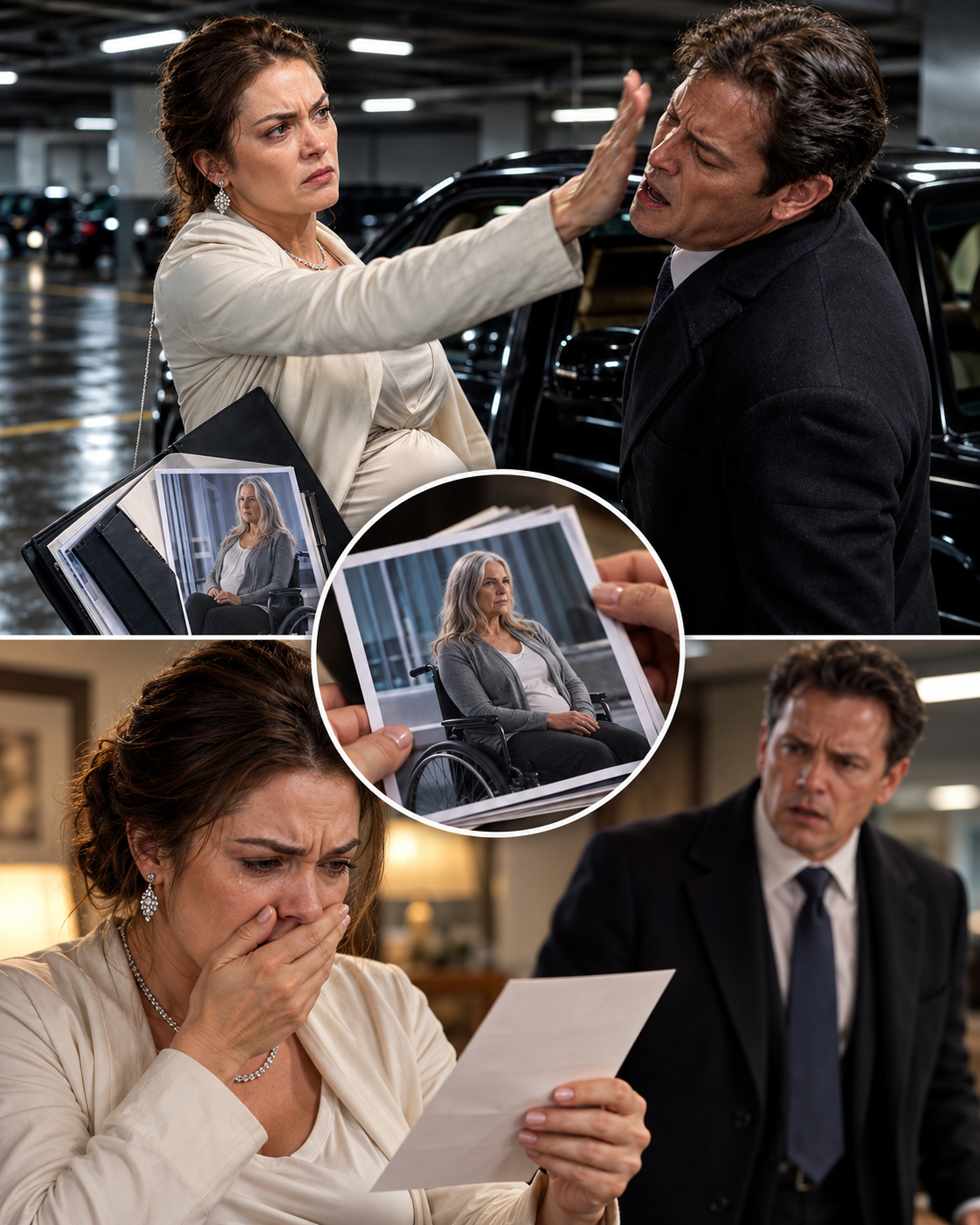
Sebastian found us in the underground garage before we could leave for Chicago. He stood beside a black sedan, rain darkening his coat, while two security men waited behind him. The sight of him awakened the old instinct to run into his arms, but the photograph, the death certificate, and the code stopped me. “This is between my wife and me,” he said to Griffin. “Which wife?” I asked, and for the first time Sebastian looked as though he had no answer ready.
He admitted he had been married to Natalie and that, legally, the situation was complicated. He said she had suffered a catastrophic brain injury, lost her memory, and endured periods of confusion, while her family fought over the Whitmore estate and reporters crowded the hospital. He claimed he had hidden her to protect her from people who wanted her dead. I asked whether the embryo inside me was biologically mine, and his gaze dropped to my stomach. “The embryo was viable when yours was not,” he said, and every word that followed only made the betrayal worse.
He admitted the embryo had come from Natalie’s egg and his sperm, after our last embryo stopped developing. He had told me ours survived, watched me grieve every failed treatment, and let me believe the pregnancy was ours by biology as well as love. “You decided I was a container,” I said. Sebastian swore he had wanted to give us the family we both wanted and would have told me when I was safe. “Safe from whom?” I asked, but he looked at Griffin instead, and I chose to go to Chicago despite his warning.
Part 3: The hotel suite holds a mother, a secret, and an escape
The key opened Suite 1901, where Natalie sat in a wheelchair beneath a cream shawl, watching me as though she had been waiting for someone she could not remember. Sebastian had kept her hidden in the Whitmore for thirteen years, and the woman in the photograph was not an affair but a prisoner inside a luxury hotel. Her memory came and went, yet she recognized that the people around her had been making decisions for her. When I told her I was pregnant with the embryo created from her egg, she closed her eyes and whispered that Sebastian had promised her a carrier who valued privacy. The truth arrived slowly: she had not known the woman carrying her child was me.
We left the suite through a service passage hidden behind a bedroom bookcase, a route I remembered from the renovation plans. Sebastian had once wanted the passage sealed, but I had insisted on preserving it because closing it violated fire regulations. Griffin pushed Natalie’s wheelchair through the narrow corridor while I followed, hearing men shout behind us. We descended in a freight elevator and slipped through the basement laundry among carts of hot linen. A car waited at the loading dock, and as we sped away, Natalie murmured, “You came for me,” while I answered, “I came for the truth.”
The safe house Griffin chose was a small lakeside home north of Chicago, smelling of cedar, dust, and old fireplace ash. That night, Natalie and I sat across from one another with untouched tea between us, and she told me about the embryos she and Sebastian had created twenty-three years earlier. She had lost several pregnancies, watched four embryos fail, and been told the final one was preserved; she said she believed Sebastian had arranged for it to be carried by a woman who wanted to remain private. She had been kept in Suite 1901 for thirteen years, with newspapers selected by staff and calls screened before she could make them. “A prison becomes ordinary if the furniture is expensive enough,” she said.
Natalie explained that she had tried to escape twice, but nurses sedated her and Sebastian showed her photographs of her half brother, Gabriel, as a way to frighten her into staying. She suspected Gabriel had caused the car crash that injured her because, while trapped in the wreck, she saw a man make the childhood salute he used. Griffin returned with medication and said Sebastian was telling police Natalie had been abducted by an armed investigator. He also produced a background report on me dated a year before Sebastian and I began dating, filled with private details, surveillance photographs, and my visit to St. Agnes, the home where adoption records had been sealed. Sebastian had known I was adopted before I knew he existed.
A laboratory sheet in Griffin’s file showed that a DNA sample taken from me was a first-degree biological relative of a redacted reference subject. Natalie and I shared the rare blood type O negative, but neither of us knew what the result meant. Then Griffin’s manner unsettled her: she said he held his gun the same way as her brother and asked him to remove his watch, remembering Gabriel’s burn scar. Before he could answer, Sebastian burst into the house alone, carrying a photograph of Natalie beside a much younger man. The man was Griffin, and the writing on the back identified him as Gabriel Carter.
Part 4: The investigator’s real name turns the hunt into a trap
Sebastian revealed that Griffin Tate was really Gabriel Carter, Natalie’s half brother and the man who had spent fourteen years searching for her. He said Gabriel needed Natalie’s legal death to remain in place until he could seize control of the family trust, but he had used me to locate her. Gabriel denied it, until Natalie accused him of cutting her brakes and recognized the childhood salute she had seen at the crash. Sebastian admitted that the hotel invoices and reservations had been planted as a false trail, originally meant to draw Gabriel away from Natalie. The plan had reached me instead.
Gabriel pulled a gun, and Sebastian lunged. A shot shattered a window; Natalie’s wheelchair overturned as I crawled to help her, while the two men fought over the weapon. Headlights swept across the house, and Gabriel grabbed the fertility records and trust papers before disappearing through the rear door. Sebastian was bleeding when security arrived, but I pressed a towel against his wound until paramedics took him away. On the floor, I found a page from his investigation of me, with one line still visible: “The subject is a first-degree biological relative of the reference female,” followed by Sebastian’s handwriting: “Do not tell her.”
Sebastian survived, but his lawyers moved quickly, petitioning to have Natalie declared mentally incapacitated and me described as delusional, unstable, and a danger to my unborn child. They included private therapy records and photographs of me grieving after my miscarriages. I moved with Natalie to the home of Evelyn Marsh, her former attorney, who had believed Natalie dead until Gabriel contacted her. Evelyn said Gabriel wanted the original trust documents, while Natalie quietly observed that Sebastian had used my love and Gabriel had used my anger. I asked what Natalie hoped to borrow from me; she answered, “Your courage.”
The Whitmore Trust passed through Natalie’s direct descendants. If none existed when she was legally considered dead, Gabriel would inherit, but a descendant discovered later could challenge every transfer made under that assumption. Sebastian had known I was related to Natalie before he met me, and the implication was impossible to ignore. “Do not confuse complexity with love,” I told Evelyn when she suggested Sebastian’s motives might have changed. Then Natalie reached across the desk and covered my hand just as her embryo—my baby—kicked beneath our joined palms.
Gabriel took control of the Whitmore ballroom and tried to force an emergency board vote naming himself temporary trustee. Natalie insisted on speaking for herself, and Evelyn helped us return through the hotel’s basement passage. The ballroom still carried the blue velvet curtains I had chosen during renovations, including a hidden service entrance Sebastian had wanted sealed. I activated the hotel’s emergency broadcast system, routing the ballroom cameras to the lobby, security office, conference floors, and an external server. Then Natalie rolled into the room and faced the brother who had once tried to kill her.
Part 5: A ballroom confession turns into a race through fire
Gabriel called Natalie his sister and claimed he had only exposed Sebastian’s crimes. She agreed Sebastian was a criminal but refused to let Gabriel replace him, and she accused him of sabotaging her car. Gabriel’s composure cracked as he blamed Natalie for inheriting their grandfather’s fortune and leaving him with resentment instead of power. “Thousands of employees lost their retirement savings,” she reminded him. “They would have survived,” he replied, and the board members heard the indifference in his voice.
Sebastian entered the ballroom, pale and bandaged, with a gun in his hand and a claim that federal agents were watching. Gabriel drew a device and threatened to lock the exits and ignite accelerants unless I gave him the trust authorization. He looked at my stomach and said that if my relationship to Natalie were recognized, I would inherit before he did—and my baby would inherit after me. Then he ordered Sebastian to explain why he had chosen me. Sebastian admitted he had found Natalie’s sealed adoption register and discovered she had given birth to a daughter at seventeen.
Her father had arranged the adoption and told Natalie the infant died. The baby was placed through St. Agnes, renamed, and raised as me; Sebastian had learned my identity before hiring my design firm and arranging our first meeting at the Whitmore. “Did you ever love me?” I asked. Sebastian’s eyes filled as he answered, “That was the part I did not arrange.” Before I could make sense of it, he fired at Gabriel’s shoulder, and the device fell as a blast shook the western wall.
Flames raced up the ballroom curtains while Gabriel dragged Natalie’s wheelchair toward the fire and Sebastian tackled him. I pushed Natalie toward a hidden passage behind the stage, but smoke filled the room and a contraction seized me. Gabriel caught my coat; I struck his injured shoulder and broke free just as Sebastian pulled him away from me. He looked through the smoke and shouted for me to go, then the burning curtain fell between us. Natalie held my hand as we reached a freight elevator, while the hotel’s screens broadcast the confessions to hundreds of guests.
Federal agents rushed toward us in the lobby, but the next contraction bent me in half. “Save my daughter,” I managed to say before the world went black. My baby was born six hours later in a public hospital under federal protection, five weeks early, weighing four pounds and nine ounces. She opened one dark eye and gave an indignant cry when the nurse placed her against my chest. In that moment, every argument about ownership, inheritance, and biology seemed small beside the child whose heartbeat I had carried.
Part 6: A DNA report names two mothers and changes everything
Natalie watched from her wheelchair as I held the baby. Her injuries were minor, though smoke had damaged her lungs, and she approached my bed carefully to ask if she could see the child. I hesitated before saying the baby was biologically hers, and Natalie answered that the baby was mine in every way biology could not measure. I noticed traces of myself in Natalie’s face—the shape of her mouth, the downward angle of her eyes, and the crease between her brows when she fought tears. “You had a baby at seventeen,” I said, and she told me that her father had sent her to St. Agnes and arranged for the newborn to be taken away.
Natalie said a nurse had told her the baby stopped breathing, and she had been too young and too controlled to challenge the adults around her. She had named the infant Claire before they took her, and my adoptive parents had kept that name. For forty-two years, I had believed my name was a gift from the people who raised me; now I understood it had crossed two families and decades of silence. Natalie touched the baby’s blanket and began to cry, while I tried to absorb the fact that the woman I had feared as a rival was my birth mother.
Sebastian survived the fire after pulling Gabriel away from the collapsed curtain. Gabriel was arrested for attempted murder, conspiracy, arson, fraud, and the attack that had nearly killed Natalie fourteen years earlier. Sebastian was arrested two days later for reproductive fraud, unlawful confinement, falsifying medical records, embezzlement, obstruction, and conspiracy. His lawyers argued he had protected Natalie, but prosecutors showed photographs of locked doors. The court ordered DNA testing during the custody dispute, and the first result confirmed Natalie’s egg and Sebastian’s sperm had created the embryo.
Then came the second result. Evelyn placed the report on my hospital bed while Natalie held my hand: the probability that Natalie was my biological parent was 99.9987 percent. Natalie bowed her head against my hand and wept for the infant she had been told was dead, the woman that infant became, and forty-two birthdays she had missed. I wept for the mother I had once searched for and forced myself to stop needing. Between us slept a child who was biologically my half sister, gestationally my daughter, and legally at the center of a battle neither of us had chosen.
Natalie asked what would happen to the baby, and I told her I had carried her, spoken to her each night, and loved her. “Then you are her mother,” Natalie said, though I told her she was the baby’s mother too. She refused to take a child from the woman who had carried her, saying she would be whatever I allowed. Months later, the court granted me permanent custody, and we named the baby Rose Claire Bennett. Natalie stood beside me as Rose grew stronger, and little by little, so did the family we had lost before we knew it existed.
Part 7: The women reclaim the trust and tell the truth
Gabriel’s trial lasted nearly two years, and he was convicted on every major charge. During sentencing, he stared at Natalie as if she had betrayed him simply by surviving. Sebastian pleaded guilty after the ballroom broadcast made denial impossible. In a letter, he admitted that he had first located me because I was Natalie’s lost daughter and that he arranged our first meeting, hid my identity, and hoped the marriage would preserve his control of the Whitmore empire. He claimed his strategy eventually became love, but the letter could not undo the years in which he had treated my consent as an obstacle.
His final request was that I tell our daughter he had loved her before she was born. I did not burn the letter, but I placed it in a sealed box for Rose to read when she was old enough to understand that love without respect can become another form of violence. The court restored the Whitmore Trust after recognizing Natalie’s survival and my identity as her firstborn child. It reviewed every transfer Sebastian had made under the false declaration of Natalie’s death. Millions were returned to employee pension accounts that had been raided while the family fought over inheritance.
Natalie and I dismantled the hidden nineteenth-floor suite and turned it into offices for an organization supporting women facing reproductive abuse, financial coercion, and unlawful confinement. We kept one smoke-damaged section of the ballroom’s blue velvet curtain, the one that had concealed the passage through which we escaped. It now hangs behind glass in the hotel lobby, beneath a plaque that reads, “Some doors are hidden until the moment we are strong enough to open them.” The building where Sebastian had hidden my mother became a place where other women could seek help. That change did not erase what had happened, but it gave the rooms a new purpose.
At Rose’s first birthday, Natalie and I stood beside a lake while the baby took three unsteady steps between us. She fell into my arms laughing, then reached toward Natalie’s silver hair and called her “Nana.” We had chosen that name after months of conversations, tears, therapy, and patience. Blood had made Natalie my biological mother, time had made her a presence in my life, and choice allowed us to become a family. That evening, after Rose fell asleep, Natalie and I sat together on the porch and remembered the note I had left on Sebastian’s counter.
“I thought Natalie was the woman destroying my marriage,” I said. Natalie smiled sadly and asked what I thought now. I told her she was the woman my marriage had been built to hide. For years, Sebastian had believed the truth belonged to whoever controlled the documents, the money, the doctors, and the locked doors. Gabriel had believed blood gave him the right to possess whatever another person inherited. They were both wrong, and neither man could decide what the truth meant for us anymore.
Part 8: Rose inherits a future no one can take from her
I had left my husband before sunrise because I believed he was living a second life. By midnight, I learned that the second life had always been mine: I was Claire Bennett, Natalie Carter’s daughter, and Rose’s mother regardless of whose blood moved through her veins. Rose would grow up knowing the truth, but she would not be asked to carry the shame of the people who had hidden it. She would know that Sebastian was her biological father and that his choices had hurt us. She would also know that a child is not responsible for the crimes, fear, or greed of the adults who came before her.
Natalie kept the first photograph Griffin had shown me, the one where Sebastian’s hand rested on her shoulder in the hotel. She no longer needed it as evidence, but she kept it to remember how close she had come to disappearing without a witness. I kept the note I had left Sebastian, though I no longer read it as the moment my marriage ended. It was the first time I had chosen my own safety without asking whether my decision would upset someone more powerful. Leaving had not solved everything, but it had given me a path toward the truth.
The Whitmore ballroom reopened after repairs, and the new owners preserved the service passage rather than sealing it. I returned once, years later, with Rose and Natalie beside me. My daughter ran her fingertips along the blue velvet curtain, now protected behind glass, and asked why it had been saved. I told her it had once hidden a door and helped two frightened women escape a fire. Rose looked at Natalie and me, then said she was glad we had found the way out.
Natalie’s health improved, though some memories remained broken and others returned without warning. She sometimes remembered the day she gave birth to me, and sometimes she remembered only the sound of my voice. We never forced the memories to come in order. We learned to be mother and daughter in the present, one conversation, one birthday, one ordinary afternoon at a time. When she called me Claire, I heard both the name she had given me and the name I had carried into a life she had never been allowed to see.
The first lie had been that Natalie was the other woman. The deeper lie was that Sebastian could love me while deciding what I was allowed to know, what I could choose, and what my body would carry. Gabriel’s lie was that inheritance made him entitled to another person’s life. The final truth was simpler: Natalie was my mother, Rose was the child I had carried and loved, and no document could reduce either of us to an asset. Rose was born into a history of secrets, but she would not inherit our silence.
✓ Lynn R. Adams
Part 2: A hidden embryo exposes the cruelest betrayal of all The code appeared beside the embryo transfer that had made me pregnant after two miscarriages and years of unsuccessful fertility treatmen…