Chapter 9: The Man Behind the Badge212
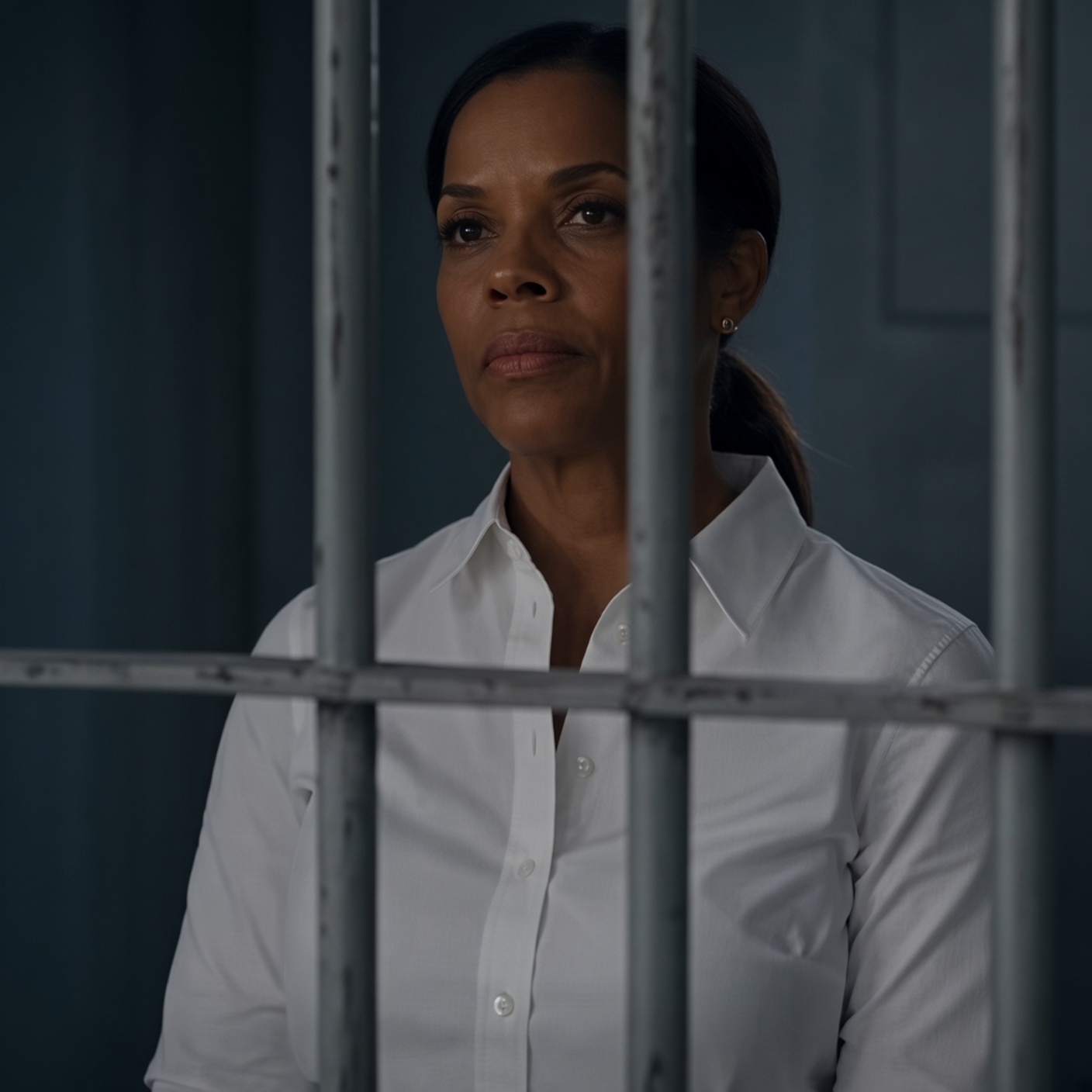
Thirteen months after the traffic stop, Sarah Reynolds entered a federal courtroom in Georgia.
She wore a dark blue suit.
Her hair was pinned neatly.
Her expression was calm.
But beneath the table, where no one could see, her fingers pressed against each other so tightly that her knuckles ached.
Clara Monroe sat beside her.
Across the aisle, Thomas Ryker adjusted his tie.
He no longer wore his sheriff’s uniform inside the courtroom.
Without it, he looked different.
Not smaller exactly.
But less certain of how people were supposed to respond to him.
The jury had been selected.
The witnesses had been prepared.
Months of depositions, document reviews, legal motions, and disputed evidence had brought the case to this room.
The central question was no longer whether Sarah had been charged with crimes.
Those charges were gone.
The question was whether Ryker had violated her constitutional rights during the stop, arrest, and detention, and whether the evidence supported civil liability.
Sarah understood the distinction.
She also understood that a favorable verdict could not give her back the afternoon she had lost.
But perhaps it could establish, in a public and accountable forum, that the sheriff’s version of events had not been the truth.
The trial began with the facts everyone agreed upon.
Sarah had been driving a rental sedan on Route 119.
Deputy Miller had stopped her.
Sheriff Ryker had arrived.
She had been handcuffed and transported to the Oak Haven Sheriff’s Office.
She had been charged with disorderly conduct, resisting arrest, and reckless driving.
She had requested access to counsel.
She had been placed in cell four.
Five minutes later, the Pentagon had called.
After further proceedings, the criminal charges had been dismissed.
The disagreements concerned why the stop occurred, whether any lawful grounds supported the arrest, what happened during the encounter, and why official records contradicted other evidence.
Clara presented Sarah’s case without dramatic accusations.
She began with the chronology.
Then she introduced the photographs of Route 119.
Walter Price’s security footage.
The dispatch entries.
The report revisions.
The evidence-preservation logs.
And the recording that had survived the attempted deletion of another backup.
The jury listened.
Some took notes.
Others watched the witnesses carefully.
Sarah found herself studying their faces.
She was accustomed to making decisions based on reports and verified information.
Now twelve strangers would weigh evidence concerning an event that had changed her understanding of her own country.
She had to trust the process.
That was more difficult than she expected.
Walter Price testified first.
He described his repair shop, the security cameras, and the way his recording system stored footage.
He explained that Clara had requested preservation of the relevant files and that he had provided an original export.
The defense questioned the camera’s viewing angle.
Walter agreed that it couldn’t show every portion of the highway.
He agreed that he couldn’t see the entire stop.
He refused to speculate beyond what the recording displayed.
When asked whether he supported Sarah because he disliked the sheriff, Walter looked genuinely annoyed.
“I support my camera recording what my camera recorded.”
A few jurors smiled.
The judge reminded the courtroom to remain quiet.
Walter continued.
“I didn’t go looking for trouble. These folks came to my shop and asked if the video existed. It did.”
The defense attorney asked whether Walter could say with certainty that Sarah had never crossed the center line anywhere along Route 119.
“No, sir.”
“Then your video doesn’t prove she drove perfectly.”
“No, sir.”
The attorney appeared satisfied.
Then Walter added, “But it shows what happened in front of my shop, and I wasn’t going to pretend it showed something else.”
Sarah looked down.
It was such a simple standard.
Yet it had required more courage than several trained officers had shown.
Brenda testified two days later.
Her attorney sat in the gallery.
Martin was beside him.
Brenda described the booking process, the records system, the preservation transfer, and the audit entries she had reviewed.
Her voice trembled at first.
Then steadied.
Clara asked whether anyone had instructed her to change the recorded facts.
“Sheriff Ryker told me not to discuss the dispatch entry.”
“Did he explain why?”
“No.”
“What happened when you reported the camera-file classification change?”
“He suspended me.”
Brenda described the encounter at her desk.
The disconnected camera.
Her request for written instructions.
Lieutenant Cross’s arrival.
The defense questioned whether she had acted outside her responsibilities.
Brenda referred to the department’s written preservation policy.
She acknowledged that she had become concerned about Ryker’s conduct.
She also admitted that she disliked the way he treated employees.
The defense suggested her testimony was motivated by anger over losing her job.
Brenda considered the question.
“I am angry,” she answered.
“Because you were terminated?”
“Because I spent years watching things happen that I should’ve questioned.”
The attorney paused.
“Are you saying your personal feelings influence your account?”
“My feelings made me afraid to speak earlier. The records are what they are.”
Clara looked toward the jury.
Brenda continued.
“I didn’t create the timestamps. I didn’t invent the dispatch entries. I didn’t make the sheriff disconnect the camera.”
Her voice grew stronger.
“I just stopped pretending I hadn’t seen what I saw.”
When she stepped down, Martin stood near the gallery door.
He took her hand.
She squeezed it.
For the first time in months, her shoulders seemed to relax.
Denise Carter testified about her earlier complaint only within the limits the court permitted.
Her encounter was not treated as automatic proof of what happened to Sarah.
Clara had to establish the relevance of the evidence to the issues being tried.
Denise described her experience, the complaint she filed, and the response she received.
She admitted she had no recording of her own traffic stop.
She did not claim to know Ryker’s thoughts.
She explained only what she had experienced.
The defense asked why she had waited so long to come forward again.
Denise looked at the attorney.
“Because the first time I tried, nobody listened.”
“Isn’t it possible you misunderstood the sheriff’s intentions?”
“Yes,” she said. “It’s possible I didn’t understand what he was thinking.”
The attorney nodded.
Denise continued.
“But I understood that he threatened to arrest me for asking why he wanted to search my car.”
The courtroom grew quiet.
She looked toward Sarah.
For a moment, their eyes met.
Denise had once believed she was the only person who remembered her stop the way she did.
Now she was speaking under oath.
Her voice carried beyond the courtroom walls.
And she no longer seemed ashamed of it.
Jared Miller arrived on the fourth day.
His appearance was unremarkable.
A gray suit.
A white shirt.
No badge.
But Sarah felt the room change when he entered.
In the months preceding trial, Miller had resolved a separate proceeding concerning his false initial account of the traffic stop.
With legal counsel, he had admitted to knowingly recording an unsupported lane violation.
The resolution included professional consequences and a criminal penalty.
His law enforcement certification was subject to disciplinary action, and he was no longer serving as an officer.
He had not been excused from responsibility.
He had accepted it.
His attorney had carefully prepared him for testimony.
Clara approached the witness stand.
“Mr. Miller, why did you stop Sarah Reynolds?”
He looked toward the jury.
“Because Sheriff Ryker ordered me to.”
“Had you observed a traffic violation?”
“No.”
“Had you received a specific alert identifying the vehicle as connected to criminal activity?”
“No.”
“Did you have another lawful reason to detain her?”
“Not that I was aware of.”
Clara paused.
“Then why did you activate your emergency lights?”
Miller swallowed.
“I was afraid of disobeying the sheriff.”
“Did General Reynolds become disorderly during your initial contact?”
“No.”
“Did she threaten you?”
“No.”
“Did she physically resist arrest?”
“No.”
“Did you observe reckless driving?”
“No.”
The answers came quietly.
Each one seemed to remove another piece from the sheriff’s official account.
Clara moved to the report.
“Did you personally submit the revised narrative containing those allegations?”
“No.”
“Do you know who did?”
“I believe Sheriff Ryker did, but I didn’t see him type it.”
Clara nodded.
“Thank you for distinguishing what you know from what you believe.”
She turned another page.
“Mr. Miller, why didn’t you tell the truth immediately?”
He looked toward Sarah.
Then back at the jury.
“Because I was more worried about keeping my job than doing it properly.”
“Do you regret that?”
“Yes.”
“Why?”
His voice trembled.
“Because I had a responsibility to protect people. Instead, I helped put someone in jail who shouldn’t have been there.”
The defense cross-examined him aggressively.
It emphasized his own admitted misconduct.
His changing statements.
His fear of prosecution.
His possible desire to shift blame.
Miller acknowledged everything.
“Did you lie in your first report?”
“Yes.”
“So you’ve lied under official circumstances before?”
“Yes.”
“Why should this jury believe you now?”
Miller took a breath.
“Because my first account was false. I’ve admitted that, and I’ve accepted the consequences. This account is supported by the radio recording.”
The defense attorney looked toward Ryker.
Then back at Miller.
“Isn’t it convenient that you blame your former boss?”
Miller shook his head.
“I’m not blaming him for my decision to stop the car.”
“Then who is responsible?”
“I am.”
The attorney paused.
Miller continued.
“The sheriff ordered it. But I was the one who turned on the lights.”
Sarah stared at him.
For the first time, she heard Miller accept responsibility without using fear as an excuse.
It did not erase what he had done.
But it changed something inside her.
She no longer saw only the young deputy who had stood silently beside the sheriff.
She saw a man who had finally decided to become accountable.
Ryker testified after the other central witnesses.
He walked to the stand with the same deliberate confidence he had displayed at roadside.
But the setting was different.
He could not order the jury to respect him.
He could not threaten Clara with arrest.
He could not add a charge to silence a question.
He had to answer under oath.
His attorney guided him through his career.
Years of service.
Community programs.
Emergency responses.
Commendations.
Ryker spoke warmly about Oak Haven.
He described himself as a sheriff who had always put his community first.
Then Clara began cross-examination.
“Sheriff, you ordered Deputy Miller to stop the silver sedan before he reported any traffic violation. Correct?”
“I directed him to investigate suspicious driving.”
“Did he report suspicious driving?”
“He identified a vehicle worth checking.”
Clara played the radio recording.
Vehicle’s maintaining speed and lane.
She paused it.
“Does that sound like a report of dangerous driving?”
Ryker shifted.
“Officers can observe things that aren’t fully communicated.”
“Did you personally see the car cross the center line?”
“I observed it from a distance.”
“Where?”
“Near the north bend.”
Clara displayed a photograph.
“Behind the grain elevator?”
“In that general area.”
“Was your vehicle positioned where you could continuously observe the sedan?”
Ryker hesitated.
“Not continuously.”
“Then you couldn’t see every movement.”
“No.”
Clara nodded.
“Did Sarah Reynolds refuse consent to a search?”
“Yes.”
“Was she legally required to consent?”
Ryker looked irritated.
“Not necessarily.”
“Did she physically resist when you handcuffed her?”
“She was uncooperative.”
“Did she strike you?”
“No.”
“Pull away?”
“She hesitated.”
Clara paused.
“Did she pull away?”
Ryker looked toward the judge.
“No.”
“Did she threaten you?”
“No.”
“Did she attempt to flee?”
“No.”
Clara picked up the arrest report.
“Then where does the documented physical resistance come from?”
Ryker stared at the paper.
“I relied on the totality of the circumstances.”
“Which circumstances?”
“She challenged lawful instructions.”
“By asking whether she was under arrest?”
“She refused to cooperate.”
Clara looked at him.
“Sheriff, is asking whether you’re under arrest a crime?”
The courtroom was silent.
Ryker’s jaw tightened.
“Not by itself.”
“Is refusing to consent to a search a crime?”
“No.”
“Is disagreeing respectfully with an officer a crime?”
“No.”
Clara stepped back.
“Then what specific criminal conduct justified handcuffing Sarah Reynolds?”
Ryker opened his mouth.
No answer came immediately.
He looked toward his attorney.
Then toward the jury.
Finally, he said, “She had an attitude.”
The word hung in the courtroom.
Clara let the silence settle.
“An attitude?”
Ryker realized what he had said.
“I mean she was confrontational.”
Clara looked toward the judge.
“Nothing further on that point.”
Later, Clara questioned him about the report revisions.
Ryker denied knowingly falsifying evidence.
He acknowledged that his office computer had been used to access the report but said multiple department employees had entered his office.
He denied deliberately ordering the deletion of protected video.
He claimed the camera disconnect had occurred during an argument about workplace conduct rather than an attempt to conceal evidence.
Clara did not accuse him of crimes she couldn’t prove in that forum.
Instead, she presented the authenticated records and asked the jury to consider their chronology alongside his testimony.
The defense argued that the sheriff had made difficult, imperfect decisions under uncertain circumstances.
It emphasized the authority of officers to investigate suspected violations.
It urged the jury not to convert every mistaken arrest into a constitutional violation.
The arguments mattered.
Sarah understood that the jury had to decide the case under law, not emotion.
When she testified, she described the encounter as accurately as she could.
She acknowledged the facts she couldn’t know.
She did not claim to hear the pre-stop radio conversation.
She explained that she had learned of it later.
She didn’t describe Ryker as evil.
She described what he did.
When Clara asked why she hadn’t revealed her military rank, Sarah looked toward the jury.
“Because I wanted the encounter to be judged on my conduct, not my position.”
“Did you believe identifying yourself would change the sheriff’s behavior?”
“Possibly.”
“Why didn’t you try?”
Sarah took a breath.
“Because a person shouldn’t need an impressive title to receive lawful treatment.”
She looked down.
“I didn’t want a privilege that made the rules different for me.”
On the final day, both sides delivered closing arguments.
The defense emphasized uncertainty.
Clara emphasized evidence.
The judge instructed the jurors on the legal standards governing the civil claims.
Then the jury retired to deliberate.
Sarah remained seated.
Clara placed a hand on her shoulder.
“You did well.”
Sarah looked toward the empty witness stand.
“Whatever happens?”
“Whatever happens.”
Aunt Evelyn approached from the gallery.
Her face was tired, but her eyes were steady.
“Your mother would’ve been proud.”
Sarah smiled sadly.
“I wish she were here.”
“She is in everything you remembered.”
Sarah embraced her.
Across the courtroom, Ryker stood beside his attorney.
For a moment, he looked toward Sarah.
Their eyes met.
He appeared to want something from her.
An apology.
An acknowledgment.
Perhaps simply the reassurance that the conflict hadn’t changed the way people saw him.
Sarah gave him none of those things.
She turned back to her family.
Hours later, a court officer entered and whispered to the judge.
The courtroom filled again.
The jury had reached a verdict.
Sarah stood beside Clara.
Ryker stood across the aisle.
The foreperson rose, holding the completed verdict form.
The judge looked toward the jury.
“Have you reached a unanimous decision?”
“Yes, Your Honor.”
Sarah felt her heartbeat pounding against her ribs.
She remembered the cold steel.
The concrete bench.
The unanswered request for an attorney.
The voice from Washington.
And every person who had finally decided to tell the truth.
The judge nodded.
“Please read the verdict.”
The foreperson unfolded the paper.
And Sarah Reynolds closed her eyes for one brief moment, knowing that the next words would determine whether the law had finally recognized what her badge had not been able to prevent.
✓ Lynn R. Adams
Thirteen months after the traffic stop, Sarah Reynolds entered a federal courtroom in Georgia. She wore a dark blue suit. Her hair was pinned neatly. Her expression was calm. But beneath the table…