Chapter 9: The Last Debt 215
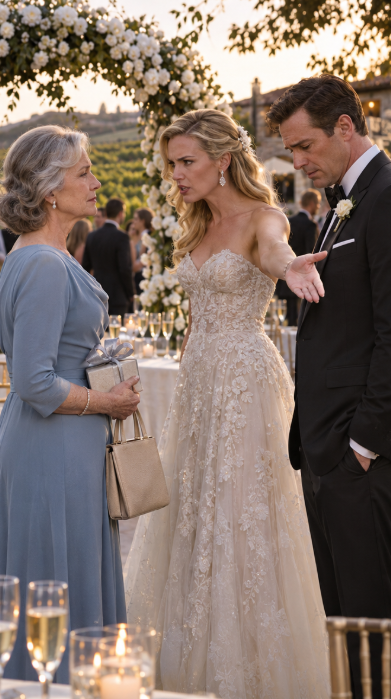
Amanda arrived at Eleanor’s office on a rainy Thursday morning.
She came alone.
No father.
No mother.
No Jacob.
She wore a dark blue coat and carried a plain canvas bag.
For the first time since I had met her, she looked like someone who had chosen her clothes without consulting anyone else’s expectations.
Eleanor greeted her professionally.
I remained seated.
Amanda looked at me.
“Thank you for agreeing to meet.”
I nodded.
“Please sit.”
She placed several papers on the conference table.
“I’ve written everything down.”
Eleanor examined the documents.
The statement described the planning process, the additional services Amanda had requested, and the assumptions she had made about my willingness to pay.
It also acknowledged that she had represented those assumptions to vendors as authorization without confirming them with me.
I listened as Eleanor read the important sections aloud.
Amanda occasionally corrected a date or clarified a conversation.
She did not attempt to blame me.
That was new.
When Eleanor finished, she looked up.
“Do you understand that this statement may affect who is responsible for some of the outstanding charges?”
“Yes.”
“And that your father may disagree with your decision to provide it?”
Amanda looked down.
“He already does.”
I studied her.
“What happened?”
She took a breath.
“He told me I was humiliating the family again.”
I felt a familiar ache.
“And what did you say?”
“I told him the humiliation came from what I did, not from admitting it.”
I looked at her for a long moment.
It was a brave answer.
Not because it erased anything.
Because it carried a cost.
Amanda continued.
“He says I’m on my own financially.”
“I’m sorry.”
She gave a small shrug.
“I have a job. I can support myself.”
I nodded.
“That’s good.”
She looked toward the rain-streaked window.
“I’ve spent years pretending I couldn’t survive disappointing him.”
Her voice trembled.
“Turns out I can.”
I thought about my own life.
How much of my time had been spent protecting other people from disappointment.
How often I had mistaken their comfort for my responsibility.
Amanda looked back at me.
“I know this doesn’t make up for the wedding.”
“No,” I said.
“I know I hurt you.”
“Yes.”
She swallowed.
“I wanted you out of the photographs because I thought you made everything look old-fashioned.”
The honesty startled me.
She continued before I could respond.
“Not just the dress. Your manner. Your stories about Harold. The way you wanted family traditions included.”
Her eyes filled.
“I thought if people saw those things, they’d see the wedding as less sophisticated.”
I sat very still.
Amanda wiped her cheek.
“And I was wrong.”
The room was quiet.
She looked at me.
“You were the only person there who wasn’t trying to impress anyone.”
Something moved painfully inside my chest.
I thought of the sky-blue dress.
Harold’s watch.
The little wrapped drawing.
I had arrived carrying the past, believing it was a gift.
Amanda had seen it as an embarrassment.
“I don’t need you to like my clothes,” I said.
She gave a wet, surprised laugh.
“I know.”
“I don’t need you to share my memories.”
She nodded.
“But I do need you to understand that I am a person. Not a decoration you can move out of sight.”
Amanda began crying openly.
“I understand.”
I hoped she did.
But I had learned not to confuse a moving conversation with lasting change.
Eleanor returned to the financial documents.
We spent two hours reviewing the remaining claims.
The event-planning agency agreed to correct several invoices.
The venue confirmed the optional services that had been canceled before delivery.
Other vendors accepted revised payment arrangements with Jacob and Amanda for expenses they had personally ordered.
My attorney confirmed that I remained responsible for the legitimate charges under my own agreements.
There was no magical disappearance of debt.
No dramatic court victory.
No sudden fortune.
Only a difficult process moving toward a fair resolution.
By the time the meeting ended, I felt exhausted but steadier.
Amanda gathered her papers.
Then she hesitated.
“Judith, may I ask you something?”
“Yes.”
“Do you think Jacob and I have any chance?”
I looked at her.
“That isn’t mine to decide.”
“I know.”
“Do you love him?”
She stared at the table.
“Yes.”
“Do you trust him?”
“Not completely.”
“Does he trust you?”
She shook her head.
“Not completely.”
I folded my hands.
“Then perhaps your marriage has to begin with honesty rather than the wedding you imagined.”
She smiled sadly.
“That’s what our counselor said.”
“Your counselor sounds sensible.”
Amanda stood.
At the door, she turned.
“I hope someday you’ll let me apologize without an attorney in the room.”
I considered the request.
“Perhaps.”
She nodded and left.
Afterward, Eleanor sat beside me.
“You handled that well.”
I looked at the empty chair.
“I don’t know.”
“What troubles you?”
“She seemed sincere.”
“She may be.”
“And part of me wants to believe everything can be repaired.”
Eleanor folded the documents.
“Some things can. Some can’t. You don’t have to decide which today.”
I appreciated that.
For years, I had rushed toward solutions because uncertainty frightened me.
Now I was learning to let uncertainty exist without immediately paying to remove it.
The following month brought gradual changes.
The remaining wedding obligations were settled through negotiated agreements and appropriate payments.
Richard’s attorney withdrew the threatened claim after reviewing the documentation and the venue’s account of the reception.
Amanda found a small apartment.
Jacob sold his second car and began making modest payments toward the debts he had listed.
His business remained uncertain, but he stopped pretending otherwise.
Sometimes he called simply to ask how I was.
The first time, I waited for the request hidden at the end.
There wasn’t one.
We spoke about the weather, the garden, and a book I was reading.
Then he said, “I just wanted to hear your voice.”
After the call, I cried for several minutes.
It was an ordinary sentence.
Perhaps that was why it mattered so much.
One afternoon, Jacob came over to help repair the porch railing.
Harold had built it twenty years earlier.
The wood was weathered, and several screws had loosened.
Jacob arrived carrying tools.
We worked together for nearly two hours.
He measured the replacement boards while I held them steady.
At one point, he laughed.
“Dad would’ve done this in half the time.”
“Your father would’ve spent the first hour telling you why the original railing was better.”
Jacob grinned.
“That’s true.”
We finished just before sunset.
As we put away the tools, he noticed the shoebox on the workbench.
“What’s that?”
I looked at it.
“Old memories.”
He smiled.
“Can I see?”
I hesitated.
Then opened the lid.
He lifted photographs, birthday cards, and school drawings.
When he reached the superhero picture, he stopped.
His expression changed.
“I remember this.”
“I thought you might.”
He studied it.
“Mom, I used to think you could do anything.”
I smiled sadly.
“So did I.”
He traced the uneven letters with one finger.
“Maybe that was too much to put on you.”
I looked at him.
“It was a lovely thing for a little boy to believe.”
“But not for a grown man.”
My eyes filled.
“No,” I whispered. “Not for a grown man.”
He carefully returned the drawing to the box.
Then he looked at me.
“Would you give it to me?”
I felt a small, unexpected reluctance.
I had kept it for thirty-eight years.
It had become proof of something I feared was lost.
“I brought it to your wedding,” I said.
Jacob stared at me.
“What?”
“It was your gift.”
His face crumpled.
“Oh, Mom.”
He sat on the workbench.
For several moments, he couldn’t speak.
Then he whispered, “I let her send you away while you were carrying that.”
“Yes.”
He covered his face.
I wanted to comfort him.
But this time, I allowed him to feel the full weight of what had happened.
When he finally looked up, his eyes were wet.
“I don’t know how to forgive myself.”
I sat beside him.
“Perhaps forgiveness begins with becoming someone who wouldn’t make the same choice again.”
He nodded slowly.
Then he asked, “Can I still have it?”
I looked at the drawing.
At the crooked cape.
At the wooden spoon.
At the unquestioning love of a child.
I could give it to him.
Or I could keep it as a reminder of what we had lost.
The choice felt unexpectedly enormous.
Because I understood that if I handed it over, I would be trusting him with something more valuable than money.
I would be trusting him with a memory I could never replace.
✓ Lynn R. Adams
Amanda arrived at Eleanor’s office on a rainy Thursday morning. She came alone. No father. No mother. No Jacob. She wore a dark blue coat and carried a plain canvas bag. For the first time since…