Chapter 8: What a Mother Leaves Behind 219
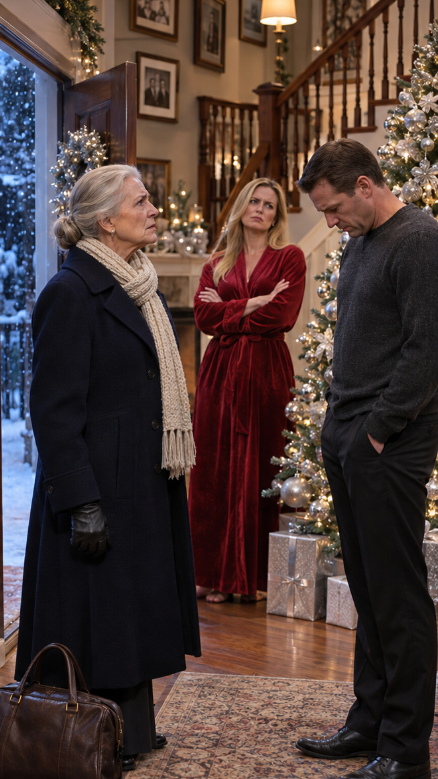
I slept better that night.
Not perfectly.
I woke once when the furnace rattled and again when snow slid from the roof.
But there were no whispered arguments in the hallway.
No unfamiliar perfume drifting beneath my door.
No fear that someone would enter and tell me the room was no longer mine.
At sunrise, I sat on the edge of my bed and looked at George’s photograph.
“Good morning,” I whispered.
It was something I’d done every morning since he died.
Some people might have considered it strange.
But grief creates small rituals that help us move through ordinary days.
I didn’t believe the photograph could answer.
I simply liked beginning the morning by remembering that I had once been loved very well.
After breakfast, I gathered the estate documents.
I spread them across the kitchen table.
The deed.
The mortgage discharge.
The insurance papers.
The old will.
The trust amendment my attorney had prepared after George died.
They represented years of work and careful planning.
Yet for the first time, I realized I had never seriously considered what kind of inheritance I wanted to leave.
I had assumed that whatever belonged to me would eventually belong to Matthew.
That was what parents did.
Wasn’t it?
They worked.
They saved.
They raised children.
Then they passed what remained to the next generation.
My own parents had left very little money.
My mother died with a few pieces of jewelry, photographs, and a sewing machine.
I inherited the machine.
It was old and heavy, with a pedal that occasionally stuck.
I used it for years.
When neighbors asked why I didn’t replace it, I told them it worked perfectly well.
The truth was that I loved the sound it made.
It reminded me of my mother sewing beside the kitchen window.
That inheritance had meant more to me than money.
Because it was a gift.
I had never looked at my mother’s belongings while she was alive and calculated when they might become mine.
I thought about that as I examined Matthew’s expected share of my estate.
I didn’t resent the idea of leaving him something.
He was my son.
I wanted him to be secure.
I wanted his children to have opportunities George and I could barely have imagined when we were young.
But I no longer wanted to reward the assumption that my possessions were already his.
There had to be a way to separate love from entitlement.
I called my attorney.
We had already discussed the immediate situation with the house.
Now I wanted to talk about what happened after my death.
He listened while I explained my concerns.
“I don’t want to punish Matthew for one terrible decision,” I said.
“That is understandable.”
“But I also don’t want him expecting to inherit the house itself.”
“Those are two separate questions.”
“I know.”
He explained that I could structure my estate in several ways.
I could direct the house to be sold after my death, subject to the administration of my estate and any applicable expenses.
The proceeds could then be divided according to instructions I chose.
Some could be placed in trusts for my grandchildren.
Another portion could support a charitable organization.
Matthew could receive a share through a trust rather than receiving the house outright.
There would be details to consider.
Trust administration.
Tax consequences.
The role of an independent trustee.
The exact language needed to carry out my intentions.
I listened carefully.
This time, I didn’t feel overwhelmed by the legal terminology.
I felt grateful that choices existed.
“What if Matthew becomes angry?” I asked.
The attorney paused.
“That is a family question rather than a legal one.”
“I understand.”
“You can explain your wishes, but ultimately the decision is yours.”
I looked at the deed.
My name appeared there in black ink.
For years, that had seemed sufficient.
Now I understood that ownership meant more than holding a document.
It meant accepting responsibility for the choices connected to it.
“Can we prepare a revised plan?” I asked.
“Yes.”
“Without disinheriting him?”
“Certainly.”
I let out a breath.
“Good.”
We discussed the arrangements in more detail.
I told him I wanted the grandchildren’s educational opportunities protected.
I also wanted to support an organization that helped older widows facing displacement or financial exploitation.
He asked why that cause mattered to me.
I looked around the kitchen.
“Because I know how easily a woman can spend her whole life building security and then be made to feel selfish for wanting to keep it.”
He was quiet for a moment.
Then he said, “That’s a clear reason.”
We arranged to review the formal documents after Christmas.
When the call ended, I sat alone with the papers.
I hadn’t signed anything new.
No decision was legally complete.
But I knew the direction I wanted to take.
And knowing that changed the way I felt about the house.
For the first time, I wasn’t thinking only about protecting George’s memory.
I was thinking about how my own choices might protect people after I was gone.
I went outside to check the porch.
The old wreath hung on the front door again.
I had tied its faded ribbon carefully.
The red and green lights remained in a box because I hadn’t yet had the energy to put them back.
I stood on the porch looking at the snow-covered garden.
George had planted roses along the walkway.
Every spring, he complained about the thorns.
Every summer, he admired the flowers as though he had personally invented them.
After he died, I learned to prune them myself.
The first year, I cut too much.
The second, not enough.
By the third, they were blooming beautifully again.
I smiled at the memory.
Perhaps that was what independence really looked like.
Not knowing how to do everything.
Not refusing help.
But being allowed to learn.
Being allowed to make mistakes.
Being allowed to remain the person responsible for your own life.
The locksmith arrived later that day, after Matthew and Jessica had surrendered their keys and completed their move.
I had arranged the appointment while confirming the appropriate steps with my attorney.
The work took less time than I expected.
When it was finished, I held the new keys in my palm.
They were ordinary metal objects.
Nothing special.
But I remembered the keys George had placed beneath our first Christmas tree.
He had tied them with a red ribbon.
I found a length of red ribbon in my sewing drawer and threaded it through the new key ring.
The gesture made me laugh at myself.
I was seventy-two years old, tying a ribbon around house keys as though I were a young bride again.
But perhaps there was something lovely about that.
I was beginning again.
Not from nothing.
Not without memories.
But from a place where I could still choose what came next.
That evening, I made a proper dinner.
Roasted vegetables.
A small portion of chicken.
Potatoes with rosemary.
Nothing elaborate.
I set one place at the kitchen table.
Then, after a moment, I lit a candle.
For years, I had avoided making a beautiful table when I was eating alone.
It seemed pointless.
George wasn’t there to admire it.
Matthew had his own family.
Why bother with a tablecloth or flowers for one person?
But as I sat down, I realized how unfair that had been.
I deserved a pleasant dinner even when nobody else was there.
I deserved clean sheets.
A decorated tree.
A comfortable chair.
A home arranged according to my own tastes.
Not because I had earned those things by being useful to others.
Because I was a person.
The thought was simple.
It also felt surprisingly new.
After dinner, I called Helen.
She was recovering steadily.
I told her about the attorney and the locksmith.
She listened.
Then she asked, “Have you heard from Matthew?”
“Not since he left.”
“Are you going to call him?”
I looked toward the tree.
“I don’t know.”
“Do you want to?”
“Yes.”
“Then why haven’t you?”
I thought for a moment.
“Because I don’t know what I’d say.”
Helen sighed softly.
“Perhaps you don’t have to know yet.”
I appreciated that answer.
I had spent so much of my life believing every difficult feeling needed to be resolved immediately.
Every disagreement needed a conversation.
Every silence needed filling.
Maybe some relationships needed time.
Not because love had disappeared.
But because the truth needed room to settle.
Before going to bed, I placed the children’s Christmas gifts beneath the tree.
I had bought them before leaving for Helen’s house.
Small things.
Books.
Warm scarves.
A few surprises I’d chosen carefully.
I hadn’t decided when they would receive them.
I hoped I could arrange a visit after the holiday.
I wanted the children to know I loved them.
I also wanted their parents to understand that the gifts did not mean the boundaries had disappeared.
I stood beside the tree for a long time.
The little school bus caught the light.
Matthew had made it decades earlier.
I wondered whether he remembered that Christmas.
I wondered whether he remembered what George had told him about taking care of things he’d worked for.
I wondered whether he would ever understand why I had asked him to leave.
Then I went upstairs.
Christmas morning arrived with fresh snow.
The roses outside the window wore white caps.
I made coffee in my GEORGE’S GIRL mug.
The house was quiet.
For the first time in years, that quiet didn’t frighten me.
It felt peaceful.
I carried my coffee into the living room and sat beside the tree.
At nine o’clock, my telephone rang.
Matthew’s name appeared on the screen.
I stared at it.
My thumb hovered above the answer button.
Then I took a breath and accepted the call.
“Mom?”
His voice sounded different.
Not angry.
Not defensive.
Almost uncertain.
“Merry Christmas,” he said.
And I realized that whatever came next might determine the future of our relationship.
✓ Lynn R. Adams
I slept better that night. Not perfectly. I woke once when the furnace rattled and again when snow slid from the roof. But there were no whispered arguments in the hallway. No unfamiliar perfume d…