Chapter 8: The House That Nearly Destroyed Us212
For three days after seeing the Baltimore job offer, I couldn’t bear to look at old photographs.
Every memory had acquired a second meaning.
The anniversary dinner when Ethan told me we couldn’t afford a weekend away.
The morning he asked whether I could cover another large repair.
The afternoon he congratulated me on my promotion but grew strangely quiet when I mentioned using the raise toward a future down payment.
At the time, I thought we were struggling together.
Now I knew he’d been hiding an opportunity that might have changed everything.
It didn’t mean the Baltimore job would have solved every problem.
Relocating would have required planning.
My career mattered too.
We might have decided not to accept it.
But the choice should have belonged to both of us.
Ethan had taken away even the possibility of discussing it.
On Monday, I arrived at work early and sat in my car for twenty minutes.
I watched people hurry through the parking lot carrying coffee cups and laptop bags.
I wondered how many of them were holding together families that had quietly stopped holding them.
When I finally entered the building, Patricia asked whether I was all right.
I told her I was having a difficult week.
She didn’t demand details.
She simply shifted one of my meetings and reminded me that I could use some of my accumulated vacation time.
I thanked her.
Then I went into my office and cried for five minutes.
Afterward, I washed my face and returned to work.
There was something strangely comforting about discovering that I could feel devastated and still function.
I didn’t have to pretend I was fine.
I also didn’t have to collapse.
That evening, I found a voicemail from Maryanne.
Her voice sounded older than I remembered.
“Alyssa, I need to speak with you about the house. This isn’t something we can keep avoiding.”
I listened twice.
Then I called Naomi.
She suggested arranging any substantial financial discussion in writing or with appropriate advisers present.
Maryanne had already retained a lawyer to review her debts and possible sale.
I sent a short message offering to consider a formal settlement proposal.
Her answer arrived almost immediately.
I never imagined you’d treat me like a stranger.
I stared at the words.
For two years, I had called her Mom.
I had brought her soup when she was ill.
Driven her to appointments.
Bought her birthday gifts.
Sat beside her on the anniversary of Richard’s death.
I had believed affection created mutual obligations.
Now I wondered whether she had understood our relationship primarily through what I provided.
I typed a reply.
I wanted us to be family. I still expect us to treat each other fairly.
She didn’t answer.
Two days later, Lauren called.
“Mom’s meeting with a real estate agent.”
I sat upright.
“She’s decided to sell?”
“She’s considering it seriously. The mortgage payments and home equity debt are more than she can comfortably manage.”
I looked around my small apartment.
“Has she spoken to a financial counselor?”
“Grant arranged an appointment. She didn’t want to go.”
“Why?”
“She said selling would mean admitting Dad’s life had been wasted.”
I closed my eyes.
“That isn’t true.”
“I know.”
Lauren’s voice became strained.
“She keeps saying that if you had just stayed patient, we could all have worked it out.”
I felt anger rise.
“Patient with what? Being told to move out while continuing to pay?”
“I told her that.”
“What did she say?”
“That I was turning against the family.”
I was quiet.
Then I asked, “How are you handling it?”
Lauren exhaled.
“Not well. But Grant and I are standing together.”
The phrase hurt.
Not because I resented her.
Because it was precisely what I had needed Ethan to do.
Stand together.
Two simple words.
An entire marriage could fail around their absence.
“I’m glad,” I said, and meant it.
Lauren hesitated.
“Mom wants to meet you in person.”
“For what?”
“She wants to explain.”
I thought about refusing.
The last conversation had ended with another attempt to make me responsible for keeping the house.
But Maryanne was still Ethan’s mother.
She had also been part of my life for seven years.
I wanted to understand how a woman who once welcomed me into her family had become someone willing to discard me.
I agreed to meet her at the house the following Saturday.
I arrived just after ten.
The driveway looked exactly the same.
The neatly trimmed hedges.
The pale stone walkway.
The brass door knocker that I had polished before every holiday.
But stepping inside felt like entering a house after the people who lived there had disappeared.
The living room was sparse.
The television was gone.
My coffee table had been removed.
Empty spaces marked where lamps once stood.
The rug was missing.
Maryanne had brought in two older chairs from storage.
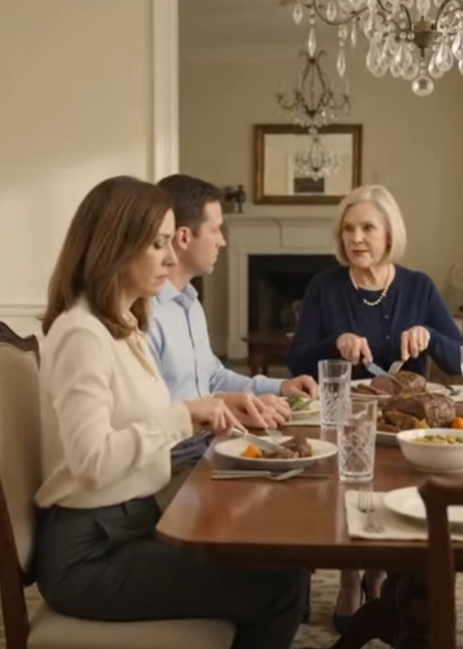
She sat in one of them, wearing the navy cardigan she’d worn at Sunday dinner.
For a moment, neither of us spoke.
Then she said, “It looks terrible without your things.”
I glanced around.
“It’s different.”
She looked down.
“I never realized how much you bought.”
I sat across from her.
“You had the receipts when I purchased most of it.”
“I didn’t think of it as yours.”
I frowned.
“What did you think of it as?”
She looked around the room.
“Part of the house.”
Her answer was remarkably honest.
Everything I brought had gradually become part of Maryanne’s property in her mind.
Furniture.
Money.
Labor.
Eventually, even my presence had been something she believed she could rearrange.
“Why did you ask me to leave?” I asked.
She tightened her hands.
“Lauren needed somewhere to be.”
“She had a home.”
“She needed her mother.”
“Then why couldn’t you make room for all of us?”
Maryanne stared toward the fireplace.
“Because Ethan told me he needed space from you.”
I felt the familiar pain return.
“I know.”
She looked startled.
“He told you?”
“I found his email.”
Maryanne closed her eyes.
For several moments, I watched her struggle.
Then she said, “He was unhappy.”
“I wish he’d told me.”
“He felt ashamed that you were supporting him.”
“I never asked him to feel ashamed.”
“I know.”
The admission surprised me.
Maryanne continued.
“When Richard was alive, he insisted that a man should provide for his family. Ethan grew up hearing that. When he lost his job, he started feeling like he’d failed.”
I looked at her.
“And you reinforced that feeling.”
She didn’t deny it.
“I suppose I did.”
“Then when he found a better job, you convinced him to turn it down.”
Her eyes filled.
“I was afraid he’d leave.”
“Maryanne, he was married. He was supposed to build a life with his wife.”
“I know that now.”
I studied her.
“Do you?”
She looked toward the window.
“I didn’t want to be alone.”
The room went quiet.
I thought of her standing beside Richard’s grave.
Of the years she’d spent preserving the house.
Of the fear that had gradually turned her children into emotional obligations.
For the first time, I saw the frightened widow beneath the controlling mother.
But I also saw how much damage she had caused by refusing to face that fear honestly.
“I understand being lonely,” I said. “But you cannot prevent everyone else from having a life because you’re afraid of losing yours.”
She wiped her cheeks.
“I thought if Lauren moved in and Ethan stayed, the house would feel alive again.”
“And I was supposed to fund it.”
She flinched.
“I didn’t think of it that way.”
“That’s the problem. None of you thought about what it cost me.”
Maryanne lowered her head.
“I know I’ve hurt you.”
I waited.
Then she looked up.
“But I could lose everything if you insist on repayment now.”
The familiar pressure returned.
I felt my shoulders tighten.
There it was.
The apology moving toward a request.
I had learned to recognize the pattern.
“I haven’t demanded immediate payment,” I said.
“My lawyer says the house may need to be sold if we can’t restructure things.”
“Then selling might be the responsible choice.”
Her face tightened.
“You’re talking about my home.”
“I know.”
“Richard’s home.”
“I know.”
“Everything we built.”
I looked around.
“Maryanne, keeping a house isn’t the same as preserving a marriage. Or a family.”
She began to cry again.
This time, I didn’t move to comfort her.
Not because I wanted her to suffer.
Because I knew that comforting her would be used to lead the conversation away from accountability.
“I can’t promise to surrender the documented advances,” I said. “But I am willing to review a realistic settlement through our attorneys.”
She looked at me with an expression I couldn’t read.
“You’ve changed.”
“Yes.”
She nodded slowly.
“I suppose you have.”
As I stood to leave, she said, “I never wanted to lose you entirely.”
I stopped.
“You didn’t act that way.”
She lowered her eyes.
“I know.”
I walked out through the front door without looking back.
In the car, I cried.
I cried because Maryanne’s fear was real.
Because the house meant something to her.
Because Ethan’s pain was real too.
Because understanding all of it still didn’t make their choices acceptable.
I had spent years believing compassion required self-sacrifice.
Now I was beginning to understand that compassion without boundaries could become another way to abandon myself.
The following week, Maryanne’s attorney sent Naomi a proposed settlement.
The proposal acknowledged some of the mortgage advances but characterized most as gifts or ordinary household support.
It offered a modest repayment amount over several years.
In exchange, I would release any further financial claims involving Maryanne’s property.
Naomi reviewed it with me.
“This is an opening proposal, not an obligation,” she said.
I studied the numbers.
The amount was far below the documented advances.
I was willing to compromise.
I wasn’t willing to pretend our original agreement had never existed.
We prepared a counterproposal based on the records.
Separately, Ethan’s attorney continued working through the marital financial disclosures.
The joint transfers remained disputed.
I didn’t want punishment.
I wanted a fair accounting and an equitable separation.
Then, on Thursday evening, Ethan called.
“Mom’s terrified,” he said.
“I know.”
“She can’t sleep.”
“I know.”
“Lauren isn’t moving in. Grant says they can’t buy the house. Everything’s falling apart.”
I sat at my dining table.
“Then everyone needs to make responsible decisions.”
He was quiet.
“I talked to my counselor,” he said.
“Good.”
“She thinks I need to make my own choices.”
I waited.
“I want to move out of Mom’s house.”
For a moment, I couldn’t breathe.
It was the sentence I had wanted to hear for two years.
The sentence that might have saved our marriage if he’d spoken it before Sunday dinner.
“I think that’s healthy,” I said.
“I want us to try again.”
My eyes filled.
“Ethan—”
“I know I hurt you. I know I lied. But I love you, Alyssa.”
I closed my eyes.
The familiar longing rose so strongly that I almost asked him to come over.
Almost.
Then he continued.
“If we can get Mom’s financial situation settled, I can finally leave. But the repayment claim is making everything harder.”
I opened my eyes.
“What are you asking?”
He hesitated.
“Maybe you could forgive the mortgage advances. Just those. We could start fresh without all this hanging over us.”
I stared at the wall.
“Are you asking me to give up the money so you’ll move out?”
“No. I’m saying it would help everyone.”
“Everyone except me.”
“Alyssa, please don’t look at it that way.”
I thought of the Baltimore job.
The hidden transfers.
The email.
The bedroom.
All the years I had spent making sacrifices in exchange for promises that something better would eventually happen.
“Would you still move out if I didn’t forgive the debt?” I asked.
He said nothing.
The silence lasted so long that I felt the answer settle in my chest.
Finally, he whispered, “I don’t know.”
I closed my eyes.
He had offered me the one thing I’d wanted most.
A home with my husband.
But beneath the offer was the same condition that had poisoned our marriage from the beginning.
First, sacrifice for his mother.
Then, maybe, I could have a life of my own.
“I can’t make that bargain,” I said.
“Alyssa—”
“I love you, Ethan. But I can’t buy your loyalty.”
He began to cry.
I sat quietly, tears moving down my own face.
Then he said, “If you insist on this, Mom may lose the house. And I don’t know whether I can forgive you for that.”
The words struck like a door slamming shut.
There it was.
The final choice he had placed before me.
Save his mother from the consequences of her decisions, or accept that my husband might never forgive me.
For a moment, I was that frightened little girl again, waiting for adults to decide whether she deserved a room.
Then I looked around my small apartment.
At the furniture I’d chosen.
The flowers on my table.
The keys beside my coffee cup.
And I realized that this time, the decision belonged to me.
✓ Lynn R. Adams
For three days after seeing the Baltimore job offer, I couldn’t bear to look at old photographs. Every memory had acquired a second meaning. The anniversary dinner when Ethan told me we couldn’t aff…