Chapter 7: The Christmas Tree George Built 219
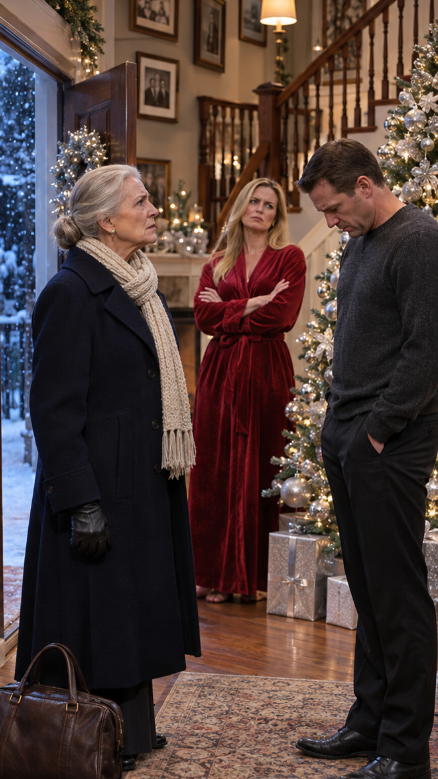
The silence after Matthew and Jessica left was unlike any silence I had experienced before.
When George died, silence had been an absence.
It lived in the empty chair beside the fireplace.
In the second pillow on our bed.
In the kitchen, where I sometimes turned around expecting to find him opening a cupboard.
That silence had been filled with longing.
The silence now felt different.
It was the sound of a house returning to its rightful owner.
I stood beside the front door with one hand resting against the wooden frame.
Outside, Matthew’s car disappeared around the corner.
Snow continued falling.
A few tire tracks marked the driveway.
I listened until the sound of the engine faded.
Then I locked the door.
The ordinary click made me unexpectedly emotional.
For twenty years, I’d locked that door because I was protecting my home from strangers.
I had never imagined I might need to protect it from people I loved.
I walked slowly through the hallway.
Jessica’s pink coat was gone.
The unfamiliar shoes had disappeared.
The shopping bags no longer crowded the table.
But the house still looked disturbed.
Empty spaces remained where photographs belonged.
Boxes stood beside the pantry.
The silver decorations had mostly been removed from the tree, leaving bare branches and a few strands of white lights.
I looked at it for a long time.
Then I took off my coat.
I had spent two days confronting other people.
Now I faced a quieter task.
I needed to decide how much of my life I was going to reclaim.
I began with the hallway.
I found the box containing our family photographs and carried it into the living room.
The frames were wrapped in newspaper.
Some had been stacked carelessly.
I unwrapped them one by one.
Matthew at five.
Matthew at graduation.
George and me on our twentieth anniversary.
Our first Christmas in the house.
The photograph from that Christmas showed an almost empty living room.
A small tree stood beside a window with temporary curtains.
George sat cross-legged on the floor, smiling with a paper plate in his hand.
I sat beside him.
We looked younger than I remembered.
Not simply younger in our faces.
Younger in the way we held ourselves.
As though everything important still lay ahead.
I sat on the sofa and held the picture.
George had been forty years old when I first met him.
He worked long hours.
He wasn’t particularly charming in the way people describe men in romantic stories.
He forgot anniversaries unless I reminded him.
He never learned how to fold a fitted sheet.
And he believed a sandwich could be improved by adding almost anything from the refrigerator.
But he kept his promises.
If he said he would be somewhere, he came.
If he made a mistake, he admitted it.
If someone needed help, he gave what he could without making them feel ashamed.
There had been difficult years in our marriage.
Bills we couldn’t pay immediately.
Arguments about money.
Exhaustion.
Disappointments.
But George never treated my sacrifices as something he was entitled to.
When I cleaned houses all day and sewed late into the night, he brought me tea.
When he worked overtime, I kept dinner warm.
Neither of us owned the other’s effort.
We built something together.
That was what Matthew seemed to have forgotten.
I returned the anniversary photograph to the mantel.
Then I placed Matthew’s graduation picture beside it.
For a moment, I considered leaving that space empty.
I was angry with him.
I was hurt.
But removing his picture would not change what had happened.
Nor would it make me feel better.
I could love my son without approving of his choices.
I could preserve his place in my family without giving him possession of my home.
The distinction felt difficult.
But necessary.
Next, I searched for my Christmas decorations.
I found them in three different boxes.
One held the ceramic village George had given me during our early years.
Another contained the ornaments we’d collected over decades.
The third was filled with miscellaneous holiday items Jessica apparently hadn’t wanted.
I opened the ornament box.
The smell of old cardboard and tissue paper rose into the air.
Near the top lay the honeymoon bell.
George and I had purchased it at a small shop because we couldn’t afford anything more elaborate.
The woman selling it told us that a bell was supposed to bring happiness into a new marriage.
George laughed and said that for the price, it ought to do more than ring.
I lifted it gently.
The metal was tarnished.
The ribbon was faded.
I carried it to the tree.
The first ornament went onto a branch near the center.
Then I found the little school bus.
Matthew had made it during kindergarten.
The wheels were uneven.
His name was written on the underside in childish handwriting.
I remembered him coming home with paint on his fingers, insisting that I close my eyes before he showed me.
George had admired it as though Matthew had built a real vehicle.
I hung it beside the bell.
My hands trembled slightly.
It occurred to me that the memory of Matthew as a child could still make me smile even while the behavior of Matthew as a man made me grieve.
Perhaps that’s part of motherhood.
You carry every version of your child inside you.
The baby.
The boy.
The teenager.
The adult.
You know they are all the same person, even when you sometimes wish you could speak to an earlier version.
I found the fingerprint ornament.
Five small impressions remained visible in the painted clay.
One was darker than the others.
Matthew had pressed too hard.
I traced them with my finger.
I could almost hear his childhood voice.
Mom, look! That’s my whole hand!
I hung the ornament on a low branch.
Then I sat for a moment.
My body felt tired.
Seventy-two years had taught me that emotional exhaustion could be every bit as physical as a day of hard work.
I made tea.
The kitchen was quiet.
I found my favorite mug inside one of the boxes Jessica had packed.
GEORGE’S GIRL.
The letters were faded, but they still made me smile.
George had given me the mug as a joke after I complained that all our cups looked alike.
He said the inscription would prevent anybody from confusing my coffee with his.
It hadn’t worked.
He still drank from it occasionally.
I washed it carefully.
Then I made tea in it.
As the kettle cooled, my phone vibrated.
Helen.
I stared at her name.
I had not told her what happened.
During our brief call the previous day, I had said only that getting home had been exhausting.
I didn’t want to upset her while she was recovering.
Now I answered.
“Hello, Helen.”
“There you are.”
Her voice sounded stronger than it had a week earlier.
“How are you feeling?”
“Better. Stop asking me that. How are you?”
I looked toward the Christmas tree.
“I’m all right.”
She was quiet for a moment.
“You don’t sound all right.”
I smiled faintly.
“Since when have you become an expert on my voice?”
“Since approximately seventy years ago.”
I laughed.
Then, unexpectedly, my eyes filled.
Helen heard the change.
“What happened?”
I hesitated.
“I came home to some surprises.”
“What kind of surprises?”
I looked at the silver ribbon still lying beneath the tree.
“Matthew and Jessica moved in while I was away.”
A long silence followed.
“Without asking you?”
“Yes.”
“Into your house?”
“Yes.”
“And you’re calling that a surprise?”
I wiped my eyes.
“Helen.”
“Tell me what happened.”
So I did.
Not every detail.
Not every hurtful sentence.
But enough.
I told her about the decorations.
The bedroom.
The lease.
The forty-eight-hour deadline.
And the fact that Matthew and Jessica had left.
Helen listened quietly.
When I finished, she asked, “Are you alone now?”
“Yes.”
“Are you safe?”
“Yes.”
“Good.”
I waited for her to tell me I’d been too harsh.
She didn’t.
Instead, she said, “I’m proud of you.”
I lowered my eyes.
“I don’t feel particularly proud.”
“Why not?”
“Because Matthew is angry.”
“He may be.”
“And Jessica probably thinks I’m cruel.”
“Possibly.”
I sighed.
“This is not what I wanted for Christmas.”
“Of course it isn’t.”
Helen paused.
“But tell me something. If you had come home and agreed to sleep in the spare room, how do you think next Christmas would have looked?”
I closed my eyes.
I imagined Jessica in my bedroom.
Matthew in George’s chair.
My photographs still in boxes.
Perhaps my belongings in storage.
Perhaps a polite conversation about whether I really needed such a large house.
“I don’t know,” I whispered.
Helen’s voice softened.
“I think you do.”
I looked toward the tree.
She continued.
“You can love Matthew and still tell him no.”
“I know.”
“Then believe it.”
We talked for several more minutes.
Before hanging up, Helen made me promise I would eat something and rest.
I agreed.
Then I returned to decorating.
I hung the glass cardinal next.
George had bought it after my mother died.
He found it in a small shop while we were out buying groceries.
My mother loved red birds.
She said they looked like drops of fire against the winter snow.
When George handed me the cardinal, I cried.
He never made fun of me for that.
He simply kissed my forehead and said, “She’d like it.”
I hung the cardinal where the tree lights could shine through its wings.
Then I reached for the wooden star.
I had placed it on the table, wrapped in a soft cloth.
I examined the damaged edge.
The splinter was small enough that I could smooth it without changing the shape.
I found a piece of fine sandpaper in George’s old toolbox.
Carefully, I rubbed the rough wood.
I didn’t try to make it look new.
I didn’t want a perfect star.
I wanted George’s star.
When the edge was safe, I climbed onto the step stool.
My knees protested.
I moved carefully, one hand resting against the tree.
Then I lifted the star and placed it at the top.
It leaned slightly to the left.
Exactly as it always had.
I stepped down.
Plugged in the lights.
And stood back.
The tree was uneven.
The ornaments didn’t match.
Some were faded.
Some were chipped.
It would never belong in a magazine.
It was perfect.
I sat in George’s chair and watched the lights.
For the first time since coming home, I felt peaceful.
But as evening deepened, another thought began troubling me.
Matthew had left the house.
Yet the belief that brought him here might not have left with him.
He still expected to inherit it.
Jessica still imagined it would someday become theirs.
I had reclaimed my home for the present.
But what about the future?
I looked toward the desk where my estate documents waited.
And I realized that unless I changed something, my son might one day receive exactly what he had tried to take.
✓ Lynn R. Adams
The silence after Matthew and Jessica left was unlike any silence I had experienced before. When George died, silence had been an absence. It lived in the empty chair beside the fireplace. In the s…