Chapter 6: The Broken Star 219
Matthew took one step into the garage.
Then he stopped.
I stood beside George’s old workbench with the wooden star in my hands.
One corner had splintered.
The paint was scratched.
The damage was small.
Almost insignificant.
Any reasonable person might have said it was only a piece of wood.
But when I ran my thumb over the chipped edge, I remembered George sitting at our kitchen table twenty years earlier, carefully sanding every rough corner so Matthew wouldn’t cut his fingers while helping decorate the tree.
George was never much of an artist.
He could repair a furnace, replace a broken door, or coax another year of service from an aging washing machine.
But he struggled to draw a straight line.
That star had taken him nearly an entire afternoon.
He had held it up proudly when he finished.
“Looks good enough from a distance.”
I had laughed.
Matthew, still young enough to believe his father could do anything, had declared it the most beautiful star in the world.
Now it lay damaged in my hands.
Matthew approached slowly.
“I’m sorry.”
I looked at him.
“For the star?”
He swallowed.
“For everything.”
I said nothing.
Apologies had always been complicated between us.
When Matthew was a boy, he apologized quickly.
Sometimes too quickly.
He learned that saying I’m sorry often brought an argument to an end.
George used to insist that an apology meant nothing unless the behavior changed.
“Words are easy,” he would tell our son. “Fixing what you broke is the hard part.”
Matthew stood before me, looking so much like his father for a moment that it hurt.
The shape of his jaw.
The way he lowered his eyes when ashamed.
Even the faint crease between his eyebrows.
I wanted to believe him.
I wanted to reach out and smooth away the discomfort in his face.
Instead, I asked, “Do you understand what you’re apologizing for?”
He looked at the star.
“I shouldn’t have let Jessica pack your things.”
I waited.
“And?”
He sighed.
“We shouldn’t have taken the bedroom.”
“And?”
His shoulders dropped.
“We should have asked before moving in.”
I nodded.
“That would have been a beginning.”
He looked at me.
“A beginning?”
“Yes.”
He frowned slightly.
I placed the star on George’s workbench.
“Matthew, this didn’t happen because Jessica moved some furniture.”
“I know.”
“Do you?”
He looked away.
I continued.
“You made plans for my house without including me. You assumed that because I’m your mother, my wishes were less important than yours.”
He rubbed his forehead.
“I didn’t think about it that way.”
“I believe you.”
He looked surprised.
“Really?”
“Yes.”
I held his gaze.
“And that’s part of what hurts.”
A long silence followed.
Outside the garage, snow slid from the roof with a muffled thump.
Matthew looked at the floor.
“I honestly thought you’d be happy to have us here.”
I considered that.
“Did you?”
He nodded.
“After Dad died, you were alone so much.”
I felt a familiar ache.
There it was.
The explanation I had half expected.
My loneliness.
My age.
My widowhood.
Convenient reasons for other people to decide what would make me happy.
“Matthew,” I said, “being alone and being lonely are not always the same thing.”
He stared at me.
“I thought you missed having people around.”
“Sometimes I do.”
“Then why—”
“Because I get to choose when I want company.”
He looked down.
I picked up the star again.
“Your father and I spent nearly forty years together. When he died, I thought the silence would destroy me.”
My voice trembled.
“For months, I left the television playing just to hear another human voice. I set two cups on the table without thinking. I woke reaching for someone who wasn’t there.”
Matthew’s eyes filled.
“I know it was hard.”
“No,” I said gently. “You know it hurt. You don’t know what it was like.”
He did not argue.
I continued.
“Eventually, I learned how to live in the quiet. I learned how to make dinner for one person. How to sleep in the middle of the bed. How to enjoy a cup of coffee without needing someone across the table.”
I looked around the garage.
“Those weren’t failures, Matthew. They were things I worked very hard to learn.”
His shoulders sagged.
“I never thought about that.”
“I know.”
He looked at the broken star.
“I guess I thought coming here would be good for everybody.”
“Then why wait until I was away?”
He closed his eyes.
For several seconds, he said nothing.
Then he answered.
“Because I was afraid you’d say no.”
The admission was so quiet that I almost missed it.
I set the star down.
“Thank you.”
He looked confused.
“For what?”
“For finally telling me the truth.”
He shifted against the workbench.
“We were having problems with the rent. Jessica was worried. We kept talking about how much money we’d save if we lived here.”
I listened.
“I said you probably wouldn’t mind.”
“Probably?”
He gave a miserable little smile.
“Then Jessica started making plans. She looked at furniture. Talked about what we’d do with the rooms.”
“And you went along with it.”
“Yes.”
“Because it was easier than telling her no?”
He nodded.
I felt sadness settle over me.
It was a familiar pattern.
Matthew had always hated disappointing people.
As a child, he wanted everyone to like him.
When he was older, he sometimes promised more than he could deliver.
George had warned him that avoiding one uncomfortable conversation often created a much bigger one later.
I wished my husband could stand beside us now.
Not to fight my battles.
Only to remind Matthew of a lesson he should already have learned.
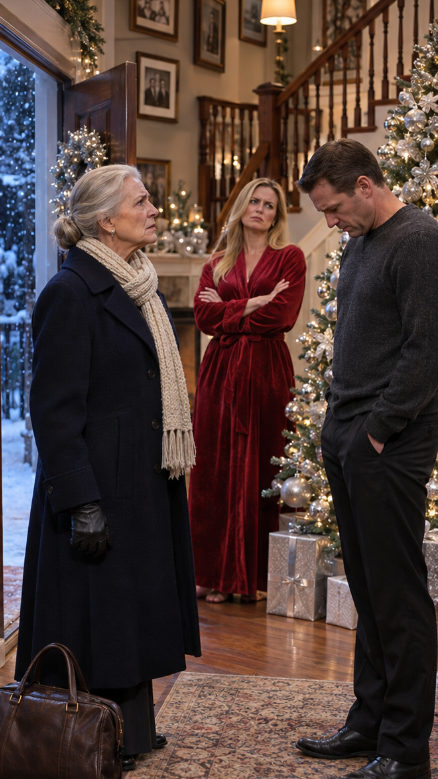
“Your wife was angry with me for coming home,” I said.
Matthew flinched.
“I know.”
“She treated me like an intruder.”
He nodded again.
“And you stood there.”
His face crumpled slightly.
“I’m sorry.”
I took a breath.
“That is the part I’ll have the hardest time forgetting.”
He looked toward the open garage door.
“I didn’t know what to say.”
“You could have said it was my house.”
He swallowed.
“I should have.”
“Yes.”
We stood in silence.
Then he asked, “Can you forgive me?”
I looked at him.
The question was harder than I expected.
Forgiveness had always seemed simple when I was younger.
Someone apologized.
You accepted.
Life continued.
But I had learned that trust was different.
Trust was built slowly.
And once damaged, it could not be restored simply because the person responsible felt sorry.
“I love you, Matthew.”
His eyes lifted.
“But I need time.”
He nodded.
“I understand.”
I hoped he did.
I turned toward the workbench and examined the star.
One splinter protruded from the edge.
George would have repaired it in minutes.
I ran my thumb along the wood.
“Do you remember when your father made this?”
Matthew gave a faint smile.
“I remember putting it on the tree.”
“You were so proud.”
“Dad made me hold the ladder.”
“You were too little to be any help.”
Matthew laughed softly.
“He said I was the supervisor.”
I smiled.
For a moment, the garage felt warmer.
A real memory stood between us.
Not a possession.
Not an inheritance.
A memory.
Then Matthew looked at the star again.
“Can I fix it?”
I considered his offer.
Part of me wanted to hand it over.
Let him repair what had been damaged.
Pretend the gesture could somehow repair everything else.
But I wasn’t ready.
“Thank you,” I said. “I’ll take care of it.”
He nodded.
The disappointment on his face was unmistakable.
I did not feel pleased by it.
I felt tired.
Behind us, Jessica called his name.
He turned toward the house.
“I should finish loading the car.”
“Yes.”
He hesitated.
“Mom?”
I looked at him.
“I really wasn’t trying to take your house away.”
I studied him.
“I hope that’s true.”
“It is.”
“Then learn the difference between expecting an inheritance and earning someone’s trust.”
He nodded.
Then he left.
I remained in the garage for several minutes.
I found a small cloth and wrapped the star carefully.
Then I picked up George’s jacket.
As I carried them toward the house, I remembered the last Christmas we spent together.
George was weak by then.
He couldn’t climb the small step stool.
Matthew had offered to put the star on top of the tree.
But George insisted on doing it himself.
I stood beside him with one hand ready to steady his arm.
He lifted the star slowly.
His fingers trembled.
When it finally settled in place, he smiled.
“There.”
Such a small word.
Such a great victory.
Later that evening, he sat in his chair with a blue blanket across his knees.
The tree lights reflected in his eyes.
I remember asking whether he was comfortable.
“Perfect,” he said.
He died several months later.
For four Christmases, I had placed the wooden star on the tree in his honor.
I wasn’t ready to stop.
Not because Jessica thought it looked old.
Not because Matthew imagined a different future for the house.
Not because my life had become less important with age.
When I entered the living room, Jessica was carrying a box of silver decorations toward the door.
She stopped when she saw the star.
“Oh,” she said.
I waited.
Her eyes moved toward Matthew, who was loading their belongings into the car.
Then back to me.
“I didn’t know it meant that much.”
I studied her.
“You knew George made it.”
She looked uncomfortable.
“I knew it was old.”
I said nothing.
She shifted the box in her arms.
“I didn’t mean to damage it.”
I wanted to believe her.
Perhaps she truly hadn’t meant to break it.
But carelessness could injure something just as surely as malice.
“I hope you’ll be more careful with other people’s belongings in the future.”
Her face tightened.
For a second, I expected another argument.
Instead, she looked away.
“Matthew says we can stay in a short-term rental.”
“I’m glad you’ve found somewhere.”
She glanced toward the tree.
“This could have worked.”
I looked at her.
“Not the way you tried to make it work.”
She said nothing.
I moved past her.
In the kitchen, I placed George’s jacket carefully over a chair.
Then I took out the old wreath.
The red ribbon was more faded than I remembered.
A few needles had fallen into the box.
I smiled.
George had been right.
It was still perfectly good.
By the time the final boxes were carried outside, dusk had settled over the neighborhood.
Matthew returned for one last bag.
Jessica stood near the open front door, looking around the house.
For a moment, I wondered whether she might apologize properly.
She didn’t.
Instead, she said, “I hope you’re happy.”
I looked at her.
“I hope we can all be happier when we’ve had time to think.”
She seemed surprised by the answer.
Then she walked outside.
Matthew paused in the doorway.
“I’ll call you.”
“All right.”
He looked toward George’s chair.
Then toward the Christmas tree.
Finally, he turned back to me.
“Merry Christmas, Mom.”
The words sounded painfully premature.
“Merry Christmas, Matthew.”
He left.
I closed the door.
Their car pulled away.
And for the first time in two days, I stood alone in my own home.
I should have felt triumphant.
Instead, I looked at the empty hallway and wondered whether I had just saved my independence at the cost of losing my son.
✓ Lynn R. Adams
Matthew took one step into the garage. Then he stopped. I stood beside George’s old workbench with the wooden star in my hands. One corner had splintered. The paint was scratched. The damage was …