Chapter 6: Part 6 – The Fourteen-Day Secret-068
## END – What We Chose to Save
**Part 6**
Rachel did not ask the obvious question.
Not immediately.
She stared at the photograph.
At the infant who had been born minutes before or after her.
At the hospital blanket.
The tiny closed fist.
The date written in fading blue ink.
Then she looked at Thomas.
“My mother told me I was an only child.”
“I know.”
“My father told me I was an only child.”
“I know.”
“You knew I had a sister for thirty-four years.”
“Yes.”
Rachel pushed back from the table.
I stood with her.
She wasn’t leaving.
She simply needed air.
Thomas remained seated.
For once, no one tried to stop her.
Rachel walked to the café window and pressed her fingertips against the glass.
Outside, people continued with an ordinary morning.
A cyclist passed.
A woman pushed a stroller.
Two men argued cheerfully beside a delivery truck.
Somewhere in the world, nothing had changed.
Inside that café, my wife’s understanding of herself had shifted again.
I went to her.
She whispered, “I’m tired of discovering my own life.”
I didn’t tell her it would be all right.
I had begun to understand how useless those words could be when nothing was all right yet.
Instead I said, “I know.”
She looked at me.
Then, despite everything, she smiled.
“You’re saying it now.”
“I’ve had a good teacher.”
Her smile became real for half a second.
Then she looked back at Thomas.
“Where is she?”
Thomas lowered his eyes.
“I don’t know.”
Rachel returned to the table.
“You just said she lived.”
“She did.”
“Then where did she go?”
Thomas rubbed both hands over his face.
“Evelyn became ill during the delivery. There were complications. I wasn’t listed as the father. Martin was.”
Rachel listened without blinking.
“The other baby was born with significant health concerns. Doctors expected she would need specialized care.”
“What kind?”
“A heart problem.”
Rachel closed her eyes.
Of course.
It always returned to the heart.
Thomas continued.
“Martin and Evelyn were overwhelmed. Their marriage had nearly ended. Your birth had already brought everything about me into the open.”
“What happened?”
“Evelyn’s older sister offered to help.”
Rachel frowned.
“Aunt Diane?”
“You remember her?”
“Barely. She died when I was eleven.”
Thomas nodded.
“Diane and her husband couldn’t have children.”
Rachel’s face changed.
“No.”
“They took your sister temporarily.”
“Temporarily.”
“That was the intention.”
“And then?”
“Months became years.”
Rachel stared at him.
“My parents gave away my twin?”
Thomas shook his head.
“Not the way you’re imagining.”
“Then explain how I grew up without knowing she existed.”
His voice softened.
“Because adults made decisions one at a time until eventually they’d built a situation none of them knew how to undo.”
That sentence could have described our entire story.
Thomas explained that Diane and her husband had moved north.
The baby needed repeated medical care.
Evelyn visited at first.
Then less often.
Martin struggled with the arrangement but believed removing the child from the only parents she’d known would cause more harm.
Eventually Diane legally adopted her.
“Her name?” Rachel asked.
“Anna.”
Rachel looked at the photograph.
“Anna what?”
“I don’t know her current surname.”
“You expect me to believe you’ve never tried finding her?”
“I did.”
“When?”
“Many times.”
“And?”
“Diane asked me to stop.”
“Everyone keeps asking you to stop.”
Thomas looked wounded.
“Yes.”
“And you always do.”
He absorbed that.
“Yes.”
Rachel sat back.
For the first time since I’d met him, Thomas looked less like a mysterious figure from the past and more like an ordinary man who had spent half a lifetime obeying decisions he wasn’t brave enough to challenge.
Rachel looked at me.
“Do you think I should find her?”
It was precisely the kind of question she’d once answered for herself.
I understood what she was really asking.
Not permission.
Partnership.
“I think,” I said carefully, “you should decide whether you want to.”
“I do.”
“Then I’ll help.”
Thomas closed his eyes.
Something like relief crossed his face.
Rachel noticed.
“This doesn’t make us a family.”
“I understand.”
“You don’t get to appear after thirty-four years and become my father.”
“I understand.”
“Martin was my father.”
“Yes.”
Thomas’s voice broke.
“I know.”
Rachel studied him for a long moment.
“But maybe we can figure out what you are.”
Thomas nodded.
“I’d like that.”
We found Anna three weeks later.
Not through dramatic detective work.
Not through secret records.
Through an obituary.
Diane’s obituary listed a daughter.
Anna Collins.
A music teacher living two hours from us.
Rachel stared at the name for an entire evening.
She wrote an email.
Deleted it.
Wrote another.
Deleted that too.
Eventually she asked me, “What would you say?”
“That I’m terrible at emails.”
“James.”
“I’d tell the truth.”
“All of it?”
“Enough to give her a choice.”
That mattered.
Choice.
Every generation before ours had been full of people making choices for someone else.
We wanted to stop.
Rachel sent a short message explaining who she was, what she had learned, and that Anna did not owe her a response.
We waited.
Four days passed.
Then six.
On the seventh evening, Rachel’s phone chimed while we were making dinner.
We both froze.
She looked at me.
“You open it.”
“No.”
“Why?”
“Because it’s yours.”
Rachel picked up the phone.
Read.
Covered her mouth.
I waited.
Finally she turned the screen toward me.
Anna had written only five sentences.
She knew.
Diane had told her when she was sixteen.
She had spent years wondering whether Rachel knew too.
She’d been too afraid to contact her.
And she wanted to meet.
Rachel cried.
Not dramatically.
She simply sat at our kitchen table while tears ran down her face.
The same table where, weeks earlier, I had accused her of spending fourteen days with another man.
How small that suspicion seemed now.
Not meaningless.
The lies still mattered.
But our lives had grown larger around them.
We met Anna in December.
She looked enough like Rachel to make me stare.
Same smile.
Different eyes.
Same habit of touching the edge of a cup while thinking.
Different voice.
They did not immediately behave like sisters.
Reality was quieter than that.
They talked about jobs.
Traffic.
Books.
Their parents.
Then Anna pulled out an old photograph Diane had kept.
Two infants together.
Rachel started crying.
Anna did too.
Neither apologized.
They spent four hours talking.
Then another three the next weekend.
They weren’t recovering a lost childhood.
They couldn’t.
They were building something new.
That difference became important.
Daniel told Claire everything.
They entered marriage counseling.
So did Rachel and I.
Not because our marriage was broken beyond repair.
Because pretending it hadn’t cracked would have been another kind of secrecy.
At our third session, the counselor asked what I needed from Rachel.
I said, “I need her to tell me things before she decides how I’ll react.”
The counselor asked Rachel what she needed from me.
Rachel was quiet.
Then she said, “I need to know disappointment isn’t abandonment.”
I looked at her.
That sentence explained more than fourteen days in the Bahamas ever could.
Rachel had spent her childhood in a family built on unspoken fear that one truth might cause someone to leave.
Thomas.
Martin.
Evelyn.
Anna.
Everything had been arranged around preventing departures.
Rachel had inherited more than biology.
She had inherited silence.
And during the worst decision of our marriage, she’d repeated it.
I reached for her hand.
“You can disappoint me,” I told her.
Her eyes filled.
“I probably will.”
“You definitely will.”
She laughed.
“So will you,” she said.
“Frequently.”
“But you’ll stay?”
I thought carefully before answering.
“I’ll tell you when I’m angry. I’ll tell you when I’m hurt. I’ll tell you when I need space.”
I squeezed her hand.
“But I won’t make you guess whether I’m still here.”
That was the promise we made.
Not that we’d never hurt each other.
Not that we’d never misunderstand.
That we would stop using silence as protection.
Our medical appointments brought less dramatic answers.
Daniel needed continued cardiac monitoring and treatment from his doctors.
Rachel’s follow-up testing showed she carried a familial risk marker, but her physicians explained that a genetic finding was not the same as a prediction of what her future would be. She built a proper care plan with specialists instead of trying to interpret frightening possibilities alone.
I was evaluated separately because of my father’s family history.
For two weeks, I slept badly.
Rachel knew.
This time neither of us pretended otherwise.
One night she found me sitting downstairs at three in the morning.
“You’re scared,” she said.
“Yes.”
She sat beside me.
“So am I.”
We stayed there until sunrise.
No solutions.
No speeches.
Just company.
When my results arrived, my doctor explained that I hadn’t inherited the specific variant found in my father’s records.
I walked out of the clinic and sat in my car.
I expected relief.
I felt it.
But I also cried for my father.
Because somewhere inside his flawed decisions had been love.
Misguided love.
Fearful love.
Love that believed silence might save his son from worry.
He had been wrong.
But understanding that allowed me to forgive him without pretending his decision had been right.
Rachel learned to do the same with Evelyn.
And eventually with Thomas.
Not quickly.
Not completely.
Real forgiveness rarely arrives like a door suddenly opening.
Sometimes it is simply a door you stop locking.
By spring, Thomas occasionally joined Rachel and Anna for lunch.
He never asked them to call him Dad.
Rachel never did.
Anna didn’t either.
They called him Thomas.
And he learned to be grateful for what was offered rather than grieving what wasn’t.
One Saturday afternoon, six months after Rachel came home from the Bahamas, we were cleaning the garage when I found the cream dress she’d worn that morning.
It was hanging inside a dry-cleaning bag.
“You never wore this again,” I said.
Rachel glanced over.
“I hate that dress.”
“Why?”
“It reminds me of coming home.”
I smiled slightly.
“You looked beautiful.”
“I was terrified.”
“I know.”
She looked at me.
“Were you really convinced I’d had an affair?”
“For about forty-eight hours, I was convinced you’d run off with a man who owned six linen shirts and called himself a yacht enthusiast.”
Rachel laughed.
“Daniel owns four linen shirts.”
“Still suspicious.”
She came closer.
“James.”
“Hmm?”
“Thank you.”
“For insulting your brother’s wardrobe?”
“For staying.”
I looked at her.
“You stayed too.”
“I was the one who lied.”
“Yes.”
“And you were the one who got hurt.”
“Yes.”
She waited.
I knew what she wanted.
Not reassurance that erased responsibility.
Truth.
“You hurt me badly,” I said.
Her eyes lowered.
“But hurt isn’t always the end of a story.”
She looked up.
“No?”
“No.”
I touched the sleeve of the cream dress.
“Sometimes it’s the place where you finally stop telling the easy version.”
Rachel smiled.
We donated the dress.
Not as a grand symbol.
We were cleaning the garage.
It didn’t fit the life she wanted anymore.
That evening, Anna and her husband came for dinner.
Daniel and Claire joined us later.
Thomas arrived carrying an apple pie he’d clearly bought from a bakery while insisting he’d helped make it.
My mother brought salad.
For a moment, I stood in the doorway between the kitchen and dining room.
Rachel was laughing with Anna.
Daniel was arguing with Thomas about sailing.
Claire was setting plates on the table beside my mother.
People whose lives had been separated by thirty-five years of secrets were discussing parking, pie and whether we’d made enough potatoes.
Nothing looked cinematic.
That made it beautiful.
Rachel noticed me.
“What are you doing?”
“Nothing.”
“You’re staring.”
“I’m observing.”
“That’s just staring with better branding.”
She walked over.
Behind her, Anna laughed at something Thomas said.
I looked at my wife.
“Do you ever think about what would’ve happened if Claire hadn’t called me?”
Rachel considered it.
“I would’ve come home.”
“Would you have told me?”
She didn’t answer immediately.
Then she said, “Eventually.”
I raised an eyebrow.
“Okay.”
She sighed.
“Maybe not.”
“That’s what I thought.”
She took my hand.
“But I would’ve been wrong.”
“Yes.”
“And now?”
“Now what?”
“If something frightening happens?”
I looked at her.
“Tell me before you’ve invented a corporate retreat.”
She laughed.
“Deal.”
I kissed her forehead.
Later, after everyone left, Rachel and I stood together in the kitchen.
The house was quiet.
Two coffee cups remained on the counter.
Someone had forgotten a scarf.
A half-finished pie sat beneath foil.
Rachel leaned against me.
“You know what’s strange?” she asked.
“What?”
“I thought Thomas was the secret.”
“He wasn’t?”
“No.”
She shook her head.
“Then I thought Anna was.”
“And?”
“She wasn’t either.”
“What was?”
Rachel looked around the kitchen.
“All of us thinking love could survive truth less easily than it could survive lies.”
I thought about my father.
Evelyn.
Martin.
Thomas.
My mother.
Daniel.
Claire.
Rachel.
Me.
“That’s a terrible family tradition,” I said.
“It is.”
“Should probably end it.”
“I was thinking the same thing.”
She rested her head on my shoulder.
For years, I’d believed trust meant never having reason to doubt someone.
I understood it differently now.
Trust wasn’t ignorance.
It wasn’t certainty.
And it certainly wasn’t the comfortable assumption that the person beside you would never make a mistake.
Trust was knowing that when difficult truths appeared, neither person would run from the room carrying half the story.
Rachel had returned from the Bahamas looking like a stranger.
Months later, standing beside me in the same kitchen, she looked like my wife again.
Not because I knew everything about her.
I never would.
No person could.
She looked like my wife because she’d stopped hiding behind the version of herself she thought I needed.
And I had stopped demanding that love mean never being disappointed.
Rachel took my hand.
“Come upstairs?”
“In a minute.”
She smiled.
“What are you thinking about?”
I looked once more at the room where the whole thing had begun.
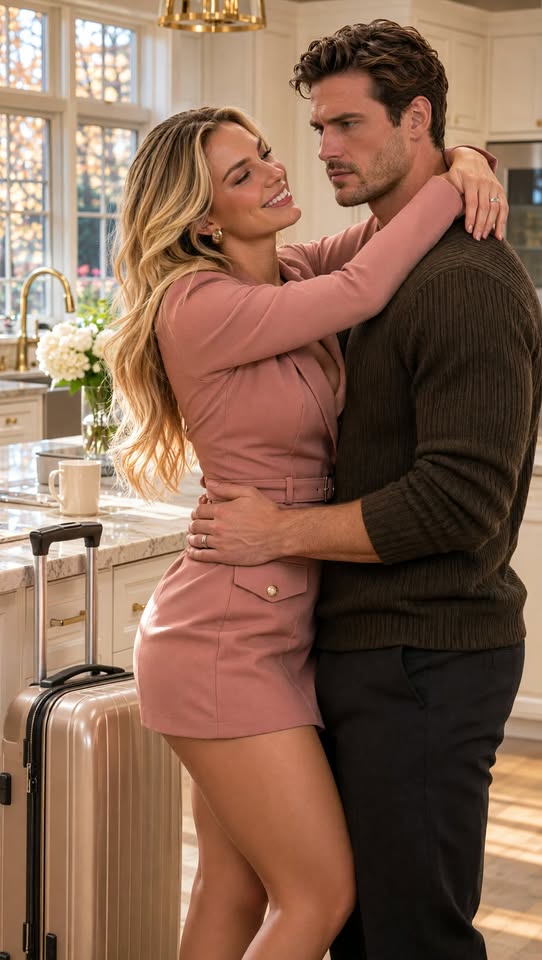
A suitcase.
A vibrating phone.
One dangerous question.
An illness that wasn’t what I’d feared.
An affair that hadn’t happened.
A brother.
A father.
A sister.
And an entire generation of people who had confused secrecy with protection.
“I’m thinking,” I said, “that fourteen days can change a life.”
Rachel squeezed my hand.
“Sometimes.”
Then she switched off the kitchen light.
And together, knowing far more than we had before—and finally understanding how much we could never control—we walked upstairs.
Not toward the life we’d had.
Toward the one we were finally ready to tell the truth inside.
**–THE END–PLEASE
Share your thoughts or feedback to motivate us to create more stories ♥️**
✓ Lynn R. Adams
## END – What We Chose to Save **Part 6** Rachel did not ask the obvious question. Not immediately. She stared at the photograph. At the infant who had been born minutes before or after her. At …