Chapter 5: The Family We Were Finally Free to Choose 212
My daughter stood in the bedroom doorway holding a worn stuffed rabbit, waiting for an answer that should have belonged to her years ago.
“Mommy, is the nice man my daddy?”
I could have told her we would discuss it in the morning.
I could have said she was too young to understand.
I could have postponed the truth until my fear became easier to manage.
But I had spent five years watching what happened when adults decided someone else wasn’t ready to know the truth.
I would not repeat that mistake with Lily.
I placed my phone on the table.
Then I knelt in front of her.
“Yes, sweetheart.”
She blinked.
“Really?”
“Really.”
Her little fingers tightened around Mr. Buttons.
“His name is Alexander?”
“Yes.”
“And he’s my daddy?”
I nodded.
She considered that with the serious concentration she usually reserved for difficult puzzles.
“Why didn’t he come to my birthday?”
My throat tightened.
“Because he didn’t know about you.”
She frowned.
“Why?”
I took a breath.
“Your daddy and I loved each other a long time ago. Then some confusing things happened, and we stopped talking. I should have found a way to tell him about you, but I was afraid.”
Lily looked puzzled.
“Afraid of him?”
“No, baby. Afraid of what might happen.”
She glanced at the phone.
“Is he afraid too?”
The question brought tears to my eyes.
“Maybe a little.”
“Because he’s never been a daddy before?”
I smiled.
“That might be part of it.”
She thought for another moment.
Then she asked the question that nearly destroyed me.
“Did you hide me because I was bad?”
I pulled her gently into my arms.
“No, Lily. Never.”
My voice shook.
“You are the best thing that ever happened to me. Nothing about this was your fault.”
She wrapped her arms around my neck.
“Okay.”
I held her until her breathing relaxed.
Then she leaned back.
“Can he come to the park?”
I laughed through my tears.
“I think he’d like that.”
She smiled.
“Good. Because I want to show him the ducks.”
Alexander met us at the park two days later.
We had spoken with a child and family counselor, who helped us think through Lily’s questions and the importance of allowing her to build the relationship at her own pace.
Alexander arrived carrying nothing.
No expensive presents.
No giant stuffed animals.
No flowers meant to impress me.
Just himself.
He stood near the pond in a dark blue sweater, looking more nervous than I had ever seen him.
Lily held my hand.
“That’s him,” she whispered.
“Yes.”
She took two steps forward.
Then stopped.
Alexander knelt so they were closer to eye level.
“Hello, Lily.”
“Hello.”
He smiled.
“I’m Alexander.”
“I know.”
I watched his expression soften.
Lily studied him.
“Mommy says you’re my daddy.”
Alexander’s eyes filled.
“Yes. I am.”
She frowned.
“Where were you?”
He looked at me briefly.
I nodded.
He turned back to her.
“I didn’t know about you until recently. I’m very sorry I missed so much.”
She considered his answer.
“Do you like ducks?”
A surprised laugh escaped him.
“I do.”
“Even the brown ones?”
“Especially the brown ones.”
She reached for his hand.
“Come on. I’ll show you.”
Alexander looked at their joined hands.
For one brief moment, he seemed unable to move.
Then he stood and followed her toward the pond.
I remained beside the bench.
I watched Lily point toward the ducks, explaining which ones were friendly and which ones stole food.
Alexander listened as though she were delivering the most important presentation of his life.
He didn’t interrupt.
He didn’t ask her to call him Daddy.
He didn’t try to compensate for missing years with promises he couldn’t yet understand how to keep.
He simply stayed.
And when Lily stumbled on the path, he offered his hand without making her feel helpless.
That small gesture broke something open inside me.
For years, I had believed love was proven through sacrifice.
Tonight, I began to understand that sometimes love was simply a person remaining beside you when there was no audience to impress.
The weeks that followed were not easy.
Alexander and I met with family-law attorneys to establish his legal parentage and agree on arrangements that would protect Lily’s stability.
We discussed schedules, medical decisions, school activities, and the practical realities of sharing responsibility for a child who had known only one home.
There were uncomfortable conversations.
There were moments when Alexander’s enthusiasm frightened me.
He wanted to help with everything.
I sometimes heard an offer of help as a threat to my independence, even when none was intended.
One evening, he suggested moving Lily to a larger apartment with a garden.
I reacted badly.
“She doesn’t need an expensive house to be happy.”
He looked startled.
“I didn’t say she did.”
“You think everything can be fixed with money.”
He was quiet.
Then he said, “Emily, I’m trying to find a place in her life. I don’t know the rules yet.”
The honesty stopped me.
I sat down.
“Neither do I.”
He joined me.
We talked for nearly two hours.
About boundaries.
About money.
About the difference between accepting support for Lily and surrendering my independence.
About the resentment I still carried toward the years he had missed.
About the grief he felt whenever he discovered something ordinary that other fathers had experienced long before him.
Eventually, we agreed to move slowly.
Lily would remain in the home she knew.
Alexander would become a consistent presence through regular visits and shared activities, with longer periods together as her comfort and trust grew.
We would make decisions as her parents, not as former lovers trying to repair everything at once.
And we would never use Lily to punish each other.
It was an imperfect beginning.
But it belonged to us.
The matter involving Mark developed more slowly.
An independent review of Reynolds Digital Systems found serious discrepancies between the company’s investor representations and the actual history of the AccessOne technology.
The review also identified unresolved licensing issues concerning the university’s original research materials.
The company had acquired technical assets from a consulting firm, but the rights attached to those assets were narrower than Mark had represented.
My research records became part of the evidence.
So did the university’s archived agreements.
The reviewing attorneys and technical specialists asked detailed questions.
I answered them.
I didn’t exaggerate my contribution.
I didn’t claim ownership of work that belonged to others.
I explained what I had designed, what the university had authorized, and what the early prototype had actually been capable of doing.
For the first time in years, my professional knowledge mattered to people who weren’t trying to diminish it.
Mark’s investors demanded corrective disclosures.
His company’s board removed him from day-to-day leadership while the corporate and legal issues were addressed.
Additional financing was suspended pending resolution of the material concerns.
Alexander didn’t personally order those consequences.
He had recused himself from the relevant decisions.
That mattered to me.
I didn’t want justice that depended on whether the father of my child was powerful enough to punish someone.
I wanted accountability that could withstand scrutiny.
Eventually, the company entered negotiations with the university to resolve the intellectual property and licensing disputes.
My contribution received formal recognition.
It wasn’t a miraculous fortune.
It didn’t turn me into a billionaire.
But seeing my name accurately credited beside work I had helped create meant more than Mark’s proposed payment ever could have.
For five years, my family had treated my abandoned graduate studies as evidence that I lacked ambition.
Now the work I had done before Lily was born was helping me rebuild the future I thought I had lost.
Chloe did not return to Mark.
She moved into a small apartment near her office and sought legal advice about separating from him.
The wedding photographs remained in boxes.
For weeks, she couldn’t bear to look at them.
One afternoon, she came to my apartment carrying a framed picture.
It showed us as children.
I was ten.
She was seven.
We stood beneath a tree in our backyard, our arms wrapped around each other.
“I found this while packing,” she said.
I studied our younger faces.
We looked happy.
Before everything became a competition.
Before Chloe learned that being praised often meant watching me be criticized.
Before I learned to hide my hopes because someone would eventually explain why they were foolish.
“I remember that day,” I said.
“You taught me to climb that tree.”
“You were terrified.”
She smiled faintly.
“You told me you’d catch me.”
I looked at her.
“Would you?”
She began crying.
“I don’t know if I would have caught you when you needed me.”
I set the photograph down.
“At the wedding, you didn’t.”
She nodded.
“I know.”
I could have reassured her.
I could have said everything was forgiven.
But I was learning that love did not require pretending the past had been different.
“Then be someone I can count on now,” I said.
She wiped her cheeks.
“I will.”
Over the following months, she tried.
She helped with Lily when my work schedule became difficult.
She attended family counseling with me.
She learned to recognize the ways our parents had taught us to compete for affection.
Sometimes we argued.
Sometimes we laughed.
Sometimes we sat together in silence, grieving the years we couldn’t get back.
Our relationship wasn’t magically repaired.
It was being rebuilt.
And for the first time, neither of us was trying to earn the title of the better daughter.
My father contacted me through an attorney after I reported the fountain incident to the police.
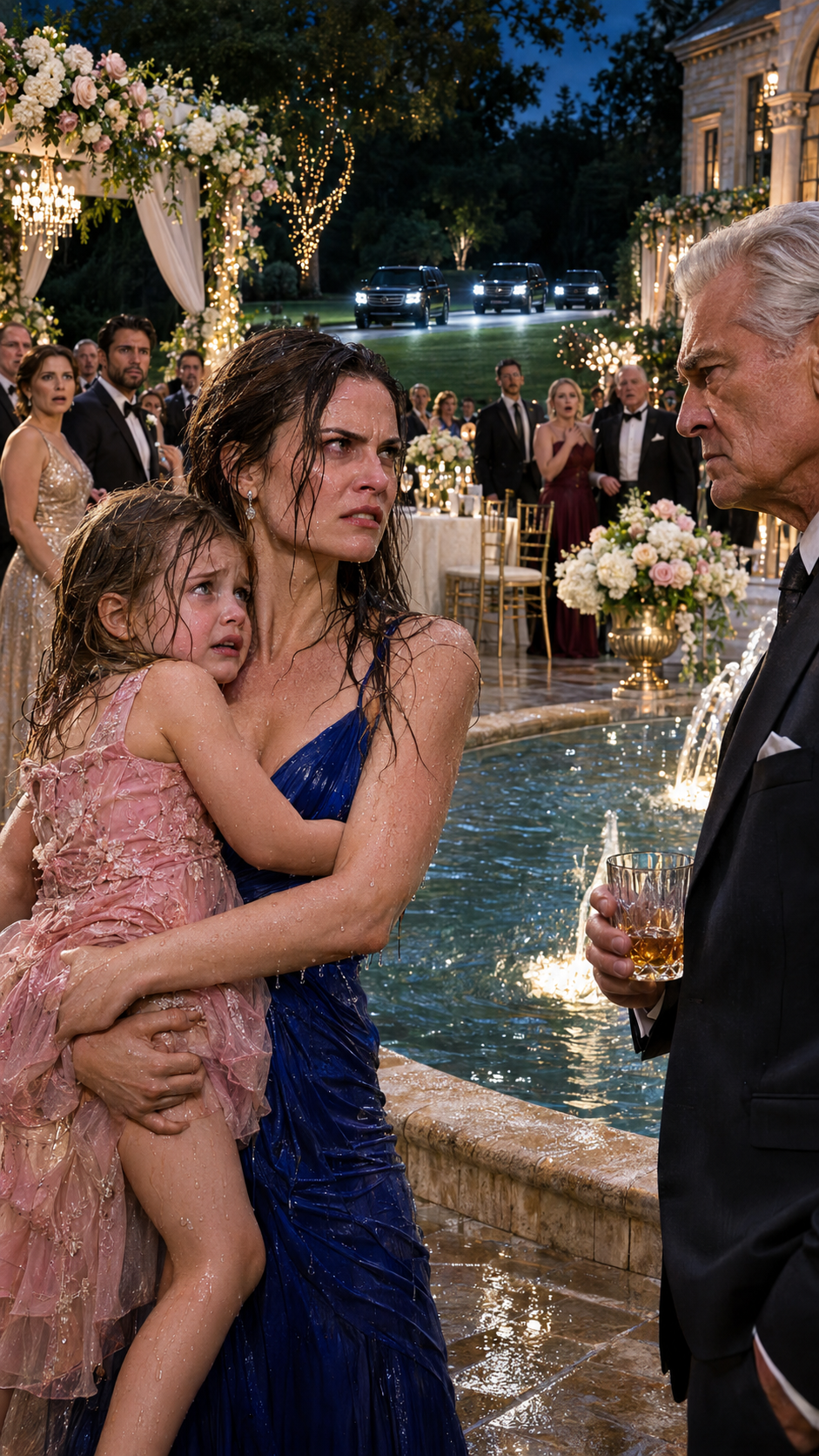
A guest had provided a recording showing him pushing me while Lily was in my arms.
Other witnesses confirmed what happened.
The investigation proceeded through the ordinary legal process rather than the dramatic punishment Mark had feared would embarrass his family.
Richard was forced to answer questions he could no longer dismiss as private family business.
His attorney eventually contacted mine about resolving the matter.
I refused to retract the facts.
I also refused to make revenge the center of my life.
Whatever legal consequences followed would not restore the childhood I’d lost or erase Lily’s fear.
My responsibility was to keep her safe.
I made it clear that Richard would have no contact with her unless and until I believed it could happen safely, with appropriate boundaries.
A month later, a letter arrived.
This one was actually addressed to me.
And this time, nobody intercepted it.
My father’s handwriting looked smaller than I remembered.
Emily,
I have been told that I need to take responsibility for what happened.
I thought I was protecting you when I interfered with Alexander Sterling.
I see now that I was wrong.
I was afraid you would leave our family and never look back.
I stopped reading.
There it was.
The truth beneath all his lectures about responsibility.
He had been frightened of losing control.
So he had tried to make my world small enough that I would never leave it.
Near the bottom, he wrote:
I don’t expect you to forgive me. I only hope that someday Lily will know I regret what I did.
I folded the letter.
Then I placed it in a drawer.
I didn’t throw it away.
I didn’t answer.
For now, that was enough.
My mother made several attempts to apologize.
At first, they sounded familiar.
She had been worried.
She had made mistakes.
She hadn’t understood how much she was hurting me.
But one afternoon, she came to the community center without asking to see Lily.
She sat across from me and said something I had never heard her say before.
“I helped your father lie because it was easier than standing up to him.”
I looked at her.
She continued.
“I watched him make you feel worthless because defending you would have meant risking his anger.”
Her hands trembled.
“I let you believe Alexander had abandoned you. Then I watched you struggle, and I told myself that helping with the baby occasionally made up for what I’d done.”
I said nothing.
She looked down.
“It didn’t.”
“No,” I whispered. “It didn’t.”
She cried quietly.
Then she asked, “Is there anything I can do?”
I thought carefully.
“Stop asking me to make you feel better about what happened.”
She nodded.
“And stop defending Dad.”
“All right.”
“If you want a relationship with me, it has to be based on the truth.”
She looked at me.
“I understand.”
I wasn’t certain she did.
Understanding would require more than one conversation.
But for the first time, she appeared willing to learn without demanding immediate forgiveness.
That was a beginning.
Not a promise.
A beginning.
Six months after the wedding, I received an email from my former graduate adviser.
The university was launching a new research initiative focused on accessible digital services.
My earlier work had been reviewed during the licensing investigation, and several faculty members wanted to know whether I would consider returning to complete my degree.
I read the email three times.
Then I called Alexander.
“They want me back,” I whispered.
“Who?”
“The university.”
He was quiet for a moment.
Then he laughed.
“Of course they do.”
I began crying.
“I don’t know if I can manage it.”
“Why not?”
“Work. Lily. Tuition. Everything.”
He listened.
Then he said, “Do you want to go back?”
I looked toward the living room.
Lily was sitting on the floor, building a cardboard castle.
She had drawn windows on every side because, according to her, nobody should live in a house without enough light.
“Yes,” I whispered.
“Then let’s work through what’s possible.”
Not I’ll pay for it.
Not I’ll take care of everything.
Not You don’t need to worry anymore.
Just an offer to help me think.
I contacted the university’s financial aid office.
I spoke with my supervisor about flexible scheduling.
I applied for a returning-student grant.
And, slowly, a plan emerged.
I would finish my degree part-time.
I would continue working.
I would remain Lily’s mother in the way I had always been her mother.
But I would stop acting as though having a child meant abandoning every other part of myself.
One Sunday afternoon, Alexander arrived at the park carrying a small paper bag.
Lily ran toward him.
“Daddy!”
He stopped.
The word had appeared naturally over the previous months.
At first, she had called him Alexander.
Then Daddy Alexander.
And now, sometimes, simply Daddy.
Each time, his expression changed in a way I never grew tired of seeing.
He knelt and hugged her.
“Hello, sunshine.”
“Did you bring the bread?”
He lifted the bag.
“The proper duck food. Just like the park sign says.”
She cheered.
He smiled at me over her shoulder.
It was a small moment.
But small moments had become the foundation of their relationship.
He knew her bedtime routine.
He knew she preferred green grapes to red ones.
He knew she hated loud vacuum cleaners and loved stories about adventurous animals.
He had attended her preschool concert and cried so visibly that Lily asked whether he’d injured his eyes.
He had been there when she got her first loose tooth.
He had also learned that fatherhood involved ordinary disappointments.
Sometimes she preferred me.
Sometimes she was tired and didn’t want to visit.
Sometimes she was angry because he wouldn’t allow her to eat ice cream before dinner.
He accepted those moments without withdrawing his affection.
And slowly, I stopped waiting for him to disappear.
We sat on a bench while Lily watched the ducks.
Alexander reached for my hand.
I let him take it.
“Are you happy?” he asked.
I considered the question.
Six months earlier, I would have struggled to answer.
Happiness had seemed like something fragile that could disappear if I acknowledged it too confidently.
Now I looked at Lily.
At the peaceful water.
At the man beside me.
At the life I was building without asking my parents for permission.
“Yes,” I said.
Then I smiled.
“Not every minute.”
He laughed.
“That’s reassuring.”
I turned toward him.
“Are you?”
He thought carefully.
“I still grieve the years I missed.”
“I know.”
“And sometimes I wonder what would have happened if I’d knocked on your parents’ door one more time.”
I squeezed his hand.
“I wonder too.”
He looked at me.
“But I don’t want to spend the rest of my life loving a version of us that never existed.”
My throat tightened.
“What do you want?”
He glanced toward Lily.
“To be the father she deserves.”
Then he looked back at me.
“And to find out whether you and I can become something good again. Not because of what we used to be. Because of who we are now.”
I held his gaze.
There were still wounds between us.
Years of loneliness.
Decisions neither of us could undo.
Questions that would require patience rather than grand promises.
But there was affection.
Respect.
A willingness to listen when the truth was uncomfortable.
And for the first time, I was no longer confusing love with the fear of losing someone.
“I’d like that,” I whispered.
Alexander smiled.
He didn’t kiss me.
Not yet.
Instead, he brought my hand to his lips.
And somehow, the gentleness of that gesture felt more promising than any dramatic declaration could have.
Near sunset, Lily came running back toward us.
“Mommy! Daddy! Come see!”
We followed her to the edge of the pond.
A family of ducks was moving through the water.
A mother duck led the way.
Several ducklings followed.
One smaller duckling had fallen behind.
Lily watched with concern.
“He’s trying to catch up.”
The little duck paddled furiously.
Then the mother slowed.
The others gathered nearby.
And the smallest one reached them.
Lily clapped.
“See? They waited for him!”
Alexander smiled.
“Yes, they did.”
She slipped one hand into his and the other into mine.
For a moment, we stood together watching the fading sunlight touch the pond.
I thought about the fountain at Chloe’s wedding.
The freezing water.
My father’s laughter.
The unbearable humiliation of holding my terrified child while the people who were supposed to love us looked away.
I had believed that night would become another memory I needed to bury.
Instead, it became the moment I stopped letting other people decide what I was worth.
I hadn’t found a perfect family.
I had found something better.
A family where apologies required change.
Where love didn’t mean surrendering your independence.
Where a little girl could ask difficult questions and receive honest answers.
Where the people who stayed did so because they wanted to, not because someone had frightened them into remaining.
Lily squeezed our hands.
“Can we come back tomorrow?”
I looked at Alexander.
He smiled.
“Tomorrow sounds good.”
Lily skipped forward, pulling us along the path.
And as we followed her into the evening light, I understood the truth I wished someone had taught me when I was young.
Family was never supposed to be the place where you learned how little you mattered. It was supposed to be the place where you never had to question whether you mattered at all.
✓ Lynn R. Adams
My daughter stood in the bedroom doorway holding a worn stuffed rabbit, waiting for an answer that should have belonged to her years ago. “Mommy, is the nice man my daddy?” I could have told her we …