CHAPTER 4 – THE TERRIFYING SECRET BENEATH HER BACK SEAT
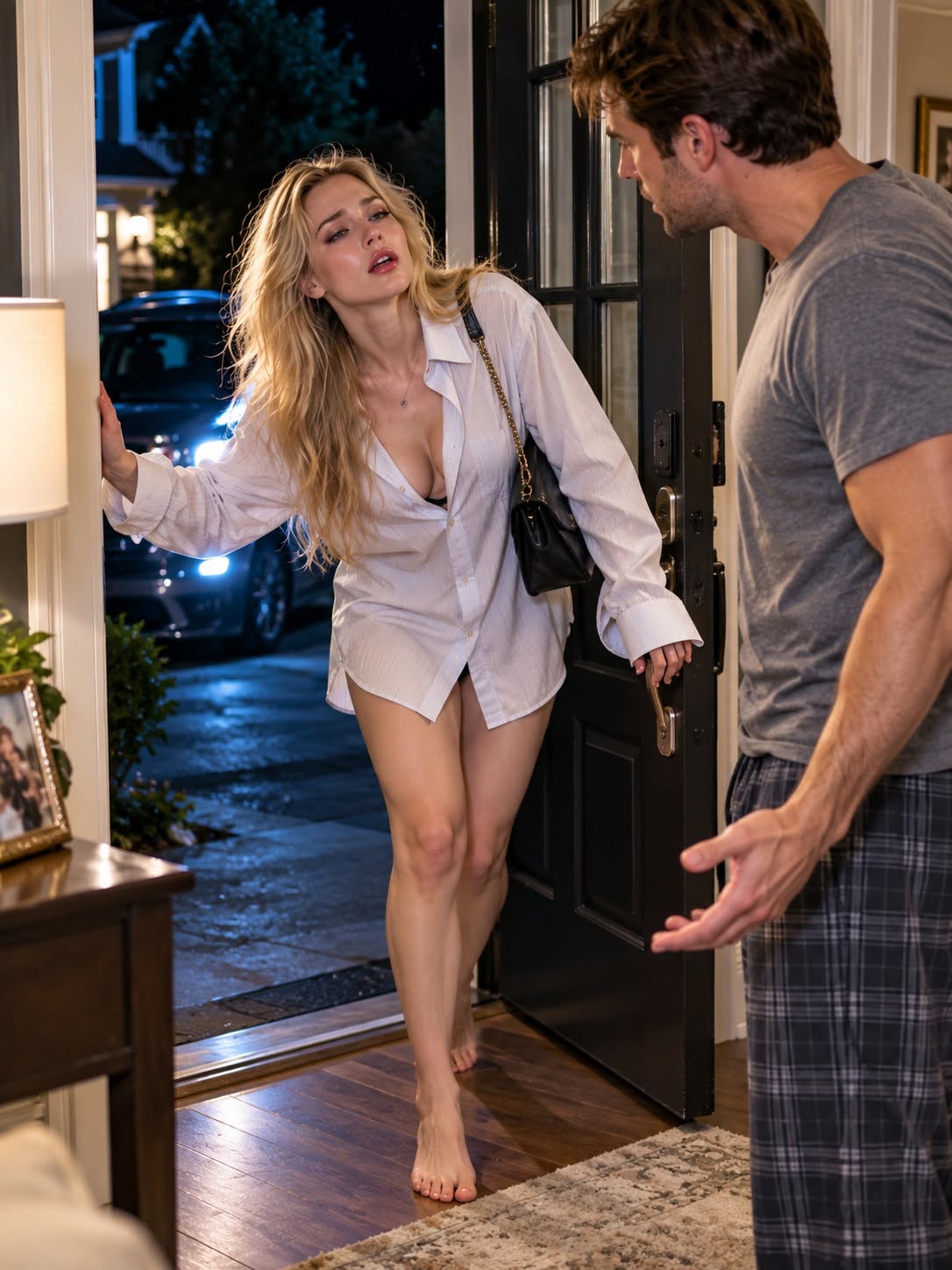
**CHAPTER 4 – THE TRAP THAT FOLLOWED US HOME**
The final message on my wife’s phone made my knees feel weak.
Grant had written:
IF HE DOESN’T COME TO THE PARKING LOT, GET HIM INTO THE GARAGE. LEAVE THE DOOR OPEN. I’LL TAKE CARE OF EVERYTHING.
And my wife had replied:
I’LL MAKE SURE HE’S THERE.
I read those six words three times.
My wife had promised another man she would deliver me into a trap.
And less than an hour later, she’d walked into our house wearing his shirt, mocked me about another man enjoying her body, and watched me grab the car keys.
Suddenly, our entire argument looked different.
“You were trying to get me into the garage,” I whispered.
She shook her head.
“Not anymore.”
I stared at her.
“What does that mean?”
She was crying so hard that the officer asked her to sit down.
“I sent that because he was threatening me. But I changed my mind. I couldn’t let him hurt you.”
I pointed toward the message.
“You told him you’d make sure I was here.”
“I know.”
“And then you came home and deliberately made me angry.”
Her silence answered me.
I felt something inside my chest turn cold.
The officer stepped between us.
“Sir, I need you to give her some space.”
I moved backward.
Not because I wanted to hurt her.
Because I couldn’t stand being close to her anymore.
For eleven years, I had trusted this woman with every important part of my life.
And now I was standing in our garage, wondering how close I’d come to being attacked because of a plan she’d helped arrange.
The officer looked at my wife.
“Did you intend to bring your husband outside so Grant could confront him?”
She covered her face.
“At first.”
My throat tightened.
“And later?”
“I wanted to stop it.”
“How?”
She looked at me.
“When he grabbed the car keys, I panicked. I realized he might drive straight back to where Grant was waiting. Then he opened my car, and I knew he’d find the phone.”
I remembered her screaming.
Don’t you dare go near my car.
I’d thought she was hiding proof of an affair.
She had been hiding evidence of a threat she’d helped create.
“You could have told me,” I said.
“I know.”
“You could have called the police.”
“I know.”
“You could have warned me before I walked into that garage.”
She began sobbing.
“I was afraid he’d hurt Megan if I didn’t do what he wanted.”
The officer raised his hand.
“We need to establish exactly when those threats happened. Start with the first message.”
My wife nodded.
For the next forty minutes, I listened while she described a series of decisions that had nearly destroyed three lives.
And the worst part was realizing how ordinary the beginning had been.
Grant hadn’t entered our marriage by breaking down a door.
My wife had invited him into her life.
The threats came later.
But the first betrayal had been entirely her choice.
She admitted meeting him through Megan at a gathering several weeks earlier.
He was charming, attentive, and unusually interested in her marriage.
She’d complained that I worked too much.
He’d listened.
She’d complained that we weren’t spending enough time together.
He’d agreed.
Then came private messages.
Compliments.
Secret lunches.
A relationship she described as something she’d never intended to become serious.
I didn’t interrupt.
I simply stood there while she explained how she’d found enough hours in the day to deceive me.
Eventually, Grant became possessive.
He wanted to know when I left for work.
Where I spent my weekends.
Whether I checked her phone.
She had answered those questions because she thought his jealousy meant he cared.
By the time she tried ending the affair, he knew almost everything about our daily routines.
“Then why agree to bring me to the parking lot?” I asked.
She stared at her hands.
“He told me that if you confronted him, he’d finally leave me alone.”
I looked at the officer.
“That makes no sense.”
My wife nodded miserably.
“I know that now.”
“Did you know he wanted to provoke me?”
She hesitated.
“He said he wanted proof you were dangerous.”
My stomach twisted.
“And you agreed anyway?”
“He made me believe you’d only yell at him. That he would record it, show me how angry you could get, and then walk away.”
I stared at her in disbelief.
“You were willing to help him make me look violent?”
She began crying again.
“I told myself nobody would get hurt.”
That sentence stayed with me.
Because it revealed something I’d been struggling to understand.
She hadn’t originally agreed to destroy my life.
She’d simply decided the risk to me was acceptable if it protected her secrets.
And that distinction didn’t make the betrayal less painful.
The officer asked about the message concerning our garage.
My wife explained that Grant had become increasingly aggressive when she refused to call me from the parking lot.
He’d threatened Megan.
Then he’d threatened to come directly to our house.
“He told me to send the message while he stood there,” she whispered. “He wanted to know I’d cooperate.”
“Did you believe he would hurt your husband?” the officer asked.
“By then, yes.”
“Why didn’t you warn him?”
She looked toward me.
“Because I was ashamed. And because Grant said he’d know if I called anyone.”
I shook my head.
“You came home knowing he might be watching.”
“Yes.”
“And you still didn’t tell me.”
Her voice broke.
“I thought I could keep you inside until morning.”
I remembered her mocking laughter in our hallway.
The way she’d tried to provoke me.
The way she’d followed me into the garage.
Nothing about her behavior had been rational.
But fear and shame rarely made people rational.
That didn’t erase what she’d done.
It only explained why her final decisions had been so chaotic.
The officer finished documenting the messages.
Another officer returned from outside.
The vehicle matching our description had been stopped several blocks away.
The driver was Grant.
He’d been detained while officers investigated the threats and the confrontation at the parking lot.
My wife closed her eyes.
For the first time that night, her shoulders relaxed.
Mine didn’t.
I looked at the garage door.
I imagined what might have happened if I’d been standing outside when Grant arrived.
He could have approached me with a camera.
He could have provoked me.
Or something worse could have happened.
I would never know.
And I was grateful for that uncertainty.
Because the alternative was finding out too late.
Before leaving, the officers explained that detectives would need detailed statements and that the phone found under the seat could contain important evidence.
They arranged to preserve it for examination through the proper legal process.
They also advised us to report any further contact immediately.
When the last officer stepped outside, the garage seemed impossibly quiet.
My wife stood beside the car.
I stood near the doorway.
Neither of us knew what to say.
Finally, she whispered, “Can we go inside?”
I looked at her.
“Are you hurt?”
She nodded slightly.
“My wrist. And my ankle.”
“You should get checked.”
“I will.”
I opened the door into our house.
But I didn’t follow her immediately.
I stood in the garage and looked at the place where I’d nearly discovered something that could have changed my life forever.
The torn fabric.
The hidden phone.
The knocking from the trunk.
Megan had been trapped inside that car while my wife and I argued about infidelity.
And somewhere across the street, Grant had been watching.
I realized then that the most frightening part of the night wasn’t discovering my wife’s affair.
It was understanding how easily secrets could become dangerous when people kept choosing lies over the truth.
By the time the sun rose, our marriage had changed beyond recognition.
My wife sat at the kitchen table wearing sweatpants and one of her old sweaters.
The unfamiliar dress shirt had been set aside as potential evidence.
She looked exhausted.
Her eyes were swollen.
I made coffee out of habit.
Two mugs.
Just like every morning.
Then I stared at them.
For eleven years, making her coffee had been one of those tiny routines I never questioned.
I knew exactly how much cream she wanted.
I knew which mug she preferred.
I knew she hated drinking coffee after it became lukewarm.
But apparently, I didn’t know the person sitting across from me.
She noticed the second mug.
“Thank you,” she whispered.
I didn’t answer.
After a long silence, she said, “I know you hate me.”
I looked at her.
“I don’t.”
She started crying.
“I wish you did.”
I sat down.
“Don’t make this about what would be easier for you.”
She lowered her eyes.
I took a breath.
“I can understand that Grant frightened you. I can understand that you panicked last night.”
She looked up hopefully.
“But I cannot understand why you betrayed me for weeks and then helped him put me in danger.”
Her face collapsed.
“I don’t have an excuse.”
“Good. Because I don’t want another one.”
We sat in silence.
Outside, our neighbors were beginning their normal morning routines.
Cars backed out of driveways.
Children waited for school buses.
Someone started a lawn mower farther down the street.
The world continued as though nothing extraordinary had happened.
Inside our kitchen, everything was different.
“Do you still love me?” she asked.
I stared at my coffee.
It was the question I’d dreaded.
Because the answer wasn’t simple.
“Yes,” I finally said.
She started crying again.
“But loving you doesn’t mean I trust you.”
She reached across the table.
I pulled my hand away.
Her fingers remained suspended for a moment before she withdrew them.
“I want to fix this,” she whispered.
I looked at her.
“You can’t fix it today.”
“I’ll do anything.”
“Then start by telling the investigators everything. Don’t delete messages. Don’t protect him. And don’t hide anything else from me.”
She nodded.
“I will.”
“And after that, I need space.”
She looked frightened again.
“Are you leaving?”
“I don’t know.”
That was the truth.
I didn’t know whether our marriage could survive.
I didn’t even know whether I wanted it to.
I only knew that I couldn’t make a permanent decision while I was still trying to understand what had happened.
Later that morning, Megan called from the medical facility where she’d been examined.
She was shaken and had injuries from the struggle, but she was safe.
I nearly cried when I heard her voice.
“Thank God you’re okay.”
She was quiet for a moment.
“I’m sorry you had to find out everything this way.”
I closed my eyes.
“You don’t owe me an apology for what happened to you.”
“Your wife told me she was going to confess.”
“When?”
“After she ended things with him.”
I looked toward the living room, where my wife was sitting alone.
“Do you believe that?”
Megan sighed.
“I think she wanted to. I also think she kept finding reasons not to.”
That sounded painfully familiar.
Megan told me she’d noticed Grant’s controlling behavior before the final confrontation.
She’d encouraged my wife to stop meeting him.
When the threats escalated, Megan insisted on accompanying her that night.
She wanted to make sure the relationship ended safely.
Instead, she’d become another target.
“I saw him take pictures of your workplace,” Megan said.
My stomach tightened.
“He actually went there?”
“Yes. Your wife tried convincing herself it was jealousy. I told her it wasn’t normal.”
I rubbed my forehead.
“Why didn’t anyone tell me?”
Megan’s voice softened.
“Because she kept asking me to give her one more chance to handle it.”
I looked down.
One more chance.
One more secret.
One more day.
And every delay had given Grant additional control.
Before hanging up, Megan said something I wouldn’t forget.
“Whatever you decide about your marriage, don’t let what happened to me become the reason you forgive her.”
I was silent.
Then she added, “She needs to be accountable for what she chose, even though Grant is responsible for what he did.”
That distinction mattered.
I thanked her.
For telling the truth.
For trying to help.
And for surviving long enough to expose what had been happening.
The next several weeks were exhausting.
Detectives interviewed us separately.
My wife gave investigators her messages and explained the meetings with Grant.
Megan provided a detailed account of the parking lot confrontation.
The clothing and phone were examined as evidence.
Investigators also reviewed available security footage from businesses near the parking area.
Some of what my wife told me was confirmed.
Some details remained uncertain.
But the central pattern became clear.
Grant had monitored my routines, threatened my wife and Megan, and attempted to engineer a confrontation with me.
The phone recovered from the back seat contained photographs of my vehicle, my workplace, and several locations I visited regularly.
Investigators eventually recovered additional messages showing his intention to provoke an angry reaction and record it.
When I learned that, I sat in my car outside work for nearly half an hour.
I kept thinking about every ordinary day he’d watched without my knowledge.
Every time I’d walked to my vehicle.
Every time I’d bought coffee.
Every evening I’d driven home.
He’d studied my life while I remained completely unaware of him.
But the investigation also confirmed something my wife couldn’t explain away.
She had voluntarily shared information about me before Grant began threatening her.
And she’d agreed to his original confrontation plan before the situation became violent.
The messages she sent later, under pressure, didn’t erase those earlier choices.
I had to live with that fact.
So did she.
We cooperated fully with investigators.
I informed my workplace about the stalking concerns and asked security to be alert for Grant or his vehicle.
My wife agreed to stay with her sister temporarily while we sorted out what came next.
We discussed practical arrangements rather than fighting over the house.
She took her clothes, medication, and essential belongings.
I remained at home.
We agreed on updated access arrangements and reviewed our financial accounts.
For the first time in eleven years, I slept in our bed alone.
The silence was unbearable at first.
I kept expecting to hear her moving around downstairs.
Sometimes I’d wake up and reach instinctively toward her side.
Then I’d remember.
And the entire night would come rushing back.
The torn dress.
The man’s shirt.
The messages.
The knocks from the trunk.
Her promise to get me into the garage.
I eventually started seeing a therapist.
Not because I was ashamed of my reactions.
Because I didn’t want the worst night of my marriage to determine the way I lived the rest of my life.
I had become suspicious of strangers.
I checked my mirrors constantly while driving.
Every unfamiliar car parked near our house made my stomach tighten.
My therapist helped me understand that fear could remain long after the immediate danger had passed.
And that rebuilding a sense of safety was different from rebuilding a marriage.
One required time and support.
The other required trust.
And I no longer knew how to give my wife that.
She began counseling too.
She told me she wanted to understand why she’d pursued the affair, ignored warning signs, and lied even when the consequences became dangerous.
For a while, she sent messages almost every day.
I love you.
I’m sorry.
I wish I could undo everything.
Most days, I didn’t respond.
Not because I wanted to punish her.
Because I couldn’t keep comforting the person whose choices had hurt me.
About six weeks after that night, we met at our kitchen table.
She looked different.
Not dramatically.
Just quieter.
She no longer tried to explain every mistake as something she’d been pushed into doing.
“I’ve been thinking about what I said when I came home,” she told me.
I waited.
“That terrible joke about another man enjoying my body.”
I stared at the table.
“I remember.”
“I said it because I was ashamed and wanted you focused on being angry with me instead of asking what had happened.”
I looked up.
“That was cruel.”
“I know.”
“You humiliated me because you didn’t want to tell me the truth.”
She nodded.
“And I made everything worse.”
“Yes.”
Her eyes filled with tears.
Then she said something I hadn’t expected.
“I don’t think I was protecting you as much as I kept telling myself I was.”
I remained silent.
“I was protecting the version of myself I wanted you to believe in. I didn’t want you to know what I’d done.”
For the first time, her explanation sounded like accountability instead of an excuse.
She wasn’t asking me to believe Grant had forced her into the affair.
She wasn’t pretending her fear erased her responsibility.
She was admitting that shame had made her selfish.
And that selfishness had placed me in danger.
“I want another chance,” she whispered.
I looked at the wedding ring still resting on her finger.
Part of me remembered the woman I’d married.
The woman who’d sat beside me through family losses.
The woman who’d celebrated small victories with me.
The woman who knew my favorite meals, my childhood stories, and every ridiculous habit I possessed.
Those memories were real.
But so was everything that happened afterward.
“I believe you’re sorry,” I said.
Hope appeared in her eyes.
“But I don’t believe I can be your husband anymore.”
She went motionless.
For several seconds, she didn’t speak.
Then tears rolled down her cheeks.
“Are you sure?”
I swallowed.
“I’ve spent weeks trying to find another answer.”
She covered her mouth.
“I would spend the rest of my life making it up to you.”
“I know you’d try.”
“Then why can’t we try together?”
I looked toward the garage door through the kitchen hallway.
Because that was where the answer lived.
“Because I don’t want to spend the rest of my life wondering whether you’re telling me the truth.”
Her shoulders collapsed.
I continued.
“I don’t want to check your phone. I don’t want to question every late night. I don’t want to feel afraid whenever you say you’re meeting friends.”
She cried silently.
“And I don’t want you living under constant suspicion either.”
I reached for the folder beside me.
Inside were notes from a consultation with a divorce attorney.
I hadn’t filed anything yet.
But I had begun preparing.
“I think we need to end the marriage.”
She stared at the folder.
Then she nodded slowly.
“I understand.”
I knew she didn’t fully accept it.
Neither did I.
Acceptance doesn’t arrive all at once.
Sometimes it begins with realizing that the life you wanted is no longer the life you can safely build.
Our divorce wasn’t immediate.
There were financial discussions, paperwork, and difficult decisions about the home and our shared belongings.
We worked toward a fair agreement rather than turning our separation into another battle.
Neither of us walked away without losses.
She lost the marriage she’d taken for granted.
I lost the future I’d imagined with her.
And both of us had to learn how to live with the consequences.
Months later, Grant’s criminal case reached a resolution.
He pleaded guilty to stalking-related and assault charges arising from the investigation.
The court imposed conditions that included no contact with the people he’d threatened.
I attended one of the proceedings.
Not because I wanted revenge.
Because I wanted to see the man who’d made me afraid inside my own home face the consequences of his actions.
He looked surprisingly ordinary.
That disturbed me.
There was no dramatic appearance.
No obvious sign that he was capable of making so many people terrified.
Just an ordinary man who’d made a series of cruel, deliberate choices.
I didn’t speak to him.
I didn’t need to.
The court handled the consequences.
And I had a life to rebuild.
Megan recovered gradually.
We remained in contact.
She was still dealing with the emotional aftermath, but she had returned to work and was receiving support.
One afternoon, she stopped by to return a book she’d borrowed months earlier.
We sat on the porch drinking coffee.
For the first time since that night, our conversation wasn’t entirely about Grant.
We talked about ordinary things.
Work.
Neighbors.
The weather.
Then she looked at me and smiled sadly.
“You seem better.”
I considered that.
“I think I’m getting there.”
She nodded.
“Good.”
Before leaving, she glanced toward the garage.
“Does it still bother you?”
I knew what she meant.
“The memory?”
She nodded.
“Sometimes.”
I took a breath.
“But I’m not afraid to go in there anymore.”
Her eyes softened.
“I’m glad.”
After she drove away, I stood in the driveway for a long time.
The evening sun was settling over our neighborhood outside Columbus.
The same houses stood across the street.
The same American flag moved beneath my neighbor’s porch.
Everything looked almost exactly as it had before.
Except I wasn’t the same person.
A few weeks after the divorce became final, my former wife called.
I almost didn’t answer.
But eventually I did.
“Hello?”
“Hi.”
Her voice was quiet.
“I just wanted to let you know I’m moving into my own place.”
“That’s good.”
She paused.
“And I wanted to thank you.”
“For what?”
“For not trying to destroy me after everything I did.”
I looked out the window.
“I was angry. I still have difficult days.”
“I know.”
“But I didn’t want the rest of my life to become about hurting you back.”
She began crying softly.
“I’m sorry.”
I closed my eyes.
“I know you are.”
She hesitated.
“Do you think we’ll ever be friends?”
It was a fair question.
And one I couldn’t answer the way she wanted.
“Maybe someday,” I said. “But not right now.”
“I understand.”
“I need us to keep our distance. Any remaining paperwork can go through the attorneys.”
She was quiet.
Then she whispered, “Okay.”
We said goodbye.
And for the first time, I didn’t feel the urge to call her back.
I put the phone down and walked into the garage.
The overhead light hummed softly.
My car was parked where hers had once been.
The floor had been cleaned.
The evidence was gone.
There was nothing left beneath the back seat.
Nothing hidden inside a trunk.
No stranger watching from across the street.
Just an ordinary garage in an ordinary neighborhood.
I stood there remembering the moment she’d shouted at me not to touch her car.
Back then, I thought the worst thing I could discover was another man.
I was wrong.
The worst thing I discovered was how dangerous silence could become when someone valued protecting a secret more than protecting the people who trusted them.
I don’t know whether I’ll ever marry again.
I don’t know whether I’ll ever trust someone as completely as I trusted her.
But I know what I will never do again.
I will never mistake familiarity for honesty.
I will never ignore danger simply because acknowledging it might change my life.
And I will never believe that loving someone requires me to sacrifice my safety or my self-respect.
My wife had asked whether I was jealous that another man had enjoyed her body.
For a long time, those words haunted me.
Now they remind me of something different.
Not what I lost.
But what I finally understood.
Love without honesty cannot protect a marriage.
Apologies without accountability cannot repair betrayal.
And forgiveness doesn’t always mean staying.
Sometimes forgiveness means refusing to let someone else’s terrible decisions define your future.
I turned off the garage light and walked back into my house.
I locked the door.
Not because I was frightened of who might be outside.
But because, for the first time in months, I felt safe enough to close it.
And this time, I knew exactly what I was leaving behind.
**I had lost the marriage I thought would last forever. But I hadn’t lost myself.**
That was the future I chose to protect.
✓ Lynn R. Adams
**CHAPTER 4 – THE TRAP THAT FOLLOWED US HOME** The final message on my wife’s phone made my knees feel weak. Grant had written: IF HE DOESN’T COME TO THE PARKING LOT, GET HIM INTO THE GARAGE. LEAVE…