CHAPTER 4 – THE NIGHT MY WIFE SET THE TRAP
**CHAPTER 4 – THE LIE THAT DESTROYED OUR MARRIAGE**
The car stopped outside our house just as my wife admitted she’d already told my family I was having an affair.
An affair that had never happened.
An affair she’d tried to manufacture the previous night.
Through the kitchen window, I watched my father’s familiar sedan pull into the driveway. He climbed out slowly, his face tight with anger.
Behind me, Lauren whispered, “Please don’t tell him everything.”
I turned toward her.
For one incredible second, I wondered whether she’d actually heard herself.
“You told my parents I cheated. You told my brother. And now you want me to protect your lie?”
Her eyes filled.
“I was scared.”
“So was I,” I said. “When I discovered my own wife had been planning to destroy my reputation.”
The doorbell rang.
Lauren flinched.
I left my phone on the kitchen table, walked through the hallway, and opened the front door.
My father stood on the porch.
He didn’t hug me.
That hurt more than I expected.
“Son,” he said quietly, “we need to talk.”
“I know.”
He looked past my shoulder.
“Is Lauren here?”
“Yes.”
“Good. Because I want to hear both sides.”
I stepped aside.
Dad entered the house he’d helped us move into years earlier. His eyes traveled across the family photographs lining our hallway.
Then he looked at me.
“Your mother has been crying since Friday.”
My stomach tightened.
“Friday?”
“She said Lauren told her you admitted having an affair with the neighbor.”
“I didn’t.”
Dad studied my face.
“Then why would your wife say you did?”
I swallowed.
“That’s what we’re about to find out.”
Lauren appeared at the kitchen doorway.
“I’m sorry you had to come over,” she said.
Dad looked at her.
“Lauren, what exactly is happening in this house?”
She folded her arms.
“We’ve been having problems.”
“That isn’t what you told us.”
Lauren lowered her eyes.
Dad continued.
“You told my wife he confessed to cheating. You said you were giving him an opportunity to leave quietly.”
The words struck me.
Leave quietly.
Suddenly, the separation agreement made even more sense.
Lauren hadn’t just wanted the house.
She’d wanted me to surrender it without challenging the accusation that made me look guilty.
“Dad,” I said, “sit down.”
We gathered around the kitchen table.
Lauren remained standing.
I opened the notebook I’d started earlier that morning.
Then I placed her proposed separation agreement beside it.
My father looked at the heading.
His expression changed.
“What is this?”
“A document Lauren prepared before the incident she intended to use against me.”
Lauren immediately objected.
“That’s not fair.”
I looked at her.
“Then explain the date.”
Dad examined the pages.
“Friday,” he said.
I nodded.
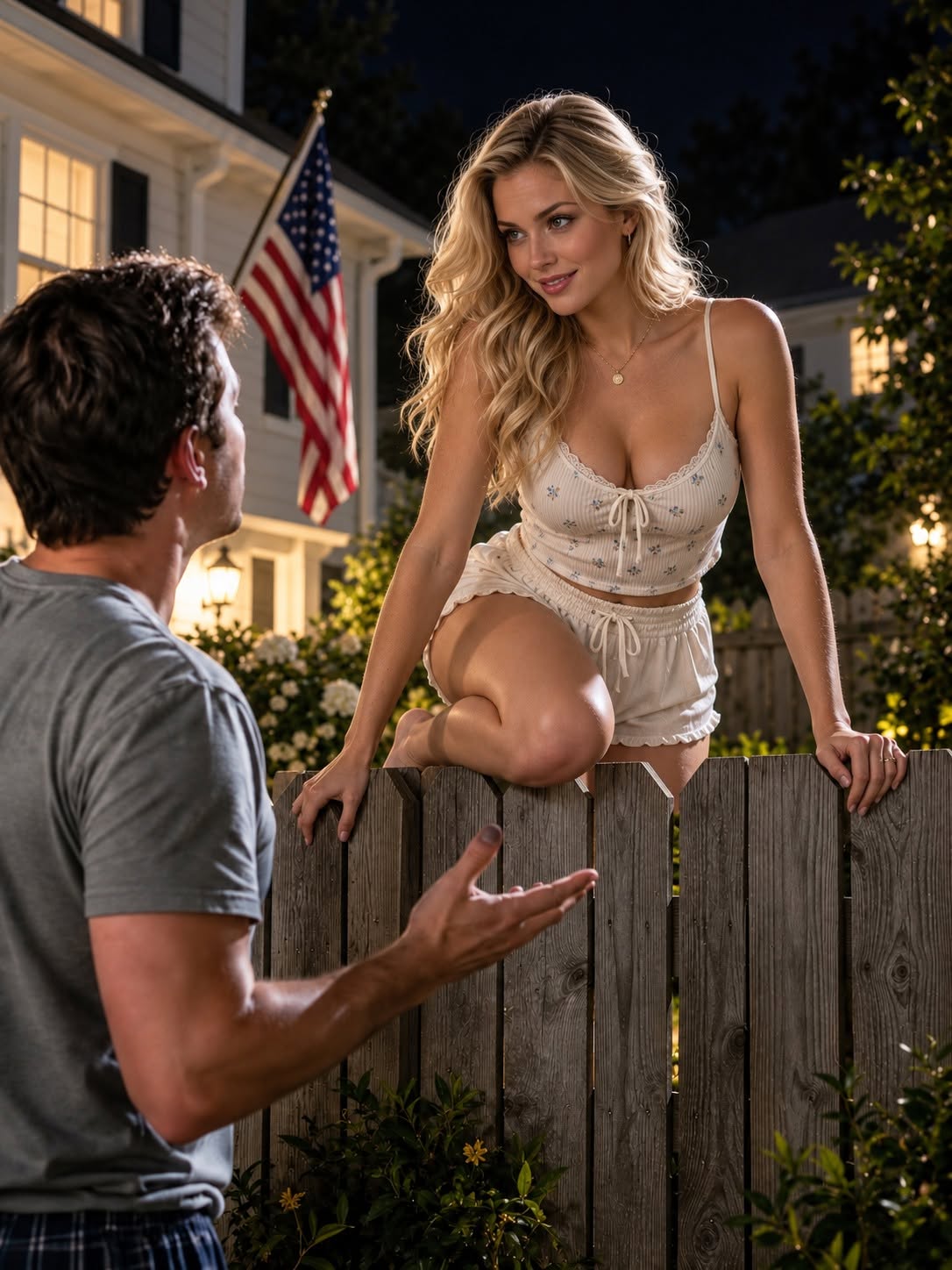
“Vanessa came into our backyard Saturday night.”
My father looked up.
“Vanessa?”
“Our next-door neighbor.”
“The woman Lauren says you’ve been seeing?”
I took a breath.
“I have never had an affair with Vanessa.”
Then I explained everything.
The six-foot fence.
The unexpected visit.
Vanessa’s confession.
Lauren’s supposed trip to Chicago.
The messages encouraging Vanessa to approach me.
And the moment my wife returned home carrying paperwork describing a betrayal that hadn’t occurred.
Dad listened without interrupting.
When I finished, he looked at Lauren.
“Is any of that true?”
She wiped her face.
“Some of it.”
“Which part isn’t?”
Lauren stared at the table.
Dad waited.
Finally, she whispered, “I asked Vanessa to talk to him.”
“Did you tell her to come while you were away?”
“Yes.”
“Were you actually in Chicago?”
“No.”
My father leaned back.
He looked as though someone had removed the floor beneath his chair.
“Lauren,” he said slowly, “why would you do that?”
She began crying.
“I thought he was going to leave me.”
Dad looked at me.
“Were you?”
“No.”
He turned back toward her.
“Did he tell you he wanted a divorce?”
“No.”
“Did you have evidence he’d been unfaithful?”
She shook her head.
Dad stared at her.
“Then you told us something you knew wasn’t true.”
Lauren covered her mouth.
For the first time that morning, she couldn’t hide behind the word complicated.
I opened the screenshots Vanessa had sent.
“These are the conversations.”
I handed my father the phone.
He read in silence.
His eyebrows drew together.
Then he reached the message telling Vanessa to avoid our driveway camera.
He looked at Lauren.
“You instructed another woman to enter your husband’s property without being seen?”
Lauren whispered, “I wasn’t thinking clearly.”
Dad continued scrolling.
He reached the message about ensuring the door closed behind Vanessa.
Then the one promising to handle everything afterward.
He placed my phone on the table.
“I’ve seen enough.”
His voice was low.
That made it worse.
My father rarely raised his voice when he was truly angry.
He looked directly at Lauren.
“You didn’t catch my son betraying you.”
He paused.
“You tried to arrange a situation where he might.”
Lauren started to speak.
Dad raised one hand.
“And before that situation ever happened, you told his family he had already confessed.”
I felt something shift inside me.
Someone else finally understood.
For almost twelve hours, I’d been defending myself against a story designed to make every explanation sound suspicious.
Now the sequence was out in the open.
And my wife could no longer control it.
Dad turned toward me.
“Did you invite Vanessa inside?”
“No.”
“Did anything happen between you?”
“No.”
Lauren nodded faintly.
“He’s telling the truth.”
I stared at her.
Four words.
After weeks of manipulation, she finally said the simplest thing she’d been avoiding.
Dad looked at her.
“Then why haven’t you corrected what you told us?”
Lauren looked down.
“I didn’t know how.”
My father stood.
“You call the people you lied to. You tell them the truth.”
She began shaking.
“Please. Not right now.”
“Especially right now.”
I interrupted.
“Dad, I appreciate you defending me. But I need to handle this.”
He turned toward me.
I continued.
“Lauren made these decisions without me. I’m not going to let anyone else decide how this ends.”
Dad slowly sat down again.
I looked at my wife.
“You said you sent a statement. Who received it?”
Lauren hesitated.
“My parents. Your parents. Your brother.”
“Anyone else?”
“Two friends from our neighborhood.”
I felt my chest tighten.
People we regularly invited into our home.
People who had shared dinner with us.
People who might now look at me as though I were a man who’d betrayed his wife.
“What did the statement say?”
Lauren stared at her hands.
“That you’d admitted an emotional affair with Vanessa.”
“Was that true?”
“No.”
“Did you say we were separating?”
“Yes.”
“Had we agreed to separate?”
“No.”
I closed my eyes.
The betrayal wasn’t limited to what she’d arranged Saturday night.
She had already begun rewriting our marriage for everyone around us.
When I opened my eyes, Lauren was crying.
“I thought if people knew, you’d finally take our problems seriously.”
I stared at her.
“You could have told people we were struggling.”
She nodded.
“You could have asked for counseling.”
Another nod.
“You could have told me you wanted to separate.”
Her shoulders trembled.
“But you told people I cheated.”
She whispered, “I’m sorry.”
For a moment, I wanted those words to change everything.
I wanted to feel the comfort I’d once felt when she apologized after an ordinary argument.
But this wasn’t an ordinary argument.
This was a deliberate series of choices.
And every choice had made the next one easier.
“Sorry doesn’t correct the story,” I said.
Lauren looked up.
“Then what do you want?”
“The truth.”
We spent the next hour addressing the people she’d contacted.
I didn’t demand that Lauren make a humiliating public confession. I didn’t want our private lives turned into neighborhood entertainment.
But everyone who’d received the false statement needed a correction.
Lauren wrote a message acknowledging that I had never confessed to an affair, that she had no evidence of infidelity, and that the earlier accusation was false.
She also admitted she’d encouraged Vanessa to approach me.
Before sending it, she read it aloud.
Her voice broke halfway through.
I didn’t interrupt.
When she finished, I said, “Send it to everyone who received the original accusation.”
She did.
My father watched silently.
Then he called my mother.
I could hear her crying through the phone.
When he explained what had happened, she asked to speak with me.
“Sweetheart,” she whispered, “I’m so sorry.”
“Mom, you believed what my wife told you.”
“I should have called you first.”
I swallowed.
“Yes. You should have.”
There was a long silence.
Then she said, “We love you.”
“I know.”
But even those familiar words felt different.
I had learned something painful about how quickly trust could be damaged.
Not only between husband and wife.
Between parents and children.
Between friends.
Between everyone who believed the first story they heard.
That afternoon, my brother called.
He was furious.
He wanted to confront Lauren and tell our neighbors what she’d done.
I stopped him.
“Don’t.”
“She was trying to ruin you.”
“I know.”
“Then why are you protecting her?”
“I’m not protecting her lie. I’m refusing to turn my marriage into a public war.”
He was quiet.
Finally, he said, “What are you going to do?”
I looked through the kitchen window.
Across the fence, Vanessa’s house stood silent.
“I don’t know everything yet,” I admitted. “But I know I can’t keep living like this.”
After my father left, Lauren and I sat across from each other.
For the first time, there were no excuses left.
No third person to blame.
No imaginary affair.
No carefully arranged encounter.
Just two people facing the damage done to their marriage.
“I want to explain something,” Lauren said.
I nodded.
She stared at the coffee mug between her hands.
“When I started thinking about separation, I panicked about the house.”
“I know.”
“I couldn’t imagine starting over.”
“You could have told me.”
“I thought you’d be angry.”
“I might have been.”
She looked up.
“But I would have listened.”
Tears filled her eyes again.
“I convinced myself that if you were the one who did something wrong, I wouldn’t have to feel guilty about leaving.”
That admission hurt in a way I couldn’t describe.
For weeks, I’d believed we were two people experiencing a difficult period.
Lauren had been searching for a way to make ending our marriage feel justified.
“So you needed me to become the villain,” I said.
She nodded.
“And when I wouldn’t become one on my own, you tried to arrange it.”
Lauren covered her face.
“Yes.”
There it was.
The truth we’d spent an entire night chasing.
And it wasn’t complicated.
It was devastatingly simple.
She’d wanted out.
She’d been afraid of the consequences.
And she’d tried to place the blame on me.
I sat quietly for a long time.
Then I said something that surprised even me.
“I don’t hate you, Lauren.”
She looked up.
“But I don’t trust you.”
Her face collapsed.
“I know.”
“I don’t know how to rebuild a marriage with someone who was willing to do this.”
“Could we try counseling?”
The question hung between us.
A week earlier, I would have agreed immediately.
I would have wanted to repair the distance between us.
But now something fundamental had changed.
“We can talk to a counselor about what happened,” I said. “But I can’t promise that means staying married.”
She nodded slowly.
For once, she didn’t argue.
That evening, Vanessa sent me a message.
She apologized again and offered to provide the complete conversation history if I needed it.
I thanked her for preserving the messages.
Then I told her our personal relationship had to end.
Not because I blamed her for everything.
I didn’t.
Lauren had manipulated her.
But Vanessa had still chosen to climb my fence and pursue a married man.
She’d ignored my boundaries until the situation became frightening.
I couldn’t pretend that was harmless.
Her reply came several minutes later.
“I understand. I’m sorry I didn’t respect your marriage or your wishes. I won’t approach you again.”
I believed her.
But I didn’t continue the conversation.
Some doors needed to remain closed.
The following week was the longest of my life.
Lauren moved into our guest bedroom while we considered separate living arrangements.
We spoke only when necessary.
The silence in our home felt heavier than any argument we’d ever had.
I met with an attorney to understand my options.
I brought the proposed separation agreement, the messages, and my timeline.
The attorney examined the document and explained that it was a proposal, not an agreement I’d accepted.
The accusation written inside it didn’t become true simply because Lauren had typed it.
Nor did refusing to sign mean I was automatically entitled to everything.
Property, debts, and separation arrangements would have to be addressed through a proper process.
That was exactly what I wanted.
Not revenge.
Not punishment.
Fairness.
I wasn’t interested in using Lauren’s wrongdoing as an excuse to hurt her financially.
But I refused to reward a false accusation by surrendering our home.
When I returned, Lauren was waiting in the living room.
“How did it go?”
“I understand my options better.”
She looked nervous.
“Are you filing for divorce?”
“I’m not making that decision out of anger.”
She nodded.
“But I am going to separate from you.”
Her eyes filled.
“Please don’t.”
I sat across from her.
“Lauren, I spent the whole weekend wondering what else you’ve hidden from me.”
“I’ve told you everything.”
“Maybe.”
She flinched.
“That’s the problem,” I continued. “I don’t know how to believe you anymore.”
She began crying quietly.
I didn’t comfort her.
Not because I wanted her to suffer.
But because I could no longer be responsible for protecting her from the consequences of what she’d chosen.
We agreed to seek independent advice, exchange financial information, and discuss a fair arrangement for the house.
Neither of us would sign the original document.
Neither of us would make accusations we couldn’t support.
For the first time in weeks, we were dealing with facts instead of imagined betrayals.
Several days later, Lauren came to me holding her phone.
“I want you to see something.”
I hesitated.
She showed me replies from the people who’d received her correction.
Her parents were shocked.
Our neighbors were confused.
One of our friends wrote that she couldn’t understand why Lauren had invented an admission of infidelity.
My mother had responded with a single sentence.
“Please never put our family through something like this again.”
Lauren stared at the screen.
“I didn’t realize how many people I was hurting.”
I looked at her.
“I think you did realize it. You just believed you could control what happened afterward.”
She lowered the phone.
Then she whispered, “You’re right.”
That was the closest we’d come to understanding each other since Saturday night.
There were no dramatic promises.
No declaration that love could fix everything.
Only the painful acknowledgment that a person could be afraid, unhappy, and deeply wrong at the same time.
Over the following weeks, we started counseling.
Not to force reconciliation.
To understand how we’d reached this point and how to separate without continuing to hurt each other.
Lauren admitted that she’d begun resenting the ordinary life we’d built.
She felt trapped by routine and frightened by the possibility of starting over.
Instead of admitting those feelings, she’d interpreted my exhaustion as rejection.
Then she’d built a story in which I was the unfaithful husband and she was the innocent wife forced to protect herself.
Vanessa’s attraction had become an opportunity.
Lauren had encouraged it until she believed she could make the story real.
Hearing her describe it was painful.
But it also freed me from a question that had haunted me.
What had I done to deserve that trap?
The answer was that our marriage had real problems, and I had contributed to some of them.
I’d become distant.
I’d assumed our routine meant we were secure.
I’d overlooked moments when Lauren needed more attention and conversation.
Those failures deserved acknowledgment.
But they hadn’t made me responsible for her deception.
Loneliness explained some of her feelings.
It didn’t justify what she did with them.
That distinction became important as I decided how to move forward.
Three months after that Saturday night, Lauren and I reached an agreement in principle to sell the house.
Neither of us could comfortably maintain the property alone while meeting our other financial obligations.
It was painful.
We’d chosen that home together.
We’d imagined growing older there.
But keeping it had become another way of clinging to something that no longer existed.
We worked through the financial details with professional guidance.
The mortgage, selling costs, and remaining equity were addressed through our negotiated settlement.
There were disagreements.
There were difficult conversations.
But there were no invented confessions.
No staged confrontations.
No demands that one person accept blame to make the process easier for the other.
Lauren eventually found a small apartment across town.
I rented a place closer to work.
The night before I moved out, I stood alone in our backyard.
The grass had grown slightly longer.
The porch light illuminated the fence Vanessa had climbed.
The same fence that had separated two ordinary suburban homes for nearly three years.
I walked toward it.
For a moment, I remembered Vanessa landing barefoot on the lawn.
Her flushed cheeks.
Her nervous smile.
Her impossible request.
“Your wife is away. Let me stay at your house tonight.”
If I’d responded differently, my entire future might have changed.
If I’d invited her inside simply to avoid confrontation, Lauren could have used that moment to support an accusation she’d already begun spreading.
Instead, I’d maintained a boundary.
And that boundary had mattered.
Not because it saved my marriage.
It didn’t.
But because it allowed me to walk away knowing what had actually happened.
Behind me, the back door opened.
Lauren stepped onto the patio.
“Can I talk to you?”
I nodded.
She stood beside me, leaving a respectful distance.
“I signed the remaining papers today,” she said.
“I know.”
She looked toward the fence.
“I still can’t believe what I did that night.”
Neither could I.
But I no longer needed to hear her explain it.
She swallowed.
“I loved you.”
I turned toward her.
“I believe you did.”
Her eyes filled.
“Do you believe I still do?”
I thought about that carefully.
Then I answered.
“I believe you feel something real. But love can’t survive on feelings alone.”
She stared at the ground.
“I know.”
“Love also requires honesty. Respect. The willingness to tell someone the truth even when you’re afraid of what they’ll say.”
A tear slid down her cheek.
“I wish I’d understood that earlier.”
“So do I.”
For several moments, we stood quietly beneath the stars.
Then Lauren asked the question I’d known was coming.
“Could you ever forgive me?”
I looked across the yard.
“I think I can forgive you for what happened.”
Hope flickered across her face.
“But forgiveness doesn’t mean I can be your husband again.”
Her expression changed.
I continued softly.
“I don’t want to spend the rest of my life wondering whether an ordinary conversation is another test.”
She nodded.
“I understand.”
“And I don’t want you spending your life feeling you have to invent a betrayal to justify your own unhappiness.”
Lauren began crying.
This time, I didn’t look away.
Our marriage had mattered.
The years we’d shared mattered.
Even the happiness that was gone still deserved to be remembered honestly.
But those memories weren’t enough to erase the choices that had brought us here.
Lauren wiped her eyes.
“I hope you find someone who makes you happy.”
I shook my head gently.
“Right now, I just want to find my peace.”
She gave a small, sad smile.
Then she went inside.
I remained in the backyard a little longer.
The neighborhood was quiet.
Somewhere beyond the maple trees, a freight train sounded in the distance.
Just as it had that Saturday night.
But I was no longer standing there in confusion, waiting for someone to explain what was happening to my life.
I knew.
And for the first time in months, I knew what I wanted to do about it.
I wanted a future without secret tests.
Without manipulated friendships.
Without apologies that came only after the truth became impossible to hide.
I wanted relationships where boundaries were respected, concerns were spoken aloud, and fear wasn’t used as permission to control someone else.
The next morning, I packed the last of my belongings.
Before leaving, I walked through the empty rooms one final time.
I didn’t feel victorious.
I felt sad.
But underneath the sadness was something steady.
Relief.
Lauren had wanted me to make one mistake so she could decide what happened next.
Instead, her plan had forced us to confront a truth neither of us could avoid.
Our marriage couldn’t be saved by assigning someone else the blame.
It could only have survived through honesty.
And that honesty had come too late.
I locked the front door, placed my key in the agreed location, and walked toward my car.
Then I paused and looked back at the house.
I thought about the man I’d been before that Saturday night.
The man who believed being loyal meant never having to defend his loyalty.
I still believed in loyalty.
But I understood something more important now.
**Loyalty without trust cannot hold a marriage together. And love without respect can become another form of control.**
I got into my car and started the engine.
For the first time, I wasn’t leaving because someone had frightened me, manipulated me, or pushed me toward a decision.
I was leaving because I’d made one myself.
I would remain fair in our separation, protect my privacy, keep my distance from Vanessa, and never again accept a relationship where proving my innocence was a condition of being loved.
I drove away without looking back.
Not because the past meant nothing.
But because it had finally taught me what my future required.
**My wife had spent weeks trying to catch me betraying our marriage. In the end, the betrayal that destroyed it was hers.**
And the decision that saved my future was mine.
✓ Lynn R. Adams
**CHAPTER 4 – THE LIE THAT DESTROYED OUR MARRIAGE** The car stopped outside our house just as my wife admitted she’d already told my family I was having an affair. An affair that had never happened….