CHAPTER 4 – THE KEY MY FATHER WANTED BURIED
I had spent the last twenty minutes trying to understand why the woman standing in the doorway had been erased from my childhood. Now she was telling me that the separation had begun with her own decision.
I looked at Miriam, then at Richard. Neither moved. The room still smelled of old paper and floor cleaner. Behind me, the pencil marks on the doorframe recorded the years when someone had stood me against the wall and watched me grow.
“You asked him to take me?” I said.
“Yes.” Miriam’s voice trembled. “I was afraid I couldn’t keep you safe with me.”
“From what?”
“From the things I was going through. And from the way they were changing me.”
She didn’t offer a diagnosis as a convenient explanation. She described months when she couldn’t reliably care for herself, when she needed treatment and ordinary tasks overwhelmed her. I was very young. She asked her brother and Anne to look after me because they had a stable home and loved me. Later, when it became clear that the arrangement would last, she consented to an adoption.
“I signed the papers,” she said. “I knew they were permanent. I won’t pretend somebody stole a pen out of my hand. But I believed I would still get to know my son.”
My eyes found Richard. “Did you promise her that?”
He nodded once. “We agreed she could see you when it was appropriate.”
“And then you stopped.”
Richard stared at the floor. “Yes.”
I wanted a simple villain. A stranger who had forced everyone into silence, some terrible mistake that would leave the people I loved untouched. Instead, the three adults who had shaped my childhood stood in front of me, each carrying responsibility for a different part of it.
I asked Miriam whether she had ever changed her mind about the adoption. She said she had questioned it constantly, especially after she began feeling better, but that questioning a choice was not the same as proving it had been forced. At the time, she said, she wanted me in the place where I had regular meals, familiar people, and a safe bedroom. Richard and Anne provided those things. She couldn’t tell me that she’d been ready to be my full-time parent, even now, without lying to me in a new way. That was what made her answer painful. I couldn’t rescue my younger self by declaring that every adult had been wrong about everything.
Miriam held out her scarred right hand, then drew it back. “Those marks on the door were ours. On visiting days, you demanded to see whether you’d grown. You always stood on your toes.”
I remembered the pencil scraping softly against wood. I remembered laughing, not knowing that someone would someday paint over the evidence that I’d been there.
“Why did you live in this room?” I asked.
“Holloway House wasn’t a hospital the way you’d picture one,” she said. “It was a residential program. I stayed here while I needed support. At first I was grateful. Some people working here genuinely helped me.”
She glanced at the shelves. “Later I started noticing how difficult it was for residents to get their belongings or speak with family. I asked questions. Sometimes I asked badly. I was angry, and I didn’t always know which answers to trust.”
Richard lifted his head. “You accused everyone of taking things.”
“I asked where things went,” she said. “That’s different.”
“Did you investigate?” I asked him.
“I asked the administrator. He told me the property was accounted for.”
“And you accepted that because it was easier?”
He said nothing. That silence answered what his words would not.
Peter remained near the table, keeping his hands away from the open folder. He quietly reminded us that his inventory documented what was in the room, not whether decades-old allegations were true. I appreciated that distinction. Everything in me wanted an instant verdict, but the papers could not testify on their own, and Miriam deserved more than another man deciding what her life meant without listening.
“Why stop the visits?” I asked Richard.
He looked toward the window. “Miriam was fighting with the management. Your mother—Anne—was frightened that you’d be pulled into it. We had a lawyer explain what the adoption meant and what contact we could decide. We thought a clean break would help you settle.”
“You could have told me she was alive.”
“I should have.”
“Why didn’t you?”
“Because every year I waited made the truth harder to say.”
His answer was small and ugly in its ordinariness. There was no elaborate plot behind every birthday and Christmas. There was a frightened man who lied once, then protected the lie until it became the foundation of a family story.
“And the funeral?” I asked. “You told me she died in an accident when I was sixteen. You let me grieve her.”
Richard finally met my eyes. “We’d lost contact with her. I was told she’d left the program and gone away. I didn’t know where she was. I told you there had been an accident. I let you believe the memorial gathering was a funeral. I’m ashamed of that.”
“You didn’t just let me believe it. You taught me to believe it.”
“I know.”
“Anne knew?”
“Yes.”
The answer hurt differently. Anne had packed my lunches, helped with homework, held my hand when I broke my wrist on a skateboard. She had also watched me cry for a woman who was alive. I could love her and still be angry at what she’d chosen. Death didn’t make her immune from the truth.
For a long moment I pictured Anne at the hospital during the final week of her life. I’d sat beside her bed and thanked her for giving me a good childhood. She had squeezed my hand and said she was proud of the man I’d become. I hadn’t imagined she was carrying an unanswered confession into that room. I didn’t know whether she had wanted to tell me or had come to believe Richard’s version so completely that the lie felt necessary. There was nobody left who could answer. That uncertainty was hers to leave behind and mine to live with. I refused to let it erase every real act of love I’d known.
Miriam moved toward the pencil marks. “When the visits stopped, I tried to reach you through Richard. I wasn’t always well enough to do it consistently. By the time I was living independently again, you were older. I thought you might hate me. Some days I convinced myself staying away was another way of protecting you.”
“Did you know he told me you were dead?”
“No.” Her answer came immediately. “Claire told me last night. Until then, I believed he’d told you I couldn’t raise you.”
Claire pressed a hand over her mouth. I remembered how she’d returned home trembling, and for the first time I understood that the worst part of her evening had not been the stranger grabbing her wrist. It had been recognizing how many lives one family lie could rearrange.
I turned to her. “How did Miriam find you?”
Miriam answered before Claire could. “I found a public notice about the property sale. I knew the stored belongings might be cleared. I looked for Daniel, but I didn’t want to appear at his workplace or house uninvited. I found Claire’s contact information through the clinic’s public office number. I called and asked her to pass on a message.”
“You asked about the locket,” Claire said.
“Yes. My mother’s locket. The initials are hers and mine. I had left it with my things when I came here. Richard took it away years ago. When Claire described it, I knew she’d married Daniel.”
Richard exhaled. “I found it in a box that came back to our family. I thought it belonged to my mother.”
“You told Daniel it did,” Miriam said. “You weren’t entirely wrong about where it came from. But you knew it had been mine.”
The silver locket suddenly felt heavier than it ever had in my hands. I’d given it to Claire believing it connected us to family history. It did. Just not the history we’d been told.
“Why not tell Claire everything on Tuesday?” I asked.
“Because I couldn’t know how she’d react,” Miriam said. “I was afraid Richard would hear and stop the meeting. That fear was unfair to both of you. I should have been direct.”
“Why bring her here at night?”
“The property inspection was scheduled for the next morning. I thought I could show her the room before the storage was moved. I had permission to enter with a caretaker. I didn’t know the security contractor would be there.”
Peter said his company had authorized an inventory visit but not a confrontation with Claire. The contractor had apparently been told to watch for missing property, not to seize jewelry from a visitor. He would provide the incident information to the police. Whether anyone had actually instructed the man to take the locket remained something investigators would have to establish.
“I told her to leave when he came upstairs,” Miriam said. “I gave her the key because I didn’t know if I’d get another chance to reach Daniel. Then I left through another exit. I called Richard because I thought he could make sure Claire got home safely.”
Richard looked up. “I came because you said she was frightened.”
“You came because the room had been opened,” Miriam replied. “Both things can be true.”
I could see it now: no mastermind controlling every movement, just a series of frightened choices. But fear did not excuse the hand on Claire’s wrist. It did not excuse the false story about Miriam’s death. And it did not give anyone permission to make my next decision for me.
“I don’t want any more secrets handled for my own good,” I said. “No one calls me through someone else. No one decides what I can bear.”
Richard nodded. Miriam wiped her eyes. Claire stood beside me, close enough that our shoulders touched.
We spent the next hour doing ordinary things that felt almost absurd after such a revelation. Peter resealed the folder and documented the photographed pages under the property’s inventory procedure. We requested copies through the trust’s attorney, along with information about which records could legally be released. Miriam agreed to provide the records she personally held and to speak with an independent attorney if questions arose about her treatment or possessions. Nobody declared the building a crime scene, and nobody pretended that an intake form settled my entire history.
Claire asked about the locket before we left the room. It was the object she’d lost, the reason she’d come home frightened and unable to explain herself. Peter said the contractor had reported taking an item he believed belonged to the property, but nobody had authorized him to use force. He would not promise its immediate return or guess about what a police inquiry might conclude. Miriam looked ashamed that a meeting she’d arranged had exposed Claire to danger. She apologized to her without making excuses. Claire said she’d decide later how she felt about accepting that apology. It was the first moment that morning when someone allowed a hurt person to choose her own response.
I asked Peter not to discard the pencil-marked doorframe during any renovation. He said he could flag it for preservation while the owner considered the request. That was the most he could promise, and I thanked him for not pretending otherwise.
Before we left, I stood beside the doorway one final time. The tallest mark ended at my childhood height, eight years old, frozen beside a date. I had spent almost three decades growing beyond it without knowing it existed.
Miriam stood a few feet away. “You don’t have to hug me,” she said. “You don’t owe me anything for being here.”
I looked at her. “I’d like to have coffee someday. Somewhere that doesn’t smell like this room.”
She laughed once through her tears. It sounded familiar, though I couldn’t say whether I remembered it or merely wanted to.
“Coffee would be good,” she said.
Outside, the morning had brightened. The air was cold, and sunlight caught the silver key in my hand as I slipped it back into its envelope. Richard walked toward his car but stopped when I called his name.
“Not today,” I told him. “I need some time without you explaining things.”
His shoulders sank. “How much time?”
“I don’t know.”
He accepted that without arguing. It was the first boundary I’d set with him that he hadn’t tried to negotiate. I watched him drive away, feeling both relieved and terribly sad.
In the following weeks, the practical consequences came slowly. A detective contacted Claire for a fuller statement. The contractor’s employer identified him and cooperated with the inquiry. The locket was later recovered and returned after it was documented. That did not erase what happened, and the question of criminal responsibility remained with the authorities, not with our family’s anger.
Claire kept a copy of her report and the photographs of her wrist, but she stopped looking at them after a while. The mark faded before her fear did. For several nights she woke whenever headlights slid across our curtains. I used to believe that if I understood the threat, I could convince her she was safe. I learned that listening was more useful. Sometimes she wanted to talk about the contractor; sometimes she only wanted me to sit with her while she drank tea. We changed our porch light and checked the door latch, small practical things that didn’t turn our home into a fortress. Slowly, the kitchen became a kitchen again.
The trust postponed clearing room 317 while the inventory and preservation requests were reviewed. An attorney helped me obtain information about my adoption and explained which older records required consent or formal requests. Miriam shared her own documents voluntarily. They confirmed important dates but also showed gaps that no family conversation could fill. We kept those gaps honest instead of forcing them into another tidy legend.
My father wrote me a letter. For once, it contained no instructions about what I should do. He listed the things he’d said about Miriam, the years he stopped arranging visits, and the fact that he had knowingly told me she was dead. He acknowledged Anne’s part without trying to put the blame on a woman who could no longer answer for herself. At the end he wrote, “I loved you as my son. I used that love to justify decisions that belonged to you.”
I read it twice. Then I put it away. I wasn’t ready to forgive him, but I was no longer waiting for a perfect explanation before moving forward.
Claire and I had our own difficult conversations. She admitted she’d been wrong to invent the birthday dinner, even if her reasons had nothing to do with another man. I admitted that I’d treated her tears as proof of an affair before hearing what happened. We agreed that fear wasn’t a reason to disappear from each other’s lives without a word. Trust wouldn’t be repaired by solving the mystery. It would be rebuilt by how we spoke to each other afterward.
One Sunday, Claire and I met Miriam at a small cafe outside Westerville. She arrived early with a paper airplane folded from a napkin. It sat beside her coffee cup, awkward and slightly crooked.
“I was hoping you still remembered how,” she said.
I sat across from her. “I remember you said mine always crashed.”
“Only because you tried to make them fly too far.”
We talked about things no document could supply: which cookies I liked, how I hated having my hair washed, the way I used to insist that all airplanes needed names. I told her about my work and our marriage. She listened without trying to claim every missed year. When I called Anne my mother, she didn’t flinch.
Miriam didn’t ask me to call her Mom. She told me I could use her name for as long as I needed, or forever. I hadn’t expected that freedom to matter so much. I’d spent days wondering whether acknowledging her would betray Anne, or whether continuing to love Richard would somehow excuse his choices. Sitting across from Miriam, I realized relationships weren’t a courtroom where one person’s love could only be admitted after another person’s was dismissed. I had space to feel gratitude and anger, longing and distrust, all at once. For the first time since opening room 317, I could imagine knowing her without pretending the missing years had never happened.
At the end of lunch, I asked whether she’d come again the following week. She smiled, not like someone who believed everything was repaired, but like someone who could finally imagine a future with ordinary Saturdays in it.
That evening, I placed the recovered locket on our kitchen table beside the silver key. Claire fastened the chain around her neck only after I asked whether she wanted to keep wearing it. She said yes. The locket wasn’t a trophy or a warning. It was a gift I had given her, and now we knew whose hands had held it before ours.
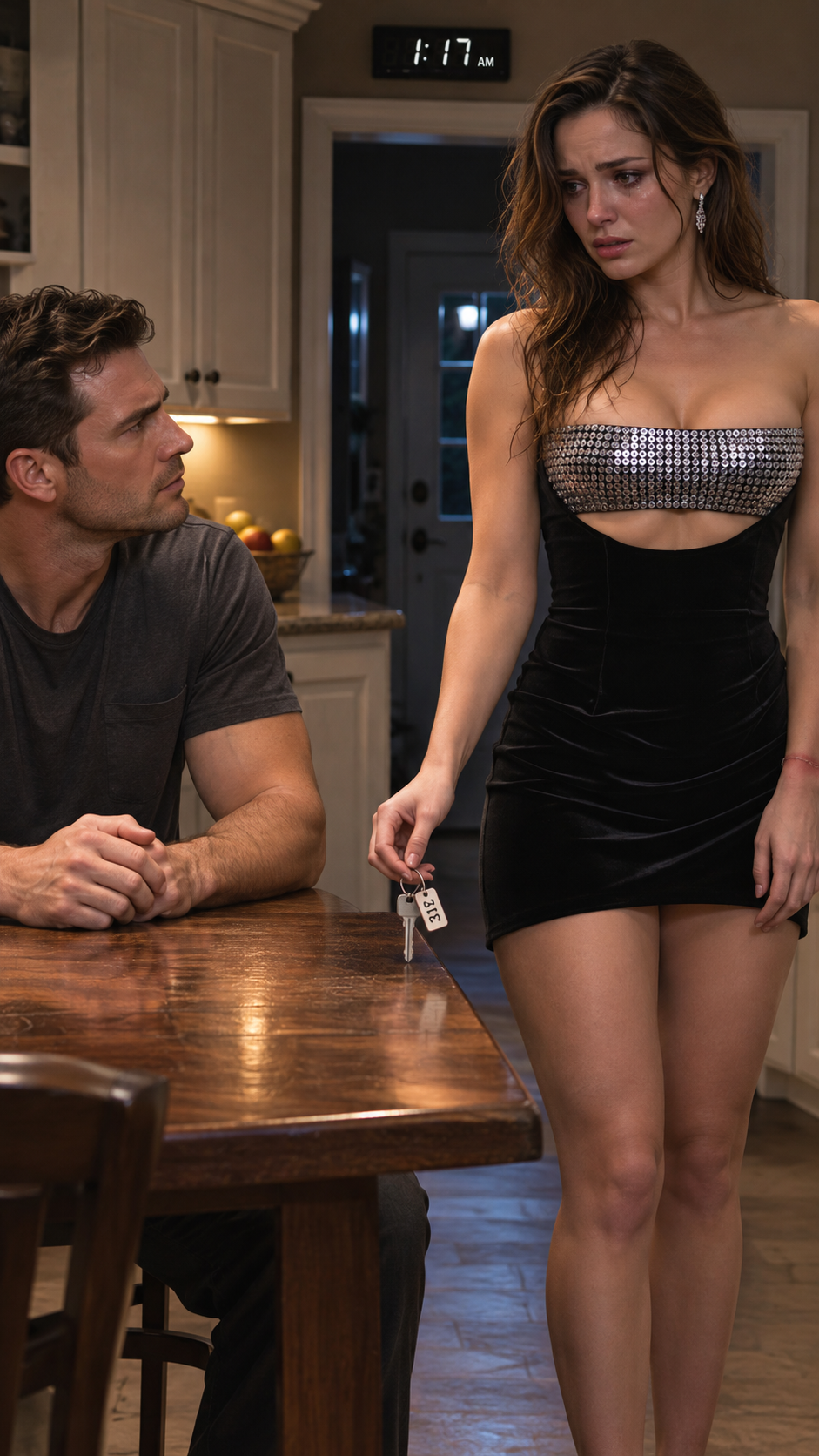
At a.m. a month earlier, I’d looked at my wife and asked how many people she’d been with. I had believed that was the question capable of destroying our marriage.
I had been wrong.
The question I needed to ask was who had been allowed to tell me the truth about my own life. And the answer, finally, was that nobody would have that right alone again.
✓ Lynn R. Adams
I had spent the last twenty minutes trying to understand why the woman standing in the doorway had been erased from my childhood. Now she was telling me that the separation had begun with her own deci…