CHAPTER 3 – THE KEY MY FATHER WANTED BURIED
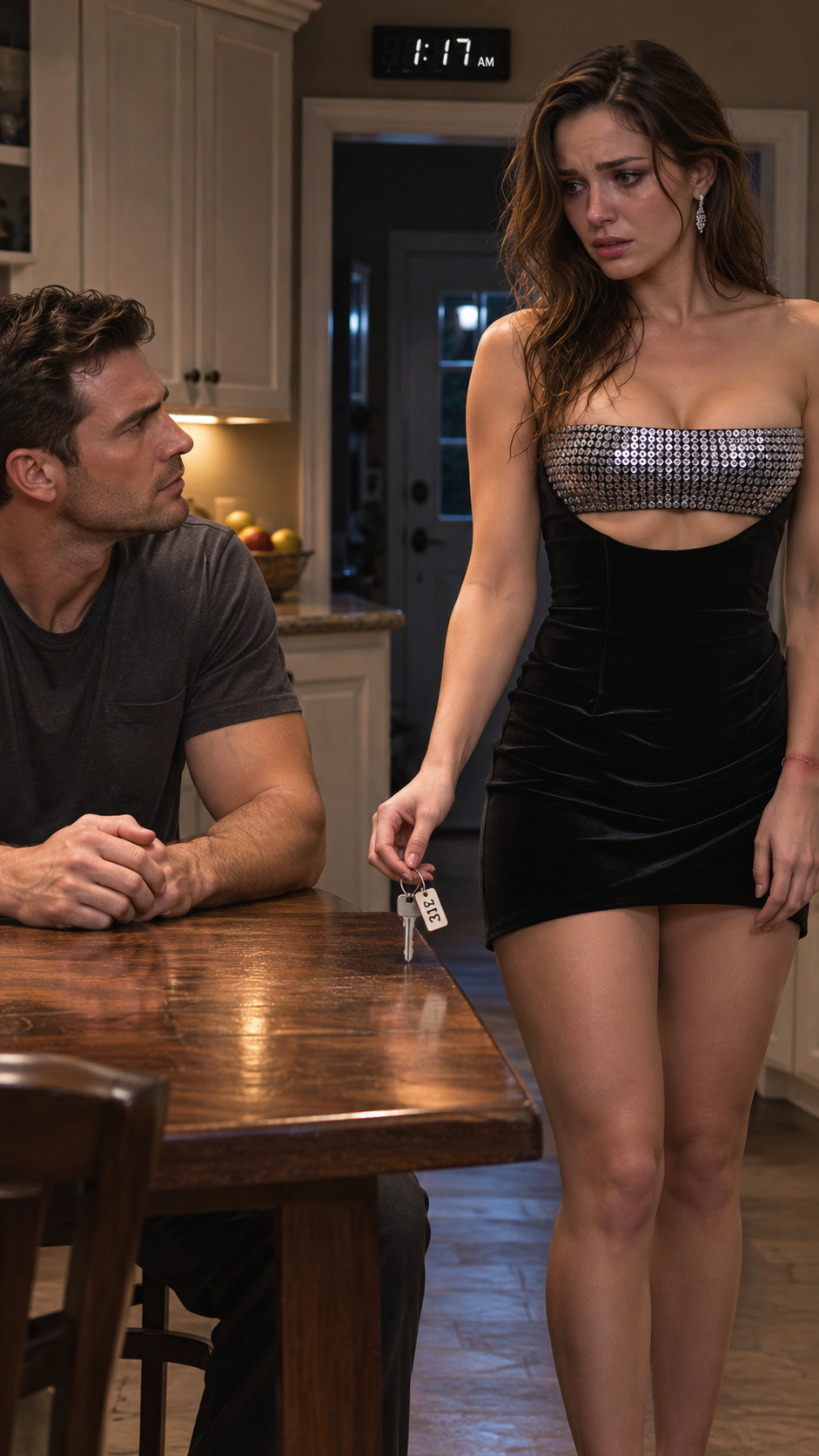
For several seconds, I couldn’t make sense of what Claire had said. My name. On the inside of room 317. Written beside a child’s height marks in a building I had been told I’d never entered.
My father gripped the back of his chair. He wasn’t looking at Claire anymore. He was looking at me, as if my reaction might tell him how much damage the truth could do.
“How old was the child when they made those marks?” I asked.
“Six or seven, judging by the height,” Claire said. “The last date I could read was 1997.”
I would have been eight that year.
Richard closed his eyes. His silence was different from the practiced pauses he used whenever someone mentioned Miriam. This time I could see him reaching for an explanation and finding none that would survive a second question.
“I was there,” I said. “Wasn’t I?”
“You visited,” he answered. “A few times.”
“You told me I’d never been inside.”
“You were young. I didn’t want you remembering the place.”
“Why would a visit be something I needed to forget?”
He looked toward the front door. For a moment I thought he might simply walk out. Instead, he said, “Some of the people living there were frightened. I thought keeping you away from that was the right thing.”
“You didn’t keep me away. You took me there and then lied about it.”
Claire leaned against the table, exhausted. “Richard, I found his name exactly where Miriam’s things were stored. You can’t keep treating that like a coincidence.”
“You don’t understand what was happening then.”
“Then help us understand,” I said.
But he offered another warning instead. The building was dangerous. The records were private. Someone had manipulated Claire. Every sentence avoided the question I had asked.
I pulled out my phone and photographed the silver key where it lay on the table. I wasn’t collecting proof for some revenge fantasy. I wanted a record of the object that had brought my father to our house after one in the morning. Claire showed me her wrist; I photographed the mark with her permission too.
“We’re reporting what happened to her,” I said.
My father stiffened. “You don’t know who that man was.”
“Exactly. She was grabbed, and her necklace was taken. We can report those facts without deciding who committed some larger crime.”
Claire nodded, her face strained but resolute.
Richard sank into his chair. “I never wanted her hurt.”
That admission struck harder than another denial would have. It suggested he’d expected a confrontation, even if he hadn’t expected violence. I asked what he knew. He stared at his hands.
“My family still has an interest in the property,” he finally said. “There is a management company. People go in to inspect it before a sale. One of them called when Claire appeared.”
“And you knew about the upstairs room?”
“Yes.”
“Then I want to see it. In daylight. With permission from whoever controls the building.”
He shook his head. “You won’t find anything there that makes this better.”
“I didn’t ask whether it would make me feel better.”
We sat in that kitchen for nearly another hour. Nobody solved anything. My father eventually agreed to meet us at nine, bring the property authorization he said he could arrange, and accompany us inside. Before leaving, he looked at Claire and apologized for what the man had done to her. She accepted the words without promising forgiveness.
When the door closed, I found myself looking at the place where my father had stood. His three knocks had once meant safety. Now even that sound seemed to belong to a story he’d written for me.
Claire sat beside me. “I should have told you about the call Tuesday.”
“Yes,” I said.
She lowered her gaze. “I was afraid you’d tell Richard before I could figure out whether it was real.”
“You let me believe you were somewhere else.”
“I did. I’m sorry.”
I wanted to say the apology was enough. It wasn’t. But neither was the accusation I’d thrown at her when she walked in. I’d asked whether there had been one man or several while she was trying to find the courage to tell me she’d been frightened and hurt.
“When I saw you without the locket,” I admitted, “I decided you were guilty before you spoke.”
“You had reasons to think I was hiding something. I was.”
“Not what I accused you of.”
She rested her hand beside mine. We didn’t touch immediately. The distance felt honest. Then I moved my fingers across the table, and she took them.
We made a report about the wrist injury and stolen necklace through the local police nonemergency number, giving the address, the approximate time, and what Claire could remember about the man. The person taking the report explained that an officer might need to speak with her again. There was no instant rescue, no promise that somebody would arrest the right person by breakfast. Only a record, and the possibility of further questions.
At dawn, I made coffee neither of us wanted. I looked through the old family photographs stored on my laptop. Most were ordinary: school pictures, birthdays, my parents standing beside a Christmas tree. Aunt Miriam appeared in only a handful. In one, she crouched next to me at about five years old, her hand extended toward a paper airplane I’d just thrown.
I enlarged the image. She had a thin pale scar crossing two fingers of her right hand.
“Claire,” I said.
She crossed the kitchen and looked over my shoulder. Her breath caught.
“That’s the woman who gave me the key,” she said.
I zoomed closer, looking for a way to tell myself she was mistaken. In the photograph Miriam was younger, smiling, with dark hair swept behind her ears. A person could change enormously in thirty years. A scar, though, didn’t change places.
“Are you sure?”
“I saw her hand when she passed me the key. I’m sure about the scar.”
I’d attended a memorial service for that woman. My father had told me she was dead. The possibility that she might be alive made the kitchen seem unfamiliar, like the walls had moved while I slept.
I didn’t call Richard. We had already asked him the question he couldn’t answer. I closed the photograph and put the key in an envelope, keeping the numbered tag attached. I wasn’t going to take the building’s contents or hunt for evidence alone. I wanted to see the room Claire had seen, with a person legally responsible for the property present.
At nine, Richard met us outside Holloway House. The brick facade rose behind a rusting fence and bare trees. It looked smaller than I’d imagined, but the upper windows were too dark to see through. A faded sign near the drive still carried the building’s name.
My father had brought an email printed from the company managing the property, identifying him as a representative of the owning trust and authorizing a supervised inspection of the third floor. A property employee named Peter was already waiting by the gate. He looked tired and wary. When Claire described the man who’d grabbed her, Peter said he was an outside security contractor, not someone who worked for him. He agreed to preserve the visitor log and cooperate if the police requested it.
Richard didn’t argue. He’d become very quiet since arriving.
Inside, Holloway House smelled just as Claire had described: damp cardboard, dust, and floor cleaner. A narrow corridor led past rooms with cracked wooden doors. There were no patients, no hidden activity, no signs of the sinister institution I’d imagined in the night. That almost made it worse. Ordinary buildings could carry extraordinary cruelty without announcing it.
At the staircase, I stopped. The handrail had a carved notch near the first turn. Something stirred at the edge of my memory: my small palm sliding over varnished wood, a woman’s voice telling me not to run.
“I remember this,” I said.
Richard looked up sharply.
“The railing. There used to be a yellow sticker above it.”
“A fire safety notice,” he whispered.
“You remember too.”
He said nothing.
We climbed to the third floor. Claire remained close, but didn’t hold my arm. She knew I needed room to make my own choice. Peter unlocked a heavy corridor door and let us proceed toward room 317. The numeral plate was tarnished, and the paint around the lock had been scratched recently.
I took the silver key from its envelope. My hand was shaking so badly I had to pause before fitting it into the lock. Richard watched without helping. The key turned once. The door opened.
Inside was a narrow room with a single tall window. A bed frame stood against one wall. Shelves held labeled storage cartons, while an old wooden wardrobe leaned beside the door. Nothing moved. Claire had been right about the smell, but she hadn’t prepared me for how personal the room felt. Someone had lived here long enough to mark time in pencil.
Beside the doorframe, the marks began low and rose in uneven steps. Under one line was the year 1995. Another was labeled 1996. Near the tallest, the date read 1997. Written in small careful letters was my name.
Daniel.
A memory surfaced so abruptly I had to steady myself against the wall. I was small, standing on the toes of my sneakers, trying to make myself taller while a woman laughed behind me. She had put a pencil over my head and asked me to stand straight. Afterward we folded a paper airplane together. I remembered the sound of it striking the window and the way she called that a perfect landing anyway.
I knelt, staring at the pencil grooves beneath the paint. My father had taken me to this room as a child. Someone here had measured me every time I came. Whoever it was had expected to see me grow.
“Who did this?” I asked.
Richard stood just inside the doorway. “Miriam.”
It was the first answer he’d given without trying to change the question.
“She measured me?”
He nodded.
“Why?”
“Because she loved you.”
I felt something inside me shift. Love was not the answer I had expected him to offer. I had expected illness, family obligation, a forgotten visit. Not a woman marking my height on the inside of a room where she’d been told to remain.
“Then why did you tell me she was dead?”
He opened his mouth, but Claire spoke first.
“Daniel, look here.”
She pointed toward a shelf behind the wardrobe. A cardboard carton bore Miriam’s name in faded marker. It was the label she’d seen the night before. Peter checked its inventory number against the room list he’d brought, then opened it on the shelf while we watched. Inside were the kinds of possessions someone might save for years: a wool scarf, a paperback with a torn cover, envelopes tied with cotton string, and a small photograph album.
I didn’t touch anything. Peter lifted the album and set it on the empty tabletop beneath the window. Its pages were fragile, the corners curled. The first photographs showed Miriam with Richard and a woman I recognized as Anne, the person I’d always called my mother. Anne had died four years earlier. I’d spent most of my life believing she and Richard were the whole truth about where I came from.
On another page, Miriam was holding a baby wrapped in a pale blanket. She looked younger than I remembered, frightened and happy at the same time. The photograph had been labeled in her handwriting, according to Richard, with a month and year that matched my birth.
“Who’s the baby?” I asked.
My father stared at the floor.
“Answer me.”
“You,” he said.
I looked at the photograph again. A baby could have been anyone. Families held one another’s children all the time. But the next page showed Miriam feeding that baby, and the one after showed her asleep on a couch with him against her chest. Each picture was dated across the first year of my life.
“What aren’t you telling me?”
Richard’s shoulders bent. “Anne and I raised you. You know that.”
“I know you called yourselves my parents. That’s not the question.”
Claire stood beside me, silent. Her hand brushed the back of my shoulder, then rested there without pushing me toward an answer.
Peter cleared his throat. “There is a document folder in the inventory as well. Do you want me to note it before anybody views it?”
Richard nodded reluctantly. Peter recorded the label and opened the folder on the table. The papers were old, and none of us pretended that one sheet automatically settled a legal question. But one intake form listed a child named Daniel Mercer. Under the heading for relationship, it identified Miriam Mercer as his mother. Richard’s name appeared in a separate field describing a relative who had assumed care.
I read the form twice, then a third time. The typed words didn’t blur. I wanted them to. I wanted a mistake in the date, an explanation about names, anything that would return me to the life I’d understood when I woke up yesterday.
“Miriam is my mother?” I asked.
Richard’s eyes filled. “Yes.”
The room seemed to lose its air. For thirty-seven years I’d called this man Dad. I’d loved Anne, mourned her, believed the stories they told me about our family. None of that love disappeared in an instant. But it was suddenly surrounded by questions they had deliberately kept me from asking.
“And you’re her brother.”
He nodded.
“You’re my uncle.”
“I became your father in every way I knew how. Anne and I adopted you when you were small. We never wanted you to feel you belonged anywhere else.”
“You could have been my father without pretending my mother was dead.”
He looked away, and I knew he’d spent years refusing to consider that simple possibility.
“She wasn’t well,” he said. “She needed treatment. She couldn’t care for a little boy. Anne and I stepped in.”
“Then why did I visit her here until I was eight?”
“Because she asked to see you. We thought those visits might help.”
“And after that?”
“Things changed.”
“That’s what you’ve said my entire life. Things changed. People had problems. It was complicated. What changed?”
My father looked at the photographs. “Miriam began asking questions about how the home managed residents’ property. She thought people were being kept from their families. There were arguments with administrators and with me. I told myself she was confusing treatment with punishment.”
“Did you believe her?”
“I didn’t know what to believe.”
“You knew enough to help run this building.”
He didn’t deny it. Instead, he admitted he’d signed maintenance and property papers for the family trust while the home was operating. He’d been close to decisions he once described as none of his business. He still claimed he hadn’t controlled Miriam’s medical care, and I wasn’t willing to turn claims into facts without records. But he had controlled what he told me.
“When I was sixteen,” I said, “you told me she died in an accident. We had a service.”
“It was a memorial gathering,” he answered weakly. “The family believed we’d lost her.”
“Lost her where?”
“She had left the program. We weren’t in contact.”
“You told me she was buried.”
He began to cry then, quietly, without theatrical excuses. It didn’t make his answer better. It only made him human enough that I had to resist the old habit of comforting him.
I closed the photograph album and moved it away from him. The small motion changed something. He no longer controlled which pages I was allowed to see or which questions I was allowed to ask.
“You don’t get to choose the story anymore,” I said. “Not for me. Not for Claire.”
Richard wiped his eyes. “I was trying to protect the family.”
“You protected a secret. Those aren’t the same thing.”
I asked Peter to keep the documents secured, preserve the inventory, and give us the contact information for the trust’s attorney. We would need independent copies and proper confirmation of the adoption history. We would also need to speak with whoever had managed the building, including the security contractor who took Claire’s locket. I didn’t want my father’s memory to become our only source of information again.
A soft sound came from the corridor. I turned, expecting Peter to call out to another employee, but he was still beside the table. Claire had gone pale. Someone stood beyond the open doorway, her gray hair tucked into a plain scarf.
She raised her right hand against the frame. Two fingers carried the same narrow scar I’d seen in the photograph. She looked at me with such unmistakable longing that for a moment I forgot the building, the records, and the angry questions waiting inside me.
“Daniel,” she said, almost too softly to hear.
I stood, but didn’t move toward her. Thirty-seven years of my life had just changed, and I couldn’t rush across the distance as if a simple embrace could make it understandable.
Richard whispered, “Miriam.”
The woman looked past me at her brother. “You said you’d tell him before he found out this way.”
He lowered his head.
I looked at her scarred hand, at the measured lines beside the door, and finally at her face. The woman my family had mourned was standing alive in the room where she’d watched me grow. She had summoned Claire, given her the key, and brought me back to a history I’d been taught to forget.
“Why didn’t you come for me?” I asked.
Miriam took a trembling breath. Her eyes filled, but she kept her voice steady.
“Because when you were little, Daniel, I was the one who asked Richard to take you.”
✓ Lynn R. Adams
For several seconds, I couldn’t make sense of what Claire had said. My name. On the inside of room 317. Written beside a child’s height marks in a building I had been told I’d never entered. My fathe…