CHAPTER 3 – THE HOTEL ROOM WEARING MY NAME
I put the phone on the dining table and stared at my wallet. My driver’s license was inside it. That should have reassured me. Instead, I kept hearing the hotel’s last sentence: somebody expected to have a photograph of my identification by morning.
Upstairs, my wife was still awake. I could see light beneath the bedroom door. I had spent years walking into that room without knocking, certain that whatever happened outside our house, we belonged on the same side of its doors. Now I stood at the foot of the stairs wondering whether she was planning to use my name before breakfast.
I opened my notebook and wrote down the manager’s words while they were fresh. He had not said anyone possessed my identification. He had said a caller expected to obtain it. The difference mattered. It was the only thing keeping my fear from becoming an accusation I couldn’t prove.
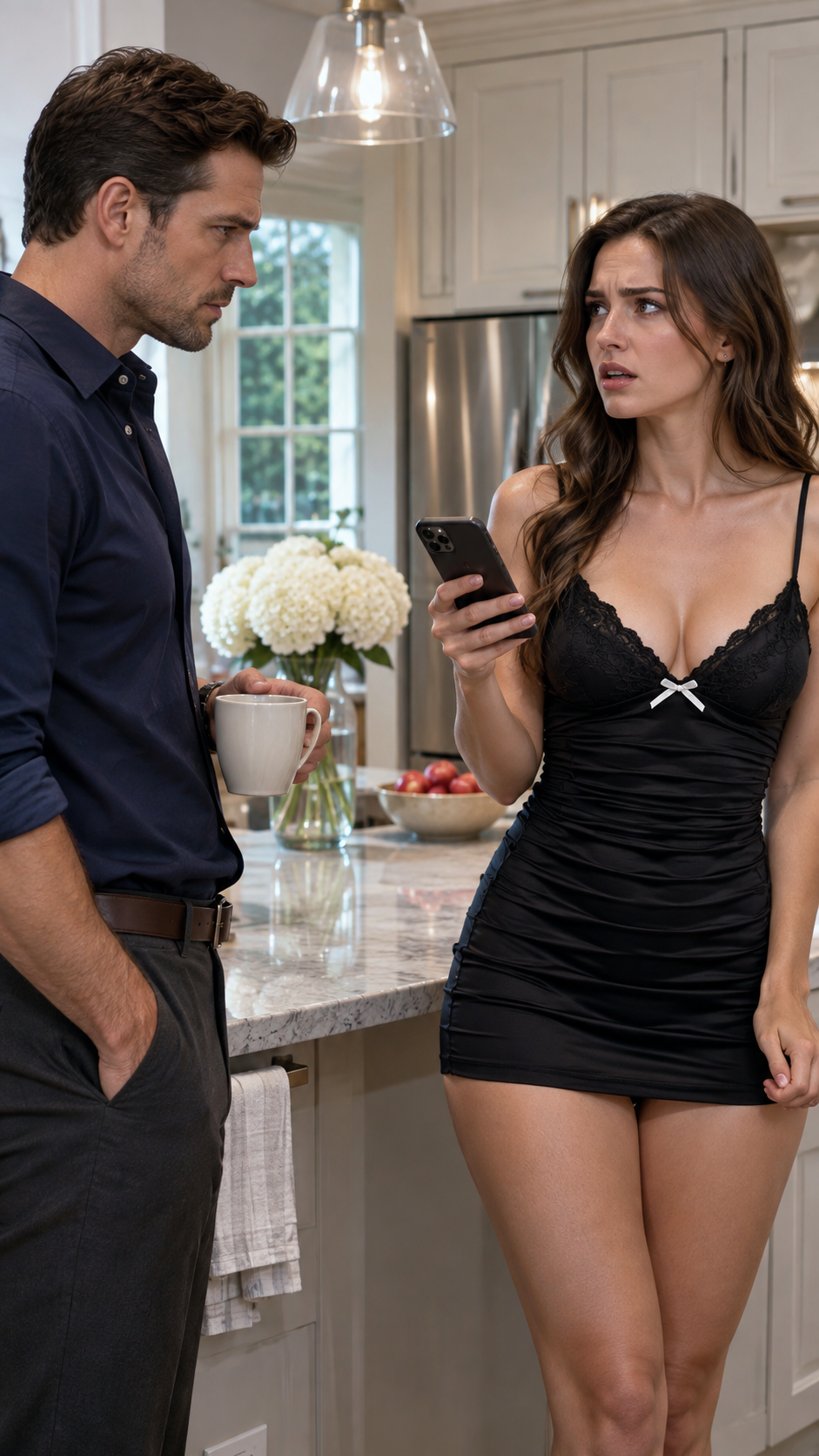
When my wife came down, she was carrying a glass of water. She stopped when she saw me at the table.
“Still making your little case against me?” she asked.
“The hotel called.”
Her fingers tightened around the glass. “Why?”
“Someone asked whether a photograph of my license would be enough to check in without me.”
For the first time that day, she didn’t tell me I was imagining things. She looked toward the front door, then back at me.
“You shouldn’t have called them.”
“That isn’t an answer.”
“They’re going to ruin everything.”
“What is everything?”
She swallowed. “A client arrangement.”
“One that needs my driver’s license?”
“You’re twisting it.”
“Then tell me what I heard wrong.”
She placed the glass on the counter, but her hand stayed wrapped around it. “I’m exhausted. We can talk tomorrow.”
“Tomorrow is Friday. The reservation is for tomorrow night.”
“Exactly,” she said, and I watched her realize what she’d admitted. “Please don’t make any more calls.”
She went upstairs without her water. The glass remained under the kitchen light, half full. It was the first time she’d left a conversation without even trying to win it.
I did not follow. Instead, I checked documents I could lawfully access: my own email, the household folder we’d both used for travel paperwork, and the account where I’d once stored a scan of my driver’s license for an insurance application. The scan was there. It had been there for almost two years, available to both of us through a shared folder we had set up together.
I couldn’t tell whether she’d opened it. I could tell that she didn’t need to steal my wallet to get a copy. I made a separate copy for my records and removed my identification file from the shared folder without touching her personal files. Then I changed the password on my own account. None of that could undo a copy she’d already taken.
At 11:20, I drafted a message to the hotel manager confirming that I had not authorized another person to use my identity, my identification, or my name for check-in. I sent it to the official address he’d given me, saving the reply and my earlier messages in one folder.
I slept in the guest room. Around two, I heard footsteps stop outside the door. There was no knock. After a moment, they moved away.
Friday morning began with rain tapping against the windows. I was awake before my alarm, staring at the pale outline of the ceiling fan. I could remember the exact tone my wife had used outside the study: not angry, not desperate, merely practical. She had spoken about spending our money on another man as casually as she’d once discussed replacing our refrigerator.
By seven, she’d left a message on my phone.
I know you’re upset. Please don’t do anything today that you can’t take back.
There was no apology attached to it.
My phone showed a picture of us from the previous spring, standing beneath the trees at a state park. I remembered the day clearly. She had complained about the mosquitoes, then reached for my hand as we walked back to the car. Looking at it now, I didn’t suddenly decide those moments had all been false. That would have been easier. I knew some of them had been real, which meant I had to live with the terrible possibility that love and contempt had existed under the same roof without my recognizing the difference. I turned the phone facedown. There was no useful answer in an old photograph, only a reminder that the person I wanted to call for comfort was the person I could no longer trust.
At work, I told Eric I needed the afternoon for a personal matter. He looked at me for a second, then said he’d cover the deliveries. I thanked him, closed my office door, and arranged a brief consultation with a North Carolina family-law attorney named Rebecca Shaw.
I didn’t tell her I wanted revenge. I told her my wife appeared to be using a shared card and my identity for a hotel reservation I had not made. I told her I had overheard a conversation about paying a man to spend the night with her. I also admitted what I could not establish: whether any hotel charge had succeeded, whether anyone had copied my license, or what the other person planned to do.
Rebecca didn’t promise an instant divorce or tell me a hotel reservation would win anything in court.
“North Carolina has rules about separation and divorce that don’t disappear because somebody behaved badly,” she said. “And you need to keep financial questions distinct from accusations about a relationship. Preserve the records. Don’t empty a joint account to punish her. Don’t impersonate her or get into her private devices.”
“What about the room?”
“You can tell the hotel you haven’t authorized anyone to act as you. Follow its verification procedure. If you think your identity has been misused, document that with the relevant institutions. And don’t sign any authorization you don’t understand.”
I wrote every word down. My hands were still shaking when the call ended, but I finally had a direction that wasn’t controlled by my anger.
At eleven thirty, an email arrived from the hotel. Daniel Ortiz asked whether I could visit in person with identification to complete its review of the reservation. He made clear that staff would not allow a photograph of my license to substitute for the identification required of a person checking in.
I replied that I would come that afternoon.
My wife called within ten minutes. I let it ring until I could step into an empty conference room.
“Where are you?” she asked.
“At work.”
“Are you leaving early?”
“Why?”
“Because you haven’t answered me. I need to know you’re not going to show up somewhere and make a scene.”
“I have a right to ask why someone made a reservation in my name.”
“Melissa says she can fix it.”
It was the first time she’d admitted Melissa had anything to fix.
“Then why hasn’t she?”
“She needs you to stop calling people.”
“She doesn’t need permission to correct a mistake she made.”
My wife went quiet. When she spoke again, her voice was different, small and impatient at once.
“What would it take for you to let tonight happen?”
I closed my eyes. She had just asked me to negotiate the terms of being deceived.
“The truth,” I said.
“You’ll never understand.”
“Try me.”
But she ended the call.
The drive downtown took longer than usual in the rain. At every red light, I rehearsed what I would say. I wanted to sound like a man concerned about his identity, because that was exactly what I was. I did not want a lobby full of strangers to hear about my marriage or become unwilling witnesses to a fight.
The hotel was a quiet brick building with polished stone floors and a lobby that smelled faintly of coffee. I asked for Daniel Ortiz by name. A receptionist checked his availability, and he met me in a small office near the front desk.
He compared my identification with the information I’d submitted through the hotel’s secure process. He checked with another member of staff, then returned with an electronic copy of the reservation summary. He kept it on his screen at first, explaining that some parts involved other people’s information he couldn’t disclose.
“The reservation lists you as the primary guest,” he said. “It was entered through a third-party event-booking channel. It has not been checked in.”
“Who put my name there?”
“The booking contact identified herself as Melissa. That’s the contact name on this record. We are still reviewing how the details were supplied.”
“Was my card used?”
“The room was initially held with payment details provided through that channel. We can’t establish ownership of every payment source from this screen, and I don’t want to speculate. Our billing team is reviewing the authorization.”
I thought about the charge that had failed that morning. A refused payment was not the same as a completed room charge. It also didn’t tell me who had supplied the number.
“What happens now?”
“We’ve flagged the reservation. No one will check in as you merely by presenting a photograph or saying you approved it. We will not treat a caller’s claim as your authorization.”
He asked whether I wanted to be present if someone tried to use my name. I said no. I did not want an ambush. I wanted the hotel to protect its own process and to document the problem accurately.
Before leaving, I requested a written acknowledgment of my report. He said the hotel could send confirmation that I’d disputed the use of my identity, along with the information it was permitted to provide after review. He made no promises about exposing other guests or sharing private records.
At the door, he stopped me.
“There is one other detail I can tell you,” he said. “A caller asked whether the named guest could be removed after arrival without creating a visible change on the original confirmation. We told her we couldn’t promise that.”
I felt my stomach turn.
Someone wanted my name at the beginning of the transaction, then wanted me absent from the end of it. Whatever else this was, it hadn’t begun with a harmless autofill mistake.
Back outside, the rain had stopped. I sat in my car and stared at the hotel entrance. I had imagined seeing my wife walk through those doors with a stranger. Instead, I had learned something that felt worse: she was prepared to place my identity in a record and then ask the hotel to conceal the change.
A message arrived from an unfamiliar number.
This is Melissa. Please call me before you speak to your wife.
I didn’t call immediately. I sent one question instead.
Did you create a hotel reservation in my name without my permission?
Three minutes passed.
I was told you agreed to the arrangements.
By whom?
Your wife.
I watched cars roll through the intersection while I considered that answer. Melissa could be lying. My wife could be lying to Melissa. Both could be lying to me. The message established only what Melissa claimed, not what had happened.
I asked her to meet me in the public seating area of a coffee shop two blocks from the hotel. I said I wanted a straightforward explanation, not a confrontation. She agreed to come before five.
Melissa arrived wearing a gray raincoat and carrying a canvas bag. I recognized her vaguely from a holiday gathering at our house, when my wife had introduced her as a friend who worked with private events and travel bookings. She looked nervous when she saw me.
“I never expected to meet you like this,” she said.
“Neither did I.”
She sat across from me but didn’t order anything.
“Your wife said the two of you had an arrangement,” she began.
“What arrangement?”
“That you were comfortable with her seeing other people, as long as it stayed private. She said you handled the finances and didn’t want her name on the paperwork.”
I felt the familiar sting of being reduced to a wallet, but I kept my voice steady.
“That’s not true. I never agreed to any of it.”
Melissa’s eyes widened. “She told me you’d discussed it.”
“Did she tell you I would be the guest at the hotel?”
“She said the reservation should be in your name for discretion. I understood that you would authorize the booking.”
“And the photograph of my license?”
Melissa looked down. “She said she could provide it. I asked the hotel whether a scanned copy would work because the named guest wasn’t planning to stay. They said no.”
“So you knew I wasn’t coming.”
“I thought you knew, too.”
“You didn’t think it was strange that I was the primary guest for a room I wouldn’t enter?”
She rubbed her forehead. “I should have asked you directly. I didn’t.”
I let the silence sit. An apology wasn’t proof of innocence, and I wasn’t there to absolve her. I needed to know how the booking connected to the conversation I’d heard.
“Was there someone else she planned to meet?” I asked.
Melissa nodded slowly. “She asked me for an introduction to an adult companion service. I gave her information about a private concierge business. I didn’t choose anyone for her.”
“Did you collect a fee?”
“For arranging the room, yes. Not for anything that happened inside it.”
Her distinction sounded carefully chosen. I didn’t pretend to know whether it was accurate.
“She wanted a man she wouldn’t recognize?” I asked.
“Someone outside her social circle. She said she didn’t want a chance encounter afterward.”
There it was. The sentence from the study had a meaning I could finally recognize. My wife wasn’t dreaming aloud about an affair. She’d asked someone to handle the logistics.
“Why my name?” I asked again.
Melissa took a long breath. “She said it was the only way to make sure her own name stayed out of the records. I warned her that it was a bad idea. She insisted you’d agreed.”
“Did she say anything about what would happen if I found out?”
Melissa hesitated. “She said you’d never want anybody to know the room was booked under your name.”
I felt an unfamiliar chill.
“Why would that stop me?”
“I don’t know,” Melissa said. “I thought she meant you’d be embarrassed.”
Now I understood a second part of the plan. My wife wasn’t merely hoping I wouldn’t check our accounts. She had counted on my shame to keep me silent if I discovered what she’d done.
I asked Melissa to put in writing what she had personally arranged, including that she had relied on my wife’s claim of consent. She said she would speak to the booking service and send a factual account. I didn’t ask her to retrieve private messages or manufacture evidence. What she’d already told me was enough to justify protecting my name.
When I stood to leave, she caught my attention.
“For what it’s worth,” she said, “the booking agency has been asking me all afternoon whether the named guest is aware of the reservation.”
“What did you tell them?”
“That I was trying to find out.”
I left the coffee shop feeling no victory. A stranger had just confirmed that my wife had been seeking another man and had used our marriage as the supposed permission for it. The confirmation didn’t make the words she’d said about me hurt any less. It made them impossible to dismiss.
I drove slowly through the neighborhoods where we’d once looked for our first house. I remembered her sitting beside me with printouts from real estate websites, circling kitchens with enough room for the table we wanted to buy. Every choice then had felt shared. The hotel booking had turned that memory inside out: she had involved my name in a decision I wasn’t allowed to make. I thought about calling her mother, or asking our neighbors whether they’d noticed anything. I rejected both ideas. Their opinions couldn’t authenticate a reservation or explain a lie. More importantly, I didn’t want to turn my pain into a public performance. If this marriage was going to end, I wanted the facts to be clear before anybody started choosing sides. When I reached our street, I sat behind the wheel for another minute, letting the engine idle until my hands stopped gripping the steering wheel so tightly.
At six fifteen, I returned home. My wife’s car was in the driveway. She stood in the entryway as I came through the door, dressed to go out and holding a small evening bag. When she saw my face, she knew where I’d been.
“You met Melissa,” she said.
“Yes.”
“She had no right to talk to you.”
“She said you told her I approved the whole thing.”
My wife opened her mouth, then shut it. The silence lasted long enough for me to hear the hallway clock tick.
“I just wanted one night,” she finally whispered.
“You could have told me you wanted to leave. You could have told me you didn’t want this marriage anymore. Instead, you put my name on a hotel room and tried to use our money.”
“I wasn’t going to hurt you.”
“You already had.”
Her eyes filled, but her voice sharpened. “You think I did all this because I wanted a stranger? You really think that’s the whole reason?”
I held her gaze. “Then tell me the rest.”
She reached into her bag, hesitated, and took out a folded sheet of paper. She didn’t hand it to me. She kept it pressed against her chest, as if the page itself could protect her.
“Melissa wasn’t supposed to put you on the reservation permanently,” she said. “It was supposed to be changed after check-in.”
“Changed to whom?”
Her face lost its color.
“That’s what you still don’t understand,” she said. “The name that was supposed to replace yours wasn’t mine.”
✓ Lynn R. Adams
I put the phone on the dining table and stared at my wallet. My driver’s license was inside it. That should have reassured me. Instead, I kept hearing the hotel’s last sentence: somebody expected to h…