Chapter 2: THE NAME AT THE DOOR
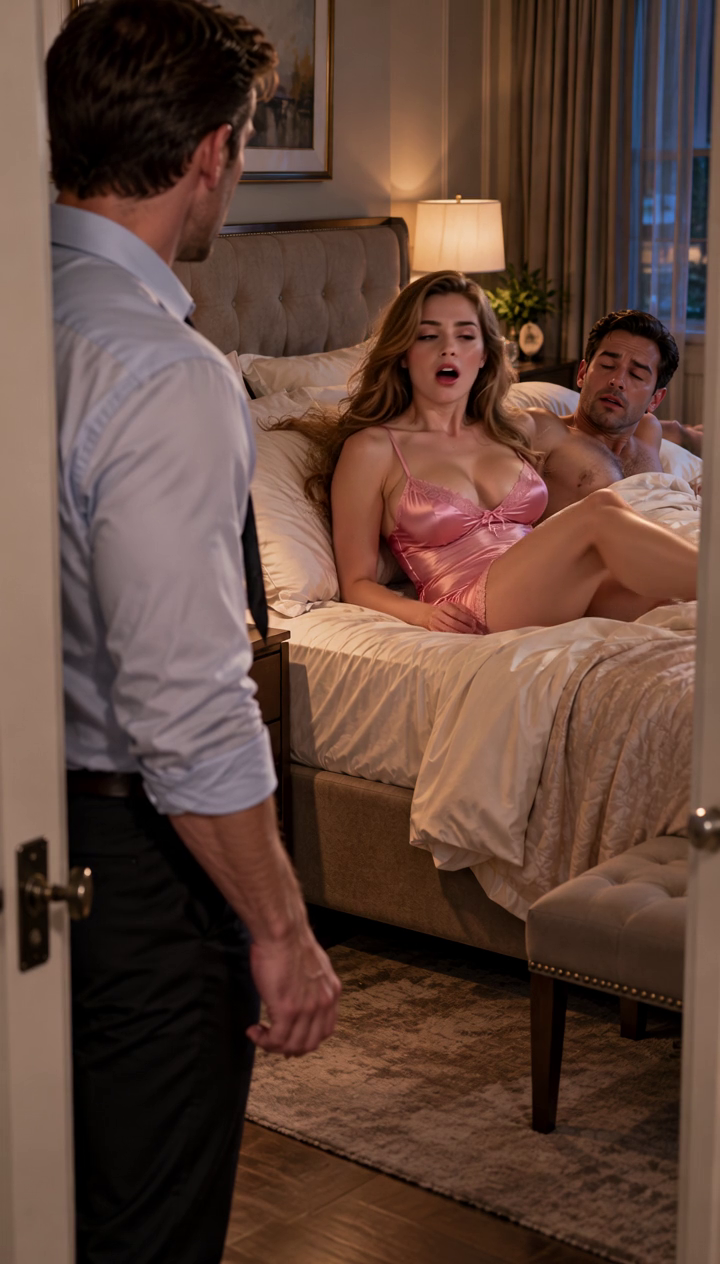
“Evelyn,” Claire whispered. “It’s Evelyn, isn’t it?”
I looked at the woman I’d slept beside for twelve years. She was gripping my wrist so hard her fingernails pressed crescents into my skin. A minute ago she had been irritated by my return. Now she looked as if somebody had pulled the floor from under her.
“Let go,” I said.
She released me and stepped backward. “You don’t understand. Evelyn has been trying to turn you against me.”
“Then you can tell me that with her here.”
“No.” Her voice broke on the word. “You have no idea what she’s done.”
I did know one thing: Evelyn had not been in my bedroom the night before. I folded the photograph back into its sleeve. The date had been printed beneath the image by the security system at a neighborhood community clubhouse: March 14. It was now October. The man beside Claire was wearing a charcoal jacket, his face angled toward her, one hand holding a manila folder. Their shoulders nearly touched. The image alone didn’t prove an affair. Yesterday had done that. What the photograph proved was that the man was not some one-night stranger.
At the bell rang.
Claire lunged toward the hallway. “Don’t answer it.”
“Move, please.”
“Andrew, listen to me.”
“I’ve been listening for months.”
I opened the door. Evelyn stood on the porch in jeans and a rain jacket, holding a small folder. Beside her was an older woman I recognized only vaguely from neighborhood meetings: Ruth Bennett, treasurer of the Brookhaven Neighborhood Improvement Association. Ruth’s husband had died in the spring. Since then she had rarely left her house.
“I didn’t know Ruth was coming,” I said.
“She insisted,” Evelyn answered. “It’s her money too.”
Claire made a sound behind me that I had never heard before.
Ruth stepped inside carefully, gripping the strap of her purse. “I want my paperwork back,” she said to Claire. “And I want you to stop telling people I approved what happened.”
I glanced from one woman to the other. “What paperwork?”
Evelyn asked whether we could sit down. I agreed, leaving the front door partly open because suddenly I wanted everyone to know nobody was trapped in that house. Daniel, whom I’d texted from the car, was on his way. Claire stood near the staircase, arms folded again, but this time they looked less like defiance than something she was holding herself together with.
Ruth took out a copy of a payment statement. The Brookhaven association was a voluntary neighborhood nonprofit, not our legally established homeowners’ association. It organized landscaping along the common entrance and maintained an emergency fund for elderly residents who needed temporary help after storms. Donors had contributed through checks and online payments for years. Claire had joined its three-person volunteer committee eight months earlier, promising to modernize the bookkeeping.
I knew that much. She had called it community service. She had also asked me to help put together a spreadsheet, but when I offered to review the accounts she said the other members preferred privacy.
“In March,” Ruth said, “Claire told us a contractor had to be paid immediately for drainage work. She brought a man named Victor Hale to a meeting. He said he worked with a local property services company.”
“Victor,” I repeated. It was the first time the stranger had a name.
Claire stared at Ruth. “He does work for that company.”
“That may be,” Ruth said. “But the invoices didn’t match the checks.”
Evelyn placed three printed screenshots on the table. They were messages from a neighborhood planning group she administered, not stolen private texts. Claire had written that an assessment had been approved and that residents should send payments through a new web address. Several people had asked why they had not received ballots. Claire replied that the board had already voted.
“We never voted,” Ruth said.
“I can explain,” Claire said.
“Please do,” I answered.
“We needed to move quickly. A real contractor was involved. There was a timing issue with the account.”
“Whose account?” Evelyn asked.
Claire said nothing.
Ruth opened another folder. She had requested bank statements as an authorized signer on the nonprofit account, and the bank had supplied duplicates after delays. Several payments were made to an entity called Crescent Property Coordination LLC. Ruth had also contacted a listed contractor, who confirmed doing a small inspection but not the major drainage work for which donors had apparently been charged.
I felt a different kind of sickness. Claire and I had combined our household checking for utilities and groceries, but our retirement accounts were separate and the deed to the house was in both names. I had never signed an association check. Still, the address linked to a company receiving neighborhood money was our home address. It appeared in the paperwork Ruth had brought.
“Why is our house listed here?” I asked.
Claire swallowed. “It was convenient for mail.”
“Were you running this company?”
“No. Victor handled it.”
“Who owns it?”
“I don’t know.”
Ruth interrupted gently. “That is what we are trying to find out. We are not accusing you of anything, Andrew. We need to identify where the money went.”
Evelyn explained why she had contacted me in September. She had seen Claire and Victor together several times, usually after hours at the clubhouse, sometimes accompanied by envelopes and a laptop. She had believed their closeness was inappropriate but had worried even more when Ruth began finding discrepancies. At first she approached Claire directly and was told to mind her business. Claire then began telling neighbors that Evelyn was unstable and obsessed with her marriage.
“I should have told you more,” Evelyn said to me. “But I didn’t have the statements then, and I wasn’t going to accuse somebody of theft based on a photograph.”
That distinction mattered. My life was collapsing, yet I could still see the difference between concern and proof.
The sealed envelope on the table came from Ruth, not Evelyn. It contained a letter sent by an accounting firm to the nonprofit’s board, advising that their engagement had been terminated because requested records had not been provided. Ruth had brought the original in case Claire denied receiving it. I read it twice. The accountant had not declared anyone a criminal; the letter merely documented missing records and unanswered requests. Somehow that made it worse. This wasn’t a dramatic anonymous warning. It was ordinary paperwork showing months of people trying to get answers.
Claire finally sat. “Victor told me the expenses would be reconciled. He said the association would get every dollar back.”
“How much?” I asked.
“I don’t know exactly.”
Ruth looked exhausted. “At least forty-eight thousand dollars is not accounted for to our satisfaction. We are still reconciling donations and disbursements.”
Forty-eight thousand. Some of that money had come from elderly neighbors who believed they were repairing dangerous drains. Other donors had funded storm relief. I thought of Ruth, who lived on a fixed income and had baked pies to raise money. I thought of Claire laughing as I left our bedroom. Two harms were emerging, and I didn’t yet know how closely they were connected.
The doorbell rang again. Daniel stepped in, scanned the room, and came directly to my side. He didn’t touch Claire or demand an explanation. He just said, “I’ve got you.”
For the first time since Friday I nearly cried.
Claire fixed her gaze on Daniel. “He’s always hated me.”
“I’ve never hated you,” Daniel said. “I hate seeing my brother hurt. Those aren’t the same thing.”
I asked Ruth and Evelyn if they would send any bank records to an independent attorney or law enforcement rather than circulate them online. They agreed. I asked Daniel to photograph the items on the table with their permission, keeping the originals with their owners. Then I told Claire the conversation was over for now.
“What does that mean?” she asked.
“It means I am leaving. And I’m speaking to a lawyer before we touch any money.”
“You can’t just walk out on twelve years.”
“You told me to get over it.”
She flinched. “I was angry. I didn’t mean it.”
“You said it while another man was in our bed.”
Claire stood so suddenly the chair scraped the floor. “If you get lawyers involved, you’ll destroy everything we’ve built.”
“If everything depends on hiding what happened, it may already be destroyed.”
Daniel helped me pack a small bag. I photographed the household account balances from my own online banking, downloaded statements for the accounts I legally owned, and left the laptop we shared untouched. I did not search her private email or take her phone. A lawyer could tell me what evidence I could properly preserve. I took my passport, medications, work computer, two changes of clothes, and the framed picture of my late father from my office. I left my wedding band on my finger because I wasn’t ready to decide what that small circle meant.
On the way out, Claire followed us to the porch. She looked at Daniel, then at me. Her face was wet, but her voice had sharpened again.
“They’re going to make you believe I did something terrible.”
“Then show the records,” I said. “That’s all anyone has asked.”
She whispered, “Victor won’t let that happen.”
I stopped. “What does that mean?”
She stared past me toward the street, where the black SUV I had noticed on Friday was now parked by the curb.
Victor was sitting behind the wheel.
I didn’t go toward him. I had no interest in giving him a confrontation he could twist into a police report. Daniel saw the vehicle too. We got into separate cars and drove to his house. A block later I pulled over long enough to write down the plate number while it was still fresh in my memory. I did not know whether Victor had come to collect Claire, threaten her, or simply watch the house. I knew only that she had seen him and seemed frightened.
Daniel’s guest room smelled of fresh laundry. I sat on the bed and called a family-law attorney whose name a colleague had once recommended, Melissa Grant. Her office couldn’t see me until Monday, but her assistant told me to preserve accessible financial records, avoid moving joint money without advice, and keep all contact civil. It wasn’t legal advice tailored to my case yet. It was enough to stop me from doing something reckless.
That evening I received a text from Claire: I need you to promise you won’t believe Evelyn. I can explain the affair. The rest is different.
I looked at the words for a long time. Even now Claire was asking for loyalty before giving me facts.
I replied: We can discuss the truth with counsel present. Please don’t delete records.
Her answer came at 10:06: If Victor finds out what Ruth has, this could get ugly.
I showed Daniel. He suggested we call the police if anyone threatened us. I agreed. We did not know whether Claire was warning me or manipulating me. But I finally understood why she had begged me not to open the door: Ruth’s visit meant her secret life was no longer controlled by her alone.
And by Monday morning, I would learn that our household finances had been pulled into the same web.
Before sleeping I wrote a timeline in the notes app on my work phone: the first strange absences, Evelyn’s warning, the SUV, the bedroom, the photograph, Ruth’s statements. I labeled each entry with what I’d personally observed and what someone else had told me. I could already feel anger mixing facts together. Keeping them separate was the first useful thing I’d done for myself in weeks.
✓ Lynn R. Adams
“Evelyn,” Claire whispered. “It’s Evelyn, isn’t it?” I looked at the woman I’d slept beside for twelve years. She was gripping my wrist so hard her fingernails pressed crescents into my skin. A minut…