CHAPTER 2 – THE KISS THAT BROUGHT DANGER HOME
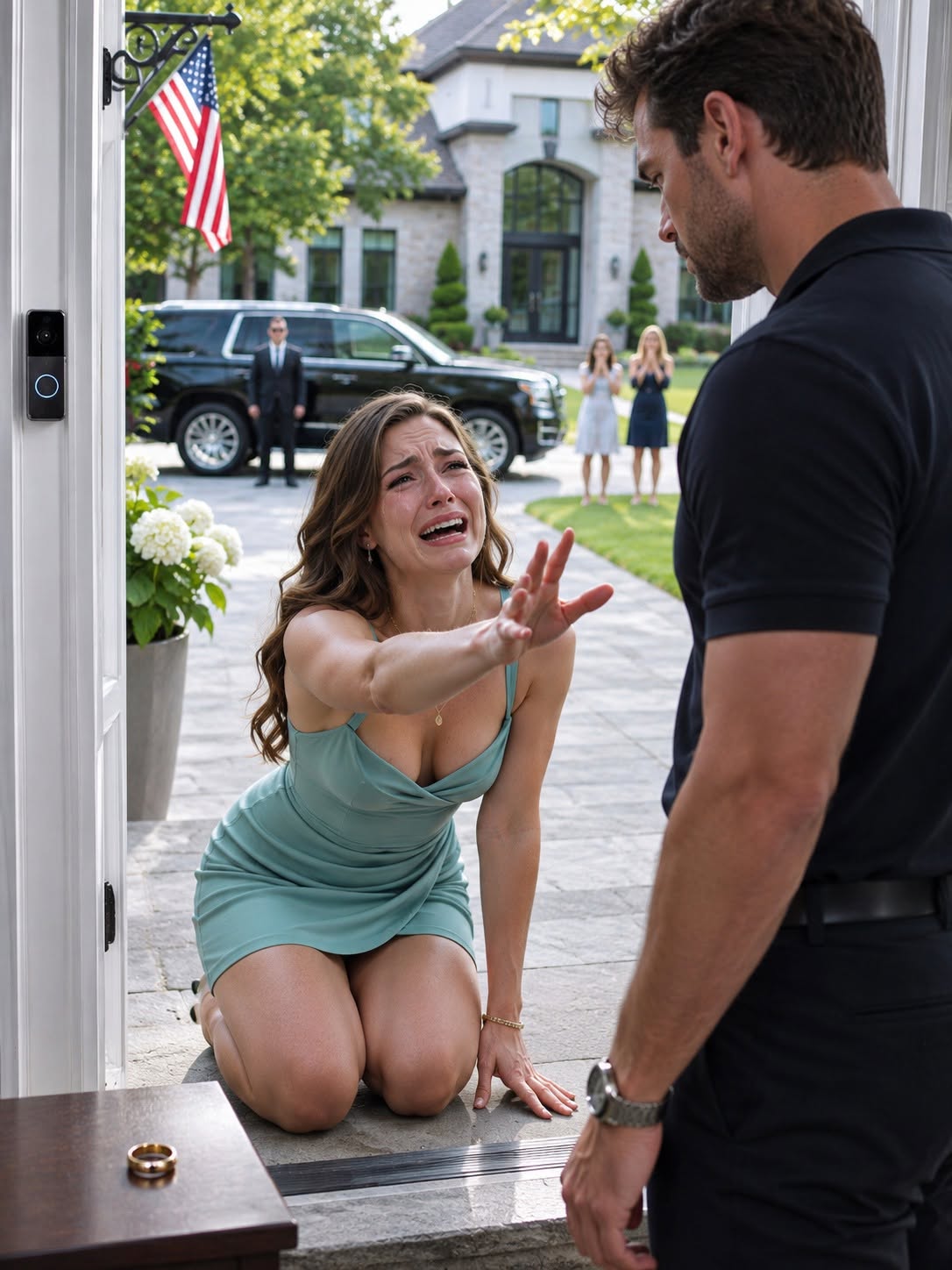
**CHAPTER 2 – THE KISS THAT BROUGHT DANGER HOME**
The man who had kissed my wife stepped out of the black SUV, and for one terrible second, I wanted to open my front door and put my fist through his face.
Then I looked at my wife on the security camera.
She was trembling so violently that she could barely stand.
And suddenly, my anger wasn’t the only thing I felt.
Fear had entered the room.
The stranger stood beside his vehicle, studying my house with the calm confidence of someone who already knew what was inside. He wore a charcoal jacket, dark trousers, and the same expensive silver watch I remembered seeing at the party.
There was no uncertainty anymore.
It was him.
The man from the hallway.
The man whose mouth had been against my wife’s.
“Nathan!” my wife screamed. “Don’t open the door!”
I had already reached for the lock.
Her warning stopped my hand.
On the camera, the stranger slipped his phone into his pocket and began walking toward my driveway.
My wife turned toward the lens.
“Please,” she whispered. “I know what you saw. I know what you think. But if you leave me out here, he’ll make sure you never learn the truth.”
I stared at her through the monitor.
This was Claire.
The woman I’d married eight years earlier.
The woman who remembered how I liked my coffee, who knew exactly when to leave me alone after a difficult day, who used to reach across the bed at night just to make sure I was still there.
And yet, less than twelve hours ago, I had watched another man kiss her.
“Tell me who he is,” I said through the intercom.
She glanced over her shoulder.
“His name is Graham Pike.”
The name meant nothing to me.
“He’s been following you, Nathan. For weeks.”
My stomach tightened.
“What?”
“He’s not here because of me. He’s here because of something you found.”
Before I could ask what she meant, the stranger called out from the driveway.
“Good morning, Nathan.”
His voice carried clearly through the camera microphone.
“We can handle this like reasonable adults.”
I watched him stop several feet behind Claire.
“You’ve already caused enough confusion,” he continued. “I’d hate for your wife to suffer because you misunderstood an unfortunate situation.”
Claire’s face twisted with terror.
I recognized something in his voice.
Not anger.
Control.
He spoke like a man who was accustomed to being obeyed.
I grabbed my phone and dialed 911.
Then I unlocked the front door.
“Claire. Inside. Now.”
She didn’t hesitate.
She rushed past me, nearly collapsing against the hallway wall. I slammed the door, turned the deadbolt, and pulled the curtains closed.
Through the narrow window beside the entrance, I saw Graham watching us.
He didn’t run.
He didn’t shout.
He simply smiled.
Then he lifted his phone.
Mine vibrated almost immediately.
An unknown number.
One message.
“YOU HAVE UNTIL A.M. TO MAKE THE RIGHT DECISION.”
I showed Claire.
Her expression changed.
“Oh, Nathan.”
“What decision?”
She closed her eyes.
And for the first time since the party, my wife began telling me something that sounded worse than infidelity.
It had started twenty-three days earlier.
She remembered the number exactly because she’d counted every day since.
A stranger had approached her outside a grocery store in Mount Pleasant. He had introduced himself as Graham Pike, a consultant working with several Charleston businesses.
He knew my name.
He knew where I worked.
He knew what time I normally left home.
And he knew about the financial review I’d been conducting for the Lowcountry Renewal project.
That last detail made my blood run cold.
For six months, my accounting firm had been reviewing expenditures connected to a waterfront redevelopment initiative. Most of the records were ordinary: construction invoices, environmental assessments, engineering fees, and payments to subcontractors.
But three weeks earlier, I’d noticed something strange.
Several payments had been routed through a consulting company that appeared to have no employees, no legitimate operating history, and no clear reason to receive project funds.
The total was nearly $1.8 million.
I’d marked the transactions for further investigation.
Only a handful of people knew about my concerns.
“How did he know?” I asked.
“I don’t know,” Claire whispered. “But he knew everything.”
She described how Graham had shown her photographs of me leaving work, buying gasoline, and sitting alone at a restaurant where I’d stopped for lunch.
One picture had been taken outside our house.
Another showed my car at a traffic light.
He’d told her that powerful people stood to lose everything if my investigation continued.
Then he’d made his first threat.
“If your husband signs off on the records, everybody walks away happy.”
Claire had refused to get involved.
Graham had smiled and shown her another photograph.
It was me, standing beside my car in an underground parking garage.
A man I didn’t recognize stood several feet behind me.
“He told me accidents happen in parking garages,” Claire said.
Her voice cracked.
“And he said nobody would question one involving an accountant who’d been under so much stress.”
I felt something twist inside my chest.
“Why didn’t you tell me?”
“Because he said the moment you learned about him, you’d become a problem they couldn’t ignore.”
I shook my head.
“Claire, you should have told me.”
“I know.”
“Twenty-three days?”
“I know, Nathan.”
Her tears fell onto the front of her dress.
“I was terrified. Every time you left for work, I wondered whether you’d come home.”
I wanted to believe her.
God, I wanted to.
But the image of that hallway kept forcing its way into my mind.
“Then explain the kiss.”
She flinched.
Not dramatically.
Just a small, involuntary movement, as though my words had struck something already bruised.
“Last night,” she began, “Graham contacted me before the party. He said you were supposed to meet someone there who could confirm the suspicious payments.”
I remembered mentioning the event to a colleague.
Someone connected to the redevelopment project had promised to introduce me to a former contractor who might recognize several invoice numbers.
I hadn’t thought much about it.
Now I wondered whether that conversation had been overheard.
“Graham wanted me to make sure you left before that meeting happened,” Claire continued.
“And you agreed?”
“No.”
She looked directly at me.
“I told him I wouldn’t help him destroy your work.”
I could hear a distant police siren somewhere beyond our neighborhood.
Claire continued.
“At the party, he cornered me near the hallway. He showed me a photograph of you standing near the bar.”
I remembered where I’d been.
Exactly where I’d been.
“He said someone was watching you. He said if I wanted you to walk out of that house alive, I needed to prove I could follow instructions.”
My mouth went dry.
“What instructions?”
Her eyes filled again.
“He wanted you to believe I was having an affair.”
I stared at her.
“He said if you thought I’d betrayed you, you’d leave before speaking to anyone about the investigation.”
My mind returned to the scene.
Her hand against his chest.
His body leaning toward hers.
Her pale face when she saw me.
“He kissed me,” she whispered. “And I put my hand against his chest because I was trying to push him away.”
I could barely breathe.
“Then why didn’t you say something?”
“Because he was still standing beside me.”
She swallowed.
“He told me that if I called after you, or tried to explain, the person watching you would follow you home.”
I stepped backward.
I had left the party.
I had driven home alone.
And I had spent the entire night believing silence was the only dignity I had left.
Now I wondered whether someone had been following me through Charleston’s dark streets.
A sharp knock interrupted us.
Both of us froze.
“Charleston Police Department!”
I checked the camera before opening the door.
Two uniformed officers stood on the porch.
Graham’s SUV was gone.
I let them inside.
Over the next twenty minutes, we explained what had happened.
Or tried to.
The officers watched the doorbell footage, recorded Graham’s physical description, and documented the threatening message on my phone.
One officer, a woman with a calm voice and tired eyes, asked Claire whether Graham had physically assaulted her.
Claire hesitated.
Then she described the coerced kiss and the threats that had preceded it.
The officer took additional notes.
“You need to preserve every message, photograph, and recording,” she told us. “And don’t meet this man privately.”
I asked whether they could arrest him.
She explained that they needed to establish his identity, evaluate the evidence, and investigate the threats. The patrol officers could document what we had reported, but they couldn’t promise immediate protection.
It wasn’t the answer I wanted.
Before leaving, they asked us to call again if Graham returned or anyone attempted to enter the property.
I watched their patrol car disappear down the street.
For a moment, the house felt unbearably quiet.
Then Claire spoke behind me.
“There’s something else.”
I turned.
She stood beside the kitchen counter, looking at the wedding ring I’d removed the night before.
It lay exactly where I’d left it.
Beside my keys.
She reached toward it, then stopped herself.
“What else?” I asked.
“Graham doesn’t just want you to stop investigating.”
She looked up.
“He wants you to admit you made the whole thing up.”
I frowned.
“Why?”
“Because somebody already knows what you found. They need you to say publicly that your findings were wrong.”
I felt my pulse quicken.
“How do you know that?”
She reached into her purse and removed her phone.
Her fingers shook as she opened a photograph.
It showed a document resting on a wooden table.
At the top was my firm’s letterhead.
Underneath, in formal language, was a statement declaring that my concerns regarding the redevelopment project’s financial records had resulted from analytical errors.
At the bottom was a blank signature line.
My name was printed beneath it.
Nathan Bennett.
I took the phone.
My own name stared back at me.
“I’ve never seen this document.”
“He showed it to me yesterday.”
“Graham?”
She nodded.
“He said you needed to sign it before the money trail reached people who couldn’t afford to be exposed.”
I enlarged the image.
The document referred to the same questionable consulting payments I’d identified.
It even used terminology from my confidential working notes.
My throat tightened.
Those notes were stored on my firm’s restricted system.
Someone had accessed them.
Someone who understood exactly what I’d discovered.
“Where did you get this picture?” I asked.
“I took it when Graham turned away. I was afraid he’d delete everything he’d sent me.”
I studied the photograph.
Part of the page was cut off, but near the bottom I could see a reference number.
It matched the internal identification system our firm used for client files.
Whoever prepared this document had access to confidential information.
“This isn’t just intimidation,” I said quietly.
Claire nodded.
“I know.”
“No, you don’t understand. Somebody is preparing to discredit the investigation before I can submit my findings.”
I opened my laptop.
My hands moved automatically through the login process.
Username.
Password.
Authentication request.
Then a message appeared.
ACCESS TEMPORARILY DISABLED.
I stared at the screen.
Tried again.
Same result.
A notification instructed me to contact our firm’s technology department.
It was a.m.
I’d accessed the system successfully the previous evening before leaving for the party.
Now I couldn’t even open my work email.
Claire watched my face.
“What happened?”
“They locked me out.”
“Who?”
“That’s what I intend to find out.”
I called my supervisor, Elaine Mercer.
She’d worked with me for almost nine years and had personally approved the expanded review of those suspicious payments.
The first call went unanswered.
So did the second.
On the third attempt, she picked up.
“Nathan?”
Her voice sounded strained.
“Elaine, I need you to listen carefully.”
There was a pause.
“Where are you?”
“At home.”
“Is anyone with you?”
I glanced toward Claire.
“My wife.”
Another pause.
Then Elaine said something I didn’t expect.
“Do not discuss the investigation over your company phone.”
I stared at the device in my hand.
“Why?”
“Because I don’t know who can access our communications anymore.”
My stomach dropped.
“Elaine, what’s happening?”
She exhaled.
“Your credentials were disabled at this morning.”
“On whose authority?”
“I haven’t received a straight answer.”
I looked toward the kitchen clock.
The police had already gone.
Graham’s deadline was less than an hour away.
“Someone prepared a false statement under my name,” I told her.
Elaine went silent.
Then she asked, “Have you signed anything?”
“No.”
“Promise me you won’t.”
“I wasn’t planning to.”
“Good.”
Her voice lowered.
“Nathan, listen. I reviewed the payment questions you raised. You’re not imagining the discrepancies.”
I gripped the phone harder.
“Then why am I locked out?”
“Because somebody is trying to take control of the review before we can finish it.”
“Who?”
“I don’t know yet.”
I heard papers moving on her end.
“Do you still have your handwritten working copies?”
My eyes moved toward the staircase.
In the upstairs office was a blue folder containing printed invoices, handwritten annotations, and my original calculations.
I’d brought it home because I wanted to compare several entries without changing the digital working papers.
“Yes.”
“Keep them somewhere secure. Don’t hand them to anyone unless you’ve verified who they are.”
“Elaine, a man named Graham Pike showed up at my house this morning.”
Her silence lasted long enough to frighten me.
“Elaine?”
“Did you say Graham Pike?”
“Yes.”
She lowered her voice further.
“That name appeared in a vendor background report two months ago.”
“Connected to what?”
“An advisory company that received payments through the redevelopment project.”
My heart began pounding.
“Was it the same company I flagged?”
“I need to verify the underlying records before I answer that.”
“Elaine—”
“Nathan, contact an attorney outside our firm. Preserve your evidence. I’ll call you when I have something I can verify.”
The line disconnected.
I stood motionless.
Suddenly, the events of the previous night seemed less like a marriage collapsing and more like a carefully arranged operation.
Graham had known where I would be.
He had known I was scheduled to speak with someone at the party.
He had coerced Claire into a scene designed to make me leave.
And now my access to the investigation had been disabled.
I looked at my wife.
“How much did he know about us?”
She didn’t answer immediately.
That hesitation frightened me more than anything she’d said.
“Claire.”
“He knew about your father.”
I went still.
My father had died three years earlier.
He’d been a quiet, stubborn man who believed that a person’s reputation was worth more than their bank account.
He had also been the reason I’d become an accountant.
Growing up, I’d watched him lose a small business after discovering his partner had been stealing from the company. He’d refused to sign a false statement blaming ordinary bookkeeping errors for the missing money.
He lost nearly everything.
But he never withdrew his accusation.
“What did Graham say about my father?”
Claire wiped her face.
“He said you inherited his inability to mind your own business.”
I felt a familiar ache rise inside me.
That was no coincidence.
Someone had researched my family.
My weaknesses.
My history.
“He told me you were going to ruin yourself the same way your father did,” Claire continued. “And he said I could prevent it if I helped him.”
I leaned against the counter.
“By making me leave the party.”
“At first.”
“What does that mean?”
“He asked me to find the blue folder.”
The kitchen seemed to shrink around us.
“What?”
“He knew you kept it upstairs.”
I stared at her.
The blue folder was not an official case file.
It was simply something I’d bought at an office supply store.
I’d written no label on its cover.
I’d mentioned it to no one outside the house.
“How did he know about it?”
Claire shook her head.
“I thought you’d told someone.”
“I didn’t.”
“I swear I never gave him anything, Nathan.”
I wanted to believe that.
But now I was remembering details I’d ignored.
A car parked across the street two evenings earlier.
A strange clicking sound on a phone call.
The rear gate I’d found unlatched despite being certain I’d closed it.
None of those things proved anything.
That was what made them frightening.
I couldn’t tell which memories mattered and which ones fear was rewriting.
“Did you ever let him inside this house?” I asked.
“No.”
“Did you give him a key?”
“Never.”
“Did he ever have access to your purse?”
Her expression changed.
“Why?”
“Answer me.”
Claire slowly lowered herself into a chair.
“Last week, I met him at a coffee shop. He said he had proof that he could make the threats stop.”
My chest tightened.
“You met him alone?”
“I know. It was stupid.”
“Claire.”
“He kept talking about you going to prison. He had copies of documents I didn’t understand. I thought I could convince him to leave you alone.”
She looked down at her hands.
“I went to the restroom once. My purse was at the table.”
I closed my eyes.
“How long?”
“Maybe three minutes.”
Three minutes.
Long enough to photograph keys.
Possibly long enough to take one.
“Have you checked whether your house key is still there?”
She opened her purse immediately.
I watched her search through its contents.
Lipstick.
Receipts.
A small wallet.
Her keys.
She held up the ring.
Our front-door key was still attached.
But its presence didn’t reassure me.
A key didn’t have to disappear to be copied.
I checked the alarm panel beside the kitchen door.
No current alerts.
Everything appeared normal.
Still, I couldn’t forget that unlatched gate.
“Pack a bag,” I told Claire.
She looked up sharply.
“Are you throwing me out?”
The question hit harder than I expected.
Twenty minutes earlier, I might have said yes.
Now I wasn’t sure what I believed.
“I’m saying we may need to leave this house.”
She nodded, but she didn’t move.
“Nathan, there’s one thing I need you to know.”
I waited.
“Even if Graham threatened me, I should have trusted you enough to tell you. I let him make decisions about our marriage because I was afraid.”
Her voice broke.
“And I understand if you can’t forgive that.”
I looked toward the wedding ring on the counter.
For eight years, it had represented something simple to me.
Not perfection.
Not a promise that we’d never hurt each other.
Just the belief that when something terrible happened, we’d face it together.
Last night, that belief had shattered.
Now I was being asked to rebuild it in the middle of a threat I barely understood.
“I’m not ready to talk about forgiveness,” I said.
Claire nodded through her tears.
“Okay.”
“But I need the truth. Every part of it. No more deciding what I can handle.”
“I promise.”
I studied her face.
“Then we’re going to find out what Graham wants before nine.”
At , my phone rang.
Unknown number.
Claire saw the screen.
Her expression drained.
“Don’t answer.”
I considered ignoring it.
Then I remembered what Elaine had said about preserving evidence.
I activated the phone’s recording feature where permitted, connected the call through the speaker, and opened a notebook.
“Hello?”
Graham’s voice filled the kitchen.
“Nathan. I’m glad we can finally talk.”
“What do you want?”
“A practical solution.”
“To what?”
“To a misunderstanding that’s become unnecessarily emotional.”
I looked at Claire.
She was gripping the edge of the table.
“You threatened my wife,” I said.
Graham sighed.
“Your wife has an unfortunate habit of exaggerating difficult conversations.”
“You followed me.”
“I prefer to call it understanding the circumstances.”
I forced myself to remain calm.
“What circumstances?”
“The ones that could destroy your career.”
Silence stretched between us.
Then he continued.
“You found financial irregularities. That happens. People interpret things incorrectly. A reasonable professional acknowledges mistakes.”
“And an unreasonable one?”
“An unreasonable one mistakes incomplete information for proof of criminal activity.”
His voice was smooth.
Almost bored.
I understood suddenly why Claire had been so frightened.
Graham didn’t sound like a man making threats.
He sounded like a man explaining decisions that had already been made.
“I haven’t made a mistake,” I said.
“Then you’ve been misled.”
“By whom?”
He ignored the question.
“You’ll receive a document shortly. Sign it, surrender your working copies, and this unfortunate episode ends.”
“And if I refuse?”
Another pause.
“Then your employer will learn that confidential financial material was removed from its systems. Your clients will learn that you compromised an investigation. And your wife will discover that certain people take broken agreements very personally.”
Claire pressed a hand over her mouth.
I felt anger surge through me.
“If you contact my wife again—”
“Nathan.”
He interrupted so softly that I stopped speaking.
“Don’t confuse courage with leverage.”
The line went dead.
For several seconds, neither of us moved.
Then Claire whispered, “He means it.”
“I know.”
She stared at me.
“You’re not going to sign, are you?”
I thought about my father.
About the business he’d lost.
About how many times he’d told me that dishonesty becomes expensive the moment you agree to hide it.
“No.”
Claire closed her eyes.
I looked at the clock.
.
Twenty-one minutes.
I took photographs of the threatening messages and saved copies of the doorbell footage. Then I forwarded the evidence to a personal account Graham had never been told about.
I also sent Elaine a brief message requesting that she preserve all records connected to my account suspension.
When I finished, I went upstairs.
Claire followed me into the home office.
The room was exactly as I’d left it.
Laptop stand.
Stack of unread mail.
An old framed photograph of my father beside the bookshelf.
The blue folder rested inside the bottom drawer of my desk.
I pulled it out.
Everything appeared intact.
I opened it and began checking my annotations.
The unusual payments were still there.
Eight invoices.
Different dates.
Different descriptions.
But the same banking destination.
A consulting company that had apparently been paid for work no one could adequately explain.
Claire stood beside me.
“Is that what he’s trying to hide?”
“Part of it.”
I showed her the entries.
“These invoices were approved separately, sometimes weeks apart. But when I compared the supporting documents, several descriptions repeated almost word for word.”
She leaned closer.
“Could that be a mistake?”
“One duplicated description, maybe. Eight suspicious payments through the same network?”
I shook my head.
“That’s why I started asking questions.”
Claire studied the pages.
Then she pointed toward the final invoice.
“Wait.”
“What?”
“I’ve seen that address.”
I frowned.
“Where?”
She took the photograph of the false statement from her phone and enlarged it.
In the lower corner, partly hidden by the edge of the table, was a small printed address.
It matched the business address attached to one of the consulting invoices.
My heart kicked.
Graham’s document had been prepared using paperwork linked to the questionable payments.
It wasn’t proof of everything.
But it was a connection we could preserve and investigate.
I photographed both pages together.
Then my phone vibrated.
A new message.
No greeting.
No explanation.
Just a photograph.
It showed our house.
Not from the street.
Not from the front driveway.
From the backyard.
I recognized the angle immediately.
The kitchen window.
The narrow side path.
The back steps beside the laundry room.
The photograph had been taken close enough to show the flowers Claire had planted that spring.
Underneath were six words.
“CHECK HOW SECURE YOUR HOME IS.”
I stared at the screen.
Claire saw my expression.
“What?”
I showed her.
Her mouth fell open.
“Nathan…”
I didn’t answer.
I turned toward the home-office window.
From upstairs, I could see part of the backyard.
The gate was closed.
The patio was empty.
But the photograph had been taken from inside our fence.
Someone had been on our property.
I called 911 again and reported the new message.
While the dispatcher gathered the details, I asked Claire to stay beside me, away from the windows.
Then an unfamiliar sound came from downstairs.
A soft electronic chime.
The kind our alarm system made when an exterior door opened.
I froze.
Claire grabbed my arm.
“Was that the back door?”
I listened.
Nothing.
Then another sound.
A quiet metallic click.
My mind raced back to the purse Claire had left unattended.
The copied key.
The unlatched gate.
The photograph of our kitchen window.
I moved toward the office doorway, keeping the dispatcher on the phone.
Before I reached it, another notification appeared.
This one came from our home security system.
BACK DOOR OPENED — USER ACCESS.
I stared at the message.
The alarm hadn’t sounded because the system believed someone had entered using an authorized code.
A code Claire and I had never shared.
Then a floorboard creaked downstairs.
Claire’s fingers tightened around my wrist.
And from somewhere beyond the office doorway, a man’s voice called softly through our house.
“Nathan?”
I knew that voice.
I’d heard it less than ten minutes earlier.
Graham Pike.
But his next words were what made my blood turn cold.
“I told you not to make this difficult.”
Then I heard the unmistakable sound of someone beginning to climb the stairs.
✓ Lynn R. Adams
**CHAPTER 2 – THE KISS THAT BROUGHT DANGER HOME** The man who had kissed my wife stepped out of the black SUV, and for one terrible second, I wanted to open my front door and put my fist through his …