CHAPTER 2 – THE KEY MY FATHER WANTED BURIED
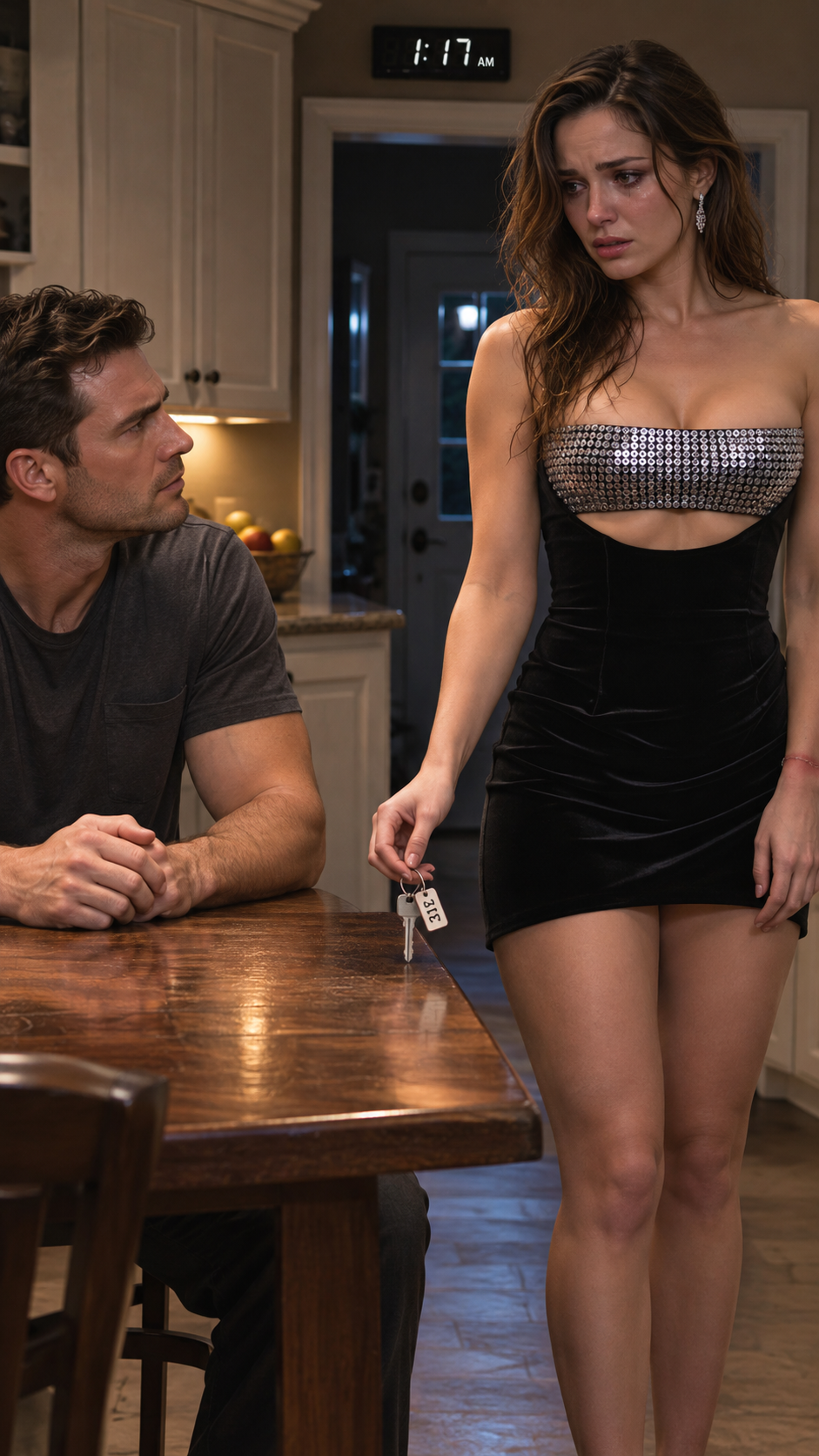
The third knock came slowly, as though whoever stood outside knew we were listening.
Claire caught my wrist before I could leave the kitchen. Her fingers were cold, and the red mark on her other wrist looked darker under the pendant lights.
“Don’t open it,” she said.
I almost told her she didn’t get to make that decision. Ten minutes earlier, I would have. But the small silver key between us had changed the shape of the argument. Her fear no longer looked like the panic of someone caught in an affair. It looked like the fear of someone who had come home expecting to be followed.
Then I heard a familiar voice through the door.
“Daniel. I know you’re awake.”
My father.
He had knocked like that for as long as I could remember: three deliberate taps, never a doorbell. When I was a boy, those knocks meant he’d come home from a late shift. Tonight they sounded like a warning.
I glanced at the clock. a.m.
My father was sixty-eight, lived twenty minutes away on the north side of Columbus, and never drove after dark unless there was an emergency. He also had no reason to know Claire had come home late.
I gently freed my wrist and went to the door. Claire followed only as far as the kitchen doorway, holding one arm across her stomach.
Richard Mercer stood beneath the porch light in a brown coat pulled over his pajamas. His silver hair was flattened. His eyes traveled past my shoulder and found Claire immediately.
“Is she all right?” he asked.
“Why are you here?”
“Let me inside, son.”
“Answer me first.”
He stared at me with an expression I hadn’t seen since I was sixteen and had asked about Aunt Miriam’s funeral. For one brief second, I saw a man measuring how much truth he could afford to give.
“Somebody called me,” he said. “About Holloway House.”
Behind me, Claire made a small sound. I stepped back, and my father walked in without removing his coat. He stopped when he saw the key on the table.
“That shouldn’t be here.”
He said it so quickly that I knew he’d recognized it before he’d read the numbers.
“Then you can tell me why it is,” I replied.
He reached toward the table. I put my hand beside the key. I didn’t grab him or raise my voice. He understood the boundary anyway.
“Not until you tell me what happened to my wife.”
My father looked at Claire’s wrist. “Who did that?”
“Someone who knew you,” she said.
His face tightened. “You went alone?”
“Who was I supposed to take? You?”
Her answer came out sharper than I’d ever heard her speak to him. Claire had always treated my father with care. She remembered his appointments, brought him soup, and listened politely to his stories. Now she was staring at him as if she could barely stand to share a room with him.
“Both of you,” I said, “start at the beginning.”
My father pulled out a chair but didn’t sit. Claire remained near the kitchen doorway. I stood between them, the key still on the table, and realized that I was the only person in my own house who didn’t know what Holloway House had to do with us.
For most of my life, Holloway House had been a name my family spoke in a careful, practiced tone. It sat on the edge of a wooded property beyond Westerville, a three-story brick building that once operated as a private residential care home. According to my father, it closed after financial problems and a fire damaged part of the upper floor. It had been empty for over fifteen years.
My aunt Miriam had worked there. She was my father’s younger sister, loud when everyone else was quiet, forever sneaking extra cookies onto my plate. I remembered her teaching me how to fold paper airplanes at our old kitchen table. I remembered the smell of oranges on her coat.
And I remembered my father telling me she was dead.
I had been sixteen. He said there’d been an accident, that the family wanted privacy, that asking questions wouldn’t bring anyone back. The memorial service was small. There was no open casket, and afterward her name disappeared from our conversations. I hadn’t understood how thoroughly a family could practice silence.
Until tonight, I had believed every word.
Claire watched me as the memory moved across my face. “That’s why I went,” she whispered. “Because of Miriam.”
“Why didn’t you tell me?”
“Because every time I asked your dad something about her, he made me feel like I’d done something cruel.”
I wanted to deny it. Instead, I remembered the Father’s Day barbecue two years earlier when Claire had asked whether Aunt Miriam had children. Richard set down his plate, looked at her for a long moment, and said, “Leave the dead alone.” We’d gone quiet for the rest of the meal. On the drive home I’d told Claire he was still grieving.
She’d looked out the window and said, “Grief doesn’t explain why he’s afraid of a question.”
I hadn’t answered.
We met eleven years ago at a fundraiser for the community health clinic where Claire worked. She wasn’t the loudest woman in the room. She was the one quietly carrying folding chairs while everyone else posed for pictures. When I offered to help, she gave me half her stack and said, “Good. I was wondering how long you’d watch.”
I fell for that honesty before I realized it. She didn’t play guessing games, not about money or marriage or what she expected from me. When our first apartment flooded, she told the landlord exactly what had happened even though admitting she’d left the balcony door open meant losing part of our deposit. When my small contracting business struggled its first year, she sat with me and figured out which bills we could pay without pretending everything was fine.
That was the Claire I knew. Which was why her lie about a birthday dinner had cut so deeply. I’d assumed that if she hid something this important, it could only be because she no longer trusted me with her heart.
Now I was beginning to understand that she’d been afraid of what I might do with a different kind of truth.
“Tell him about the necklace,” my father said quietly.
I looked at him. “You knew it was missing?”
He pressed his lips together.
The necklace was a small oval silver locket Claire wore on special occasions. I had given it to her on our fifth anniversary, after finding it among the things my father said had belonged to my grandmother. I’d cleaned the chain, replaced a bent clasp, and tucked it into a velvet box. Claire cried when she opened it. She said a gift with a history meant more than something expensive from a store.
She’d worn it earlier that evening, adjusting it in the hall mirror as she teased me for worrying about her. Until my father spoke, I hadn’t told him it was gone.
“Who took it?” I asked.
Claire’s eyes moved to his face. “The man at the house.”
My father closed his eyes for an instant.
“Did he hurt you?” I asked.
“He grabbed my wrist when I tried to leave. That’s all. I got away.” She swallowed. “But he took the locket.”
“Who is he?”
“I never heard his name.”
“Richard,” I said, “apparently you know more than she does.”
He finally sat down. The old chair creaked under him. “I know that people associated with that building have been looking for things they shouldn’t have. That’s all I’m prepared to say tonight.”
“Then you came to the wrong house.”
I could hear the anger returning, but it had a different target. My father had entered without surprise at the key, asked whether Claire went alone, and named the missing necklace without being told. He wasn’t a confused parent checking on an emergency. He was involved in it.
Claire eased into the chair across from him, leaving a full seat between them. “I got a call Tuesday afternoon,” she said. “A woman asked whether I still had a silver locket with the initials M.M. inside.”
I frowned. I’d never noticed the initials. Claire explained that the engraving was worn and barely visible. She’d only found it recently while cleaning the hinge.
“The caller said she knew someone who’d worked with Miriam. She said there was something my husband deserved to know about his family. I thought it was a scam at first. I hung up.”
“Why did you call back?”
“Because she mentioned the paper airplanes.”
I felt the room tilt around me.
Aunt Miriam and I used to race paper airplanes down my parents’ staircase. It was a private ritual from before my family turned quiet. I hadn’t told Claire about it until after our wedding. And my father had never mentioned it to anyone in front of her.
“Someone could have learned that from you,” Richard said.
“I know,” Claire replied. “That’s why I wanted to meet her somewhere public. She refused. She said the answers were at Holloway House.”
I looked at my father. He didn’t look back.
“Why tonight?” I asked.
“The woman said the building was about to change hands. She said whatever remained upstairs might be removed.” Claire rubbed her palms together. “I should have told you. But I knew you’d call your father, and she’d warned me that if he found out, she couldn’t show me anything.”
Richard gave a humorless laugh. “So you believed a stranger over your own family.”
“No,” Claire said. “I believed what I saw.”
She told us she’d driven out shortly before ten. The road was unlit beyond the last neighborhood. The gate stood partly open. One downstairs window glowed. An older woman met her at the side entrance, introduced herself only as someone who’d worked there, and led her inside.
“It smelled like damp cardboard and floor cleaner,” Claire said. “Not like a place that’s been empty for fifteen years.”
The woman led her past empty offices and up a narrow staircase. On the third floor, she stopped beside a numbered door. She handed Claire the small key and said the room had been kept locked because the contents belonged to people who hadn’t been allowed to take them when the building closed.
“What contents?” I asked.
Claire twisted her hands together. “Boxes. Old clothes. Personal things. There were names written on shelves, and dates. I didn’t know what I was looking at. The woman told me not to touch anything.”
“Did you see Miriam’s things?”
“I saw her name.”
“Where?”
“On a storage label near the back. And I saw a photograph of her that looked nothing like the one in your father’s house. She was older in it.”
I turned toward Richard. His face had gone oddly still.
My aunt had supposedly died before Holloway House closed. A later photograph, if Claire had understood it correctly, could overturn the timeline I’d been given. But I hadn’t seen the image. I had only my wife’s frightened account and a key that shouldn’t have existed.
“Could it have been dated wrong?” I asked.
“I don’t know. I didn’t get to look long.”
Claire described hearing heavy footsteps in the hallway. A man came upstairs and demanded to know why the room was open. The older woman tried to explain. He saw Claire’s necklace and went directly for it, saying she had no right to wear something taken from the house.
“I told him it was a gift from my husband. He called me a liar.”
Her voice broke. “He pulled the chain over my head. I tried to stop him, and he held my wrist. I thought he was going to drag me into another room.”
I crossed to her without thinking. She reached for my hand, and this time I let her hold it.
“What happened next?”
“The woman shouted at him. He let go. She told me to take the stairs down, leave through the side door, and not use my phone until I was away from the property. She said someone was watching the road.”
“Who?”
“I don’t know. She wouldn’t tell me.”
I looked at the key. “Then why did you bring that back?”
“Because she pushed it into my hand before I left. She said, ‘Give it to Daniel. Not Richard.'”
The words landed between us. My father didn’t move, but the muscles beside his jaw tightened.
“She knew my name,” I said.
“She did.”
“Did she say why?”
Claire shook her head. “Only that your family had taken something from the wrong person.”
Richard stood. “That’s enough.”
“No,” I said. “We’re just getting somewhere.”
He drew a long breath, placed both palms on the table, and looked at me with the exhausted authority that had ended so many arguments when I was growing up.
“Daniel, people at Holloway House were sick. Their families trusted us to protect their privacy. Whatever you saw in room 317 is not yours to expose.”
“Us?” I repeated.
His expression changed. He hadn’t meant to say it.
“You told me you never worked there.”
“I didn’t work for the institution.”
“That’s not what I asked.”
He stared at the key, then finally admitted he’d helped maintain the building after his father became involved with the property. He claimed it was occasional work, nothing to do with the residents, and that he’d stayed away from the upstairs rooms.
Claire looked at him. “Then how did you know room 317 was upstairs?”
He froze.
I realized she’d never mentioned the room number while my father was in the house. She’d described the third floor, but never spoken the room number. Richard had barely glanced at its tag before calling it dangerous.
He took a step away from the table. “This is getting out of hand.”
“It got out of hand when somebody grabbed my wife,” I said. “And you still haven’t told me who called you.”
“A caretaker.”
“From a building that’s been closed for fifteen years?”
“Someone still looks after the property.”
“Someone you’re paying?”
He didn’t answer.
I thought of all the little moments I’d ignored. The way he turned down the radio whenever the road to Holloway House came up on the traffic report. The way he’d refused to let me help clear out boxes from my grandparents’ attic. The night he’d grown furious because Claire asked whether Miriam had ever married.
Each memory was small enough to dismiss alone. Together they made a pattern I could no longer pretend not to see.
“Was Miriam really killed in an accident?” I asked.
My father lowered his eyes.
“Dad.”
He sat again, slowly this time. “What I told you was what I believed you needed to hear.”
I felt my chest go tight. “That isn’t an answer.”
“Miriam had problems. There were doctors, disagreements, things you were too young to understand.”
“I was sixteen.”
“You were a child.”
“You held a funeral.”
Richard pressed his fingers against his forehead. “There was a service. That’s all I can talk about tonight.”
I wanted to push him until he gave me a fact I could use. But Claire’s hand trembled in mine, and my father chose each word carefully. He was trying to make me angry enough to stop listening.
So I asked a quieter question.
“Who was the older woman who gave Claire the key?”
He glanced at my wife. “What did she look like?”
“Gray hair, short, maybe in her sixties. She had a scar across two fingers on her right hand.”
My father stared at her. All the color drained from his face. He seemed about to speak, then stopped himself.
“Do you know her?” I asked.
“I need you to put that key away,” he said.
“Why?”
“Because if she’s back, this isn’t finished.”
Claire took a sharp breath. “You know who she is.”
He was silent.
Outside, a car passed our house. Its headlights moved slowly across the curtains, then vanished. Nobody spoke until the sound of the engine had faded.
My father looked suddenly older, less like the man who had always known what to do and more like someone who had spent years waiting for a particular night.
“Listen carefully,” he said. “Don’t go back there. Don’t call the number that contacted Claire. And don’t mention the third floor to anyone until I’ve had a chance to explain.”
“Then explain now.”
“I can’t do it with half the story.”
“You’ve had fifteen years to find the other half.”
He flinched. It was the first time I’d ever seen him look hurt by something I said without turning that hurt into anger.
Claire released my hand. Her eyes were fixed on the key, but I could tell she was deciding whether to tell me something she had held back. She had been careful all night, keeping one detail behind another as if each confession might break something neither of us could repair.
“Daniel,” she said, “there was one more thing in that room.”
My father rose so abruptly his chair scraped the floor.
“Claire. Please.”
She looked at him, and the fear in her expression gave way to a weary kind of determination.
“It’s his life,” she said. “He should get to know.”
“What thing?” I asked.
She rubbed the red mark on her wrist. “On the inside of the door, near the frame, someone had marked a child’s height in pencil. There was a date beside it. I could barely read it under the paint.”
I felt my father watching me.
“And a name?” I asked.
Claire nodded.
“Whose name?”
She took a breath and looked directly into my eyes.
“Yours, Daniel. The name on the inside of room 317 was yours.”
✓ Lynn R. Adams
The third knock came slowly, as though whoever stood outside knew we were listening. Claire caught my wrist before I could leave the kitchen. Her fingers were cold, and the red mark on her other wris…