CHAPTER 2 – THE HOTEL ROOM WEARING MY NAME
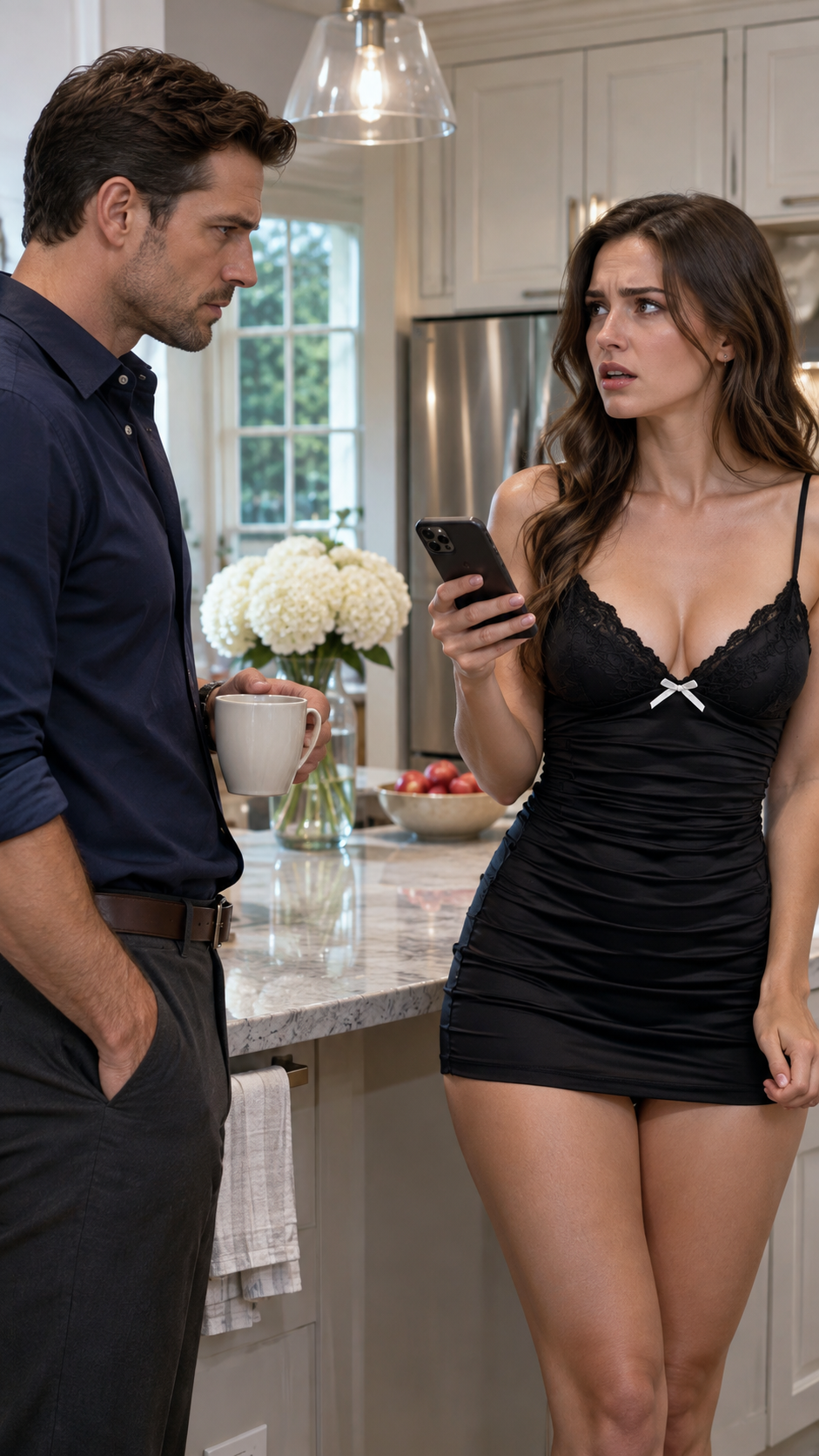
I knew what the screen said. What I didn’t know was how my name had gotten there, or why my wife looked more frightened of that discovery than of the declined card.
She tilted her phone toward her chest. Her thumb hovered over the screen, but she didn’t lock it. For one brief second, her eyes flicked toward the hallway leading to our garage, as if the answer might be waiting outside.
“You read that wrong,” she said.
“I read my name.”
“It’s a reservation.”
“For Friday night. In downtown Raleigh. Under my name.”
She let out a laugh that stopped too abruptly. “I booked something for a client. Sometimes these systems autofill saved information. You’re making a huge deal out of nothing.”
“Then show me the booking.”
“Why would I need to do that?”
“Because your client apparently has my name.”
Her face hardened. “You don’t trust me. That’s what this is.”
I looked at the coffee between us. A few minutes earlier, I had been worried about spilling it on the countertop. Now I was trying to decide whether I could stand in the same room with the woman I’d heard speak about me the night before.
“I’m asking a simple question,” I said. “Why is my name on that room?”
“And I’m telling you it was a mistake.”
“A mistake you tried to pay for with our household card?”
Her jaw moved. Nothing came out.
“I have a meeting,” she finally said.
“So do I.”
“Then stop this.”
She started toward the stairs, still gripping her phone. I didn’t block her. At the foot of the staircase, she stopped and turned back.
“You didn’t cancel anything, did you?”
That question mattered more than anything she’d said so far. She had called the reservation a mistake, but she was suddenly terrified I might have corrected it.
“I haven’t touched the reservation.”
“Good,” she said, too quickly. “Don’t.”
Upstairs, a bedroom door closed. I stayed beside the island until my coffee went cold.
Nine years earlier, when we married at a small venue outside Durham, I thought our biggest arguments would be over money or where to spend the holidays. We’d met at a friend’s cookout. She had laughed at my terrible attempts to work the grill, then stayed beside me when I burned the first batch of burgers. I was thirty-eight now, older than the man in those wedding photographs and considerably less certain about what a smile meant.
Back then, she did freelance marketing and helped organize corporate events. I managed operations for a regional equipment supplier. Neither job was glamorous. We shared a modest rental before buying our house, and we spent our first year there eating takeout on a moving blanket because we hadn’t yet saved enough for a proper dining table.
She used to sit beside me while I paid bills and make fun of my color-coded spreadsheet. “You keep the lights on,” she would say, kissing my cheek. “I’ll make sure we remember to live.”
I had believed we were working toward the same life.
Things hadn’t collapsed all at once. The first joke about our intimacy had been light enough that I laughed. The next came during an argument. Eventually, she used that same subject whenever she wanted to end a conversation or win an audience. I stopped telling her how much it hurt because every attempt seemed to give her another opening.
What she’d whispered into the study phone had stripped those jokes of their disguise. Now I wondered how many of our ordinary evenings had been rehearsals for a life she was planning without me.
I got ready for work, taking my wallet from the dresser as I always did. My license was there, behind my debit card. I remember noticing it, though at the time I couldn’t have explained why.
On my drive toward Raleigh, my wife sent a message.
Don’t interfere with Friday. It’s important to my work.
I read it after pulling into the office parking lot. There was no explanation, no apology, and no mention of the room registered under my name.
I typed a response, erased it, and wrote something shorter.
Please send me the reservation details and explain why my name was used.
The typing indicator appeared, vanished, and appeared again.
Finally: You always turn everything into an investigation.
She still hadn’t answered.
At ten, I shut my office door and called the number on the back of the household card.
The representative confirmed that the spending restriction I’d arranged was active. Ordinary recurring charges would continue under the agreed settings. An attempted authorization had been declined that morning, but the representative cautioned that a failed authorization did not prove what service was involved or whether someone could complete a booking through another method.
“Can you tell me who tried the charge?” I asked.
She read the merchant descriptor to me. It was a payment-processing name I didn’t recognize, not the name of the downtown hotel.
“That doesn’t mean the room is paid for, correct?”
“Correct. A reservation can also be held without a completed charge, depending on the merchant’s arrangements.”
I thanked her. After we hung up, I wrote down the exact time of the attempt and what she had actually confirmed. Not what I feared it meant. Just the facts.
That distinction kept me from doing something reckless.
For half an hour, I considered calling my wife and telling her everything I’d overheard outside the study. Instead, I called the hotel listed on the notification. I could have taken her phone when she slept. I could have searched her laptop. I didn’t want my next decision to depend on another violation I would later have to explain.
A front-desk employee answered. I gave my name and said I’d seen an upcoming booking that appeared to use my identity without my permission.
“I’d like to know what I should do to make sure nobody checks in pretending to be me,” I said.
The employee sounded careful rather than surprised. She explained that she couldn’t simply read private reservation information over the phone. She could connect me with the reservations manager, who could describe the verification process.
After a short hold, a man introduced himself as Daniel Ortiz.
“If you believe someone used your name without your authorization, we take that seriously,” he said. “We can document your concern. We may also need to verify your identity before discussing or changing any booking.”
I told him I understood. He gave me a secure way to submit identification directly to the hotel, not to an unknown link or caller. I asked him not to treat my phone call as permission for anyone else to represent me.
“We do require acceptable identification at check-in,” he said. “A name on a reservation alone doesn’t establish that somebody is you.”
It should have relieved me.
Instead, I thought about my wife asking Melissa whether someone could keep her identity hidden. She wasn’t merely trying to keep me from knowing what happened inside a hotel room. She had chosen to place my name on the room itself.
At lunch, a coworker named Eric knocked on my door carrying a sandwich he’d picked up for me.
“You look like you haven’t eaten since Tuesday,” he said.
“Feels about right.”
He set the bag on my desk. Eric had been married longer than I had, but I wasn’t about to turn him into an unwilling audience for my private life. He sat anyway.
“You want me to cover the afternoon deliveries?”
“No. Just give me ten minutes.”
He nodded and left without asking for an explanation. That small courtesy nearly broke me.
My wife had once been the person who noticed when I needed quiet. Now I was hiding the ruin of our marriage from a colleague who barely knew what was wrong.
I pulled out my phone and opened the message she’d sent about Friday. Every word was an instruction. Don’t interfere. It’s important. Not one word about what she had asked Melissa to arrange.
I sent another message.
You said the hotel was a booking error. If it is, please correct the guest name yourself and send confirmation.
She responded almost immediately.
I can’t change it now. Stop trying to sabotage my job.
I stared at the contradiction. The name was supposedly an automatic mistake, yet changing it was suddenly impossible.
A second message followed.
And don’t talk to anyone at the hotel. You will embarrass me.
I read that one twice. She hadn’t asked why I might call the hotel. She’d already thought about how dangerous a conversation with the front desk could be.
When I finally drove home, I found her car in the driveway and the porch light on even though the sun hadn’t set. The house smelled of garlic and tomatoes. She’d cooked dinner, something she hadn’t done on a weekday in weeks.
She was at the stove in the same dark dress she’d worn that morning, now with a cardigan over her shoulders. She glanced up when I entered.
“I made pasta,” she said.
I put my keys in their usual bowl. “Thanks.”
“We don’t have to fight.”
“I didn’t know we were fighting.”
“Don’t do that. Don’t use that calm voice to make me sound unreasonable.”
I looked at the two plates she had already set out. For a moment, I saw a version of the evening where we ate together and pretended the morning hadn’t happened. It was an attractive lie. We had practiced versions of it for years.
“Why did you use my name?” I asked.
She turned off the burner. “I told you. A booking mistake.”
“Then why can’t you correct it?”
“Because the person handling the event isn’t available.”
“Melissa?”
Her hand stopped above the pot.
I hadn’t raised my voice. I hadn’t mentioned the study. But I’d said the name she thought belonged to a conversation I hadn’t heard.
“What about Melissa?” she asked.
“She’s been calling you. Is she handling the reservation?”
“She helps with bookings sometimes.”
“Then she can fix it.”
“It’s complicated.”
“What part?”
She set the spoon down so hard that sauce jumped onto the counter. “The part where I have a husband who thinks paying the mortgage entitles him to approve every decision I make.”
The familiar accusation arrived on schedule. I was controlling. I cared too much about money. I made her feel small. In the past, those arguments could keep us circling for hours until I’d apologized just to make the shouting stop.
This time, I stayed with the question.
“You are free to make your decisions,” I said. “But you used an account we share and put my name on a hotel room I didn’t book. That’s not a private decision anymore.”
“Maybe I wanted one night where I didn’t have to answer to you.”
She said it so quickly that both of us seemed surprised.
“At a hotel?” I asked.
“I didn’t say that.”
“You didn’t need to.”
She folded her arms. The cardigan shifted, and I noticed how tightly she was holding herself. She wasn’t just angry. She was frightened of something beyond this argument.
“Did you go through my phone?” she asked.
“No.”
“My laptop?”
“No.”
“Then what do you think you know?”
I could have told her I heard every word about my body and the stranger she wanted to pay. Part of me wanted to force those words into the open, to make her hear how ugly they sounded when someone else repeated them.
But I didn’t trust my voice yet. I knew that if I started with the insult, we’d end up discussing my insecurity instead of the room booked in my name.
“I know what I saw,” I said. “And I know you haven’t given me one straight answer.”
She looked toward the countertop where she’d left her phone. It lit up, then went dark. Neither of us moved to pick it up.
“I can’t believe you’re doing this,” she said.
“I’m not the one who made the reservation.”
“You don’t understand what’s at stake.”
“Then explain it.”
For one second, she looked as if she might. Her shoulders dropped, and the anger fell away from her face. I saw the woman who had once sat on a blanket in our empty dining room and promised we could handle anything together.
Then the phone vibrated again. She caught sight of the screen and whatever she was about to say disappeared.
“I’m going upstairs,” she said.
“Dinner’s ready.”
“I’m not hungry.”
She left the kitchen. I didn’t follow her. I put the pasta into containers and cleaned the splash of sauce from the counter. Those were ordinary tasks, and I clung to them because I knew what came next could not be undone by cleaning up.
Around eight, I sat at the dining table with a notebook. I wrote two columns: what I’d heard and what I could verify. The first included my wife’s cruel remarks, her questions about the cost of a night with another man, and her request to use card 4418 without her name appearing. The second held the bank’s report of a declined authorization, the hotel notification I’d seen, and her messages insisting that I leave the booking alone.
There were gaps. I could not prove what service the declined charge was for. I didn’t know whether Melissa was a friend, a booking agent, or something else. And I had no explanation for the most important question: what advantage did my wife gain by using the name of a man who wasn’t supposed to know about the room?
That last question made me open a drawer where we kept documents for trips. Our passports were in a folder, undisturbed. I checked that my driver’s license was still in my wallet. It was. I didn’t accuse my wife of stealing anything. I simply began to understand that names and identification could carry consequences far beyond a credit-card bill.
I took out my notebook again and wrote one sentence across the bottom of the page: Do not guess where proof is required.
At nine, my wife came downstairs. She had changed into sweatpants and a sweatshirt. Her makeup was gone, and she looked tired enough that my first instinct was to ask whether she felt all right.
“Are you writing about me?” she asked.
“I’m keeping track of what happened.”
“That’s sick.”
“I’d rather have accurate notes than another argument about what either of us said.”
She stood at the end of the table. For a while, she just watched me.
“Do you want to destroy our marriage over a hotel room?”
I looked up. “I want to know why my name is on it.”
“If I tell you, you’ll make it worse.”
It was the closest she’d come to admitting that the reservation wasn’t an innocent mistake.
“Worse for whom?” I asked.
She rubbed her forehead. “Please. Just let Friday happen. Then we’ll talk.”
A rush of grief hit me so unexpectedly that I had to look away. She was asking me to protect a plan that had already humiliated me, using the promise of an explanation afterward as if my agreement could be purchased with a future conversation.
“No,” I said.
She stared at me.
“I’m not promising to stay out of something with my name on it.”
“You have no idea what you’re interfering with.”
“You’re right. I don’t. You won’t tell me.”
She opened her mouth, closed it, then went back upstairs. I heard the bedroom door shut. A few seconds later, her voice came faintly through the ceiling. She was talking on the phone again, but this time I didn’t approach to listen.
I had already heard enough to know how little she thought of me. What I needed now was to know what someone might do using my identity.
At , my own phone rang. The caller ID showed the hotel. I answered in the dining room, one hand resting on the notebook.
“Sir, this is Daniel Ortiz, the reservations manager you spoke with earlier,” the man said. “I’m following up because you asked us to flag any request involving your identity.”
My throat tightened. “Has someone tried to change the booking?”
“I can’t discuss every detail until the identity-verification process is complete,” he said. “But I can tell you someone contacted our desk this evening about the Friday reservation. They asked about alternate check-in arrangements.”
“What kind of arrangements?”
“Whether a person arriving without the named guest could use a photograph of that guest’s identification instead of the original. We explained that a photograph alone would not satisfy our procedure.”
I stood so quickly my chair scraped the floor.
“Did they say why the named guest wouldn’t be there?”
He paused. “They said you would be unavailable to appear in person.”
I stared at the dark staircase. My wife was upstairs, behind a closed door, making calls about a hotel reservation that belonged to me on paper and to someone else in every other way.
“I never authorized anybody to check in as me,” I said.
“I’ve noted that, sir. We will require proper verification. If you believe there’s attempted identity misuse, you may also want to document it with the appropriate authorities.”
I thanked him, then asked one final question.
“Did the caller say how they expected to get a picture of my ID?”
“No, sir,” he said. “But they were quite specific that they would have one by tomorrow.”
The line went quiet after we said goodbye.
I kept my phone to my ear for a few seconds. Then I lowered it and looked toward the stairs.
My wife had promised that after Friday, we’d talk.
Now I understood why she needed me to stay out of the hotel before then.
Somebody was counting on having a copy of my identification by morning.
And I had no idea whether they already knew where to find it.
✓ Lynn R. Adams
I knew what the screen said. What I didn’t know was how my name had gotten there, or why my wife looked more frightened of that discovery than of the declined card. She tilted her phone toward her ch…