Chapter 2: PART 2 – A Name Folded Into Paper b035
PART 2: A Name Folded Into Paper
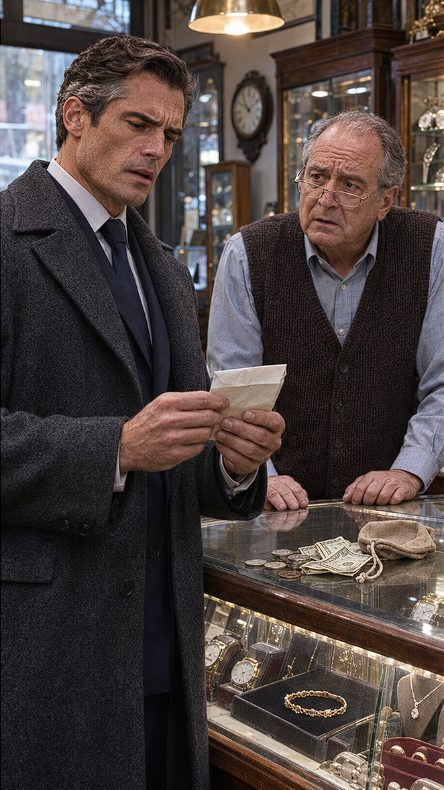
Sophie looked at me for several seconds, her small hands resting against the straps of her backpack, while Frank remained completely silent behind the jewelry counter.
I kept the paper raised between us, suddenly aware that I was holding something far more personal than an ordinary request for financial assistance.
“Did someone tell you I was coming here?”
My question came out more sharply than I intended, and I immediately noticed the way Sophie’s shoulders drew inward.
Frank cleared his throat.
Mercer, there’s no reason to frighten her.”
“I’m not trying to frighten anybody, Frank, but I’d like to understand why a child I’ve never met has a letter with my name on it.”
Sophie stepped forward before Frank could respond.
Collins told me you were picking up a watch.”
I turned toward the shop owner.
Frank removed his glasses and rubbed the bridge of his nose.
“She asked whether anybody came here who could afford the bracelet, and I told her people from all walks of life visit my shop.”
I waited, allowing him to continue.
“She heard me mention that you were coming to collect the watch for your father’s birthday, and later she asked what your name was.”
I looked back at Sophie, who was standing very still beside her carefully arranged savings.
“Why did you want to know?”
She glanced at the folded paper.
“Because I thought maybe you’d understand.”
“Understand what?”
She looked toward the display case.
“Why somebody would want an old thing when they could buy a new one.”
Her answer caught me off guard.
The watch I had purchased for my father was hardly an ordinary secondhand object, but I understood the distinction she was trying to make.
“You thought that because I bought something old for my father, I might understand why your mother’s bracelet mattered?”
She nodded.
Collins said the watch was special.”
Frank quietly replaced his glasses.
“I may have mentioned that your father liked old watches.”
I looked at the girl again, trying to reconcile her reasoning with the elaborate requests for assistance I had received throughout my career.
She had not studied my financial statements or tried to impress me with a complicated argument about charity.
She had simply heard that I was buying something meaningful for someone I loved and decided that might make me willing to protect something meaningful for her mother.
I unfolded another section of the paper.
The handwriting was uneven, with several letters carefully erased and rewritten, but the words were surprisingly deliberate.
The opening line read, “Dear Mr.
Mercer, I know you came here to buy a birthday present for your dad.”
I felt an unexpected tightening in my chest.
Below that sentence, Sophie had written that she hoped my father would like his watch, because she thought birthday presents were important when they reminded people that somebody remembered them.
I looked up from the page.
“You wrote this because of my father’s watch?”
“Yes, sir.”
I returned my attention to the letter.
The next sentence explained that her mother didn’t need an expensive bracelet because it was made of gold, but because her grandmother had once fastened it around her wrist.
There was something painfully earnest about the distinction, as though Sophie understood that adults often confused the price of an object with the reason somebody loved it.
She had underlined the word “remembered” twice.
I could picture her sitting somewhere with a pencil, searching for the right words because she believed her one opportunity to recover the bracelet depended upon them.
“How long did it take you to write this?”
She pressed her lips together.
“A few nights.”
I looked at Frank.
He gave a small, almost apologetic shrug.
“She asked me how to spell your last name correctly.”
I studied the uneven letters again, remembering that my name appeared on buildings, business documents, and investment reports throughout the country.
I had seen it engraved on plaques and printed across contracts worth more money than most people would ever encounter.
But I had never seen it written with such determination by a child who possessed less than ninety dollars.
“Did your mother ask you to come here?”
Sophie shook her head immediately.
“Does she know you’ve been saving for the bracelet?”
She hesitated.
“She knows I save my money.”
“That isn’t quite what I asked.”
Sophie’s gaze dropped toward the counter.
“Mama doesn’t like talking about the bracelet.”
I noticed Frank’s expression change.
He seemed to understand something about the little girl’s hesitation that I had not yet grasped.
“Why doesn’t she like talking about it?”
Sophie looked through the glass at the delicate gold chain.
“Because she says she did what she had to do.”
There was no anger in her voice, only the quiet sadness of someone who had heard the same explanation many times.
I imagined how difficult it must have been for her mother to surrender a treasured possession while trying to make a practical decision.
I had spent years treating financial sacrifices as numbers on a spreadsheet, yet here was a child showing me the emotional cost behind one of those decisions.
I continued reading.
Sophie had explained that she wasn’t asking me to rescue her mother from every problem or make their lives rich.
She wanted one thing restored, something small enough to fit around a wrist but important enough that her mother still reached for it when she forgot it was gone.
The letter became increasingly difficult to read without picturing the woman whose hands Sophie kept describing.
I had never met Mrs.
Carter, but I could imagine her expression whenever her daughter noticed that empty wrist.
“Your mother must miss her mother very much,” I said.
Sophie nodded.
“Sometimes she gets quiet when she talks about Grandma.”
I swallowed.
My father was still alive, and I suddenly remembered how easily I had considered sending his birthday present through someone else rather than delivering it myself.
Sophie watched my expression with growing concern.
“Did I write something wrong?”
I shook my head.
“No, Sophie, you didn’t.”
She relaxed slightly, although her fingers continued gripping her backpack.
I looked down at the lower section of the page, where the pencil marks grew darker and several words had been crossed out.
There was a small heading written above a paragraph she had apparently struggled to finish.
It read, “What I Can Give You.”
I felt myself returning instinctively to the question I had asked before accepting the paper.
This was supposed to be the part where she explained what I would receive for spending eight hundred dollars.
I expected a promise to repay the money, perhaps through chores, savings, or some imaginative arrangement that made sense to a child.
But the first sentence beneath that heading made me stop.
Sophie had written, “I cannot give you eight hundred dollars, and I don’t want to promise something I know I cannot do.”
I stared at the line for a long moment.
In my world, people routinely made promises they had no intention of keeping, particularly when making them helped secure an investment.
A nine-year-old girl had apparently decided that asking for help did not excuse dishonesty.
I looked toward her again.
“Why did you write that?”
She appeared confused by the question.
“Because it’s true.”
I lowered the page slightly.
“And you knew I might say no if you couldn’t pay me back?”
Her expression became serious.
“Yes, sir.”
“Then why didn’t you promise anyway?”
She looked at me as though the answer were obvious.
“Because Mama says a promise isn’t worth anything if you don’t mean it.”
The simplicity of her response embarrassed me more than I wanted to admit.
For several seconds, I stood between a child who refused to make an impossible promise and a counter filled with objects people had surrendered because life had become difficult.
Then Sophie reached toward the paper without touching it.
Mercer, there’s one thing I need to tell you before you read the rest.”
I raised my eyes.
She swallowed, glanced nervously at Frank, and spoke in a voice barely above a whisper.
“If you buy Mama’s bracelet and she thinks I made somebody feel sorry for us, she might make me give it back.”
✓ Lynn R. Adams
PART 2: A Name Folded Into Paper Sophie looked at me for several seconds, her small hands resting against the straps of her backpack, while Frank remained completely silent behind the jewelry counter…