Chapter 10: The Woman Who Finally Belonged 215
I looked at Jacob sitting beside me on the old workbench.
He held the shoebox carefully, as though it contained something fragile enough to break beneath the pressure of his hands.
Perhaps it did.
For thirty-eight years, the drawing had belonged to me.
Not merely as paper and crayon.
It belonged to the version of motherhood I had once believed would last forever.
A little boy who thought his mother could fix everything.
A woman who thought being needed was the same as being loved.
Now my son was asking for the picture.
And I had to decide whether giving it to him meant surrendering the past or allowing us both to grow beyond it.
I took the drawing from the box.
The paper had yellowed.
One corner was bent.
The red cape had faded into a dull pink.
I ran my finger along the uneven letters.
MY MOM FIXES EVERYTHING.
Then I held it out.
“Yes,” I said. “You can have it.”
Jacob took it carefully.
His eyes filled.
“Thank you.”
“But I want you to understand something.”
He looked up.
“I don’t want to be your superhero anymore.”
His face changed.
“I know.”
“I want to be your mother. A woman who loves you, who sometimes needs help herself, who has opinions you may not like, and who deserves kindness even when she can’t solve your problems.”
He nodded.
“I understand.”
I studied him.
“Do you?”
He took a long breath.
“I think I’m beginning to.”
For a moment, I saw Harold in his expression.
Not because Jacob suddenly resembled the man his father had been.
Because he was finally willing to look uncomfortable truth in the face.
We sat together as the evening light faded.
Then Jacob carefully slipped the drawing into a folder he had brought for the repayment papers.
“I’ll have it framed,” he said.
I smiled.
“I’d like that.”
He stood.
“Mom, there’s something else.”
I looked at him.
“Amanda and I have decided to try again.”
My heart tightened.
“I see.”
“We’re not moving back together immediately. We’re continuing counseling.”
“That sounds wise.”
“She asked whether she could write to you.”
I considered the question.
“She can write.”
“Would you read it?”
“Yes.”
He nodded.
Then he added, “I told her I wouldn’t pressure you to forgive her.”
I looked at him with quiet surprise.
“Thank you.”
He smiled faintly.
“I think I’m learning.”
We finished putting away the tools.
Before leaving, Jacob hugged me.
It was not hurried.
It was not performed while reaching for his car keys.
He simply held me.
For a few seconds, I rested my cheek against his shoulder.
I remembered the boy who had once wrapped his arms around my waist because he was too small to reach higher.
Then he stepped back.
“Love you, Mom.”
“I love you too.”
He left.
I stood on the repaired porch watching his taillights disappear.
The house behind me was quiet.
But the silence no longer felt like proof that I had been forgotten.
It felt like space.
Space to think.
Space to rest.
Space to become someone beyond the person everyone called when something needed fixing.
Over the following months, the changes in my life were small enough that most people would not have noticed them.
I began attending a weekly watercolor class.
I had always wanted to paint, but for years I told myself I didn’t have time.
The first morning, I sat among strangers with a brush in my hand, staring at a blank sheet of paper.
Our instructor asked us to paint something that made us feel peaceful.
I painted Lake Michigan.
Badly.
The horizon was crooked.
The water looked more green than blue.
My clouds resembled overcooked potatoes.
But when I finished, I felt strangely proud.
Nobody had needed me.
Nobody had asked me to solve anything.
I had spent two hours doing something simply because I wanted to.
Margaret came over that evening.
I showed her the painting.
She studied it solemnly.
“Well,” she said, “the lake appears to be experiencing unusual weather.”
I burst out laughing.
We laughed until tears ran down our faces.
Then she hugged me.
“I’ve missed hearing that sound.”
I knew what she meant.
For years, I had moved through life as though joy were something I had to earn after completing every obligation.
Now I was learning that happiness did not require permission.
I also began volunteering twice a month at the community grief center where I had once worked.
Not as the counselor who stayed late and carried everyone else’s sorrow home.
As a retired volunteer who helped arrange chairs, prepare tea, and welcome people arriving for support groups.
One afternoon, a woman around my age lingered after a meeting.
Her husband had died three years earlier.
Her daughter lived several states away.
“She only calls when she needs something,” the woman said.
I felt a familiar ache.
“What do you need from her?” I asked.
She looked startled.
“I suppose I just want her to remember me.”
I nodded.
“Have you told her that?”
“No. I don’t want to burden her.”
I thought of Jacob.
Of my own years of carefully avoiding requests that might make him uncomfortable.
“Wanting affection isn’t a burden,” I said gently. “But sometimes people need us to tell them what we need instead of hoping they’ll guess.”
The woman wiped her eyes.
“Do you think that works?”
“Not always.”
I smiled.
“But it gives them an honest chance.”
When I returned home, Jacob had left a voicemail.
“Hi, Mom. Just checking in. I know you volunteer on Thursdays. Hope it went well. Call when you feel like it.”
I listened twice.
Then I called him back.
We talked for twenty minutes.
Not once did money come up.
Three months after the wedding, Amanda’s letter arrived.
It was handwritten on plain stationery.
No embossed initials.
No expensive envelope.
She wrote that she had begun understanding how her fear of humiliation had shaped the way she treated others.
She described the wedding as a moment when she had chosen appearances over kindness.
She acknowledged that she had tried to make me invisible because she feared being judged by her parents and their friends.
She did not ask me to forget what happened.
She did not claim that her own childhood excused it.
She simply apologized and said she hoped one day we might know each other honestly.
I read the letter at the kitchen table.
Then I placed it beside the wedding contracts.
The contrast was striking.
The contracts described responsibilities, prices, penalties, and signatures.
The letter described a kind of responsibility that could not be enforced by law.
I took out a sheet of paper.
My reply was short.
I thanked her for writing.
I told her I appreciated her willingness to take responsibility.
I also explained that trust would require time and consistent behavior.
I wished her and Jacob well.
Then I added:
I hope that whatever happens in your marriage, you learn that a family is not a photograph. It is how people treat one another when nobody is watching.
I mailed the letter the following morning.
Winter arrived.
Snow covered the garden.
The lake turned dark and restless.
Jacob continued making the payments he had promised.
Sometimes the amounts were small.
Sometimes he paid a little extra.
I did not monitor his progress obsessively.
I had decided that his responsibility belonged to him.
His business gradually stabilized.
He found a new client and reduced his office expenses.
He took on work he once would have considered beneath him.
When he told me about it, he sounded embarrassed.
“It’s not exactly glamorous,” he said.
“Does it pay fairly?”
“Yes.”
“Does it help you rebuild?”
“Yes.”
“Then it sounds worthwhile.”
He laughed.
“Dad would’ve said the same thing.”
“I suspect he would.”
Amanda returned to her job full-time.
She and Jacob continued counseling.
They eventually moved into a smaller apartment together, choosing a place they could afford on their actual incomes rather than the incomes they hoped other people believed they had.
Their marriage remained imperfect.
They argued.
They disappointed each other.
Sometimes they called me separately, hoping I would agree that the other person was unreasonable.
I refused to become their referee.
“That sounds like something you should discuss together,” I would say.
At first, they seemed irritated.
Eventually, they stopped asking.
The following spring, Jacob invited me to dinner.
Amanda would be cooking.
I hesitated before accepting.
Not because I wanted to punish her.
Because I was still learning to trust my own comfort.
But I agreed.
Their apartment was smaller than the house Jacob had once rented.
There were books stacked beside the sofa and a plant growing unevenly near the window.
The dining table had four chairs, none matching.
It looked lived in.
Amanda opened the door.
“Judith.”
“Hello, Amanda.”
She smiled nervously.
“I’m glad you came.”
“So am I.”
She took my coat.
No one commented on my clothes.
I wore the sky-blue dress.
I had chosen it deliberately.
Not as a challenge.
As a reminder that I no longer needed to apologize for being myself.
Amanda noticed.
Her eyes moved briefly across the fabric.
Then she smiled.
“That color is beautiful on you.”
I looked at her.
“Thank you.”
The words were simple.
They mattered.
Dinner was roasted chicken, potatoes, and green beans.
Nothing extravagant.
Nothing arranged for an audience.
We ate slowly.
Jacob told a story about a difficult client.
Amanda described a project at work.
I spoke about my watercolor class.
They asked questions.
They listened.
After dinner, Jacob brought out an old wooden frame.
“Mom, I wanted to show you something.”
Inside was the superhero drawing.
The crooked cape.
The wooden spoon.
The proud letters.
He had placed it on a shelf beside a photograph of Harold.
I stared at it.
“You framed it.”
“Of course.”
Amanda came to stand beside him.
“Jacob told me the story.”
I looked at her.
She smiled sadly.
“It’s beautiful.”
For a moment, the three of us stood together.
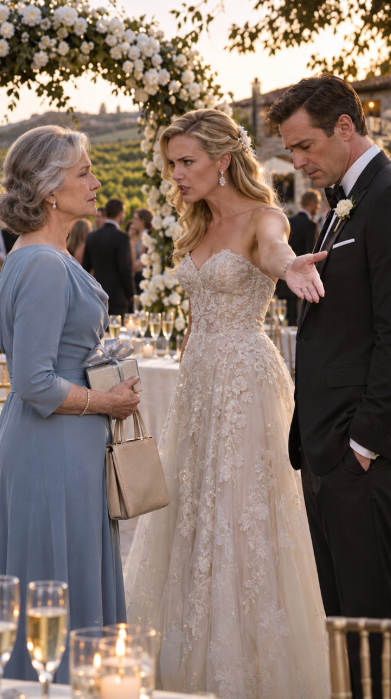
I thought about the wedding.
The white flowers.
The silver ribbons.
The expensive lights.
The long tables filled with strangers.
I thought about Amanda telling me I didn’t belong.
And Jacob saying nothing.
Then I looked around the little apartment.
At the mismatched chairs.
The ordinary dinner dishes.
The drawing on the shelf.
There were no photographers.
No important guests.
No elaborate flowers.
Yet this humble room held something the magnificent vineyard had not.
The possibility of honesty.
Jacob put his arm around my shoulders.
“Mom?”
“Yes?”
“I’m glad you’re here.”
I felt tears gathering.
“Thank you, sweetheart.”
Amanda looked at us quietly.
Then she said, “Would you like some tea?”
I smiled.
“Yes, please.”
We returned to the table.
And for the first time since the wedding, I didn’t feel like a visitor waiting to discover whether I was welcome.
I felt like a person whose presence mattered.
Later that evening, Jacob walked me to my car.
The air smelled of rain.
He opened the door for me.
“Mom, can I ask you something?”
I laughed softly.
“You may always ask.”
He smiled.
“Are we okay?”
I considered the question.
A year earlier, I would have rushed to reassure him.
I would have said everything was fine.
I would have hidden my hurt to protect his comfort.
Now I understood that love could survive an honest answer.
“We’re getting better,” I said.
He nodded.
“I’ll take that.”
I touched his cheek.
“Good.”
Then I drove home.
The house near Lake Michigan was waiting.
Harold’s boots still stood in the mudroom.
His photograph remained on the mantel.
The kitchen table still bore its old water stain.
But the woman who entered that house was not the same woman who had left for Hollow Creek Vineyard.
I had lost money.
I had lost illusions.
I had learned painful things about my son, my daughter-in-law, and myself.
Yet I had gained something I hadn’t realized was missing.
The right to choose.
The right to say no.
The right to be loved without buying my place in someone else’s life.
I hung up my coat and walked into the living room.
On the wall above the fireplace, I had placed my first watercolor painting.
The lake was still crooked.
The clouds still looked ridiculous.
But I loved it.
I stood before it for a long moment.
Then I looked at Harold’s photograph.
“You were right,” I whispered.
Outside, the wind moved softly through the trees.
I imagined his familiar laugh.
I imagined him telling me that it had taken long enough.
And I smiled.
Because at seventy-three, after a lifetime of fixing everything for everyone else, I had finally discovered that the most important life I was responsible for was my own.
And I no longer needed anyone’s permission to belong in it.
✓ Lynn R. Adams
I looked at Jacob sitting beside me on the old workbench. He held the shoebox carefully, as though it contained something fragile enough to break beneath the pressure of his hands. Perhaps it did. …