Chapter 10: The Direction Home 219
“I love my son,” I said.
My voice sounded steadier than I felt.
Across the courtroom, Julian lowered his eyes.
“I have loved him since the moment I first held him. I loved him when he was small enough to sleep against my chest. I loved him when he struggled in school, when he failed in business, and when he made decisions I could not understand.”
I paused.
“But love did not protect me from what happened on his thirtieth birthday.”
The courtroom remained silent.
I unfolded the second page of my statement.
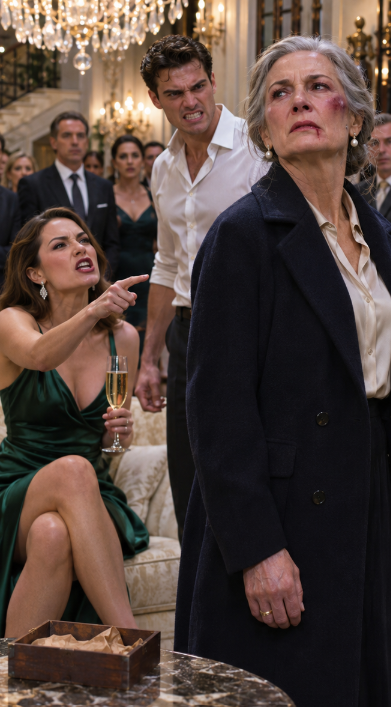
“My son struck me thirty times. I counted because I was frightened, and counting gave me something to concentrate on. I was surrounded by people I knew, yet nobody intervened.”
My hands began trembling.
I placed the paper on the lectern.
“The physical injuries have healed. But I still become frightened when someone raises their voice unexpectedly. I still remember the sound of the room going silent. And I still struggle with the fact that the person who hurt me was the child I spent my life trying to protect.”
Julian covered his face.
For a moment, I wanted to stop.
I wanted to walk toward him, put my arms around his shoulders, and tell him everything would be all right.
That instinct had guided so much of my life.
But I remained where I was.
“I am not asking the court to ignore what he did because I am his mother. I am asking that his actions be taken seriously.”
I looked toward the judge.
“Julian needs to understand that anger does not give him the right to hurt another person. He needs to accept responsibility without blaming embarrassment, stress, his wife, or me.”
My throat tightened.
“And I need to know that I can live without being afraid of my own son.”
The words settled over the courtroom.
I turned toward Julian.
“I hope you become a better man,” I said. “I hope you learn that being strong means protecting people, not frightening them.”
He looked up.
Tears streamed down his face.
“But I cannot do that work for you anymore.”
I folded the statement.
Then I returned to my seat.
For the first time since the party, I felt that I had spoken about what happened without defending, minimizing, or explaining away my son’s behavior.
The judge proceeded with sentencing.
Julian received a sentence reflecting the admitted assault and the circumstances of the case, including court-imposed supervision and requirements intended to address his violent conduct.
The court made clear that his behavior was unacceptable.
I listened without celebrating.
There was no pleasure in watching my son face consequences.
Only the quiet recognition that consequences had become necessary.
Outside the courthouse, David stood beside me beneath the afternoon sunlight.
“How do you feel?” he asked.
I considered the question.
“Tired.”
He nodded.
“Anything else?”
I looked toward the courthouse doors.
“Sad.”
“Of course.”
“But I don’t regret telling the truth.”
David gave a small smile.
“That’s something.”
I drove home alone.
The city looked ordinary.
Traffic moved along the boulevards. People crossed streets carrying shopping bags. A delivery driver argued with someone over a parking space.
I had expected the world to feel different after such an important day.
Instead, it continued.
That evening, I made myself dinner, watered the plants, and opened the study window.
For months, I had lived as though the next legal notice or telephone call might determine whether I could finally begin healing.
Now I understood that my life could not remain suspended while other people decided what they were prepared to admit.
The financial cases continued.
They moved slowly, through records, testimony, settlement discussions, and court proceedings.
Sarah’s work helped establish how the investor funds had been used.
A significant portion had gone toward older obligations and personal expenses. Other payments had passed through North Pier Consulting and accounts associated with Chloe.
Some transfers were recoverable.
Others were not.
The distinction was painful.
People had trusted the promises made about Cedar Point Medical Plaza, and many would never recover everything they lost.
No amount of accounting could turn every dishonest transaction back into available money.
Philip Ward’s investment group pursued claims against the parties responsible for the losses.
Additional records demonstrated that my company had not approved the development or authorized Julian to borrow on its behalf.
The signatures had been reproduced from earlier documents.
The disputed materials had been prepared without the authorization they claimed to represent.
After extensive legal work, Vance Infrastructure Group and I were dismissed from the investor litigation.
The result brought relief.
It did not bring back the time, money, or peace the proceedings had consumed.
There were legal expenses.
There were difficult conversations with business partners.
There were people who had believed the allegations simply because they appeared in a lawsuit.
I learned that protecting a reputation could require as much patience as building one.
The mansion dispute lasted longer than I wanted.
Chloe continued asserting that the house had been promised to her and Julian.
David challenged her claims using the deed, the signed occupancy agreement, and the surrounding correspondence.
My affectionate note was examined in context.
The written arrangement had never transferred ownership.
The property remained in the LLC’s name.
Eventually, Chloe abandoned her ownership claim as the evidence and related proceedings developed.
The occupancy dispute was resolved through the legal process, and possession was returned to the LLC.
Only then could the sale move forward without the same complications.
I visited the mansion once before closing.
The rooms were empty.
Without the furniture, flowers, and expensive decorations, the house seemed strangely unfamiliar.
My footsteps echoed across the marble floor.
I walked into the living room.
The cream-colored sofa was gone.
So were the chandeliers Chloe had insisted on replacing, the imported rugs, and the artwork selected to impress visitors.
The space looked larger.
And lonelier.
I stopped beside the cabinet where Samuel’s compass had landed.
There was no sign of the broken glass.
No stain.
No visible evidence that my son had attacked me in that room.
I thought of the guests.
The silence.
Chloe’s laughter.
Then I looked through the windows toward the garden.
I had once imagined Julian raising children there.
I had pictured family dinners, birthdays, and Christmas mornings.
I had hoped the house would become a place where the life Samuel and I never got to share could continue through our son.
But a home cannot be created by architecture alone.
And safety cannot be purchased for someone who believes he has the right to destroy it.
I walked to the front door.
Before leaving, I turned around one final time.
“Goodbye,” I whispered.
Not to the house.
To the belief that if I gave Julian enough, he would eventually understand what mattered.
The sale closed after the remaining legal requirements were satisfied.
I did not buy another mansion.
I did not purchase a replacement property for Julian.
I returned to my modest home and continued working, though not quite as much as before.
For years, I had treated exhaustion as evidence of dedication.
Now I began taking afternoons off.
I visited old friends.
I spent time in my garden.
I accepted invitations that had nothing to do with business.
And I gradually learned how to enjoy an ordinary day without feeling that someone else’s emergency required my attention.
Grace remained with the company.
Our friendship changed.
There were subjects we discussed honestly that we had once avoided.
Sometimes, when I remembered her standing silently during the assault, I still felt hurt.
She knew.
She never asked me to forget.
Instead, she showed through her actions that she understood the difference between regretting a failure and accepting responsibility for it.
She provided records when investigators requested them.
She cooperated with the legal proceedings.
And she stopped treating difficult truths as problems best avoided.
Our trust returned gradually.
Not exactly as it had been.
Perhaps something more honest had taken its place.
Evelyn Hart and I also remained in contact.
She had lost money through the investment, though legal recovery efforts returned part of what she had contributed.
She never again described the loss as something I should repair.
Instead, she acknowledged the decisions she had made and the warning signs she had overlooked.
We sometimes met for coffee.
Our conversations were quieter than before.
Neither of us pretended the birthday party had never happened.
But we discovered that an imperfect friendship could continue when both people were willing to face uncomfortable truths.
Julian’s financial case eventually reached its own resolution.
By then, the investigations had established enough evidence for him to accept responsibility for major aspects of the misrepresentations and misuse of investor funds.
His guilty plea and the resulting judgment carried serious consequences, including imprisonment and restitution obligations.
The legal process did not transform him overnight.
It did not make the losses disappear.
And it did not erase the damage he had done to our relationship.
Chloe also faced consequences for her role in the financial misconduct.
The proceedings against her involved the misleading consulting arrangements, the movement of investor funds, and her participation in preparing documents that created false impressions of authority.
She ultimately entered into a legal resolution that imposed criminal penalties and financial obligations.
By then, her marriage to Julian had collapsed.
They had spent years presenting themselves as partners in success.
When the money disappeared and the documents were examined, their partnership became a contest over responsibility.
I did not involve myself in their marital dispute.
I had spent too long standing between Julian and the consequences of his choices.
I would not become the referee of his broken marriage.
The investors recovered portions of the money through traced assets, settlements, and restitution proceedings.
Some losses remained.
I found that difficult to accept.
There were nights when I still wondered whether writing one enormous check would have spared everyone years of uncertainty.
Then I remembered the other people whose interests I was responsible for protecting.
My employees.
My business partners.
The communities supported by the foundation.
And myself.
I had not created the fraudulent documents.
I had not borrowed the money.
I had not received it.
Finally, I allowed those facts to matter.
Nearly a year after the sentencing in the assault case, I received permission to visit Julian at the correctional facility where he was serving his sentence connected to the financial crimes.
I had considered the visit for weeks.
Part of me wanted to see him.
Another part feared that one conversation would reopen wounds I had only begun to understand.
I spoke with a counselor.
I talked to David about appropriate boundaries.
Then I made the appointment.
On the morning of the visit, I stood in front of my mirror.
My face was completely healed.
There was no visible mark where Julian had struck me.
But I no longer mistook the absence of a bruise for the absence of harm.
I wore a simple navy blouse and comfortable shoes.
Then I drove to see my son.
When he entered the visiting room, I barely recognized him.
He was thinner.
His hair was shorter.
The expensive clothing that once seemed inseparable from his identity was gone.
He sat across from me.
For several seconds, neither of us spoke.
Then he said, “Hi, Mom.”
I felt tears rise.
“Hello, Julian.”
He looked at his hands.
“Thank you for coming.”
I nodded.
“I wasn’t sure I would.”
“I know.”
He looked up.
“I’m glad you did.”
There were so many things I wanted to ask.
Was he sleeping?
Was he eating?
Was he frightened?
Did he have friends?
Was anyone treating him cruelly?
Those questions belonged to the mother I had always been.
But another question mattered more.
“Julian,” I said, “what have you learned?”
He lowered his eyes.
For a moment, I feared he would give me the familiar explanation about pressure, misunderstanding, or unfair circumstances.
Instead, he spoke quietly.
“I spent my whole life thinking I deserved what other people worked for.”
I said nothing.
“I thought because you loved me, you were supposed to fix everything. And when you stopped, I hated you for it.”
He swallowed.
“I blamed Chloe. I blamed investors. I blamed you. I blamed Dad for dying and leaving me with a name I couldn’t live up to.”
My chest tightened.
Julian looked at me.
“But nobody made me forge those documents. Nobody made me take the money. And nobody made me hit you.”
The room seemed to become very still.
He continued.
“I did those things.”
I felt tears slide down my cheeks.
He wiped his eyes.
“I don’t expect you to forgive me.”
I took a slow breath.
“I don’t know what forgiveness will look like, Julian.”
He nodded.
“I understand.”
“But I want you to keep doing the work you’ve started. Not because you want something from me. Because you need to become someone who can live honestly with himself.”
His face crumpled.
“I want to.”
“Then begin there.”
For several minutes, we spoke about ordinary things.
Books he had been reading.
Work assignments.
The counseling program he attended.
He did not ask me for money.
He did not ask me to make a phone call.
He did not ask me to convince anyone to reduce his sentence.
When the visit ended, he stood slowly.
“Mom?”
I looked up.
“Do you still have Dad’s compass?”
My breath caught.
“Yes.”
“Is it still broken?”
“The casing was repaired. The glass was replaced. There’s still a small crack in the brass.”
He nodded.
“Does it work?”
I smiled through my tears.
“The needle still points north.”
Julian looked down.
“I’m glad.”
Then he said something I had waited most of my life to hear.
“Maybe when I get out, I can start small. Find a job. Do something properly.”
I studied his face.
“That would be a good beginning.”
He hesitated.
“Would you ever come see me again?”
I thought carefully before answering.
“Yes,” I said. “When I’m ready.”
He nodded.
“That’s fair.”
For once, he did not argue.
I drove home beneath a pale afternoon sky.
I cried several times along the way.
But the tears felt different.
They were not only grief.
There was relief in them.
And cautious hope.
Not hope that my son would suddenly become the person I had always imagined.
Hope that he might eventually become a person who understood the value of telling the truth, keeping promises, and accepting responsibility.
Hope that we could build some form of relationship without pretending the past had not happened.
Hope that I could remain his mother without surrendering myself.
That evening, I took Samuel’s compass from the study drawer.
A specialist had repaired the damaged glass and stabilized the brass casing. The crack remained visible along one edge.
I had asked him not to polish it away.
I wanted the compass to show what it had survived.
I carried it into the garden.
The sun was setting behind the trees, and a cool breeze moved through the leaves.
I opened the compass.
The needle shifted.
Then it settled.
North.
Exactly where it had always been.
I remembered Samuel standing in our little kitchen, explaining direction to a toddler who barely understood the words.
I remembered the years of work that followed his death.
The buildings I constructed.
The mistakes I made.
The son I loved.
The night everything changed.
For so long, I had believed being a good mother meant giving Julian whatever he needed to avoid pain.
Now I understood that love required something more difficult.
It required truth.
It required boundaries.
And sometimes it required allowing someone you loved to face consequences you could not spare them.
I closed the compass and held it gently in my palm.
Then I walked back toward the warm light of my own home.
Samuel had once said the compass would remind him that every worthwhile journey required direction.
He had been right.
But I had spent too many years confusing my son’s direction with my own.
The compass still pointed north, and for the first time in decades, I was free to choose where my own life would go.
✓ Lynn R. Adams
“I love my son,” I said. My voice sounded steadier than I felt. Across the courtroom, Julian lowered his eyes. “I have loved him since the moment I first held him. I loved him when he was small eno…