Chapter 10: The Crown Could Not Erase Her Name – C102
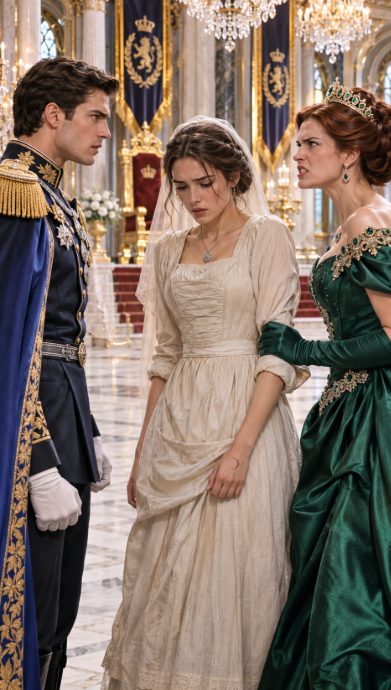
My father’s words silenced the council chamber.
I stood motionless.
For three years, I had believed the worst secret in our family was Layla’s supposed betrayal.
Now I understood that the truth had been buried beneath layers of fear, pride, and misplaced loyalty.
King Richard looked toward the Lord Chancellor.
“Before the marriage covenant was registered, Crown Prince Adrian came to me privately.”
I stared at him.
The memory returned.
Three years earlier, I had entered his study with a sealed envelope and told him I intended to marry Layla.
He had listened without interruption.
Then he had asked whether I understood the consequences.
I told him I did.
I had almost forgotten that conversation because everything that followed had been swallowed by the pain of her disappearance.
My father continued.
“My son informed me that he wished to marry Miss Bennett.
I warned him that the council would object.”
He looked toward me.
“But he was determined.”
The chamber remained silent.
“I told him that if the marriage was entered lawfully, I would not interfere merely because Miss Bennett lacked noble ancestry.”
My throat tightened.
I remembered those words now.
I had held onto them for days.
They had made me believe our future was possible.
My father turned toward the chancellor.
“I knew the covenant would be registered.
I instructed the palace chaplain to ensure the legal requirements were observed.”
Sir Alden lowered his head.
Father Lucien closed his eyes.
Layla remained motionless.
The chancellor studied the king.
“Then Your Majesty acknowledges that the marriage was entered with your knowledge?”
“And that no lawful royal objection was recorded before registration?”
The chancellor looked down at the documents.
“Then the charter’s requirement has been satisfied.”
A murmur swept through the chamber.
I could barely breathe.
My father continued.
“When allegations were later presented against Miss Bennett, I believed the marriage had been invalidated through lawful procedure.”
“That belief was wrong.”
He turned toward Layla.
“I allowed my fear of scandal to outweigh my duty to examine the truth.”
His voice trembled.
“I cannot undo the years you lost.
But I can ensure the record is corrected.”
Layla’s eyes filled.
My father bowed his head.
Not as a king addressing a subject.
As a man acknowledging the harm he had caused.
“Miss Bennett, I ask your forgiveness.”
She looked at him for a long moment.
Then she answered quietly.
“Your Majesty, forgiveness may come.
But first, the truth must remain visible.”
My father nodded.
The chancellor stood.
The chamber became silent again.
“Having examined the registered covenant, the testimony of its witnesses, and the evidence presented, the council finds that the marriage between Crown Prince Adrian Richard Valedore and Layla Bennett was lawfully entered three years ago.”
I closed my eyes.
The words seemed impossible.
Three years of grief.
Three years of anger.
Three years of believing we had been separated by betrayal.
And all that time, the marriage we had entered in love had remained valid.
The chancellor continued.
“The attempted cancellation was ineffective.
The original register shall be restored, and the corrected entry shall be certified.”
He looked toward Layla.
“Miss Bennett’s legal position as the prince’s wife is recognized.”
The chamber erupted into whispers.
I turned toward her.
She stood perfectly still.
Her hands were clasped together.
A tear slipped down her cheek.
For a moment, I wanted to cross the room and embrace her.
But I remembered her words.
She wanted the freedom to decide what happened next.
So I remained where I was.
The chancellor continued with the council’s findings.
The accusations of financial misconduct against Layla had not been substantiated.
The alleged settlement payment had never reached her.
The confession had been altered.
The royal inventory records had been manipulated.
The council directed that the disputed royal artworks be returned to proper custody and that the financial transactions involving the heritage foundation undergo a full independent examination.
Valerie stood abruptly.
“This is outrageous!”
The chamber fell silent.
She looked toward my father.
“Richard, you cannot allow them to destroy everything I have built.”
My father remained seated.
“You built your authority on trust, Valerie.”
She stared at him.
“And you betrayed it.”
Her face twisted.
“I protected this family!”
“No,” he answered.
“You protected your control over it.”
Valerie turned toward me.
“Adrian, think carefully.
That woman will never understand what it means to serve a crown.”
I looked at Layla.
She had spent years preserving the kingdom’s history while the people who claimed to protect it altered its records.
“She understands more about service than anyone in this room who used a title to silence her,” I said.
Valerie’s expression hardened.
“You will regret choosing her.”
I shook my head.
“I regret not choosing to listen to her three years ago.”
She looked toward the chancellor.
“You cannot prove that I personally forged those documents.”
The chancellor remained calm.
“That question will be examined through formal proceedings.
The evidence is sufficient to suspend your authority over the Royal Heritage Foundation and the royal household records.”
Valerie’s face went pale.
The council formally removed her from her supervisory positions pending the outcome of the inquiry.
Her access to royal financial accounts and archives was revoked.
The foundation’s records were placed under independent control.
She stood motionless as the decision was read.
For decades, she had moved through the palace as though every corridor belonged to her.
Now she was being told that her title did not place her beyond accountability.
She looked at Layla one final time.
There was anger in her eyes.
But beneath it, something more revealing.
She still could not understand how a woman she had dismissed as insignificant had become the person who exposed her.
Layla met her gaze without flinching.
“You could have let me do my work,” she said.
Valerie said nothing.
“You could have let the paintings remain where they belonged.”
Still no answer.
“You could have let Adrian hear the truth.”
Valerie looked away.
Layla’s voice remained steady.
“But you wanted to decide which parts of our lives were allowed to exist.”
The chamber became silent.
Layla lowered her hands.
“You don’t get to do that anymore.”
Valerie left under the supervision of the royal household officials.
There was no shouting.
No dramatic confrontation.
Only the quiet closing of a door.
And somehow, that sound seemed to mark the end of an entire era.
When the council adjourned, my father approached Layla.
He looked exhausted.
“The royal collection will be reviewed in full,” he said.
She nodded.
“It should be.”
“I would like you to supervise the restoration inquiry.”
Layla looked surprised.
“Your Majesty, I cannot accept such a position merely because of my marriage.”
“I am not offering it because of your marriage.”
“I am offering it because you identified irregularities that the rest of us failed to see.”
She studied him.
“Then the position must be subject to an independent appointment process.”
My father almost smiled.
“Very well.”
“And the inquiry must be able to examine records without interference from the royal household.”
“And the findings must be published.”
For the first time that morning, Layla smiled.
It was small.
But it was real.
Later, the council announced that the royal collection would undergo an independent audit.
Several paintings that had been transferred improperly were returned to the palace.
The original portrait of Queen Eleanor was restored to its rightful place.
The altered marriage register was corrected.
The official record now showed the truth.
The covenant had been registered.
The cancellation had been invalid.
And Layla Bennett had never accepted the alleged settlement payment.
The public correction was issued from the same palace that had once condemned her.
I insisted on delivering the announcement myself.
This time, I did not hide behind formal language.
I told the kingdom that I had been wrong.
I explained that the evidence against Layla had been unreliable and that the royal household had failed to provide her with a fair opportunity to respond.
I acknowledged that my own words had contributed to the damage done to her reputation.
Then I said something I had never said publicly before.
“Layla Bennett was not a woman who used the royal family for personal gain.
She was a professional who discovered serious problems and refused to ignore them.”
“She deserved to be heard.”
When the statement ended, I returned to the eastern gallery.
Layla was there.
She stood before my grandmother’s portrait, examining the frame.
The afternoon sunlight illuminated her hair.
For a moment, I saw the woman I had fallen in love with.
Not because she looked unchanged.
But because she was doing what she loved.
I approached quietly.
“Does it need more work?”
She glanced at me.
“The frame needs a little attention.”
“Of course it does.”
She almost laughed.
The sound struck me with unexpected force.
I had missed it more than I could explain.
We stood together before the painting.
Then Layla spoke.
“Your father asked me to attend the royal dinner tonight.”
I looked at her.
“Do you want to?”
“I don’t know.”
“Then don’t go unless you choose to.”
She turned toward me.
“You make that sound simple.”
“It should be.”
She looked down at her hands.
“For three years, every important decision about my life was made by somebody else.”
She touched the gold band on her finger.
“And now everyone expects me to step into the role of a royal wife as though nothing happened.”
I felt my chest tighten.
“Layla, I don’t expect that.”
She looked at me.
“Then what do you expect?”
I took a breath.
“The truth.”
She waited.
“I love you.”
Her eyes filled.
“I loved you before the palace knew your name.
I loved you when we worked in this room and argued about whether a painting could be restored too perfectly.”
She gave a small, trembling smile.
“I remember that argument.”
“You said restoration should preserve history, not replace it.”
“Because damage is part of an object’s story.”
“I didn’t understand how much that mattered.”
She looked toward the painting.
I continued.
“I can’t restore what we had by pretending the last three years didn’t happen.”
Her eyes returned to mine.
“I can’t ask you to forget what I said or how I treated you.”
I swallowed.
“But if you’ll allow it, I’d like to build something honest from what remains.”
Layla was silent for a long time.
Then she whispered, “I’m afraid.”
She looked surprised.
I almost smiled.
“I spent my life believing a prince was supposed to know what to do.”
“Now I know how much damage certainty can cause.”
She looked down at her ring.
“I never wanted to become a symbol, Adrian.”
“You don’t have to.”
“I don’t want the court using me to prove that the royal family has become generous or modern.”
“Then we won’t allow that.”
She studied me.
“And if they object?”
I thought about the crown.
The council.
The future I had been taught to protect.
Then I looked at the woman standing beside me.
“If the crown requires me to treat you as less than my equal, then I have no right to wear it.”
Layla’s lips trembled.
“Do you mean that?”
She lowered her eyes.
For several seconds, neither of us spoke.
Then she reached for my hand.
The touch was gentle.
Almost uncertain.
But it was her choice.
And I understood how precious that made it.
“We can’t become the people we were,” she whispered.
“And I can’t promise I’ll forgive everything quickly.”
“I won’t ask you to.”
She looked into my eyes.
“But I’d like to know who we might become.”
I felt my throat tighten.
“So would I.”
She stepped closer.
Then she rested her forehead against mine.
For the first time in three years, I allowed myself to believe that our future might contain something other than regret.
Not because the past had been erased.
But because we had finally stopped lying about it.
In the months that followed, the kingdom changed slowly.
The investigation into the heritage foundation uncovered further irregularities.
Several officials were removed from their positions.
The disputed artwork was recovered.
The royal household introduced independent oversight of its archives and charitable accounts.
My father accepted the council’s formal criticism of his conduct and began reforming the procedures that had allowed one office to control investigations, financial records, and correspondence without adequate review.
Valerie’s authority was never restored.
The forged records and redirected funds became central evidence in the proceedings against her.
But Layla refused to let the scandal become the only story of her return.
She returned to her work.
Not as a servant.
Not as a decoration of the royal household.
As a respected professional whose expertise had finally been acknowledged.
She accepted a role helping establish an independent royal conservation institute.
The institute was responsible for protecting the kingdom’s historic collections and training young adult restorers who could not afford private instruction.
Layla insisted that appointments be based on ability rather than family connections.
My father agreed.
The first restoration project was Queen Eleanor’s portrait.
I watched Layla work on it for several afternoons.
Sometimes she spoke.
Sometimes she remained silent.
I learned not to fill every silence with explanations.
I learned to ask questions before making assumptions.
And I learned that trust was not a declaration made once in a chapel.
It was a choice repeated in ordinary moments.
One evening, months after the council’s decision, I found Layla standing beside the same blue porcelain vase that had once cut her thumb.
She had completed its conservation report.
The vase rested on a velvet stand beneath a glass case.
I looked at her left hand.
The crescent-shaped scar remained visible.
“Does it still hurt?”
She glanced at the mark.
“Only when I remember how badly you wrapped the bandage.”
She laughed with me.
The sound filled the gallery.
For a moment, the years between us seemed less heavy.
Then she grew serious.
“Adrian, I’ve made a decision.”
My heart quickened.
“About what?”
She took my hand.
“I don’t want another grand royal wedding.”
I smiled faintly.
“Neither do I.”
“I don’t want a ceremony designed to impress the council.”
“And I don’t want to pretend we never made our first vows.”
I looked at her ring.
“Neither do I.”
She stepped closer.
“But I would like to make new promises.”
My chest tightened.
She smiled.
“With you.”
We returned to the private chapel on a quiet spring morning.
There were no hundreds of guests.
No elaborate procession.
No political negotiations.
My father attended.
So did Father Lucien and Sir Alden.
The ceremony was not a new legal marriage.
It was a renewal of the vows that had never ceased to exist.
Layla wore a simple ivory gown.
I wore a dark formal suit without medals.
The sunlight filtered through the stained-glass windows.
For a moment, I remembered the young man I had been three years earlier.
So confident.
So certain that love could be protected by power.
I wished I could tell him what I had learned.
But perhaps he would not have listened.
Father Lucien opened his small leather book.
He read the words of our original covenant.
Then he asked whether we wished to make new promises.
I looked at Layla.
Her eyes were bright.
I took her hands.
The scar rested beneath my thumb.
“I promise to listen before I judge,” I said.
My voice trembled.
“I promise never to use my position to silence you, and never to mistake my fear for the truth.”
Layla’s eyes filled.
I continued.
“I cannot promise that I will never make mistakes.
But I promise that I will face them honestly, and that I will never again ask you to carry the consequences of my pride alone.”
A tear slipped down her cheek.
Then she spoke.
“I promise to tell you the truth, even when it is difficult.”
I smiled through my tears.
The same words.
The same promise.
But now we understood their weight.
She continued.
“I promise to let our marriage grow from who we are today, not from the people we remember being.”
Her hands tightened around mine.
“And I promise to keep choosing love without surrendering myself.”
Father Lucien smiled.
My father lowered his head.
Sir Alden quietly wiped his eyes.
When the vows ended, I placed a new narrow gold band beside Layla’s original ring.
Inside, I had chosen a different engraving.
Not a declaration of ownership.
Not a title.
Only four words.
Truth is our beginning.
Layla read them.
Then she looked at me.
“That’s better than the first one.”
I laughed softly.
“I hoped you’d think so.”
She touched my cheek.
And this time, when I kissed her, there was no fear that someone would enter the room and tell us our love was forbidden.
There was only the warmth of her hands.
The quiet of the chapel.
And the knowledge that whatever came next would belong to both of us.
Later that afternoon, we walked through the palace gardens.
The fountains glittered beneath the sun.
The royal banners moved gently in the breeze.
Somewhere beyond the walls, the kingdom continued its ordinary life.
There would still be disagreements.
Difficult decisions.
Public scrutiny.
And memories neither of us could erase.
But I no longer believed that love meant never being hurt.
Or that a crown could protect me from every mistake.
I had learned that the greatest betrayals were sometimes committed by people who claimed to be protecting us.
And that the deepest wounds were not always the ones visible on the skin.
Layla slipped her hand into mine.
I looked at the small crescent-shaped scar on her thumb.
Three years earlier, I had failed to bandage it properly.
Then I had failed to recognize the truth those same hands were trying to show me.
But when the entire court had demanded that I look away, that little scar had made me stop.
It had brought us back to the beginning of a story we thought had ended.
I lifted her hand and kissed it gently.
Layla smiled.
“What are you thinking?”
I looked at her.
“That I was wrong about something.”
She raised an eyebrow.
“Only one thing?”
“Many things.”
“Then which one?”
I glanced toward the palace.
“Three years ago, I told the court that faces could lie, but hands would always tell the truth.”
Layla looked at me thoughtfully.
I tightened my fingers around hers.
“I think the truth was always there.
I just wasn’t brave enough to listen.”
She leaned against my shoulder.
We continued walking.
And for the first time in three years, I no longer felt that the palace was a prison built from memories.
It was simply a place.
A place where mistakes had been made.
Where the truth had finally been heard.
And where two people had chosen to begin again.
Because the greatest treasure in the royal palace was never the crown, the throne, or the priceless paintings hanging on its walls.
It was the woman whose hands had preserved its history—and whose courage had taught its future king that love without truth was only another beautiful lie.
✓ Lynn R. Adams
My father’s words silenced the council chamber. I stood motionless. For three years, I had believed the worst secret in our family was Layla’s supposed betrayal. Now I understood that the truth had…