Chapter 10: PART 10 – When the Smallest Farm Found Its Voice j260
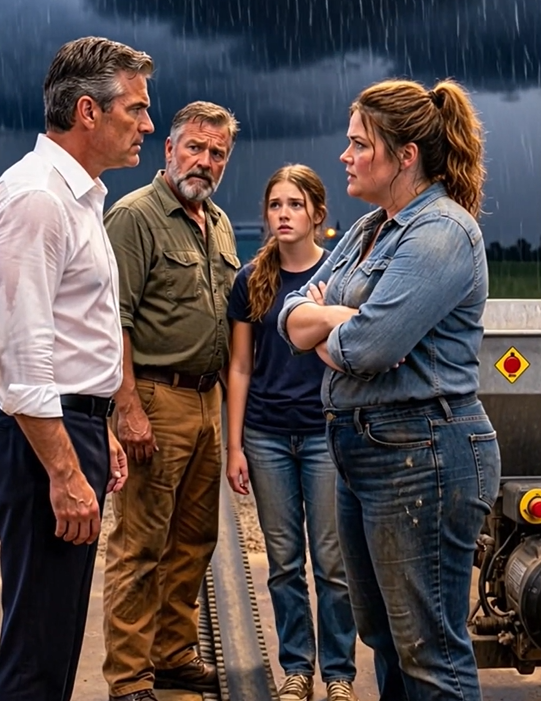
PART 10: When the Smallest Farm Found Its Voice
“Preston Kingsley,” I said, reading the name from the clearance record.
The words seemed to hang in the air between us.
Preston stopped reaching for the clipboard.
Laurel kept the original document firmly in her hands.
Cody stared at the ground.
And for the first time since the crisis began, nobody appeared willing to let Preston decide what could or couldn’t be discussed.
I looked at him.
“You authorized the intake to keep operating after someone reported a dangerous problem.”
His face tightened.
“I approved continued operations based on the information available.”
Wade pointed toward the report.
“Then where is the documented inspection that justified clearing the hold?”
Preston didn’t answer.
“Where is the repair record?”
Wade continued.
“The equipment was running.”
“Running isn’t proof that it’s safe.”
Cody raised his head.
“I told them the vibration was getting worse.”
Preston turned toward him.
“You had a responsibility to report problems.”
“I did report them.”
“Then you should’ve followed the process.”
“I followed the process twice.”
Cody’s voice was shaking now.
“And when I saw that support moving again, I shut the intake down before somebody got hurt.”
The silence that followed was more powerful than shouting.
I looked toward the damaged receiving building.
“So that’s what happened.”
Wade nodded.
“Cody used an emergency shutdown because he believed the machinery was becoming dangerous.”
Laurel confirmed the recorded time of the manual stop.
“The shutdown record is consistent with what he described.”
Preston looked trapped between the evidence and the people who had finally begun asking questions he couldn’t dismiss.
“This doesn’t mean every decision was wrong.”
“No,” I said.
“But it means you had a warning, and the equipment was cleared without the supporting repair documentation.”
His eyes met mine.
“And that should’ve been investigated instead of turning the employee who stopped it into a saboteur.”
Cody looked at me.
I could see how much he wanted someone to tell him he’d done the right thing.
But I wasn’t prepared to pretend he’d behaved honorably in every part of this story.
“You protected people when you stopped that intake,” I said.
Then I glanced toward my conveyor.
“But that doesn’t excuse what you did to me yesterday.”
His face flushed.
“You took a photograph of my machine when it failed.”
“You laughed at me in front of my daughter.”
“And you helped turn something I worked years to build into a joke.”
Cody swallowed.
“I’m sorry, Tessa.”
I looked at him for a moment.
“Did you know I built it?”
“Would that have made a difference?”
He lowered his eyes.
“It should’ve.”
I appreciated that he didn’t try to defend himself.
But the apology didn’t erase what he’d done.
“You were right to stop dangerous equipment,” I said.
“And you were wrong to humiliate somebody who was trying to solve her own problem.”
Cody nodded.
“I understand.”
Then I turned toward Preston.
“Your company had a serious equipment problem, and your people were trying to deal with it.”
He looked away.
“Instead of listening, you called it sabotage.”
I held up my canceled delivery notice.
“And before any of this happened, you turned me away because my farm wasn’t big enough to matter.”
Preston looked at the paper.
For the first time, he seemed to understand that I hadn’t forgotten a single word.
“Your appointment should have been handled differently,” he said.
“Yes, it should have.”
He took a breath.
“I’m sorry.”
I studied him.
An apology from Preston Kingsley was something I’d never expected.
But I had learned during the hardest years of my life that words and consequences were not the same thing.
“Then make sure the apology means something.”
He glanced toward Laurel.
“What do you want?”
“Protect the farmers waiting here.”
I pointed toward the signed receiving agreement.
“Honor every appointment affected by this shutdown, provide accurate documentation, and let the maintenance records go through an independent investigation.”
Preston’s mouth tightened.
“And the accusations?”
“The records can speak for themselves.”
Wade nodded.
“The damaged intake stays out of service until it’s properly evaluated and repaired.”
Laurel looked at Preston.
“I’ll preserve the shutdown and maintenance records.”
He hesitated.
Then he gave a tired nod.
I looked toward the waiting trucks.
The rain had become heavier.
Outdoor transfer was no longer safe.
Wade had already stopped the operation, and I had no intention of arguing with that decision.
We secured the conveyor, confirmed the grain already transferred was properly accounted for, and made sure the remaining loaded trailers were protected as conditions required.
The storm passed through with hard rain and flashes of lightning that briefly turned the concrete silos white against the darkness.
During the delay, Laurel worked with the waiting farmers to verify their delivery appointments and the approved temporary receiving arrangements.
Preston stayed in the office.
I didn’t know whether he was thinking about the lost business, the exposed maintenance record, or the consequences waiting beyond sunrise.
I only knew that, for once, he wasn’t controlling every conversation.
Nell sat beside me beneath the office awning.
“Are we still going to lose the farm?” she asked quietly.
I looked toward the trucks standing in the rain.
“We’re closer to saving it than we were yesterday.”
She leaned against my shoulder.
“That’s not a promise.”
I wrapped an arm around her.
“But it’s the truth.”
When the storm moved far enough away and the site was cleared for safe work again, Wade inspected our temporary arrangement before allowing another transfer.
The conveyor had remained secured through the weather.
The electrical supply was checked.
The receiving route was confirmed.
The guards and emergency controls were inspected again.
Then we restarted with another controlled load.
The belt tracked straight.
The motor held steady.
Golden wheat flowed toward the approved storage route.
One truck followed another through the weighing, grading, documentation, and transfer process.
It wasn’t fast enough to make thousands of bushels disappear in minutes.
There were pauses, inspections, changing loads, and the careful work necessary to keep grain records accurate.
But the important thing was that the operation kept moving safely.
No one was forced to gamble with damaged equipment.
No one had to pretend a failed intake was ready for service.
And no farmer was told that having a smaller operation made their harvest less deserving of attention.
By the following morning, the temporary receiving process was functioning steadily, and the outstanding deliveries had a documented path into approved storage.
Laurel kept the records organized.
Graham helped coordinate the movement of equipment and trucks.
Wade continued monitoring the conveyor within its tested operating limits.
I stayed beside the machine, checking the feed and watching the belt carry grain toward the receiving point.
At one stage, Graham leaned closer and smiled.
“Your father would’ve had plenty to say about this.”
I glanced at the moving wheat.
“Probably would’ve told me the frame needed another coat of paint.”
Graham laughed.
“That sounds like him.”
“And Ray would’ve asked whether we could make the whole thing quieter.”
“He probably would’ve.”
The laughter caught in my throat.
For a moment, I could almost see Ray standing beside us with his old wrench and that patient smile.
I missed him so fiercely that my eyes burned.
But I wasn’t standing there wishing he could take over anymore.
I wished he could see what we’d accomplished.
There was a difference.
By Friday, our wheat deliveries and storage records were being handled through the authorized arrangement, and Laurel helped ensure the necessary documentation reached the buyer.
The acceptance of our properly recorded grain meant the sale I’d been counting on could proceed.
When the buyer confirmed the documentation, I sat in my pickup for several minutes without moving.
I thought about the forty-six-thousand-dollar operating note.
I thought about the seed we’d need for the following season.
I thought about my daughter sitting at the kitchen table asking whether we were about to lose the only home she’d ever known.
And for the first time all week, I could see a realistic way through.
The money wasn’t in my account yet.
The bank didn’t suddenly disappear from our lives.
There were still repairs to make, bills to pay, and another year of farming ahead of me.
But the sale was no longer slipping away because a wealthy elevator owner had decided I wasn’t worth serving.
The evidence surrounding the intake shutdown was preserved for review, and Preston could no longer pretend nobody had warned him about the equipment.
His company would have to answer questions about its maintenance decisions and the treatment of farmers whose deliveries had been canceled.
Cody’s emergency shutdown was no longer being discussed simply as an act of sabotage.
And the people who had watched him mock my conveyor now knew the machine he’d laughed at had helped keep their wheat moving.
Later that afternoon, Preston approached me near the west receiving area.
He looked exhausted.
His expensive shirt was wrinkled, and his expression carried none of the confidence I’d seen when he ordered me away.
“Tessa,” he said.
“I wanted to say something.”
“You were right about one thing.”
“Which thing?”
He looked toward the trucks.
“I forgot that every load represents somebody’s livelihood.”
I studied his face.
“I don’t think you forgot.”
He looked back at me.
“I think you decided some livelihoods mattered more than others.”
He didn’t argue.
For a long moment, we stood beneath the enormous silos that had once seemed powerful enough to decide my future.
Then he held out his hand.
“Thank you for helping us.”
I looked at it.
I thought about Ray’s funeral.
I thought about the canceled delivery.
I thought about my daughter’s tears after strangers laughed at something I’d built.
Finally, I shook his hand.
“You’re welcome.”
Then I added the words I wanted him to remember.
“Next time a small farmer comes through your gate, listen before you decide they don’t matter.”
He lowered his eyes.
I couldn’t know whether he would keep that promise.
But I no longer needed his approval to believe in myself.
When I returned home, Nell was waiting near the farmhouse.
She ran down the driveway as soon as she saw my truck.
I climbed out.
She threw her arms around me.
“Did the buyer accept everything?”
“The records were accepted, and the sale is going forward.”
She pulled back.
Her face crumpled.
For a moment, she looked like the thirteen-year-old girl I’d held after we buried her father.
Then she began to cry.
I held her tightly.
“We’re going to be okay,” I whispered.
She shook her head against my shoulder.
“I was so scared.”
“I know, sweetheart.”
“I thought we’d have to leave.”
I closed my eyes.
“So did I.”
We stood together until the tears passed.
Later, when the farm grew quiet, I walked to the machinery shed.
Ray’s wrench still hung beside the workbench.
The empty space where my conveyor had stood looked strange after so many years.
I touched the worn wooden edge of the bench.
“I finished it, Ray,” I whispered.
The shed was silent.
But for the first time in four years, the silence didn’t feel quite so empty.
I thought about all the people who had assumed the conveyor belonged to my husband.
I thought about the people who had laughed when it failed.
And I thought about how close I’d come to abandoning it because I was afraid another failure would prove them right.
The machine hadn’t succeeded because I was fearless.
It had succeeded because I was willing to admit what I didn’t know, ask for help, correct my mistakes, and keep working.
My father had taught me to respect the land.
Ray had taught me that love could make hard work bearable.
Wade had reminded me that confidence meant nothing without responsibility.
Graham had shown me that accepting help didn’t erase my independence.
And Nell had given me a reason to keep fighting when I could barely imagine another morning.
I looked toward the fields stretching beyond the cottonwoods.
The wheat was harvested.
The farm was still ours.
And the woman Preston Kingsley had sent away as unimportant had helped eight farms protect the work of an entire season.
I turned off the shed light and walked toward the house, where my daughter was waiting and another farming season would eventually begin.
Because the day Preston Kingsley told me I wasn’t worth his time was the day I learned that my worth had never been his to decide.
✓ Lynn R. Adams
PART 10: When the Smallest Farm Found Its Voice “Preston Kingsley,” I said, reading the name from the clearance record. The words seemed to hang in the air between us. Preston stopped reaching for …