Chapter 1: THREE LADLES OF WATER – a041
By sunrise, nearly three hundred Apache warriors had surrounded my ranch, and every one of them appeared to be waiting for me to make a mistake.
My name is Corvin Torne.
I had spent eleven years learning how to live without depending on another human being.
I owned a small ranch in a forgotten desert valley, two days south of my nearest neighbor, where the wind carried dust instead of conversation and the mountains kept their secrets better than men.
I had one rule.
Stay far enough from people that nobody could reach me.
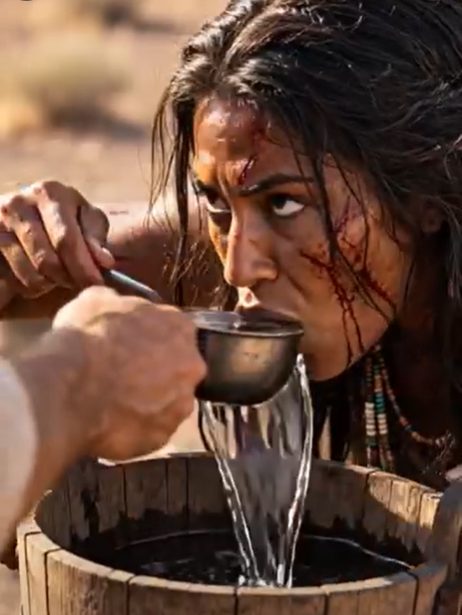
Then I gave a wounded woman three ladles of water.
And everything I had built began to unravel.
It happened on an afternoon when the heat was so fierce that even the lizards had disappeared beneath the stones.
I was hauling water from my well toward the horse trough when I noticed something beside the western fence.
At first, I thought a dark blanket had blown against the rails.
Then it moved.
I set down my bucket.
A woman was sitting in the narrow shadow beneath the fence, her back against a weathered post.
She was the largest woman I had ever encountered.
Even seated, her shoulders seemed nearly as broad as my own.
Her long dark hair hung in tangled strands around her face, and a deerskin garment covered a powerful frame hardened by years of travel.
Blood had dried along her left temple.
Another dark stain marked her side.
Her lips were cracked, her breathing shallow, and the dust on her clothing suggested she had traveled a considerable distance.
She was Apache.
That much I understood immediately.
What I could not understand was why she had come alone.
I looked toward the hills.
Nothing moved.
No sign of companions.
Only the endless shimmering desert.
“Can you hear me?”
Her eyes opened.
They were dark, steady, and remarkably alert.
She studied my face without answering.
I had met frightened travelers before.
I had seen desperate men beg for food, thieves pretend to be wounded, and strangers approach isolated homes with smiles that concealed loaded revolvers.
But this woman did not beg.
She did not even extend her hand.
She simply watched me.
I glanced at the bucket.
Then at the rifle leaning beside my porch.
The sensible thing would have been to stay away.
An isolated rancher survived by recognizing danger before danger recognized him.
But when I looked back at her cracked lips, I remembered something my late wife used to say.
“Water belongs to the thirsty before it belongs to the man holding the bucket.”
I had spent years trying not to remember her voice.
That afternoon, I failed.
I dipped my ladle into the bucket and approached slowly.
“Water,” I said.
The woman’s gaze moved to the ladle.
For a moment, I thought she might refuse.
Then she accepted it.
She drank slowly, carefully, taking only what she needed before returning the ladle.
I filled it again.
A third time, I offered her water.
She finished it and placed the ladle back in my hand.
Three ladles.
Nothing more.
I gestured toward the porch.
“You should rest.
That wound needs cleaning.”
She looked toward the northern hills.
Then she spoke.
“Your water is good.”
Her English was clear, though her voice was rough from thirst.
I almost smiled.
“It’s the only good thing this valley has left.”
She pushed herself upright.
I stepped backward involuntarily.
Standing, she was nearly as tall as the upper fence rail, an imposing figure with broad shoulders and a face that seemed carved from determination.
She swayed once.
I reached toward her.
She raised a hand.
Not threateningly.
Simply refusing help.
“I can walk.”
“Didn’t say you couldn’t.”
She studied me.
“What do people call you?”
“Corvin Torne?”
My stomach tightened.
“How do you know my surname?”
She glanced toward the cabin, where an old wooden sign hung above the porch.
TORNE RANCH.
For the first time, something resembling amusement crossed her face.
“Your house told me.”
I felt foolish.
She turned toward the northern hills.
“Wait,” I called.
“You haven’t told me your name.”
She paused.
Then she walked away.
I watched until the heat swallowed her silhouette.
Only afterward did I notice that she had left a small dark stain on the fence post where she had been sitting.
More than I liked.
I considered following her.
Instead, I collected my bucket and returned to work.
That was the first decision I would regret.
My ranch occupied a narrow stretch of land between two ridges, with a dry streambed winding along its eastern boundary.
The house was small, built from pine and stone by men long dead.
Behind it stood a stable, a corral, and a neglected garden that had not produced anything worth eating in years.
The well stood fifty paces from my front door.
It was the reason I had survived so long in that country.
It was also the reason I never welcomed strangers.
Water was worth more than silver in a drought.
And the summer had been merciless.
For weeks, the waterline inside the well had fallen lower each morning.
I had already reduced the horses’ drinking allowance and abandoned the vegetable patch.
If the drought continued, I would have to leave.
But leaving meant returning to a world I had deliberately abandoned.
I preferred not to consider that possibility.
That evening, I repaired a loose section of fence.
I fed the horses.
I carried two buckets into the cabin.
Then I opened my leather-bound ranch ledger beneath the brass clock.
At exactly p.m., I wrote:
“Apache woman at the well.
Gave water.
Left north.”
I stared at the words.
Then I added one more sentence.
“May need help.”
I nearly scratched it out.
Instead, I closed the book.
The cabin settled around me with its familiar noises.
The hinge near the door squealed.
A cricket chirped beneath the floorboards.
Somewhere outside, a horse struck the stable wall with its hoof.
I lit a lamp.
On the mantel stood a small framed photograph.
My wife, Elin.
She had been twenty-nine when it was taken.
Her smile had always made strangers feel that they were welcome before she had spoken a word.
Mine had never possessed that quality.
Six years earlier, fever had taken her while I was riding for a doctor.
I had reached the nearest settlement before dawn, only to find the physician away treating another family.
By the time I returned, Elin was gone.
For a long while, I blamed the doctor.
Then the distance.
Then the desert.
Eventually, I blamed myself.
A man cannot lose what he refuses to love, I had reasoned.
So I stopped inviting people into my life.
I built stronger fences.
I stopped visiting town.
I let old friendships disappear.
And whenever someone asked whether I was lonely, I told them I appreciated the peace.
That evening, looking at Elin’s photograph, I found myself wondering what she would have done for the woman at the fence.
I already knew.
She would have brought her inside.
Cleaned her wounds.
Given her a meal.
And insisted she stay until she could travel safely.
“Three ladles,” I murmured.
The photograph offered no comfort.
I extinguished the lamp and went to bed.
Sometime after midnight, the horses became restless.
Their hooves scraped against the hard ground.
Leather tack rattled.
Then my oldest mare screamed.
I woke with my hand reaching automatically toward the rifle beside the bed.
The sound was unlike her usual nervous whinny.
It was sharp.
I sat motionless.
Outside, the wind moved against the cabin walls.
I heard a distant clicking sound.
Then another.
Perhaps stones shifting on the ridge.
Perhaps horses moving through dry brush.
I rose and approached the window.
The valley lay beneath a thin wash of moonlight.
Nothing appeared unusual.
Yet the horses remained uneasy.
I considered stepping outside.
Instead, I checked the door latch and returned to bed.
That was the second decision I would regret.
Because while I slept, men were gathering in the darkness.
Not twenty.
And every trail leading into my valley was being watched.
I learned that at dawn.
I had barely pulled on my boots when a peculiar silence drew my attention.
The horses were no longer making noise.
Even the birds had stopped calling.
I opened the cabin door.
The morning air was cool enough to deceive a man into forgetting the heat that would follow.
I stepped onto the porch, adjusting my suspenders.
Then I looked north.
Figures lined the ridge.
At first, I mistook them for scattered rocks.
Then another.
Sunlight flashed against metal.
I counted ten mounted warriors.
Then twenty.
Then forty.
My mouth went dry.
More riders appeared along the eastern slope.
Others stood above the streambed.
Horses shifted among the rocks, their riders sitting motionless beneath the pale morning sky.
I turned toward the western hills.
Every approach was covered.
Some carried rifles.
Others held long weapons upright against the rising sun.
I stopped counting somewhere beyond two hundred.
There were nearly three hundred of them.
Possibly more.
My ranch was surrounded.
I stood on the porch with a cold pressure spreading through my chest.
The rifle rested just inside the doorway.
For one absurd moment, I considered grabbing it.
Then I looked at the ridges.
Three hundred warriors.
That was not a battle.
It was a funeral waiting for a foolish decision.
I stepped away from the weapon.
The riders did not advance.
Their silence unsettled me more than shouting would have.
If they intended to attack, why wait?
If they wanted my horses, why surround the ranch instead of taking them?
I searched the line of mounted figures for the woman I had helped.
I saw no one resembling her.
A rider on the northern ridge lifted his arm.
Every man around him seemed to straighten.
Then one horse descended the slope.
Its rider was elderly, broad across the chest, with silver threading his long dark hair.
His face bore the deep lines of a man who had spent his life beneath the sun.
He wore no elaborate ornaments.
Nothing about him seemed designed to impress.
Yet his approach commanded absolute attention.
He stopped approximately fifty feet from my porch.
I walked down the steps.
My hands remained visible.
“Morning,” I said.
It sounded ridiculous.
The old man did not smile.
He examined me for several seconds.
Then he looked toward my well.
“You are Corvin Torne.”
It was not a question.
“That’s right.”
“You live alone.”
He glanced at the cabin.
“Your wife?”
The question struck with unexpected force.
His expression changed slightly.
“I am sorry.”
I had not expected those words.
Before I could answer, he pointed toward the well.
“Yesterday, a woman came here.”
My heartbeat quickened.
“You gave her water.”
“Three ladles.”
“Because she was thirsty.”
He watched me.
“Did she threaten you?”
“Did she offer you payment?”
“Did she tell you who she was?”
“Only her name.”
The old man lowered his gaze.
For several moments, he said nothing.
Then he raised his hand.
The riders on the eastern ridge separated.
A narrow passage opened between them.
And through that passage came Teya.
She rode a dark horse with the same powerful composure I remembered from the fence.
Her temple had been bandaged.
She was still wearing the dust-stained deerskin garment.
But something had changed.
Yesterday, she had been alone.
Today, hundreds of armed men appeared to be waiting for her.
Across her saddle lay a bundle wrapped in a bloodstained blanket.
Whatever it contained was small enough for her to support with one arm.
Yet she held it with extraordinary care.
She stopped beside the old warrior.
Her eyes found mine.
For the first time, I saw something in them that had not been there yesterday.
Not for herself.
For whatever lay inside the blanket.
The old man turned toward me.
“Yesterday, you gave my daughter water.”
I looked at Teya.
His daughter.
The old man continued.
“Today, she has brought something to your door.”
Teya dismounted carefully.
She approached me, carrying the bundle against her chest.
“Corvin,” she whispered.
“I need you to look.”
The blanket moved.
A tiny hand slipped through its folds.
Then I heard a faint, broken sound.
Teya began pulling back the bloodstained covering.
And when I saw the terror on her face, I understood that whatever lay underneath would demand far more from me than three ladles of water.
✓ Lynn R. Adams
By sunrise, nearly three hundred Apache warriors had surrounded my ranch, and every one of them appeared to be waiting for me to make a mistake. My name is Corvin Torne. I had spent eleven years lea…