Chapter 1: THREE KNOCKS AT THE EDGE OF SILENCE VALLEY 248
The first time I heard a woman begging outside my gate, I was certain the sound had come from the dead.
For twelve years, no human voice had crossed the threshold of my ranch, and I had worked hard to keep it that way.
My name is Ethan Callahan, though most folks in Socorro County had forgotten what to call me long before that summer afternoon.
The few who remembered me called me the Ghost in Boots, a name I had never bothered to correct.
A ghost was something people left alone, and being left alone was the only kindness I had wanted from the world.
My ranch stood at the edge of the Sangre de Cristo Mountains, where the last wagon tracks disappeared into stone, dust, and the merciless wilderness known as Silence Valley.
There was nothing welcoming about that country, especially in summer, when the earth cracked beneath the sun and a careless traveler could die with the mountains still in sight.
I had chosen the place because ordinary men wanted nothing to do with it.
I had built my fences, repaired the old house, raised my horses, and buried every unnecessary thought beneath the steady labor of surviving another day.
Each morning began with the same familiar tasks, and each evening ended with me watching the mountains swallow the last red light.
I spoke to my horses because they never asked questions, and I trusted silence because it never promised anything it could take away.
Twelve years earlier, I had buried my wife and daughter beneath the old cottonwood tree beyond my back pasture.
The memories of that night remained broken into pieces I could neither assemble nor escape.
I remembered gunfire, the savage glow of flames against a black sky, and voices calling through smoke that seemed thick enough to choke the stars.
Most clearly, I remembered the silence afterward, when everything I had loved was gone and the world somehow continued turning.
Before that night, I had made my living hunting men who had prices on their heads, and I had been foolish enough to believe a gun could settle almost anything.
Afterward, I put away that life, rode into the emptiest country I could find, and decided that nothing would ever matter enough to hurt me again.
That afternoon, the southern wind came rolling across the valley like something angry, dragging red dust through the fences and whipping the dry grass flat.
I was standing beside my horse, tightening a saddle girth, when the first knock sounded against the wooden gate.
The noise stopped my hands before my mind could make sense of it.
Then came a second knock, followed by a third, each one carrying strangely across the empty yard.
I stood perfectly still, listening to the wind move around the house.
Nobody visited my ranch, and the last man who had wandered onto the property had turned around before reaching the porch.
My first thought was to retrieve the shotgun hanging above the fireplace, a habit left over from years when survival often depended upon reaching for a weapon first.
Instead, I straightened slowly and watched the gate as though it might explain itself.
Another knock came, weaker than the others but somehow more urgent.
I crossed the yard with dust curling around my boots, already preparing the words that would send my visitor away.
Then I heard a woman’s voice speaking Apache on the other side of the boards.
The language struck me harder than any fist ever had.
For one terrible moment, the gate disappeared, and I was standing beneath a different sky, listening to my wife’s gentle voice as she spoke to our little girl.
My wife had loved the sound of her own language, especially when she whispered stories after sundown and thought I was too tired to understand.
I had learned enough from her to follow those conversations, though I had never managed to make the words sound as beautiful as they did in her mouth.
I had not heard those familiar sounds spoken so close to me since the night I lost them both.
I closed my eyes, but doing so only brought back her smile and the small warm hand that used to fit inside mine.
Then another voice reached me, this one struggling through broken English.
“Please, we need shelter for one night.”
The words sounded scraped from a throat that had gone too long without water.
I remained on my side of the gate, with one hand hanging near my belt and the other curling into a fist.
“Who are you?”
For several seconds, nobody answered, though I heard feet shifting against the ground and someone breathing with painful effort.
“We are women who have traveled too far,” the voice finally replied.
“We cannot go farther today.”
I had heard desperate voices before, and experience had taught me that desperation did not always make a stranger harmless.
Still, something in her answer held my attention because she had not demanded protection, threatened me, or pretended to offer something in return.
She had simply admitted a truth that seemed to cost her a great deal of pride.
The wind changed direction, bringing the unmistakable smell of sweat, old smoke, and blood through the cracks between the boards.
I looked toward the back pasture, where the cottonwood tree stood motionless against the shimmering heat.
For twelve years, I had kept its two graves as the only company I permitted myself, telling myself that opening my home again would mean betraying what lay beneath that earth.
A horse whinnied behind me, and I realized my hand had been resting on the gate latch for several seconds.
“How many of you?”
I stared at the wood, certain I had misheard her.
“Twelve women?”
A long silence followed, broken by a low cough and a faint sound that might have been someone stumbling.
I knew how little water stood in my barrels, how much food remained in the kitchen, and how difficult it would be to shelter twelve people in a house built for a single man.
I also knew that sending exhausted travelers back into Silence Valley beneath that sun could amount to watching them die from a comfortable distance.
The iron latch felt hot enough to burn my palm when I finally lifted it.
The gate swung inward with a long wooden groan, and the sight beyond it emptied every prepared word from my mouth.
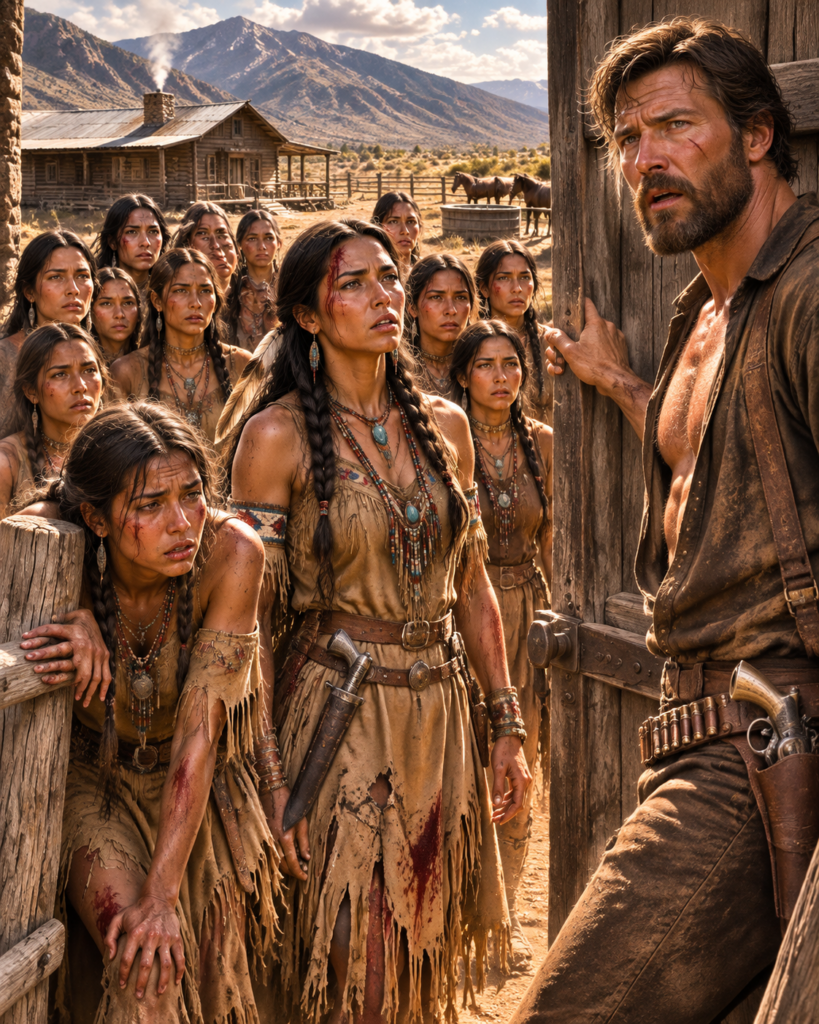
Twelve Apache women stood before me in the swirling dust, their torn deerskin clothing stained with travel, their faces hollow with exhaustion, and their feet wounded by the country they had crossed.
They carried knives, but none had drawn a blade, and even the strongest among them seemed to be holding herself upright through determination alone.
Their beads were tangled, their arms and legs marked by old blood and fresh scratches, and their eyes watched me with the wary attention of people who had learned that help could carry a price.
One woman stood slightly ahead of the others, her shoulders squared despite the tremor running through her legs.
Beside her, a girl who looked no older than seventeen leaned against a fence post, blinking slowly as though the world had become too bright to bear.
The older woman met my eyes without lowering her head.
“My name is Mara,” she said.
“We ask only for water and shelter until morning.”
I looked beyond her at the others, noticing how closely they stood together and how two of them kept glancing toward the youngest girl.
The girl tried to straighten when she realized I was watching, but her legs would no longer obey her.
She took a shallow breath, pushed away from the fence, and attempted one more step.
Her knees buckled before her foot touched the ground.
I moved without thinking, catching her beneath the shoulders as her body collapsed against me.
She weighed almost nothing, and the terrible heat of her skin brought back a memory I had spent twelve years trying to bury.
For one heartbeat, I was holding my daughter again, helpless against a suffering I could neither understand nor stop.
The girl’s head fell against my arm, and her lips moved around a word I could barely hear.
Mara stepped forward, desperation breaking through her disciplined expression at last.
“Please, mister, she has nothing left.”
I looked at the motionless girl in my arms, then at the eleven women waiting outside a gate I had sworn would never open again.
Whatever life I had built in solitude ended with the decision that came out of my mouth.
“Get inside.”
But when I carried the girl toward the house, I felt how faintly she was breathing, and I realized that opening my gate might already have come too late.
✓ Lynn R. Adams
The first time I heard a woman begging outside my gate, I was certain the sound had come from the dead. For twelve years, no human voice had crossed the threshold of my ranch, and I had worked hard t…