Chapter 1: The Woman They Pushed Into the Fountain 212
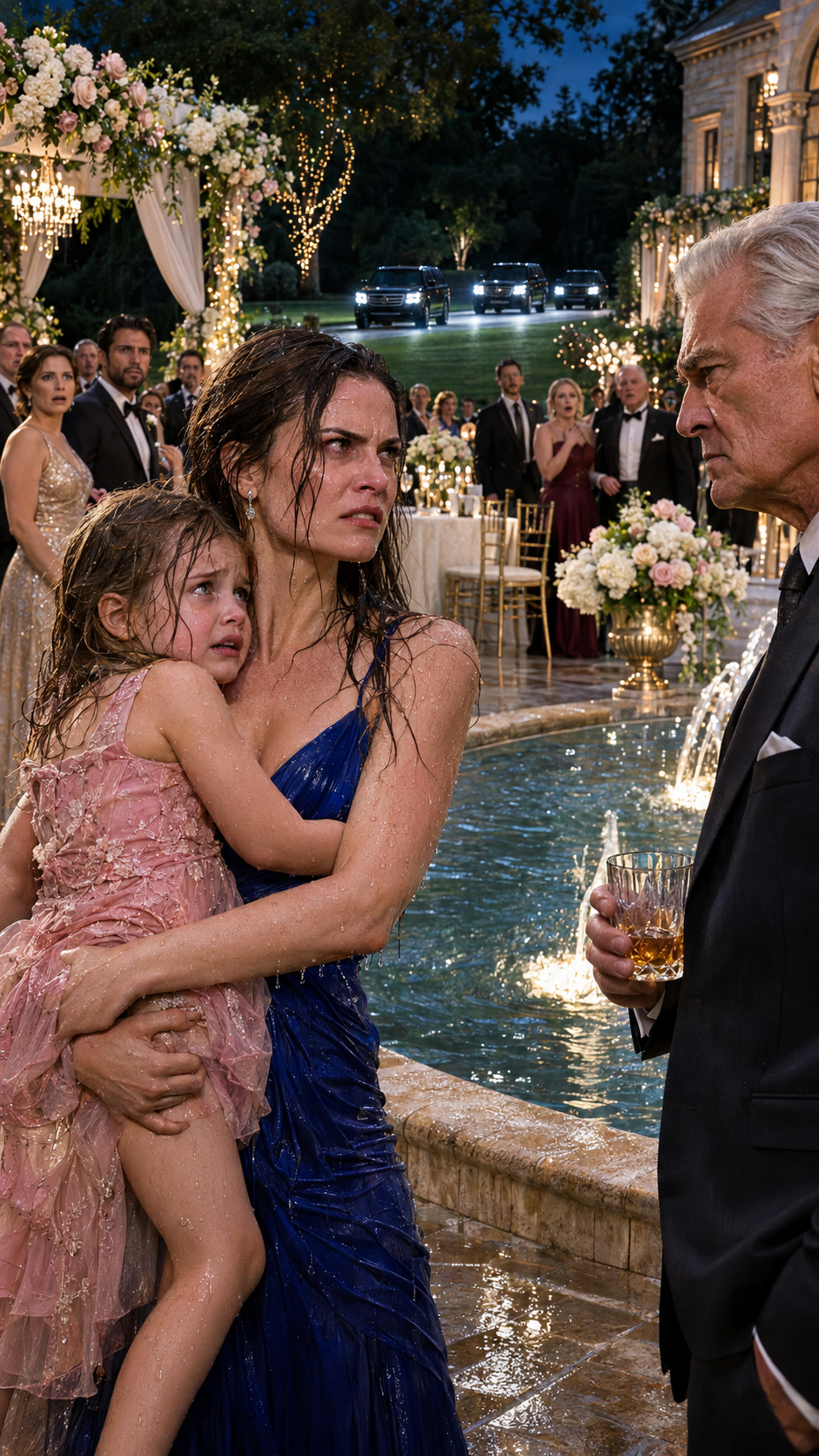
My father shoved me into the wedding fountain while I was holding my four-year-old daughter, and the first thing he said afterward was that we never should have been invited.
The second thing he did was laugh.
But the laughter stopped when three black SUVs crossed the manicured lawn, and the most powerful man at my sister’s wedding stepped out of the center vehicle.
Because Alexander Sterling was looking at my little girl as though he had just seen a ghost.
And I knew, with a certainty that made the cold water feel almost warm, that the secret I had protected for five years was about to destroy everything.
“Mommy, don’t let them take me!”
Lily’s scream tore through the evening as I struggled to find my footing in the shallow stone basin.
Her pink dress clung to her trembling body.
One of her shoes had disappeared beneath the water.
My right shoulder throbbed where it had struck the fountain’s edge, but I barely noticed.
I lifted Lily against my chest, shielding her face from the watching guests.
“Nobody is taking you, sweetheart.”
“Grandpa’s angry.”
“I know.”
“Did I do something bad?”
The question hurt more than the fall.
“No, baby. You didn’t do anything wrong.”
Behind us, the wedding reception had gone silent.
Only moments earlier, music had floated across the gardens of the Hawthorne Estate, where my younger sister Chloe was celebrating her marriage to Mark Reynolds.
White roses spilled from elaborate arrangements. Crystal glasses glittered beneath strings of golden lights. Nearly three hundred guests had gathered to witness what my parents proudly called the wedding of the decade.
I had been invited as an obligation.
Lily had been tolerated as an inconvenience.
And now we were standing in freezing fountain water while people who had spent thousands of dollars on evening clothes stared as if my humiliation were another part of the entertainment.
My father, Richard Carter, stood beside the fountain holding a glass of bourbon.
“You always have to make everything about yourself,” he said.
I stared at him.
He had pushed me.
He had seen Lily in my arms.
Yet somehow he had convinced himself that what happened was another example of my selfishness.
“She’s four years old,” I whispered.
“And you’re thirty-two. Perhaps it’s time you started acting like it.”
A few guests exchanged uncomfortable glances.
Nobody intervened.
Not my mother.
Not Chloe.
Not even the man who had just married into our family.
Then the engines approached.
Three black SUVs rolled past the wedding entrance, crossed the gravel drive, and stopped beside the garden terrace.
I recognized the center vehicle immediately.
It wasn’t the license plate or the expensive finish.
It was the small silver emblem mounted near the windshield.
Sterling Capital.
My stomach tightened.
The rear door opened.
A tall man stepped onto the patio wearing a charcoal suit and a white shirt without a tie.
Alexander Sterling.
Five years had passed since I had last stood close enough to hear him breathe.
The years had sharpened his features. His dark hair carried the faintest trace of silver near his temples, and his expression possessed a guarded stillness I didn’t remember.
But his eyes were the same.
Gray-green.
Exactly like Lily’s.
Mark Reynolds hurried toward him.
“Mr. Chairman!”
Alexander barely seemed to hear.
His gaze had found me.
Then it moved to the little girl trembling against my shoulder.
He stopped walking.
For one suspended moment, the entire reception seemed to hold its breath.
“Emily?”
Hearing my name in his voice nearly broke me.
Not because he sounded angry.
Because he sounded like the man who had once loved me.
And I had spent five years teaching myself not to remember him that way.
Alexander and I met at a university research library on a rainy Thursday afternoon.
I was twenty-seven, completing graduate work in human-computer interaction, and attempting to repair a malfunctioning public-access terminal before a community technology demonstration.
He appeared beside me carrying two terrible coffees and an equally terrible suggestion.
“Have you tried turning it off and telling everyone it’s conceptual art?”
I looked up, irritated.
He smiled.
I should have returned to work.
Instead, I laughed.
He was finishing a research fellowship and quietly developing a company focused on accessible digital services.
I had no idea his family’s investment firm was already worth hundreds of millions.
He rarely discussed money.
What interested him was the way ordinary people struggled with technology designed by people who had never needed to struggle with anything.
We argued about interface design, drank cheap coffee, and spent entire evenings exploring ideas that made our professors question whether we ever slept.
Then friendship became something neither of us had planned.
He remembered how I liked my tea.
He walked me home when the library closed.
He once spent an entire Saturday helping me organize donated laptops for a neighborhood learning center, even though he had an important investor presentation the following Monday.
When I asked why, he said, “Because this matters to you.”
Nobody in my family had ever offered such a simple explanation for showing up.
My father considered academic research impractical.
My mother called my graduate degree an expensive exercise in postponing adulthood.
Chloe, who was three years younger, had always been the daughter whose choices made sense to them.
She wore the right clothes.
Dated the right men.
Attended the right parties.
I wore comfortable shoes, worked two jobs, and believed public libraries deserved better technology.
At family dinners, Chloe’s achievements received champagne.
Mine received questions about when I intended to find a proper career.
Alexander listened to those stories without making promises he couldn’t keep.
He simply asked what I wanted.
I told him I wanted to build something useful.
“And what else?” he asked.
I had never answered that question aloud.
“A family that actually wants me there.”
He took my hand.
“That doesn’t sound unreasonable.”
For eleven extraordinary months, I believed happiness might be something I could build rather than something I had to earn.
Then his father suffered a major stroke.
Alexander was called home to assume responsibilities within Sterling Capital while the family reorganized its leadership.
I remember the night he told me.
We were sitting on the floor of his apartment, surrounded by books and half-packed boxes.
“I’ll have to travel constantly,” he said. “New York, London, Singapore. For a while, I won’t know where I’m sleeping next week.”
I tried to smile.
“You’ll figure it out.”
He looked at me carefully.
“Emily, I don’t want to figure it out without you.”
For one beautiful second, I imagined following him.
Then I thought about my research, the fellowship I had worked years to earn, and the expensive world awaiting him.
I had spent my childhood being told I was a disappointment.
I didn’t want to enter Alexander’s future as another problem he had to solve.
So I asked for time.
He gave it to me.
That should have been the beginning of a conversation.
Instead, it became the beginning of five years of silence.
“Emily.”
Alexander’s voice pulled me back to the wedding terrace.
He stood several feet away.
His eyes moved to the soaked sleeve of my blue dress.
“You’re hurt.”
“We’re fine.”
He glanced at Lily.
“She’s shaking.”
“I know.”
He removed his jacket.
I instinctively stepped back.
“Alexander, please.”
He stopped immediately.
The gesture was so familiar that my throat tightened.
He had always listened when I said no.
“Would she let me give her this?” he asked.
I looked at Lily.
She was watching him with solemn curiosity.
“Would you like a warm jacket, sweetheart?”
She nodded.
Alexander approached slowly and wrapped the enormous charcoal jacket around her shoulders.
The sleeves hung below her little hands.
“Thank you,” Lily whispered.
He swallowed.
“You’re welcome.”
The softness of his response made me look away.
Behind him, Mark was staring.
My brother-in-law had built Reynolds Digital Systems into one of the fastest-growing technology companies in the region.
At least, that was how he described it.
For a year, he had reminded everyone who would listen that Sterling Capital had financed his expansion.
He displayed photographs with investors, collected expensive watches, and spoke of ordinary employees as if they were interchangeable components.
But now his confidence had deserted him.
“Mr. Sterling,” he began, “I’m terribly sorry about this embarrassing family misunderstanding.”
Alexander turned.
“Misunderstanding?”
“Yes. Just a disagreement that got out of hand.”
Alexander glanced at the fountain.
“A disagreement put a child in the water?”
Chloe stepped forward.
“Dad pushed Emily, but Lily wasn’t supposed to—”
“Chloe!”
My father’s shout silenced her.
Alexander faced him.
“Did you push her?”
My father straightened his shoulders.
“This is private family business.”
“That wasn’t my question.”
“She’s my daughter.”
“And the little girl?”
Richard’s face hardened.
“A child whose father she refuses to identify.”
The words landed like a slap.
I felt Lily shrink against my shoulder.
Alexander’s expression changed.
Not dramatically.
His eyes narrowed, and his jaw became still.
“That doesn’t answer why you pushed them.”
My mother finally moved.
“Mr. Sterling, please understand that Emily has always been difficult.”
“Mother,” I whispered.
She ignored me.
“She makes decisions without considering their consequences. Tonight was supposed to be Chloe’s special day.”
I looked at my sister.
She stood beside her husband, her white wedding gown spreading across the terrace like snow.
Her eyes were red.
For a moment, I remembered a different Chloe.
The little girl who used to crawl into my bed during thunderstorms.
The teenager who cried when her first boyfriend broke her heart.
The sister who once told me that being brave looked easier when I was beside her.
Now she couldn’t meet my eyes.
Alexander turned toward me.
“Do you want to leave?”
“Yes.”
The answer came before I could think.
“Then we’ll leave.”
My father scoffed.
“Of course. Run away. That’s what she does whenever anyone expects her to take responsibility.”
Something inside me went cold.
Five years earlier, I would have defended myself.
I would have explained my choices, apologized for disappointments that weren’t mine, and searched desperately for one sentence that might make him proud.
But Lily was trembling in my arms.
I understood, with sudden terrible clarity, that my daughter had just witnessed what I had mistaken for normal love throughout my childhood.
And I would not let her learn that lesson.
“You’re right about one thing, Dad.”
He looked almost pleased.
“What’s that?”
“I’m leaving.”
I adjusted Lily against my chest.
“But I’m not coming back.”
His smile disappeared.
“Don’t be dramatic.”
“This isn’t drama.”
“Emily—”
“You pushed us into a fountain.”
He glanced toward the guests.
“Lower your voice.”
“You didn’t seem worried about everyone hearing you when you called my daughter a bastard.”
Silence spread across the terrace.
My mother’s lips parted.
Chloe closed her eyes.
Richard’s face darkened.
“Watch how you speak to me.”
For the first time in my life, I didn’t lower my gaze.
“No.”
Alexander stood beside me without interrupting.
I was grateful for that.
He could have commanded the room with a word.
Instead, he allowed me to speak for myself.
Lily pressed her damp cheek against my neck.
“Mommy, can we go home now?”
“Yes, sweetheart.”
I turned toward the SUVs.
One of Alexander’s staff members had brought blankets.
A driver opened the rear door, and warm air spilled into the cold evening.
I climbed inside with Lily.
Alexander remained outside.
“Emily,” he said softly.
I looked up.
His gaze moved from my face to Lily’s.
There were questions in his eyes.
Questions he had earned the right to ask.
Questions I had spent years avoiding.
“Not tonight,” I whispered.
He nodded.
“All right.”
That small kindness nearly undid me.
For five years I had imagined what would happen if he discovered the truth.
I had pictured anger, lawyers, accusations, and the unbearable possibility that he would think I had deliberately stolen something from him.
I had never imagined he might simply recognize my fear and give me a little room to breathe.
Then Mark spoke.
“Wait a minute.”
The door remained open.
Mark stepped closer, studying Lily’s face.
His earlier panic had transformed into something colder.
Calculation.
“You and Mr. Sterling knew each other before tonight?”
I said nothing.
“From graduate school, perhaps?”
Alexander turned.
“Mark, that’s enough.”
But Mark was no longer watching him.
He was watching Lily.
Her gray-green eyes.
The dark curls framing her forehead.
The tiny crease between her eyebrows.
He looked at Alexander again.
“Emily,” he asked slowly, “how old did you say Lily was?”
My heart began hammering.
“Mark,” Chloe whispered.
He ignored her.
“Four? Almost five?”
Across the terrace, my mother dropped her champagne glass.
Crystal shattered against the stone.
I turned toward her.
She wasn’t looking at Lily.
She was looking at Alexander.
And the expression on her face was not surprise.
It was recognition.
As though she had been waiting five years for a particular lie to come undone.
Then she looked directly at me and whispered words I could barely hear.
“Emily, please. Don’t tell him about the letter.”
The letter.
I had no idea what she meant.
But Alexander heard her.
And the way his face changed told me that he did.
For the first time that night, he looked genuinely frightened.
“Carol,” he said, addressing my mother by name, “what letter?”
My mother backed away.
And I realized that whatever had separated Alexander and me five years earlier might not have been the truth at all.
✓ Lynn R. Adams
My father shoved me into the wedding fountain while I was holding my four-year-old daughter, and the first thing he said afterward was that we never should have been invited. The second thing he did …