Chapter 1: THE WOMAN NOBODY WANTED – a041
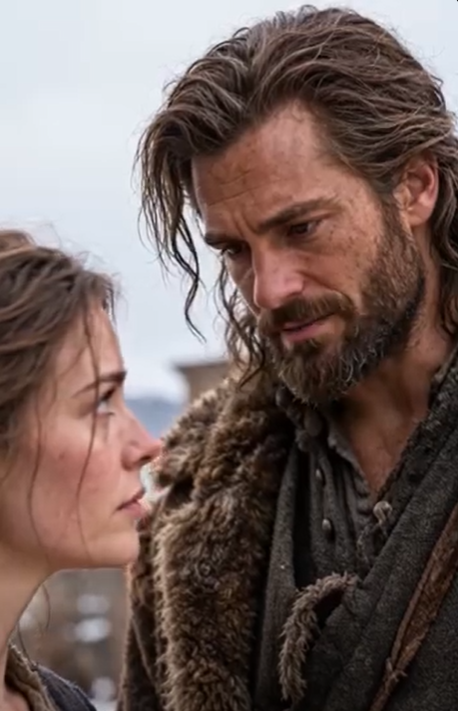
The day a stranger offered to make me his wife, I was standing knee-deep in humiliation, washing another woman’s filthy sheets while half the town discussed why I was worthless.
I was thirty years old.
I had buried my husband.
And according to the respectable people of Oakhaven, I had failed at the only thing a woman was born to do.
I had never given birth to a child.
That was all they remembered about me.
Not the years I had spent nursing my husband through his final illness.
Not the freezing mornings when I carried laundry through streets still dark with night.
Not the endless hours I worked until my fingers split and bled.
To them, I was simply Sadie Whitcomb.
The barren widow.
That afternoon, the November wind came tearing through Oakhaven like something angry enough to strip the paint from every building.
I stood outside Hargrove’s General Store, bent over a wooden washtub filled with steaming water.
My sleeves were pushed above my elbows, exposing arms reddened by soap and cold.
A damp sheet twisted between my hands.
Behind me, beneath the store’s wooden awning, Mrs.
Pritchard was holding court.
“Such a tragedy,” she announced.
I knew that voice.
Everyone did.
Pritchard was a stout woman with silver spectacles, expensive gloves, and an extraordinary talent for making cruelty sound like Christian concern.
“Only thirty years old,” she continued.
“Already widowed, and not a single child to remember her when she’s gone.”
Another woman sighed.
“Some women simply aren’t meant for motherhood.”
I scrubbed harder.
The soap burned the cracks across my knuckles.
“Her poor husband,” Mrs.
Pritchard added.
“Imagine dying without an heir.”
My hands stopped.
His name had been Daniel.
He had possessed little worth inheriting beyond a small collection of books, a silver watch that no longer worked, and a laugh that used to fill our kitchen.
He had also loved me.
Not because I could give him children.
Because I was Sadie.
That was something the women of Oakhaven had never understood.
Daniel had died three winters earlier, after a fever settled into his lungs.
I had stayed awake beside him for eleven nights.
On the final morning, he had taken my hand and whispered, “You were enough for me.”
Then he was gone.
I had carried those words through every winter since.
Sometimes they were the only thing keeping me upright.
“She ought to be grateful Mr.
Hargrove gives her work,” another woman remarked.
“Indeed,” Mrs.
Pritchard replied.
“A woman in her condition cannot afford pride.”
I swallowed.
My condition.
As though widowhood and childlessness were diseases.
I lifted the wet sheet, twisted it between my fists, and dropped it into the rinse bucket.
The water splashed across my worn boots.
I had exactly fourteen cents hidden in a tin beneath my mattress.
My husband’s funeral debt was still unpaid.
The rent on my little room was due in six days.
And the first serious snowstorm of the season was coming.
Pride was a luxury I could not afford.
But neither was surrender.
Hargrove appeared in the doorway.
He was a narrow-faced man with a pencil tucked permanently behind one ear.
“Those sheets had better be finished before sundown.”
“Yes, sir.”
Pritchard says you left a stain on her table linen last week.”
I looked at the woman beneath the awning.
She smiled.
“I washed it twice,” I said quietly.
“Then wash it a third time.”
He disappeared inside.
I lowered my eyes.
The women continued talking.
They always did.
I had learned that silence was cheaper than argument.
But that afternoon, something inside me felt dangerously close to breaking.
I was tired.
Not merely tired from labor.
Tired of being tolerated instead of wanted.
Tired of hearing my husband’s memory twisted into a judgment against me.
Tired of waking each morning wondering whether there was any place in the world where I might be allowed to exist without apologizing.
Then I heard wagon wheels.
Not the quick rattle of a merchant’s carriage.
These wheels moved slowly, heavily, grinding against the frozen dirt.
The horses came first.
Two enormous shaggy creatures with frost clinging to their dark manes.
Behind them rolled an old pine wagon loaded with traps, rolled furs, cooking pots, rope, and supplies that smelled faintly of woodsmoke.
The wagon stopped near the church.
People turned.
Conversations faded.
Oakhaven rarely received visitors from the high country once November arrived.
The mountain passes were dangerous even in good weather.
Then I saw the children.
Five of them.
The oldest was a boy of perhaps twelve, thin and serious, with dark hair falling across his forehead.
One hand rested protectively near a small hunting knife on his belt.
Beside him sat a girl who looked about ten.
She held a toddler wrapped in a faded wool blanket.
Two younger boys huddled together beneath a canvas covering, watching the town with frightened eyes.
The toddler coughed.
A terrible, scraping sound.
I knew that sound.
I had heard something terribly similar during Daniel’s final days.
My fingers released the sheet.
The little girl adjusted the blanket around the toddler’s shoulders.
“Easy, Nell,” she whispered.
“Please, just breathe.”
My heart tightened.
Then I noticed the man walking beside the horses.
He was enormous.
Well over six feet tall, with shoulders broad enough to block the light from the store window.
His coat was made from thick animal hides, his beard was dark and streaked with gray, and his face carried the weathered severity of someone who had spent more winters fighting nature than speaking to people.
He wore a rifle across his back.
A heavy knife hung at his waist.
But it was his eyes that unsettled me.
They were pale blue.
The eyes of a man who had forgotten what rest felt like.
Reverend Alden stepped into the road.
“Afternoon, stranger.
Can we help you?”
The giant stopped.
His gaze traveled over the storefronts, the curious faces, the church, and finally the women beneath the awning.
“I need a wife.”
Silence swallowed the street.
Pritchard made a strangled sound.
A young woman beside her blushed.
The mountain man did not seem embarrassed.
“My name is Elias Mercer,” he said.
“My cabin is north of Pine Ridge, near the snowline.”
Reverend Alden frowned.
“That’s difficult country.”
“Especially with winter coming.”
“That’s why I’m here.”
Elias turned toward the wagon.
“My wife died two months ago.
Fever took her.”
The girl holding the toddler lowered her head.
The eldest boy’s jaw tightened.
Elias continued.
“I have five children.
They need someone who can cook, sew, wash, tend sickness, and keep a household alive while I’m trapping.”
“I’m not looking for romance.”
Several women exchanged glances.
“I’m looking for someone who knows how to work.”
The silence became uncomfortable.
Pritchard stepped forward.
“Surely you cannot expect a respectable young lady to abandon civilization for a wilderness cabin?”
“No, ma’am.”
His voice was low and steady.
“I expect a willing woman to make her own decision.”
I almost smiled.
Pritchard clearly had not expected that answer.
“Well,” she said sharply, “there are several eligible women in town.”
Elias studied them.
One by one, their gazes shifted toward his children.
Toward the toddler’s coughing.
Toward the rough wagon and its mountain supplies.
Nobody volunteered.
“I cannot promise an easy life,” Elias said.
“There will be snow, hard labor, and long nights.
But there will be food, a roof, and fair treatment.”
Still nobody moved.
Then he said something that changed the entire afternoon.
“I’m not searching for someone beautiful.”
His eyes crossed the street.
And stopped on me.
I felt the weight of that gaze before I understood what it meant.
He began walking toward the washtub.
The women went silent.
I straightened slowly, conscious of my soaked apron, my cracked fingers, and the loose strands of hair escaping my braid.
He stopped several feet away.
“Are you married?”
The question was so direct that I almost forgot how to answer.
“How long?”
“Three years.”
“Children?”
My stomach twisted.
There it was.
The question that had ended every hopeful conversation since Daniel’s death.
Elias waited.
I could feel the women watching.
I knew what they expected.
So I gave him the answer before anyone else could deliver it for me.
“And I never will.”
The words hurt more than they should have.
Elias looked toward his wagon.
Five children stared back.
Then he returned his attention to me.
“I already have enough children.”
For a moment, I thought I had misunderstood him.
“I need someone who knows how to survive winter.”
Pritchard made a disapproving noise.
Mercer, perhaps you should understand that Sadie’s circumstances are rather unfortunate.”
Elias turned his head.
“What circumstances?”
“Well, she’s unable to—”
“I heard her.”
The blunt interruption made several people gasp.
Elias faced me again.
“What’s your name?”
“Sadie Whitcomb.”
Whitcomb, can you cook?”
“Keep a fire going through a cold night?”
“I’ve done it.”
“Care for someone who’s sick?”
My throat tightened.
I remembered eleven nights beside Daniel’s bed.
“Yes,” I whispered.
His expression changed.
But enough.
“Then you know more than most people standing here.”
I stared at him.
Nobody had spoken to me that way in years.
“You don’t know anything about me,” I said.
“I know you’ve been working while everyone else watches.”
His gaze shifted toward Mrs.
“And I know they haven’t been kind.”
The woman stiffened.
“Really, sir, that is an outrageous assumption!”
Elias looked back at my reddened hands.
“Doesn’t seem much of an assumption.”
A strange warmth rose behind my ribs.
He had known me for less than a minute.
Yet he had noticed what everyone else had spent years refusing to see.
“Because you were the only person who looked at my sick child before looking at my money.”
I went still.
He had noticed that too.
Elias reached into his coat.
A worn leather pouch appeared in his enormous hand.
He set it on my washboard.
Several gold coins spilled across the damp wood.
The sound was small.
But it seemed to shake the entire street.
Pritchard gasped.
Hargrove emerged from the store so quickly that his pencil fell from behind his ear.
Elias ignored them.
“I’ll pay whatever honest debts you owe,” he said.
“I’ll provide a home.
You’ll have your own room, and no one will raise a hand against you.”
My pulse hammered.
“You don’t have to love me,” he continued.
His voice softened.
“You don’t even have to share my bed.”
I could barely breathe.
“Then what do you expect from me?”
He looked toward the wagon.
“Help me keep my children alive.”
I followed his gaze.
The eldest boy was watching with open suspicion.
The girl looked too tired to be ten years old.
The two younger boys were trembling.
And the toddler…
She coughed again.
Longer this time.
Her little body folded forward.
I took a step toward her before I realized I had moved.
Elias noticed.
“She’s been sick since we left the mountain,” he said quietly.
“I thought the lower air might help.”
“Has she had a fever?”
“Three nights.”
“Has she been drinking?”
“Not enough.”
Fear slid through me.
Three nights.
Cold weather.
A cough that sounded far too deep.
I glanced toward Reverend Alden.
He was studying the little girl with concern.
Mercer,” he said, “perhaps we should talk inside.”
Elias nodded, but his gaze returned to me.
“I won’t force an answer, Mrs.
If you say no, I’ll keep looking.”
I stared at the coins.
At the man.
At the children.
Behind me stood an entire town that had spent years teaching me I was nothing.
Before me stood a stranger offering me a place in a family already wounded by loss.
I was afraid of him.
Afraid of the mountains.
Afraid of discovering that this impossible chance was another cruel mistake.
But beneath the fear was something I had not felt in years.
The possibility of being needed.
I took a breath.
Mercer, I—”
A sharp scream interrupted me.
The little girl in the wagon had risen to her feet.
Everyone turned.
She was shaking the toddler’s shoulder.
“Pa, Nell won’t wake up!”
Elias moved instantly.
I ran before he reached the wagon.
The little girl thrust her sister toward me, tears streaming down her face.
I pulled back the blanket.
Nell’s lips were turning blue.
I pressed two trembling fingers beneath her chin.
And felt no breath at all.
✓ Lynn R. Adams
The day a stranger offered to make me his wife, I was standing knee-deep in humiliation, washing another woman’s filthy sheets while half the town discussed why I was worthless. I was thirty years ol…