Chapter 1: The Vegetables Nobody Wanted 251
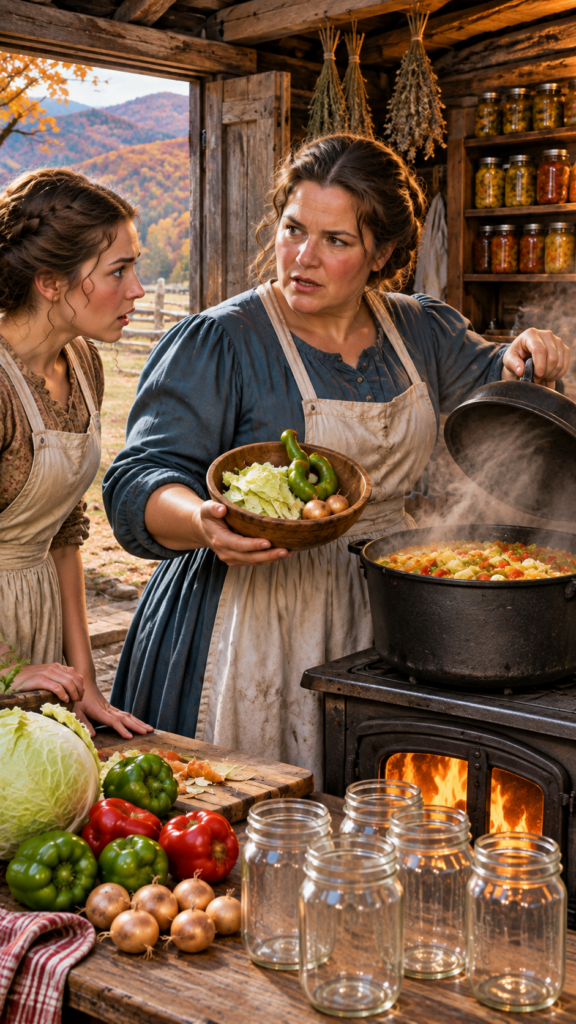
The first hard frost had already silvered the low places between the Appalachian ridges when my neighbor leaned against our gate, watched me carry a wooden bowl of crooked peppers toward the cabin, and laughed as though I had just announced that stones could be boiled into supper.
“You’re saving garbage now?”
I looked down at the vegetables in my arms, at the two peppers twisted almost into hooks, the loose cabbage leaves with browned edges, and the onions scarcely larger than marbles, and I felt no shame at all because I knew exactly what those scraps could become.
“Winter doesn’t care how pretty your vegetables are.”
His laughter followed me across the yard.
To him, the best of the harvest had already been gathered, and everything left behind was something a sensible woman would toss to the chickens or drop onto a compost pile.
To me, every edible piece represented another spoonful of food, another taste of autumn, and another small defense against the months when the mountains could close around a family like a locked door.
Our cabin stood deep between wooded ridges whose oak and maple leaves had turned copper, scarlet, and gold, but the beauty of November never fooled me because I had lived through enough mountain winters to know how quickly those colors could disappear beneath snow.
The tomatoes worth admiring had already been canned in neat rows of glass jars.
Bundles of beans hung drying where warm air from the stove could reach them.
Potatoes rested in the coolest corner of our storage space.
The corn had been gathered weeks earlier, and sacks of meal waited against the pantry wall.
On the surface, it looked as though our work was finished.
But I had learned long ago that the difference between enough and not enough was sometimes measured in things other people considered too ugly to save.
I carried the bowl inside and set it on the heavy wooden kitchen table.
My children had been helping all afternoon, carrying jars, wiping rims, sweeping vegetable trimmings from the floor, and watching me with the tired patience of people who believed the harvest should have ended hours earlier.
My eldest child picked up one of the crooked peppers and turned it between both hands.
“This one hardly has anything on it.”
“It has enough.”
I took it back gently, cut away the damaged spot, and laid the good green flesh beside the cabbage.
The kitchen smelled of woodsmoke, earth, vinegar, dried herbs, and the faint sweetness of vegetables warming near the stove.
Outside, the wind moved through bare branches with a sound that reminded me of water rushing over stones.
Inside, I began sorting what remained.
I did not keep anything spoiled beyond use, and I did not pretend rot was food, but crookedness was not rot, smallness was not uselessness, and a cabbage leaf torn by weather could still nourish a family if the sound parts were carefully trimmed and preserved.
That distinction mattered to me.
Our neighbors had grown accustomed to choosing the finest vegetables first, and nobody could blame them for wanting straight peppers, firm heads of cabbage, and onions large enough to justify peeling.
What troubled me was the ease with which good food could be dismissed once it stopped looking perfect.
I ran my fingers over the last cabbage leaves and remembered planting seeds when the earth was still cold enough to numb my hands.
I remembered kneeling beneath spring rain to pull weeds from between the rows.
I remembered carrying buckets through summer heat when the garden needed water.
Nothing in that bowl had appeared without labor.
Every leaf, pepper, and onion had required soil, time, patience, and hope.
Throwing away what could still be eaten would have felt like throwing those months away with it.
My neighbor’s laughter drifted through the open doorway once more.
“You’ll fill your pantry with scraps and call yourself rich.”
I turned toward him with my knife in my hand, not threateningly but deliberately.
“Maybe I will.”
He shook his head and walked back toward his own place before the evening cold settled lower in the valley.
My children watched him go.
“Do you think he’s right?”
I looked toward the pantry shelves.
That single word came easily because this was not the first year I had made what my family called chow-chow.
The recipe was not written in some fine book, and no merchant had taught it to us.
It belonged to kitchens like mine, to people who understood that preservation was less about elegance than survival, and to generations who had learned that a garden’s final handfuls could be gathered together and turned into something far more useful than their appearance suggested.
I pulled the cutting board closer.
My knife began its steady work.
Cabbage became thin ribbons.
Peppers became bright little pieces.
The smallest onions were peeled, halved, and chopped with the same care I would have given the largest.
Nothing sound was discarded.
On the stove, my heavy iron pot waited.
Into it went vinegar, sugar, and the familiar mixture of spices I measured almost without thinking.
The vinegar gave the air a sharpness that caught in the nose.
The sugar softened it.
The spices warmed as the pot heated, and before long the kitchen was filled with the unmistakable fragrance that always made me think of winter suppers before winter had even arrived.
My eldest began lining clean glass jars across the table.
“You really think we’ll use all of these?”
“We might wish we had twice as many.”
The words quieted the room.
In the mountains, nobody joked for long about winter.
We had all seen storms that buried fences.
We had watched roads disappear.
We had heard stories of families unable to reach a store or neighbor for days.
We had stretched beans farther than seemed possible and sliced cornbread thinner because nobody knew when travel would be safe again.
I poured the chopped vegetables into the iron pot.
The colors brightened beneath the steam.
Green pepper, pale cabbage, white onion, and bits of other sound garden remnants rolled slowly through the bubbling vinegar mixture beneath my wooden spoon.
Outside, frost began creeping across the lower corners of the windows.
Inside, the final pieces of autumn were becoming something that could survive it.
My children gradually stopped thinking of the vegetables as leftovers.
They watched the mixture thicken and soften.
They smelled the spices.
They saw the jars waiting.
One by one, they understood what I had understood from the beginning.
Those vegetables were not what remained after the harvest.
They were part of the harvest.
Hours later, just when I thought we had finished, I bent to pick up a cloth that had fallen beside the table.
That was when I saw another wooden bowl pushed into the shadows underneath.
I pulled it toward me.
Inside were the true last scraps from our garden.
Two badly twisted peppers.
Several torn cabbage leaves.
A handful of tiny onions.
My child sighed when she saw them.
“Surely we can throw those away.”
I reached toward the iron pot, but instead of answering, I stopped with my hand above the lid.
The room had grown quiet enough for me to hear the fire shifting in the stove.
I looked at the forgotten bowl, then at my children, and suddenly I knew that what I did with those final scraps would teach them more about surviving winter than anything I had said all afternoon.
✓ Lynn R. Adams
The first hard frost had already silvered the low places between the Appalachian ridges when my neighbor leaned against our gate, watched me carry a wooden bowl of crooked peppers toward the cabin, an…