Chapter 1: THE UNIFORM THEY WERE ASHAMED OF 248
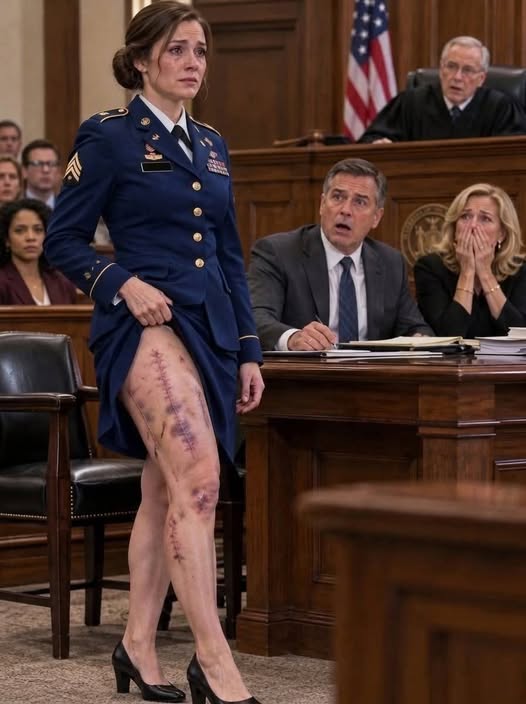
The first time my father saw me in twelve years, he laughed at my Navy uniform, completely unaware that the judge sitting ten feet away was about to address me with a rank my parents had never imagined I could earn.
I stood inside a Maryland courtroom wearing my formal Navy dress uniform, feeling the familiar pull of old scar tissue around my reconstructed knee as every conversation in the room gradually disappeared.
My father, Donald Holloway, sat at the plaintiffs’ table with the same expression he had worn whenever I disappointed him growing up.
Beside him, my mother, Patricia, wore a floral dress, polished earrings, and the pearl necklace she reserved for occasions when appearances mattered more than feelings.
She looked at my ribbons before she looked at my face, and the disgust moving across her expression felt painfully familiar.
“Look at that uniform,” she whispered.
Dad gave a quiet chuckle and straightened his tie, apparently delighted that I had provided him with one more opportunity to be embarrassed by his daughter.
I had walked into dangerous situations with considerably less fear than I felt standing before those two people.
Their disapproval had followed me through officer training, deployments, hospital rooms, and countless nights when I wondered whether anything I accomplished would ever be enough.
Yet something was different that morning, because the woman standing inside that courtroom was no longer the young daughter who had begged them to understand her choices.
Judge Albright glanced up from his case file, and his eyes moved slowly across the decorations fastened to my jacket.
He studied the ribbons for several seconds before examining my face with unmistakable recognition.
“My God,” he murmured, “is that really her?”
My father seemed amused by the judge’s reaction, while my mother shifted uncomfortably in her chair.
Neither of them understood what had caught his attention.
Neither knew what those ribbons represented, what they had cost, or how many people had trusted me to make decisions when mistakes could mean somebody never returned home.
I kept my shoulders square despite the dull ache spreading through my injured leg.
There was a time when I would have wanted to explain everything to my parents, beginning with the accomplishments they dismissed and ending with the sacrifices they had never bothered to acknowledge.
That morning, I wanted something considerably simpler.
I wanted the truth to remain standing after their accusations had fallen apart.
Two days earlier, I had been outside my little house near Annapolis, trimming the rose bushes that grew along the front walkway.
It was one of those peaceful Maryland mornings when the breeze carried the smell of damp soil and the trees seemed to move without making a sound.
My hound, Buster, had claimed a sunny patch beside the porch steps and was supervising my gardening with the complete indifference only an old dog could achieve.
I had recently started finding comfort in small routines that required patience rather than urgency.
Military life had taught me to prepare for the unexpected, but civilian mornings offered the extraordinary luxury of deciding whether to prune roses or sit outside with a cup of coffee.
My knee still objected whenever I crouched too long, although I had learned to work around its complaints.
The postal carrier left a cream-colored envelope among the ordinary mail, and I noticed the county courthouse seal before I noticed my own name.
For a moment, I assumed it concerned some administrative matter involving Grandpa Walter’s property.
Then I saw the formal summons and the case number printed across the first page.
Holloway versus Holloway.
I stood beside my front door with the envelope open, reading those words repeatedly because my mind refused to accept what they meant.
Donald Holloway and Patricia Holloway were listed as the plaintiffs.
Joanna Holloway was listed as the sole defendant.
My parents were taking me to court.
The accusation concerned the countryside farmhouse my grandfather had left me before he died, a place I had loved since childhood and had never stopped considering part of my responsibility.
According to the complaint, I had abandoned the property and left my parents to shoulder its expenses.
They claimed they had been paying for everything themselves.
I read that paragraph three times, searching for some harmless misunderstanding that might explain why my parents had put their names beneath those statements.
There wasn’t one.
I knew exactly where the property-tax payments had come from, because I had personally arranged every one of them through my military account since 2013.
I remembered checking those payments while stationed overseas, sometimes after exhausting shifts when I could barely remember what day it was back in Maryland.
I remembered worrying about the aging farmhouse while handling responsibilities that left little room for my own problems.
I remembered Grandpa Walter telling me that ownership meant looking after something even when nobody was watching.
My parents had never helped my grandfather build that house, and they had never been the people he trusted with its future.
Yet the papers in my hands described them as the responsible caretakers and me as the absent daughter who had failed her obligations.
I walked inside slowly, set the summons on the kitchen table, and stared at it until Buster came over to investigate my silence.
He rested his heavy head against my knee, apparently deciding that whatever had happened could be improved by having somebody nearby.
“Well, Buster,” I whispered, scratching behind his ears, “it looks like they have finally come up with another way to talk to me.”
Twelve years had passed since I last visited the family home.
Twelve years since I stopped believing my parents would eventually become proud of the life I had chosen.
I had imagined that if we ever met again, it might happen somewhere ordinary, perhaps in a grocery store or at a family gathering where we would be forced to exchange uncomfortable greetings.
I had never imagined our reunion would appear on a court docket.
I carried the summons to the window and looked outside at the roses I had left half-trimmed.
Their blossoms were bright against the green leaves, utterly unconcerned with legal filings or the complicated ways parents could hurt their children.
I wanted to be angry enough to dismiss the whole thing as another attempt to control me.
Instead, beneath the anger, I felt the familiar grief of realizing that my mother and father still believed the worst about me.
They had taken a family wound that had never healed and turned it into an official accusation.
I returned to the table and placed the document flat beneath my hands.
For years, their rejection had existed mostly in memories and unanswered messages.
Now it had a courthouse address, a hearing date, and a case number.
And if I wanted to protect the one home my grandfather had trusted me to keep, I would have to stand before the two people who had spent twelve years pretending I was a disappointment.
✓ Lynn R. Adams
The first time my father saw me in twelve years, he laughed at my Navy uniform, completely unaware that the judge sitting ten feet away was about to address me with a rank my parents had never imagine…