Chapter 1: THE STRIKE THAT SILENCED A THOUSAND SOLDIERS 246
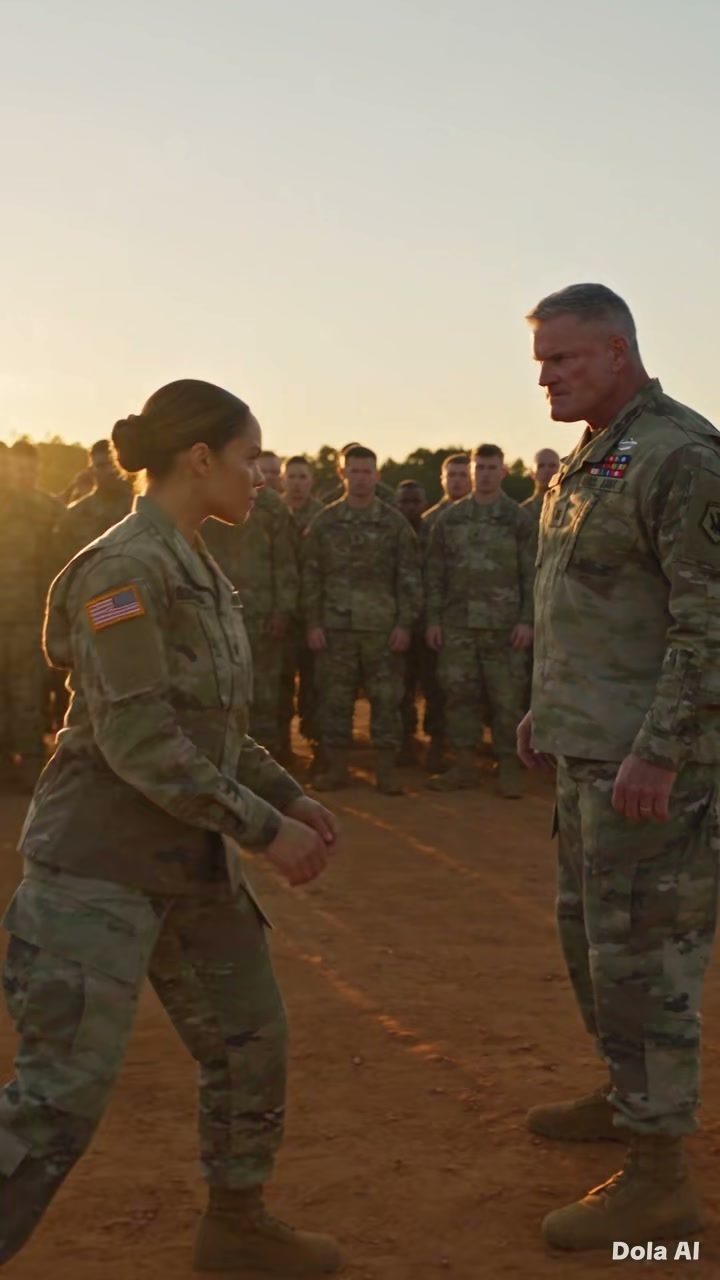
The moment Commander Jackson struck me across the face in front of a thousand American soldiers, I knew the next few seconds would determine far more than the outcome of a military training demonstration.
My name is Captain Aria, and I had survived three combat deployments in Afghanistan, years of elite military training, and enough dangerous situations to recognize when a man was about to make a terrible mistake.
Yet nothing in my career had prepared me for being deliberately humiliated by a fellow American officer beneath the blazing Georgia sun.
That morning, the training field at Fort Benning had looked like the setting for an ordinary joint military exercise.
Long formations of soldiers stood beneath a cloudless sky while instructors moved between equipment stations and senior officers gathered beneath temporary shade structures.
Heat shimmered above the packed dirt, turning the distant buildings into wavering shapes against the horizon.
The temperature had already climbed into the nineties, and sweat darkened the collars of nearly every uniform around me.
I stood at parade rest beside Lieutenant General Harper, trying to ignore the sunlight pressing against the back of my neck.
General Harper was among the most accomplished women I had ever encountered in uniform, and her presence carried the quiet authority of someone who had earned respect through decades of service.
She studied the enormous formation before turning toward me.
“Nervous, Captain?”
“No, ma’am.”
Her eyes narrowed slightly, not because she doubted my answer, but because she knew what I had been through to reach that field.
“You understand how many people are watching?”
“Yes, ma’am.”
“And you understand why this demonstration matters?”
I looked across the rows of soldiers.
Some were seasoned combat veterans, while others were young service members still learning what their bodies and minds could endure.
Every one of them had been taught that survival depended upon preparation, discipline, and the ability to respond under pressure.
Today, I was supposed to demonstrate that physical size did not always determine the outcome of a close-quarters confrontation.
“Yes, General.”
She nodded once.
“Then show them what you know.”
I had spent much of my life learning how to remain composed when someone wanted me frightened.
Long before I wore an officer’s uniform, I competed in mixed martial arts, spending countless hours practicing the exhausting fundamentals of balance, movement, timing, and control.
Inside a fighting ring, I learned that anger could become a weakness more quickly than fear.
A fighter who lost control of her emotions could lose track of distance, forget her training, and surrender the advantage she had worked so hard to create.
Later, during military deployments, those lessons acquired a more serious meaning.
There were places in Afghanistan where hesitation could endanger an entire team.
There were moments when the difference between surviving and becoming a casualty depended upon recognizing a threat before it fully developed.
And there were experiences I never discussed outside the company of people who had stood beside me.
I carried those lessons onto the training field that afternoon.
Colonel Brielle approached from the command area, her expression purposeful beneath the brim of her uniform cap.
She was an accomplished Air Force officer whose aviation career had made her a respected figure among the women gathered for the exercise.
“They’re ready for you, Captain.”
I straightened.
“Yes, ma’am.”
Brielle glanced toward the soldiers, then lowered her voice.
“Remember that this is more than a demonstration.”
“I understand.”
“Some people still need to see what competence looks like before they’ll believe it.”
I met her gaze.
“Then I’ll give them something worth learning.”
The corner of her mouth moved slightly.
“That’s what I expected.”
I stepped away from the officers and walked toward the open space at the center of the training formation.
My assigned partner was Staff Sergeant Rodriguez, an experienced instructor who understood both the techniques and the purpose of the presentation.
We had reviewed our sequence earlier that morning.
He would demonstrate controlled attacks, I would respond with defensive movements, and together we would explain how leverage and positioning could allow a smaller service member to escape a physically stronger opponent.
There was nothing unusual about the arrangement.
Military instruction depends upon predictability where safety is concerned.
An instructor may train students to respond to unexpected threats, but the demonstration itself must remain disciplined enough that everyone involved understands its boundaries.
I had barely reached the center of the field when I noticed Commander Jackson walking toward me.
His uniform was immaculate.
His posture was confident.
The decorations on his chest represented more than twenty years of service, including missions that had made his name familiar throughout special operations circles.
I knew his reputation before I ever met him.
He was a highly decorated Navy SEAL, admired for his operational experience and regarded by many younger soldiers as a living example of military excellence.
But I had also heard another side of his reputation.
He disliked being questioned.
He treated disagreement as disrespect.
And he appeared to believe his accomplishments entitled him to control any room he entered.
Jackson stopped several feet from me and turned toward the formation.
“Captain Aria, I volunteered to assist with today’s demonstration.”
I kept my expression neutral.
That was the first thing about the afternoon that felt wrong.
“Commander, I was scheduled to work with Staff Sergeant Rodriguez.”
Jackson smiled.
“I’m aware.”
He said those two words as though the schedule were a minor inconvenience beneath his attention.
I glanced toward the senior officers.
General Harper was watching closely, while General Wolfenbarger stood near the command group and appeared to be considering the unexpected substitution.
After a brief hesitation, Wolfenbarger gave a small approving nod.
I understood the decision, even if I did not particularly welcome it.
A decorated special operations officer participating in a joint exercise was not inherently inappropriate.
There was no reason a professional demonstration could not proceed safely if everyone respected its purpose.
“Very well, Commander.”
Jackson approached until only a few feet separated us.
His smile remained in place, but his voice dropped.
“I’ll go easy on you.”
I looked directly into his eyes.
“There’s no need for that.”
“Just follow my lead.”
“We have an established sequence.”
He tilted his head.
“You’re not worried, are you?”
“No, Commander.”
For a fraction of a second, something unpleasant passed across his face.
Then he turned away, raising his voice toward the watching soldiers.
“Looks like we’re going to have ourselves a little lesson.”
A few people laughed.
Most remained silent.
I could feel the difference between a crowd anticipating a professional demonstration and a crowd beginning to suspect that someone wanted a spectacle.
Among the observers, I recognized Colonel Rowan, a celebrated aerospace officer whose achievements had made her familiar throughout the services.
She stood beside other senior personnel, her attention fixed on Jackson.
I also spotted members of my own unit.
Several had deployed with me.
They knew how I moved when I was relaxed.
They also knew how I moved when I was assessing danger.
I turned toward the formation.
“Today’s demonstration focuses on surviving close-quarters attacks when a service member is at a physical disadvantage.”
My voice carried across the field.
“Physical strength matters, but distance, timing, positioning, and decision-making can matter just as much.”
Jackson began circling me.
His boots scraped against the dry ground.
I continued speaking.
“Our objective is not to prove who is stronger.”
Jackson stopped behind my right shoulder.
“That’s convenient.”
A few scattered laughs drifted from the formation.
I turned enough to keep him in view.
“Our objective is to demonstrate defensive control.”
He stepped closer.
“You hear that, everybody?”
His voice rose theatrically.
“Strength doesn’t matter.”
He smiled at the soldiers.
“Guess all those years of training were a waste.”
I could have challenged him publicly.
I could have reminded him that I had fought professionally before joining the military.
I could have recited my deployment history or pointed toward the distinguished officers who had personally reviewed my qualifications.
Instead, I remained focused on the demonstration.
“Commander, we’ll begin with the defensive sequence.”
He moved another step closer.
“You’re supposed to react to me, Captain.”
“I understand the demonstration.”
His smile vanished.
For the first time, I saw the man beneath the polished reputation.
He wasn’t interested in teaching the soldiers how to defend themselves.
He wanted to demonstrate that I was beneath him.
The realization made me more alert, not more frightened.
I adjusted my stance subtly, keeping my shoulders relaxed and my eyes on his upper body.
“Commander, let’s maintain the agreed training boundaries.”
His jaw tightened.
Then he raised his voice until it thundered across the field.
“DON’T FORGET I’M A NAVY SEAL!”
The shout was still echoing when his arm moved.
I saw the strike beginning, but the speed and unexpected timing left me only an instant to react.
His hand connected with the side of my face.
My head snapped sideways.
Pain flashed along my cheek.
A collective gasp swept through the formation.
Somewhere behind me, General Harper shouted something I couldn’t make out.
The world seemed to narrow into a circle of sunlight, dust, and the man standing before me.
Jackson lowered his arm.
For an instant, he looked satisfied.
I raised one hand toward the officers rushing forward.
Then I slowly turned my face back toward him.
I did not shout.
I did not threaten him.
I simply moved my feet into a balanced stance and watched his shoulders.
Because Commander Jackson had just crossed a boundary every experienced instructor on that field understood.
And the expression on his face told me he wasn’t finished.
He leaned forward, preparing to move again.
I recognized the change in his weight.
I recognized the tension in his shoulders.
Most importantly, I recognized the look in his eyes.
And when he suddenly lunged toward me, I knew the demonstration had become something else entirely.
✓ Lynn R. Adams
The moment Commander Jackson struck me across the face in front of a thousand American soldiers, I knew the next few seconds would determine far more than the outcome of a military training demonstrat…