Chapter 1: THE SMELL BENEATH THE PERFECT SKINS 251
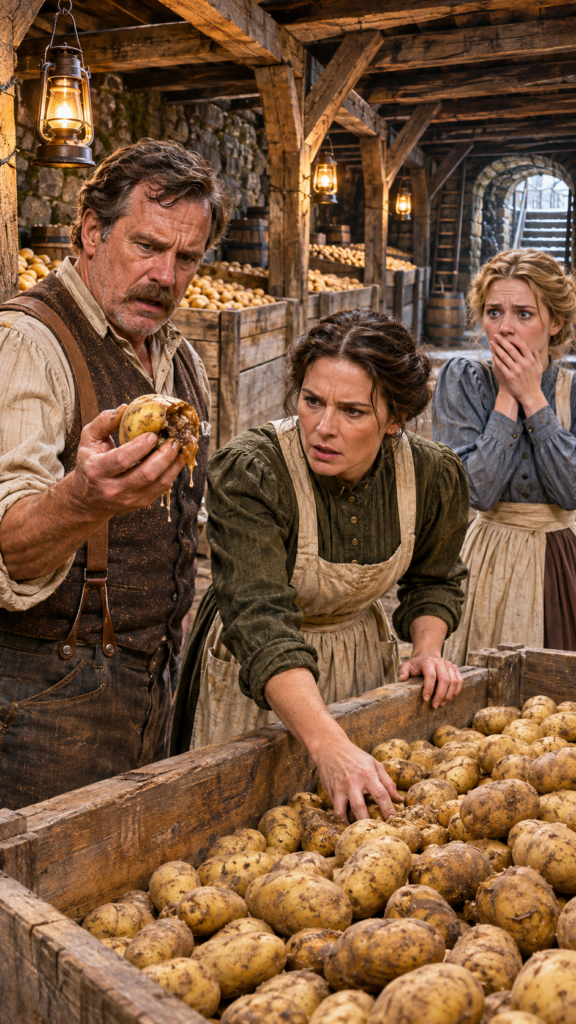
The first thing that warned me Nathan Cole was about to lose the finest potato harvest of his life was not something I saw, but a sour smell so faint that everyone else in his underground cellar kept working as though nothing had changed.
I was thirty-nine that autumn of 1905, old enough to know that farms rarely announced disaster with thunder or flames, because more often ruin arrived quietly, hiding beneath ordinary things until the damage had already begun.
Nathan Cole was forty-nine, broad-shouldered, stubborn, and respected throughout our part of Maine because he had spent nearly thirty years learning how to coax enormous potato crops from soil that froze hard enough each winter to split neglected boards.
He understood planting dates, rainfall, frost, insects, wagon loads, market prices, and the dark moods of Maine weather better than almost anyone I knew, which was exactly why he had become so confident about changing the one practice his father had never questioned.
That autumn Nathan had washed every potato before placing it into winter storage.
“No dirt means fewer problems,” he had proudly told his twenty-four-year-old daughter Evelyn when I first saw the clean potatoes stacked inside the bins.
Evelyn had smiled because the pale skins looked beautiful under the lantern light, and I could not deny that the crop appeared more impressive than the rough, earth-covered potatoes farmers usually stored after harvest.
By October, hundreds of bushels filled the long wooden bins beneath Cole Farm, and whenever Nathan lifted one for inspection, he seemed pleased by how clean, smooth, and marketable it looked.
The first wagonloads had impressed buyers, which strengthened his belief that he had discovered an improvement other farmers would eventually copy.
I had not argued with him then because a clean potato was not automatically a ruined potato, and I believed observation was more useful than criticizing a method before there was evidence against it.
Three weeks later, the evidence found us.
I was standing near the largest bin when that faint sour odor drifted through the cellar, and I stopped so abruptly that Evelyn almost walked into my shoulder.
“Do you smell that?”
Nathan looked up from a crate and shook his head as if I had imagined something.
I stepped closer to the largest pile, leaned over the rough boards, and breathed slowly through my nose until the smell reached me again.
It was weak, almost hidden beneath damp wood, earth, lantern smoke, and the natural smell of potatoes, yet there was something unmistakably wrong about it.
Nathan finally came beside me and frowned.
“Probably the cellar warming up,” he said.
He reached into the pile before I could answer and selected one of the cleanest potatoes near the top.
Its pale skin was smooth enough to make his point for him.
Nathan turned it under the lantern and almost smiled.
Then his thumb pressed into its side.
The potato collapsed.
Wet flesh burst beneath the apparently flawless skin, and a foul stream of soft, rotten tissue slipped between Nathan’s fingers.
For the first time since I had known him, Nathan Cole looked at one of his own potatoes as though it had betrayed him.
Evelyn stepped backward and covered her mouth.
“Father, what’s happening?” she whispered.
Nathan stared at the ruined potato and then toward the cellar doorway as though the temperature outside could explain everything.
“The cellar’s too warm,” he muttered.
I did not answer because I was already reaching beneath the clean upper layer.
The first potatoes I touched were cool.
A few inches farther down, my fingers found another potato that felt damp.
Then another.
I pulled them out one at a time and examined their skins beneath the lantern.
They looked dry.
They did not feel dry.
Nathan shook his head.
“They went in perfect.”
I pressed my thumb against a tiny scraped place nearly invisible on one potato.
“No,” I said.
His expression hardened because Nathan was accustomed to trusting what his eyes told him.
“These are the cleanest potatoes we’ve ever stored.”
“That may be exactly what changed.”
Evelyn looked from him to me.
I asked Nathan how long the crop had been allowed to dry after washing.
“Until they looked dry,” he replied.
That answer bothered me more than the rotten potato.
I turned toward Evelyn because she had helped keep the harvest records.
“Did every wagonload dry the same amount of time?”
Her hesitation told me the answer before she spoke.
“Some dried longer than others.”
Nathan dropped the rotten potato into an empty bucket and wiped his hand on an old cloth.
“We had hundreds of bushels coming in,” he said.
I understood his problem because harvest never waited for perfect schedules, and fields did not stop producing simply because workers were tired.
Still, the potatoes had been washed, handled, moved, dried unevenly, packed together, and buried under thousands more before anyone knew what remained trapped against their skins.
I picked up another apparently healthy potato and rotated it slowly beneath the lantern.
The washing had removed the dirt, but it had also made every scrape easier to see once I knew where to look.
Some injuries were so small they resembled harmless lines.
Others were barely more than roughened patches.
“What are you looking for?”
Evelyn asked.
“Places where the skin was damaged.”
Nathan crossed his arms.
“Those marks aren’t enough to ruin an entire bin.”
“Maybe not by themselves.”
I reached back into the pile and felt moisture again.
“But damaged skins, hidden moisture, and poor air together might be.”
Silence settled over us.
I could hear drops of water somewhere near the stone wall.
Nathan stared at the mountain of potatoes as though calculating how many dollars might be buried inside it.
“This crop is supposed to carry us through winter,” he said quietly.
I knew what he meant because a harvest was not merely food or produce, but wages, seed money, repairs, debts, winter supplies, and the promise that another spring could begin without desperation.
I reached farther into the bin until the potatoes pressed tightly against my forearm.
The deeper I went, the warmer the air between them seemed.
I withdrew my arm.
“Nathan, we need to open this pile.”
His eyes narrowed.
“How much?”
“Enough to learn whether we’re looking at a few damaged potatoes or something spreading underneath.”
He stared at the clean surface, still reluctant to disturb something that appeared so perfect.
Evelyn moved beside him.
“Father, we already know one collapsed.”
Nathan looked toward the bucket where the rotten potato lay.
Then another faint wave of sour odor drifted from somewhere deeper inside the bin.
This time all three of us smelled it.
Nathan’s face changed.
He grabbed a wooden scoop, pulled the first layer aside, and exposed potatoes that had never seen lantern light since the day they entered storage.
The top ones still looked beautiful.
The next layer did too.
Then I saw moisture shining between two potatoes farther down.
I reached toward them.
My fingers touched one.
The skin shifted beneath my thumb.
I looked at Nathan.
“Don’t move anything else.”
Evelyn whispered my name.
I slowly lifted the potato into the lantern light, and although its upper half looked as clean as everything Nathan had proudly stored, the underside was soft enough that my fingers had already begun sinking into it.
That was when I understood the first terrible truth about Nathan Cole’s experiment.
The cleanest potatoes in Maine could be rotting where no one could see them.
And we still had no idea how deep the damage went.
✓ Lynn R. Adams
The first thing that warned me Nathan Cole was about to lose the finest potato harvest of his life was not something I saw, but a sour smell so faint that everyone else in his underground cellar kept …