Chapter 1: The Silence That Terrified Me 246
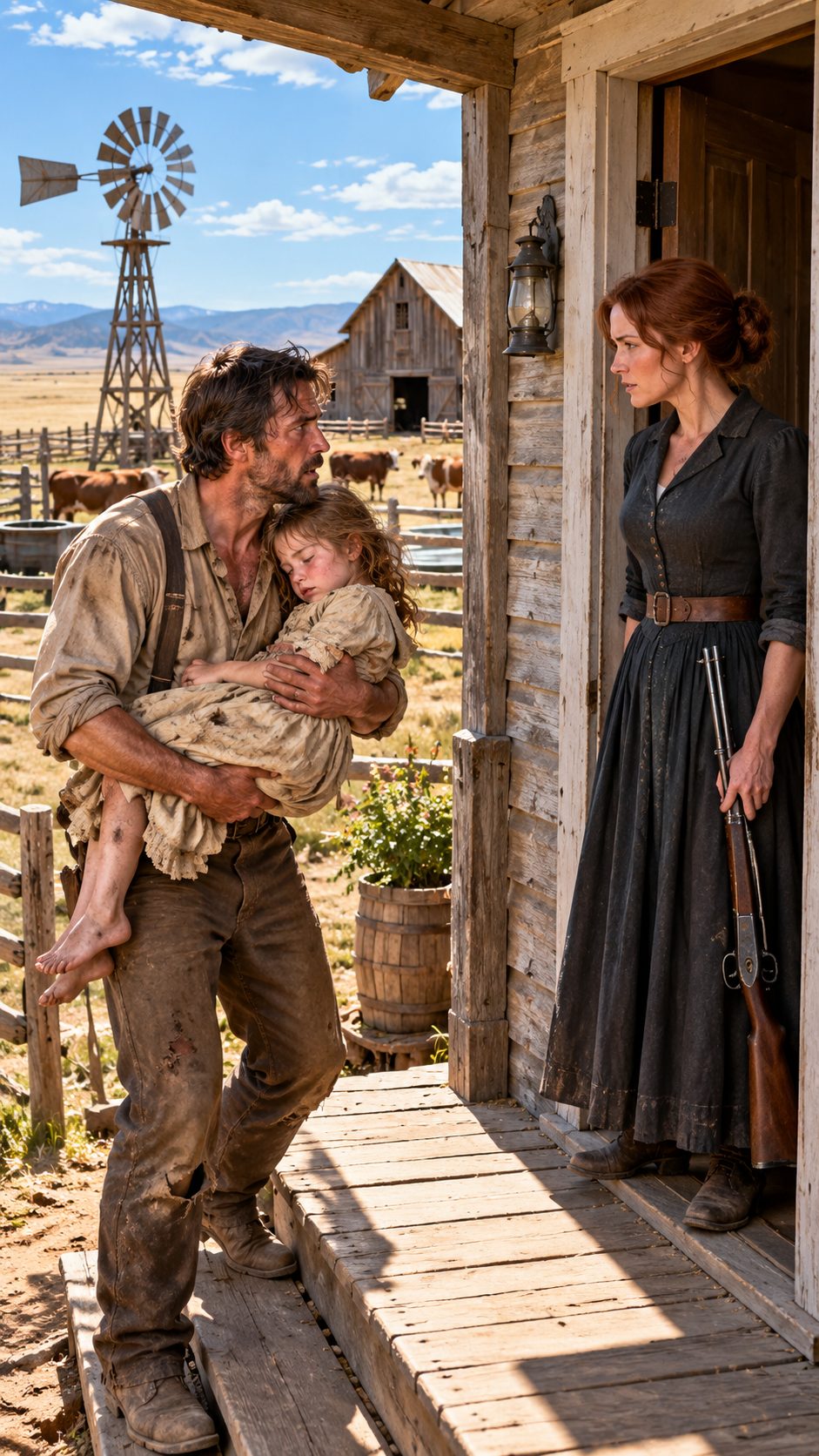
The most frightening sound I had ever heard was not the crack of a rifle, the scream of a wounded animal, or the winter wind tearing boards from a Wyoming barn, but the absolute silence of my four-year-old daughter in my arms beneath the punishing August sun of 1888.
Lydia had always talked about everything she saw, from clouds shaped like rabbits to stones that resembled frogs, and during better days she could ask more questions before breakfast than most grown men managed in an entire afternoon.
“Daddy, can Mama see us from heaven?”
“Daddy, when we have another cow, can I name her Star?”
“Daddy, are we always going to stay together?”
I would have given everything I had ever owned to hear any one of those questions again as I stumbled across the prairie with her feverish body pressed against my chest.
“Stay with me, sweetheart.”
She did not answer.
I lowered my cheek against her damp hair and felt heat rising from her skin, while each shallow breath she took seemed weaker than the one before it.
I had been walking since before sunrise, and every mile had driven another nail through my boots, my legs, and what remained of my strength, yet stopping felt impossible because I had already watched too many things I loved disappear while I stood helplessly beside them.
A year earlier, I had owned eighty acres, a modest herd of cattle, a weather-beaten house, and enough confidence to believe that a man willing to work from darkness to darkness could protect his family from almost anything.
Then my wife died during the winter, and for the first time I learned that strength meant very little when the person you loved most stopped breathing.
Rebecca had been the one who could calm Lydia after nightmares, remember where I had left my tools, laugh when bread burned, and somehow make our small house feel warmer even when the January wind came through the cracks.
After she was gone, I tried to become both parents without admitting how badly I was failing at either role.
Then the season turned against us.
Disease moved through my cattle, feed became harder to afford, debts multiplied, and every desperate decision I made to save the ranch seemed to push it one step closer to the bank.
By spring, the eighty acres Rebecca and I had fought to build our future on belonged to someone else.
By summer, nearly everything we owned could fit into what I could carry.
I had lost more than thirty pounds in four months, and men who once knew me as a broad-shouldered rancher now looked twice before recognizing the hollow-cheeked stranger standing in front of them.
None of that frightened me as much as Lydia’s fever.
Six weeks before that brutal August day, I had spent my final dollars on a doctor who listened to her chest, examined her eyes, and finally gave me an answer that had followed me into every sleepless night afterward.
“She is fighting something serious, Mr.
Hale, and whether she wins will depend on how strong her body remains.”
I had asked what she needed.
“Good food, milk, rest, clean water, and time.”
Those sounded like simple things until a man had no money.
I could build a fence in frozen ground, lift a broken wagon tongue alone, rope cattle in a storm, and work until my hands bled through gloves, yet I could not create milk from an empty cup or put nourishing food on a table I no longer owned.
In the last town we passed through, I had gone from store to stable asking whether anyone needed a ranch hand, and three separate men gave me the same answer.
“The Cross Ranch.”
The property belonged to a widow named Eleanor Cross, whose husband had died six years earlier and who had somehow kept the land productive without turning its management over to any man.
One fellow warned me that she expected competence, hated excuses, and disliked unexpected strangers appearing at her door.
“Don’t show up without warning unless you’re desperate.”
I looked at Lydia sleeping weakly against my coat.
That afternoon, with the Wyoming sun pressing down like a hand against my skull, my legs began trembling badly enough that I wondered whether I would collapse before finding the ranch.
Then I climbed a low rise and saw a windmill turning slowly against the hard blue sky.
For several seconds I simply stood there.
Beneath the windmill stretched fenced pasture, a barn with repaired boards, a farmhouse, water troughs, and cattle moving lazily through grass baked pale by the summer heat.
The place did not look wealthy.
It looked cared for.
That difference mattered to me.
“A little farther, Lydia.”
Her head shifted against my shoulder, but she did not wake.
I tightened my arms around her and started downhill.
With every step, the windmill seemed to grow taller, and the farmhouse became something larger than a building because I had placed all my remaining hope inside a door I had never seen and a woman who had no reason to open it.
By the time I reached the final stretch of dirt leading toward the porch, sweat ran into my eyes, my shirt clung to my back, and my knees felt loose beneath me.
I nearly called out.
Before I could, the farmhouse door opened.
A tall woman appeared with a rifle resting comfortably along one side of her body.
She was perhaps thirty-five, with reddish-brown hair pinned practically behind her head, a plain dark work dress, and hazel eyes that moved over me with the swift, calculating attention of someone accustomed to judging trouble before allowing it through her door.
She looked at my boots.
Then my face.
Then Lydia.
Everything about her changed.
“What’s wrong with the child?”
Her voice held no sweetness, but it held something far more useful.
“How long?”
“Eleven days.”
Her eyes sharpened.
“Has she had anything to drink?”
“Very little.”
My throat tightened because answering that question felt like confessing a crime.
“Yesterday morning.”
For one terrible moment, Eleanor Cross stood motionless in the doorway.
I imagined her telling me to move along.
I imagined walking another mile.
I imagined Lydia’s breathing becoming quieter until there was nothing left to hear.
Then Eleanor leaned the rifle against the wall inside the house and opened the door wide.
“Bring her inside, now.”
I crossed the porch so quickly my knee struck the frame, but I barely felt it as Eleanor cleared a place near the stove and ordered me to sit Lydia down where she could examine her.
The kitchen was simple and spotless, with a heavy wooden table, shelves of crockery, an iron stove, and a broad window overlooking the barn.
I lowered Lydia into a chair, but she weakly clutched my shirt.
That single word nearly brought me to my knees.
“I’m right here.”
Eleanor already had a pan over the stove.
“What are you doing?”
“Warming milk.”
“I don’t have money.”
She did not turn around.
“I didn’t ask whether you did.”
There was something in the way she said it that stopped every apology in my mouth.
She returned with a cup, crouched beside Lydia, and held it carefully while my daughter took one weak swallow, then another.
I watched Eleanor tip the cup gently, patient enough to wait between each sip, and the sight of a stranger giving my child what I had been unable to provide made shame and relief rise together inside me.
“Thank you.”
She touched Lydia’s forehead, then looked up at me.
“Your name?”
“Garrick Hale.”
“And hers?”
“What did you come here looking for, Garrick Hale?”
I swallowed.
She studied my hands.
“What kind?”
“Anything a ranch needs.”
“You know cattle?”
“I owned cattle.”
Her eyes narrowed slightly.
“Eighty acres and fifty-two head before things went bad.”
“What happened?”
I looked at Lydia.
“My wife died last winter.”
Eleanor’s expression softened by the smallest degree.
“I’m sorry.”
“Then disease hit the herd, I borrowed money to keep the place running, and I couldn’t repay it.”
“The bank took your land?”
“Your wife’s people?”
The bitterness came out before I could stop it.
“They didn’t want us.”
Eleanor did not ask why.
She simply gave Lydia another careful sip and then looked at me for a long moment as though weighing something far more complicated than whether I could repair fences.
Finally, she stood and glanced toward the window.
“There is work here.”
Hope struck so hard that I almost did not understand her.
“Fences, cattle, repairs, barn work, and more things than I have hands for.”
“I can do all of it.”
“You don’t know what all of it is yet.”
“I’ll learn anything I don’t know.”
She watched me.
“You’ll have a room, wages, and meals.”
I stared at her.
“You’re hiring me?”
“If you’re still here tomorrow morning and willing to work, yes.”
“I’ll work harder than any man you’ve ever hired.”
“Don’t promise what you haven’t proved.”
I nodded because even that sounded like mercy.
For the first time since Rebecca died, I felt something dangerous enough to hurt.
Then Eleanor turned toward the window overlooking the barn, placed both hands against the sill, and remained there longer than made sense.
Something about her posture unsettled me.
She did not turn.
“There is something else.”
The small hope inside me tightened.
“The job, room, wages, and food do not depend on what I’m about to say.”
“Then what does?”
Eleanor finally faced me.
For the first time since I had seen her standing in the doorway with a rifle, she looked uncertain.
Her eyes moved toward Lydia.
Then back to me.
“Your answer.”
I felt my stomach tighten.
“What answer?”
Eleanor drew in a slow breath, and I realized that whatever came next frightened the strongest woman I had met in years.
✓ Lynn R. Adams
The most frightening sound I had ever heard was not the crack of a rifle, the scream of a wounded animal, or the winter wind tearing boards from a Wyoming barn, but the absolute silence of my four-yea…