Chapter 1: The Roof Everyone Mocked 251
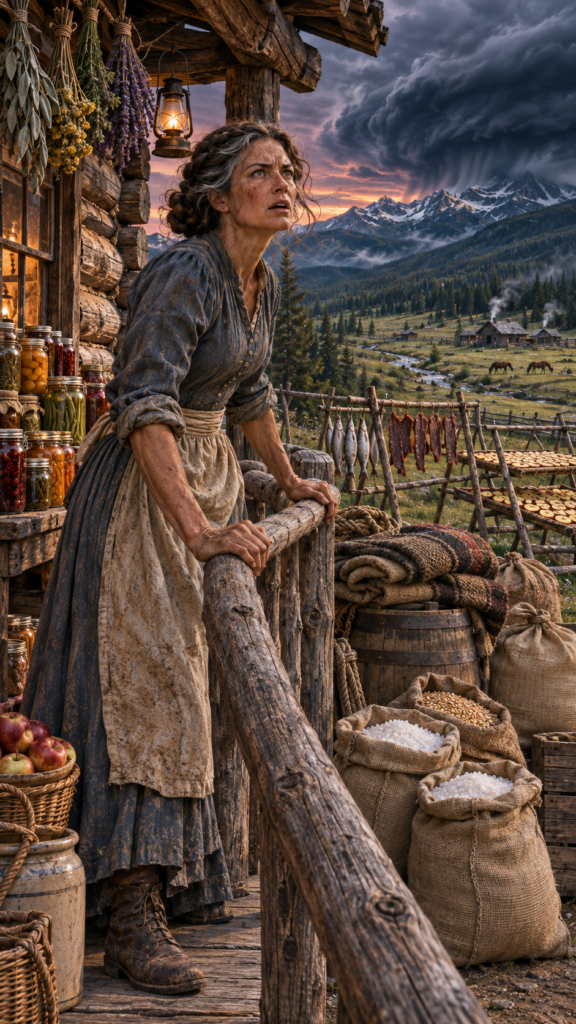
The first apple slice had barely touched the canvas when a man’s laughter rolled up from Ashaow Valley and told me the whole town had already decided I was mad.
I did not look toward the general store, because I knew exactly what I would see if I turned my head.
Men would be standing beneath the awning with their hats pushed back, pointing toward my cabin on the ridge as if I had become the morning’s entertainment.
The June sun had just cleared the mountains, and warm light spilled across my roof while I knelt beside a wooden bowl filled with thin pale-gold apple slices.
I spread each piece carefully across the canvas, leaving enough space between them for the dry mountain air to move.
One slice became ten, ten became fifty, and before breakfast the western half of my roof shimmered with fruit.
“Grief has finally driven that woman insane!”
The voice belonged to one of the ranchers who spent more time discussing other people’s affairs than tending his own fences.
A burst of laughter followed.
“Would you look at that!”
“Apples on a roof!”
“Who dries food in June?”
Another man called up that perhaps I was feeding ghosts.
Their voices traveled cleanly through the valley because the morning was still, and every word reached me as clearly as if they had been standing beside my ladder.
I lifted another apple slice and laid it down.
Samuel had once told me that people laughed hardest at things they were afraid to understand.
My husband had been gone almost four years by then, and my children had been gone nearly as long, yet some mornings I still expected to hear Samuel’s boots crossing the floor behind me.
The silence afterward was always the hardest part.
Ashaow Valley believed that silence had damaged me.
Perhaps it had.
Grief had hollowed places inside me that no neighbor could see, but it had also burned away the foolish certainty that tomorrow would always resemble today.
I had learned what cold could do.
I had learned what hunger could do.
More importantly, I had learned that catastrophe rarely announced itself when people still had time to prepare.
By the time hunger showed itself on a child’s face, the real mistake had often been made months earlier.
I reached for another slice.
The backs of my hands were crossed with pale scars from knives, tools, fire, frost, broken wire, and years of work that nobody considered remarkable because women were expected to endure without calling endurance a skill.
I knew how long meat could hang before spoilage.
I knew how much salt a barrel of fish required.
I knew which roots survived longest in sand and which herbs lost their strength if dried in direct sun.
Most importantly, I knew exactly how much food one person consumed when winter closed every road and turned the mountains into walls.
The men below knew cattle prices.
I knew empty cupboards.
That was why I kept working.
By noon, the canvas was nearly covered.
I climbed down, sliced another basket of apples beneath the porch awning, and returned to the roof while the valley shimmered beneath the summer heat.
I could see the general store from my ridge.
Hollis stood outside with his sleeves rolled up, listening while another man pointed toward me.
Even from that distance, I recognized the shape of Mr.
Hollis’s grin.
I did not hate them for laughing.
Hatred consumed energy, and energy was another thing I had learned not to waste.
I carried the empty bowl downstairs when the sun began sinking, turned the slices one by one, and examined the edges for trapped moisture.
The first day’s work looked almost absurdly small compared with what I intended to accomplish.
There would be more apples.
There would be venison, fish, beans, tomatoes, herbs, roots, smoked meat, and anything else the valley offered before frost.
There would be jars.
There would be sacks.
There would be lists.
There would be no guessing.
That evening I sat at my wooden table with an oil lamp burning beside me and opened Samuel’s old ledger.
Most of its original pages had once contained purchases, feed calculations, and repairs, but the final pages belonged to me now.
I wrote the date.
Then I wrote the number of pounds of apples I had prepared.
Beneath that, I calculated how much remained after drying.
The result disappointed me.
Fresh fruit lied about abundance because most of its weight disappeared with water.
I stared at the number and remembered another winter, another table, and the dreadful arithmetic of trying to divide too little food into portions that still looked respectable.
I closed my eyes.
I could almost hear a spoon scraping an empty bowl.
My throat tightened.
I opened my eyes again and doubled the number of apples I intended to dry.
The following morning I was on the roof before sunrise.
The laughter returned by midmorning.
For the next week, it became part of the weather.
Sometimes the men shouted jokes.
Sometimes women passing on the road slowed their wagons and stared.
Children occasionally pointed.
I answered none of them.
By the middle of June, the first dried apples were leathery, sweet, light, and ready for storage.
I packed them into clean containers and moved the first batch to shelves inside the cabin.
Then I began again.
The roof was only the beginning.
I built narrow drying racks between the pines where afternoon wind moved constantly.
I stretched protective cloth above them.
I repaired an old smoking pit.
I inspected every jar I owned and discarded anything with chipped glass or questionable seals.
When supplies ran short, I bartered.
When I could not barter, I paid.
When money became tight, I cut everything that did not directly support survival.
Sugar became unnecessary.
Coffee became a luxury.
New fabric could wait.
Salt could not.
Lamp oil could not.
Sharp knives could not.
Strong cord could not.
One afternoon, after spending hours gutting fish beneath the eaves, I heard wagon wheels on the road below.
Two men had stopped where they could see my drying racks.
One leaned toward the other.
“She’s worse than we thought.”
His companion laughed.
I kept cleaning the fish.
The knife slid down the belly exactly where I intended.
I removed what would spoil.
I rinsed what would keep.
I salted the flesh carefully.
The men eventually drove away.
By July, my homestead no longer looked like the quiet widow’s place the valley remembered.
Venison hung beneath stretched cloth.
Fish dried beneath the eaves.
Bundles of herbs swung from porch beams.
Tomatoes rested on mesh screens.
Beans filled jars.
Roots disappeared beneath the floor in layers of clean sand.
Smoke drifted steadily from the covered pit.
Everywhere I looked, something was drying, curing, sealing, cooling, or waiting to be counted.
Every evening, I weighed what I had preserved.
Every night, I recorded it.
Every few days, I recalculated.
The numbers never felt large enough.
One night, I sat beside the oil lamp long after midnight while moths fluttered against the glass.
I added the figures three times.
The amount should have comforted me.
Instead, an old memory returned so sharply that my hand stopped moving.
There had been a winter when snow covered the roads for weeks.
I remembered frozen water inside the house.
I remembered smoke hanging low because the chimney could not draw properly.
I remembered hunger turning every conversation into an argument about portions.
I remembered looking toward the mountains and waiting for weather that refused to change.
Ashaow Valley remembered that winter as unpleasant.
I remembered it as a warning.
I lowered my pencil.
Outside, the night was warm.
Crickets sounded in the grass.
The creek moved peacefully in the darkness.
Nothing suggested danger.
That was precisely what frightened me.
I turned to a fresh page and wrote two words across the top.
The next morning, I hitched the wagon and headed toward the general store.
Hollis watched me enter.
I walked straight to the counter.
“Three sacks of salt,” I said.
His eyebrows rose.
He glanced toward the men near the door.
“You opening a mine?”
“A fishery?”
His grin widened as several men listened.
“Planning to preserve the whole mountain?”
I placed my coins on the counter.
Something in my voice made him stop smiling.
He counted the money.
Then he studied me more carefully than he had all summer.
“What are you planning for, Martha?”
I could have told him.
I could have spoken about winters the valley preferred to forget.
I could have explained what hunger looked like when pride finally disappeared.
Instead, I picked up the first sack.
He gave a short laugh.
“We get one every year.”
I looked directly at him.
“That doesn’t mean they’re all the same.”
For the first time, Mr.
Hollis had no joke ready.
I loaded the salt into my wagon.
Then I added lamp oil.
As I drove back toward the ridge, clouds rested harmlessly over the distant mountains.
The day was warm.
The valley was green.
Children ran near the creek.
Men worked without urgency.
Everything looked safe.
I should have felt foolish.
Instead, the closer I came to my cabin, the stronger the old uneasiness became.
That night I opened my ledger again.
I counted what I had.
Then I counted what an entire winter could take.
For the first time since beginning my preparations, I realized I was not calculating for myself alone.
✓ Lynn R. Adams
The first apple slice had barely touched the canvas when a man’s laughter rolled up from Ashaow Valley and told me the whole town had already decided I was mad. I did not look toward the general stor…