Chapter 1: The Question Beneath the Applause.037
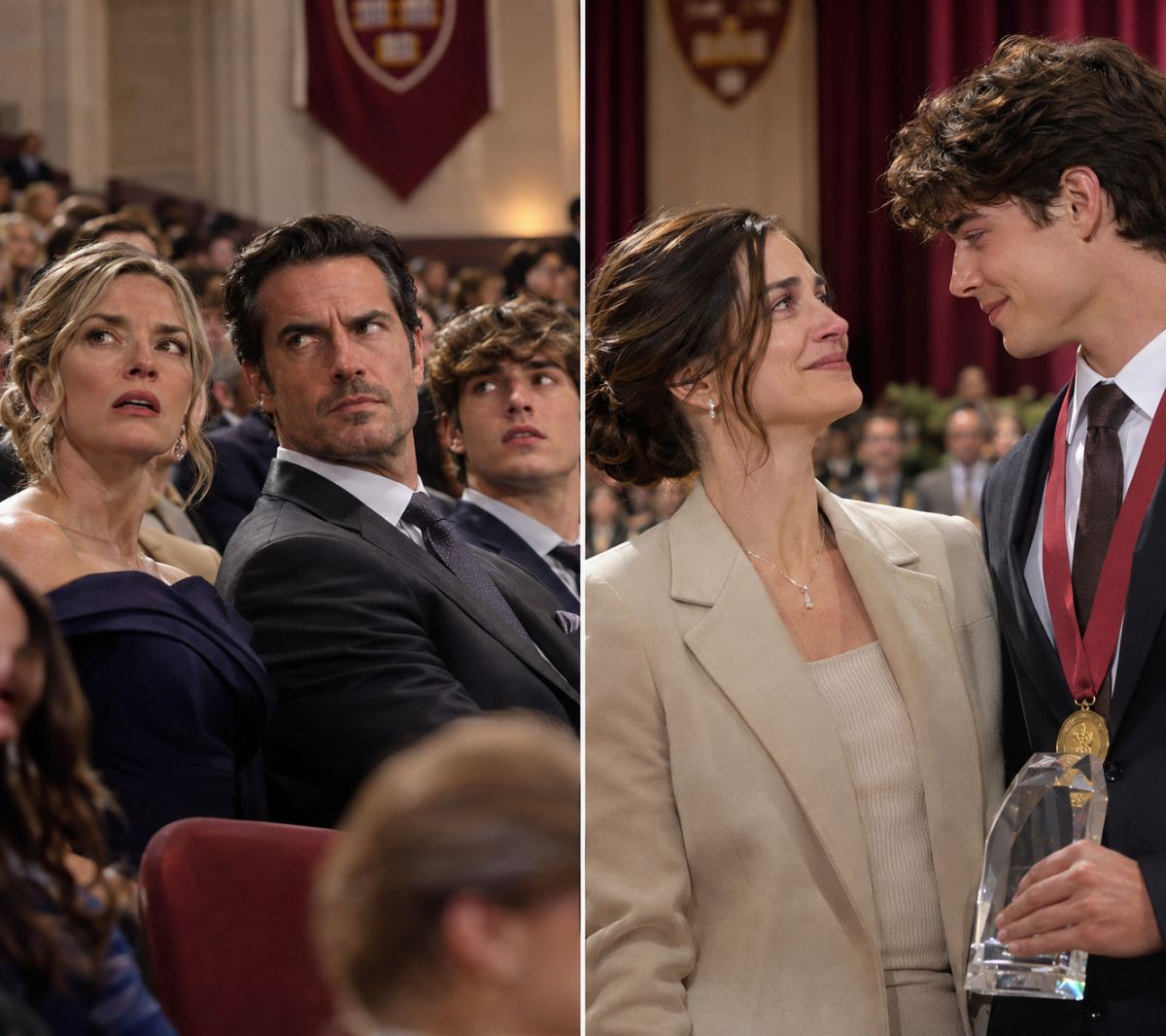
Vincent Moretti recognized his own eyes in my son just as a stranger handed me a microphone and asked where my husband was.
For eighteen years, I had imagined meeting Vincent again in a place where I could walk away.
Instead, I stood on a Harvard stage beside Noah, and hundreds of people were waiting for my answer.
The host smiled, unaware that her harmless question had opened the oldest wound in my life.
“Was your husband able to help you raise such an extraordinary young man?”
Noah’s fingers tightened around mine.
He had just received an academic honor reserved for incoming students whose assessment results astonished even the faculty.
His jacket was freshly pressed, but the cuffs were a little short, because he had grown again since I bought it.
I had ironed that jacket twice in our hotel room, although he kept insisting the wrinkles would not matter.
Now the boy who had solved equations on grocery receipts waited beside me, looking suddenly very young.
I looked toward the third row.
Vincent sat there with silver at his temples, his hands gripping his knees as though the floor had moved.
Beside him, Sophia Reynolds had gone white beneath her perfect makeup.
Ethan, the son they had raised together, looked from Vincent to Noah with a confusion I understood too well.
Eighteen years earlier, I had been Claire Moretti, married to a man whose quietest words could terrify an entire Chicago room.
I had loved him despite the doors that closed when I approached and the conversations that stopped when he entered.
Our home had felt safe until I learned it was also a place where lies could live comfortably.
Sophia had been one lie.
Ethan had been the truth behind it, a child Vincent had already welcomed into a life I thought belonged to us.
When I confronted him, he did not deny that other family existed.
That failure to deny it hurt more than anything he might have said.
I asked for a divorce, packed a suitcase, and left before I could change my mind.
I was pregnant, although I had not yet found the courage to tell him.
Afterward, pride and fear hardened into a decision: Noah would not grow up standing outside his father’s second home, hoping to be invited inside.
I gave him my maiden name, Bennett, and built the life I could afford.
I never told Noah that I sometimes searched Chicago news for Vincent’s name, then closed the pages before the photographs loaded.
I was not waiting for him to rescue us.
I wanted to know that the man I had once loved was still somewhere in the world, and I hated myself for wanting even that.
Every search ended with the same decision: close the screen, turn toward my son, and keep going.
There were nights when I divided a bag of rice into portions and told Noah I had eaten earlier.
He always noticed.
Once, when he was nine, he silently pushed half his dinner across the table and opened his mathematics workbook as though nothing had happened.
I learned to take extra shifts, mend the elbows of his shirts, and make our little kitchen feel like enough.
Noah learned to read before I had saved enough for the books he wanted.
When his teachers called him gifted, I thought of him checking whether the heat was working before he sat down to study.
He was not remarkable because of Harvard; he had been remarkable when nobody outside our apartment knew his name.
Then came the afternoon he stared at his laptop without moving.
“Mom,” he whispered, and I feared the worst.
When he turned the screen toward me, the word HARVARD filled the room like sunlight.
We held each other until we were both laughing through tears.
That acceptance brought us to this symposium, where Noah had walked onstage and spoken about persistence.
“Success isn’t just intelligence,” he told the audience.
“It’s keeping going when nobody’s watching.”
Then he had searched the crowd until he found me.
“There’s someone who deserves to be up here with me.
Mom, come up here.”
I had risen to applause and met Vincent’s eyes for the first time since Chicago.
He looked from my face to Noah’s, tracing the dark hair, the jaw, and a familiar expression of concentration.
I could almost see him doing the arithmetic.
Eighteen years.
Back onstage, the host waited with the microphone extended.
I could answer with a polite lie, spare Noah a public embarrassment, and leave the building before Vincent reached us.
But lying would turn all our quiet years into something shameful, and they had never been that.
I took the microphone carefully.
“No,” I said.
“His father wasn’t there to help raise him.”
A rustle moved through the seats, then faded.
“But Noah has never been a child without love, and I refuse to speak of our life as if it were a tragedy.”
I looked at my son, who was watching me rather than the audience.
“He worked for every opportunity he earned, and I was lucky enough to be there to watch.”
Noah reached for my hand again.
The host lowered her gaze, realizing too late that she had asked the wrong question.
We left the stage to another wave of applause, but I hardly heard it.
At the foot of the steps, Vincent was waiting, Sophia a few paces behind him.
He said my name the way he had spoken it on the last morning of our marriage.
I moved between him and Noah before I realized what I was doing.
Vincent looked past my shoulder, his face stripped of the certainty that had once made him dangerous.
“Tell me the truth,” he said, loud enough for Noah to hear.
“Is that boy my son?”
✓ Lynn R. Adams
Vincent Moretti recognized his own eyes in my son just as a stranger handed me a microphone and asked where my husband was. For eighteen years, I had imagined meeting Vincent again in a place where I…