Chapter 1: THE MORNING TWO HUNDRED WARRIORS SURROUNDED MY CABIN 245
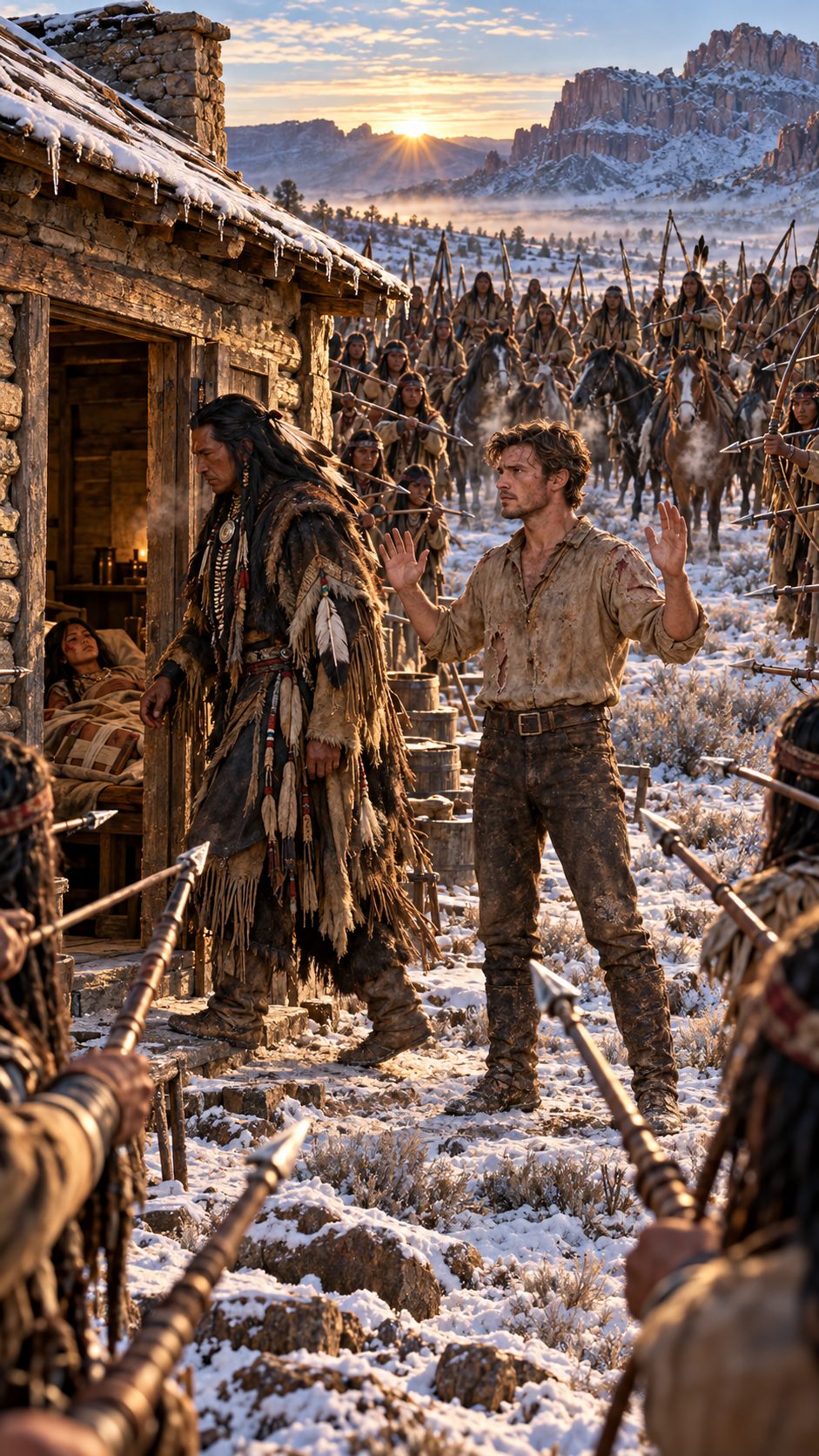
Two hundred bows were pointed at my chest before I understood that the frozen Arizona dawn had become the most dangerous morning of my life.
I stepped outside my lonely cabin with an empty tin cup in one hand, intending to collect water from the well, when I noticed something unusual moving beyond the fence.
At first, I thought the shapes belonged to horses grazing in the distance, but then the morning light caught the metal and polished wood of weapons carried by mounted men.
I stopped walking.
More riders appeared behind the first group, spreading across the open ground until there was nowhere I could look without seeing another Apache warrior.
Then I saw the arrows.
Every bow was drawn, every sharpened arrowhead was directed toward me, and every man holding a weapon seemed to be waiting for the same mistake.
I slowly placed the tin cup on the ground and raised both hands.
Nobody shouted.
Nobody threatened me.
Nobody charged across the desert.
The silence was worse than anything I had imagined because I understood that these men had not come to frighten me away.
They had come looking for someone.
Then the circle of warriors opened, and a powerful chief dismounted from a black stallion.
He walked toward me with a steady expression, his dark eyes fixed on my face, while the men behind him maintained their aim.
“My daughter,” he said.
“Where is she?”
I swallowed.
“On my bed.”
“Both her legs are broken, and I made wooden splints to keep them from moving.”
The chief’s expression hardened.
“White man lies.”
“Then go inside and see for yourself.”
He stared at me for several seconds before glancing toward the cabin door.
I had no idea whether he believed me, but I knew that the next few minutes would determine whether I lived long enough to explain anything else.
To understand why that chief found his daughter in my cabin, I have to explain what happened during the twenty-four hours before his arrival.
For five years, I had lived alone beyond the final fences of settled country, where the desert stretched toward the mountains and the nearest trading post was far enough away that visiting it felt like a journey.
My name was Wade Callaway, and I was twenty-seven years old.
I owned a rough wooden cabin, one horse, a well, a few tools, and enough supplies to survive as long as I worked hard.
The cabin had two small windows, a stone fireplace, a narrow bed, and a table I had built myself from timber left over after construction.
Most mornings began with the same routine of feeding my horse, checking the well, cutting wood, and repairing whatever the desert weather had damaged during the night.
I rarely spoke to anyone.
I rarely visited the trading post.
And I had stopped expecting company long before I understood how completely loneliness could change a man’s life.
Once, however, I had not been alone.
Once, I had Sarah.
She was twenty-two when she died, and for a while I had believed that loving her would be enough to make any place in the world feel like home.
She had bright eyes, a gentle voice, and a habit of humming while she worked around the house.
She could turn an ordinary morning into something worth remembering simply by placing two cups of coffee beside the window and asking me how I had slept.
Five years earlier, I had ridden two miles south to inspect a damaged fence, expecting to return before the afternoon became too hot.
I had been gone less than three hours.
When I returned, my home was burning.
The roof had collapsed, smoke rolled into the sky, and flames consumed the walls where Sarah and I had spent our happiest days.
Her blue shawl hung from a fence post, fluttering in the hot wind as though she were still standing there, waiting for me to come home.
I called her name until my throat hurt.
I tried to approach the doorway, but the heat drove me backward, and eventually I had to accept that there was nothing I could do.
At the trading post, everyone gave me the same explanation.
Apache raid.
They told me that Apache warriors had attacked while I was away and that Sarah had died in the fire.
I believed them because grief needed someone to blame, and hatred seemed easier to carry than the helplessness of losing the person I loved.
There was one detail I had never forgotten, though.
Bootprints.
Not moccasin tracks.
Heavy bootprints with military-shaped heels had crossed the burned yard, leading toward the cabin and then away from it.
I had noticed them immediately after discovering the fire, but before I could examine them carefully, a neighbor arrived shouting about Apache raiders.
His certainty had been so strong that I stopped questioning what I had seen.
For five years, I buried those bootprints beneath anger and loneliness.
I convinced myself that remembering Sarah meant remembering the people I believed had taken her from me.
Then, yesterday, something happened that forced me to confront the past in a way I had never expected.
I was riding toward the eastern canyon, searching the dry washes for water, when I noticed an eagle circling unusually low above the rocky slopes.
I slowed my horse and watched the bird make another wide turn.
Something about its behavior bothered me, although I could not explain why.
The wind carried dust across the canyon entrance, and the ground looked different from the way I remembered it.
I followed the eagle toward the rocks.
That was when I noticed the fresh collapse along the cliff.
And among the broken stones, I saw something that made my heart stop.
A piece of fabric.
Then a hand.
✓ Lynn R. Adams
Two hundred bows were pointed at my chest before I understood that the frozen Arizona dawn had become the most dangerous morning of my life. I stepped outside my lonely cabin with an empty tin cup in…