Chapter 1: THE MORNING I COULD NO LONGER LOOK AWAY 246
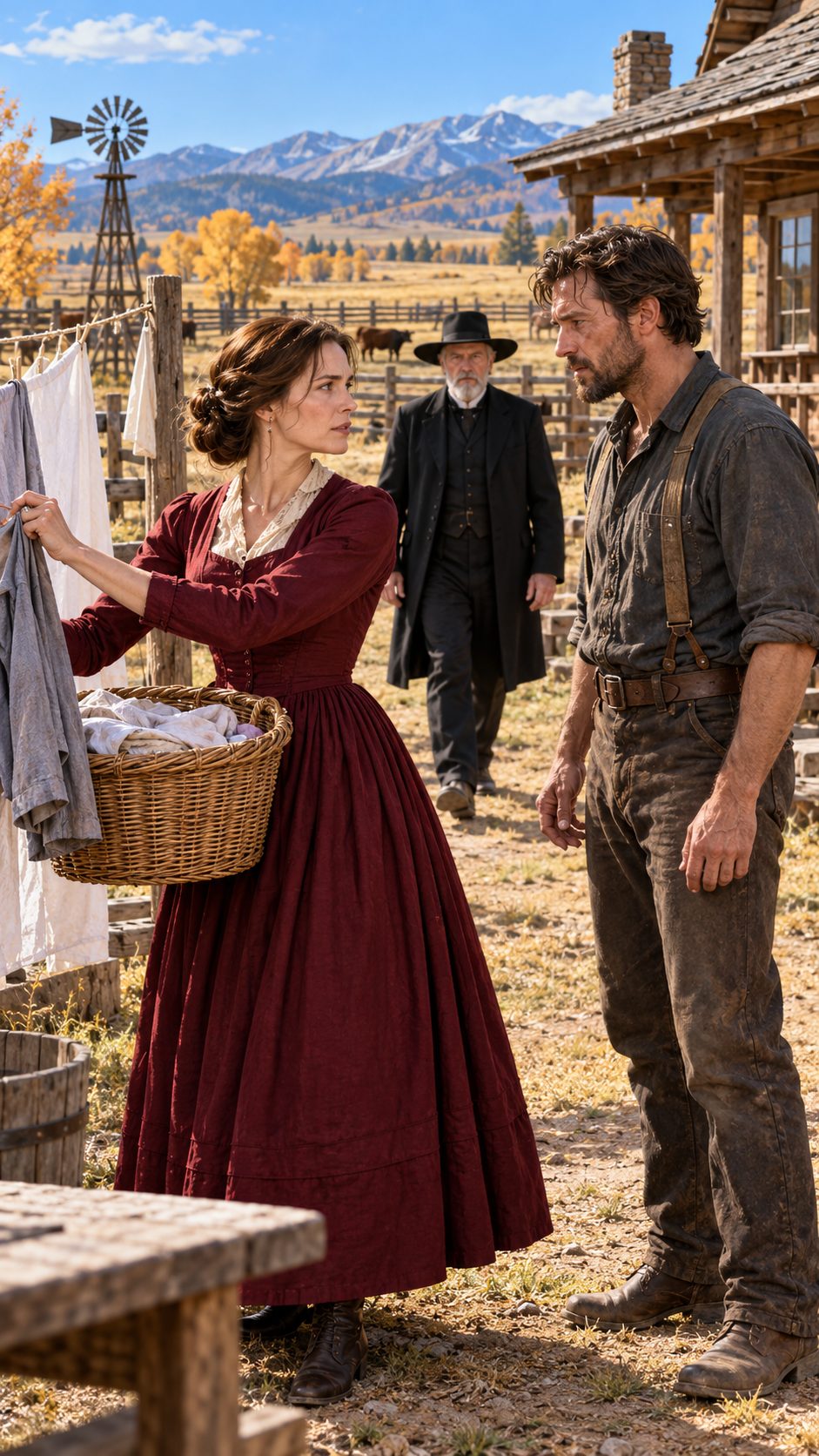
For four months, I watched the Turner ranch slowly fall apart from the safe side of my fence, and every morning I found a new reason to tell myself that Caleb Turner’s grief was private and that entering another person’s sorrow without invitation could do more harm than good.
Then, on a cold Wyoming morning in the autumn of 1888, I saw four-year-old Tommy Turner kneeling barefoot beside the pig trough with both hands submerged in filthy water.
At first, I thought he had dropped something and was reaching down to retrieve it, so I stood frozen beside my basket of eggs and waited for him to straighten.
Instead, Tommy lifted something dripping from the trough, pushed it into his mouth with both hands, and chewed as quickly as a starving animal afraid someone might steal its meal.
The word left my lips before I knew I had spoken.
I gripped the wooden fence so tightly that a splinter entered my palm, but I barely felt it because all I could see was that little boy’s thin back beneath an oversized shirt.
Tommy wiped his mouth with his sleeve and looked toward his house, apparently hoping no one had witnessed what hunger had driven him to do.
I had witnessed it.
Worse, I had witnessed everything that had led to it.
Mary Turner had died in the spring, leaving Caleb with Samuel, who was ten, Ruth, who was eight, and Tommy, who had only recently turned four.
Before Mary’s death, laughter had traveled easily across the field separating our properties, especially when Ruth chased chickens, Samuel practiced throwing a rope, and Tommy followed everyone with the serious determination of a child who believed being smallest only meant running faster.
After Mary’s funeral, the laughter disappeared.
Caleb continued rising with the sun because cattle did not care whether a man’s heart was broken, fences still collapsed, water still had to be hauled, and winter did not postpone itself for grief.
I watched him ride out every morning and return near dusk with dirt on his boots and a stillness around him that seemed heavier than exhaustion.
He walked like a man whose body remembered every obligation while the rest of him had stopped participating in his own life.
Samuel changed first.
At ten years old, he stopped behaving like a boy and began carrying himself like a small, grim ranch hand who believed every task left undone was somehow his responsibility.
Ruth stopped smiling soon afterward.
Tommy simply became thinner.
I saw all of it.
I also saw dirty clothing remain on the line through rain, dishes accumulate near the kitchen window, and smoke fail to rise from the chimney on mornings cold enough that even my own stove struggled against the wind.
I told myself grief required time.
I told myself Caleb would eventually recover enough to notice.
I told myself a widow had to be especially careful around a widower because decent intentions could become indecent rumors faster than prairie fire crossed dry grass.
I knew that lesson well because I had lived alone for five years since burying my own husband.
I had no children waiting in my house.
I never would.
That knowledge had once felt like a wound, then a sentence, and finally something I simply carried quietly because there was no usefulness in asking why life had closed one particular door.
Perhaps that was why the Turner children drew my attention so sharply.
Once, I baked a cake and left it on their porch.
I did not knock.
For several days afterward, I congratulated myself for being helpful without interfering.
Standing beside the fence while Tommy ate from the pig trough, I suddenly understood how pitiful that gesture had been.
A cake left anonymously on a porch was kindness performed at a safe distance.
Tommy needed someone willing to cross the distance.
I set my basket of eggs on the ground.
I hurried back to my house, dragged the old tin bathing tub from the washroom, took my largest pot, found two bars of soap, gathered towels and a comb, and carried everything outside before fear could recover enough strength to argue with me.
The tub was awkward and heavy, and by the time I reached the fence my shoulders ached, so I shoved it underneath the lowest rail and crawled through after it like a woman escaping her own better judgment.
Tommy saw me coming.
His eyes widened.
I noticed him wipe his mouth again.
“Good morning, Tommy.”
“Morning, Mrs.
His voice was quiet.
I did not mention the trough.
“Is your father inside?”
I picked up the tub.
Tommy followed me all the way to the house.
I had crossed that yard many times when Mary was alive, yet the walk felt completely different now because every step carried me farther beyond the rules I had spent months using as protection.
At the door, I hesitated.
A respectable widow did not simply walk into a widower’s house.
A neighbor did not decide another person’s children needed bathing.
A woman alone protected her reputation because sometimes reputation was the only protection she had.
Then I glanced down at Tommy’s bare feet.
I opened the door.
The smell hit me first.
Cold ashes, old food, damp fabric, dirty dishes, and the unmistakable stale heaviness of a house whose occupants had stopped noticing how they lived.
Samuel sat at the table with a book open in front of him.
Ruth stood near the stove.
Caleb sat in a chair with his elbows resting on his knees.
All three looked at me.
Caleb did not appear angry.
He did not appear surprised.
He looked too tired for either reaction.
I set the tub in the center of the kitchen.
“I need water.”
His eyes moved from my face to the tub.
“For what?”
“For your children.”
Samuel immediately reddened.
Ruth lowered her eyes.
Caleb stared at me as if he could not decide whether to object or simply surrender.
I crossed the room, opened a curtain, and allowed sunlight into the kitchen.
Dust floated everywhere.
The daylight exposed dishes, clothing, crumbs, ashes, and more neglect than I had been able to see through a distant window.
Caleb flinched.
I pretended not to notice.
This was not the morning for shame.
It was the morning for soap.
“Samuel, bring me another bucket of water.”
“I can wash myself.”
His voice carried the wounded pride of a boy who had been forced to grow older before anyone taught him what adulthood actually required.
“Then help me finish faster.”
He looked toward his father.
Caleb gave the smallest nod.
Samuel obeyed.
I heated water on the stove and hung a blanket across part of the kitchen so each child would have some privacy.
Samuel went first.
When he emerged, his hair was wet and his face was scrubbed pink, but he still refused to look directly at me.
“Thank you, Mrs.
“You are welcome.”
Ruth came next.
Her hair had become so badly tangled that I sat her on a stool and worked slowly through one knot at a time.
After several minutes, her shoulders began shaking.
I immediately stopped.
“Did I hurt you?”
She shook her head.
“Then what is it?”
She pressed both hands over her mouth.
That was when I understood.
She was not crying because I hurt her.
She was crying because someone was touching her gently.
My own hands began trembling.
I resumed combing without asking another question.
“You have beautiful hair, Ruth.”
Her crying became harder.
I kept working.
Tommy was last.
When I lowered him into the warm water, he gasped, then smiled so suddenly that my chest tightened.
He splashed once.
Samuel told him to stop.
“Let him splash.”
Samuel looked surprised.
Tommy splashed again.
For a few minutes, the kitchen sounded like a house with children living inside it instead of a place where grief had swallowed every ordinary noise.
When Tommy was clean, I wrapped him in a towel and lifted him from the tub.
His small arms circled my neck.
“Are you going to stay?”
Behind him, Caleb looked down.
I could not promise what I did not yet understand.
“I’ll come back tomorrow.”
Tommy leaned away.
I dried his hair.
Then I turned toward Caleb.
He remained in the same chair.
He blinked.
“The bathwater is still warm.”
Samuel’s mouth twitched.
Caleb stared at me.
“You can use it or not.”
I picked up the soap and placed it beside him.
“But I’ll be back tomorrow.”
I gathered my things.
As I stepped outside, I heard the scrape of Caleb’s chair behind me, but I did not turn around.
I had almost reached the yard when Tommy ran after me.
He grabbed two fingers of my hand.
“Tomorrow, could you bring food?”
Nothing I had seen that morning hurt as much as that quiet request.
I looked through the doorway.
Caleb stood inside.
He had heard.
His face changed.
For the first time since Mary died, I saw something stronger than exhaustion in him.
It was shame.
And as his eyes met mine across the yard, I understood that crossing the fence had been the easy part, because now Caleb Turner knew exactly how far his family had fallen while he was too broken to see it.
✓ Lynn R. Adams
For four months, I watched the Turner ranch slowly fall apart from the safe side of my fence, and every morning I found a new reason to tell myself that Caleb Turner’s grief was private and that enter…