Chapter 1: THE LAUGHTER AT THE BACK DOOR 246
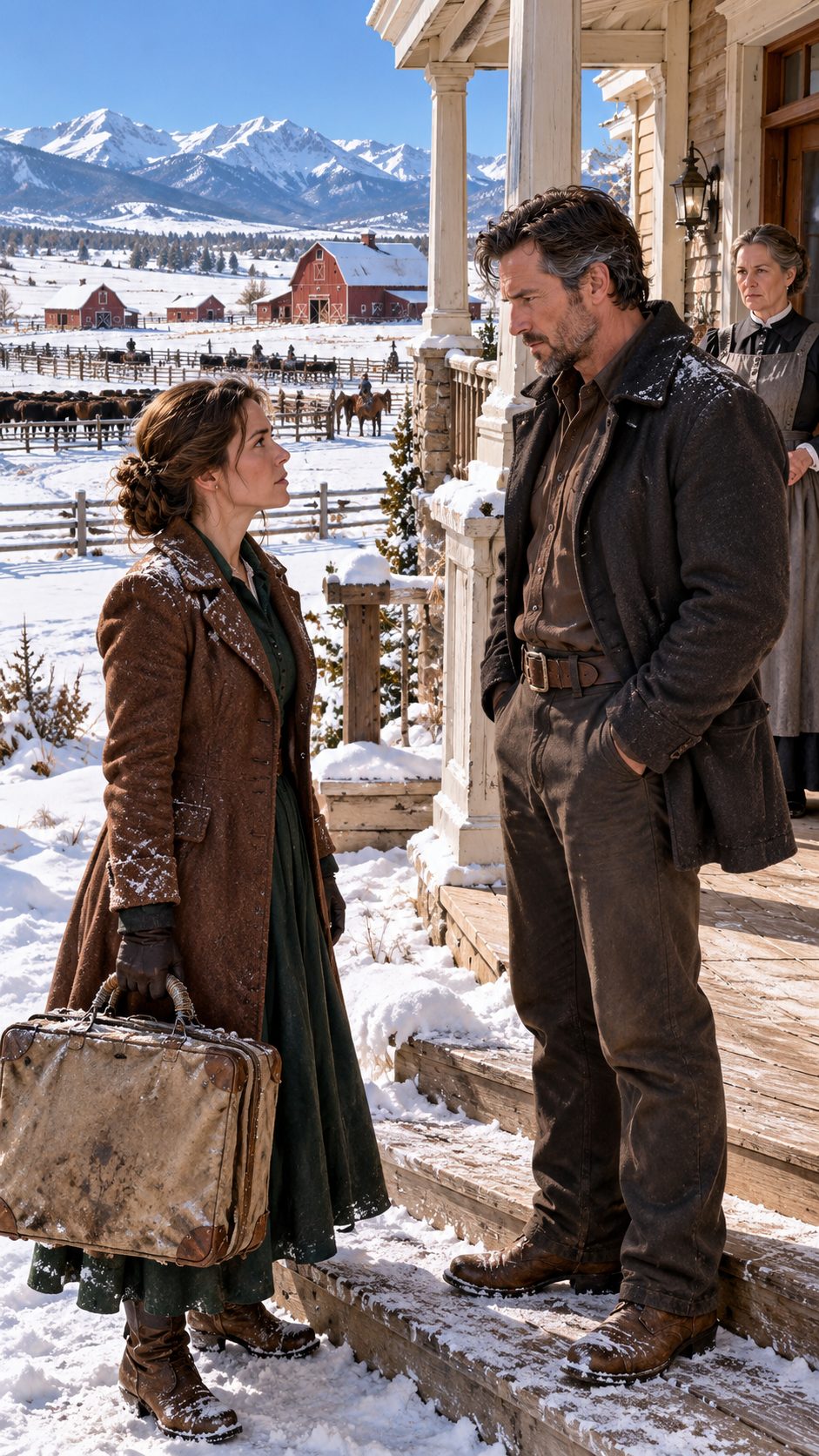
The first thing I heard when I reached Callahan Valley Ranch was laughter, and after walking through Montana snow with everything I still owned packed inside one battered canvas suitcase, I discovered that humiliation could feel colder than the wind cutting through my coat.
I had been standing at the kitchen entrance for less than a minute when the laughter came again from somewhere beyond the open door, softer this time but unmistakably aimed at the forty-one-year-old widow who had arrived on foot asking for work at the richest ranch in that part of Montana.
Margaret Voss blocked the doorway with her arms folded across a dark dress, her gray-brown hair pinned so tightly behind her head that it seemed even her hairstyle disapproved of unexpected visitors.
“The back door is for suppliers and beggars, so which one are you?”
Her eyebrows rose.
“Then you came to the wrong door.”
“I came to speak with Mr.
“About what?”
She looked from my worn boots to the suitcase whose handle had been repaired with wire and then back to my face.
“We are not hiring.”
“I would rather hear that from Mr.
The laughter behind her stopped.
Margaret stared at me as though no woman wearing a coat as shabby as mine had ever contradicted her without immediately apologizing afterward.
“And what exactly do you imagine Ethan Callahan could employ you to do?”
“We have a kitchen.”
“I noticed.”
“We also have someone to take care of it.”
Callahan can tell me himself that he does not need me.”
The wind pushed snow across my boots while Margaret continued staring, and although every sensible part of me whispered that I should preserve what little dignity I had left and walk away, I had lost too much during the previous year to be defeated by one housekeeper and a closed door.
My husband had died.
The accounts he had kept hidden from me had swallowed what money remained.
The modest house where we had spent the last years of our marriage belonged to the bank before I had even finished packing his clothes.
Everything that had once made my life appear secure had vanished so quickly that I sometimes woke in the morning believing I had imagined owning any of it.
What remained was experience.
I still had my hands.
I still knew what flour should feel like beneath my fingers.
I knew how long onions needed before sweetness replaced sharpness.
I knew how to stretch inexpensive meat without making a family feel poor.
I knew how to make bread fill a room with enough warmth that people came toward the kitchen before anyone called them.
Those things were not much, but they were mine.
Margaret finally stepped backward.
The door closed in my face.
I adjusted my gloves around the suitcase handle and turned to study the ranch while I waited.
Callahan Valley was even larger than people in Billings had described.
Red barns stood beyond long stretches of clean fencing.
Well-built corrals occupied the lower ground.
Smoke rose evenly from chimneys attached to workshops and workers’ quarters.
Cattle moved in dark clusters against the snow.
Nothing sagged.
Nothing appeared neglected.
A place that large did not merely possess money.
It possessed enough money to hide mistakes.
Yet the closer I looked at the main house, the more something bothered me.
There was wealth everywhere.
There were workers everywhere.
There was activity everywhere.
But around the house itself there was no life.
No one talked near the porch.
No door slammed.
No laughter escaped from an upstairs window.
I heard no running feet.
I saw two small toy tractors beside the shed, half covered in snow.
A jacket hung from a hook beneath the porch roof, far too small to belong to any ranch hand I had seen.
A faded blue ribbon had become tangled around a section of railing and moved whenever the wind rose.
There were children here.
Yet the house remained silent.
I knew silence.
After my husband died, silence had moved into my home before the bank ever took possession of it.
It waited at breakfast.
It followed me down hallways.
It sat beside me when I went to bed.
People imagined grief sounded like sobbing, but the worst grief I had known made almost no sound at all.
The door opened again.
Margaret stepped outside.
Callahan will receive you on the front porch.”
I thanked her.
She looked as though gratitude irritated her.
I carried my suitcase around the house, climbed the first porch step, and stopped when Ethan Callahan appeared in the doorway.
He was forty-six, taller than I expected, broad across the shoulders, and weathered in the way men became when years of cold, dust, cattle, broken fences, and responsibility had shaped them more than comfort ever could.
Silver showed at his temples.
His coat was used.
His boots were scuffed.
Nothing about him resembled the kind of millionaire ranch owner I had expected to meet.
Then he looked directly at me.
I recognized pain before I recognized anything else.
His eyes carried the same exhausted distance I had seen too many mornings in my own mirror.
“Margaret says you are looking for work.”
“Yes, sir.”
“She also tells me she explained that we are not hiring.”
“And yet you stayed.”
His attention moved toward my suitcase.
“Experience?”
“Ten years cooking for ranch families, before that a hotel kitchen in Cheyenne, and after that a private household outside Laramie.”
“Why did you leave those positions?”
“Some ended naturally, one employer stopped paying regularly, and the last arrangement disappeared when my husband died.”
Ethan did not say he was sorry.
That small silence made me like him more than sympathy would have.
People had been telling me how sorry they were for nearly a year, as though apologizing for death might somehow make them responsible for correcting it.
“I would like to propose something.”
“Let me prepare one dinner.”
His forehead creased.
“One dinner?”
“And afterward?”
“If it is not the best food your kitchen has served in the last six months, I will leave tomorrow morning without asking you for wages.”
For the first time, genuine interest appeared in his expression.
“What makes you think we have eaten badly for six months?”
I glanced toward the chimney.
“The smoke is clean, which tells me somebody maintains the stove properly.”
“When Margaret opened the kitchen door, I saw spice boxes near the shelves, but I could not smell a single spice being used.”
His expression changed slightly.
“Anything else?”
“Three ranch hands passed me while I was coming toward the house.”
“We employ many men.”
“It was nearly lunchtime, and none of those three appeared eager to reach the table.”
Something like amusement touched the corner of his mouth.
“You observe too much.”
“It is useful when a person depends on kitchens.”
I looked toward the quiet windows.
His faint smile disappeared.
“What else did you observe?”
I hesitated.
That was the moment I could have stopped.
I could have secured the chance to cook.
I could have kept my thoughts private.
Instead I looked toward the toy tractors.
“You have children living here.”
Ethan became completely still.
“Who told you that?”
“Then how do you know?”
“Two toy tractors near the shed, a jacket too small for a grown man hanging by the porch, and a blue ribbon caught around the railing.”
I turned toward the silent house.
“But I have not heard one child’s voice since I arrived.”
The wind dragged loose snow between us.
“A house with children should not feel this quiet.”
Whatever amusement had existed in Ethan’s face vanished.
“You are making a dangerous number of assumptions for a woman asking me for employment.”
“I am making observations, Mr.
Callahan, because judgments come later.”
His gaze held mine.
For several long seconds I believed I had just talked myself back onto the road.
Then he stepped slightly aside.
“One meal.”
My breath caught.
“Dinner at six, you work under Margaret’s supervision, and you follow the rules of this household.”
“That seems fair.”
I lifted my suitcase.
“You traveled a considerable distance.”
“There are ranches between Billings and here.”
“There are kitchens in Helena, Bozeman, and towns much closer to where you started.”
His eyes went to my suitcase and returned to my face.
“So why this ranch?”
My fingers tightened around the wire-wrapped handle.
Beneath two dresses, a Bible, a brush, and the final photograph of my husband lay the reason I had crossed Montana.
Cooking was part of it.
Desperation was part of it.
But neither was the whole truth.
Something connected to Callahan Valley had brought me specifically to Ethan’s door, and before I allowed myself to stay, I needed to know whether what I had heard in Billings was true.
Ethan stepped closer.
“I heard you might need a cook.”
“That is not what I asked.”
“It is the answer I can give you right now.”
His jaw tightened.
Then his voice dropped.
“Before you enter my house, I suggest you decide whether you came here looking for employment or looking for something you are not willing to tell me.”
I stood on the porch with my secret folded inside my suitcase and realized that crossing Montana had been the easy part, because convincing Ethan Callahan to let me remain long enough to uncover the truth might be far harder.
✓ Lynn R. Adams
The first thing I heard when I reached Callahan Valley Ranch was laughter, and after walking through Montana snow with everything I still owned packed inside one battered canvas suitcase, I discovered…