Chapter 1: The Joke at the Back Table 251
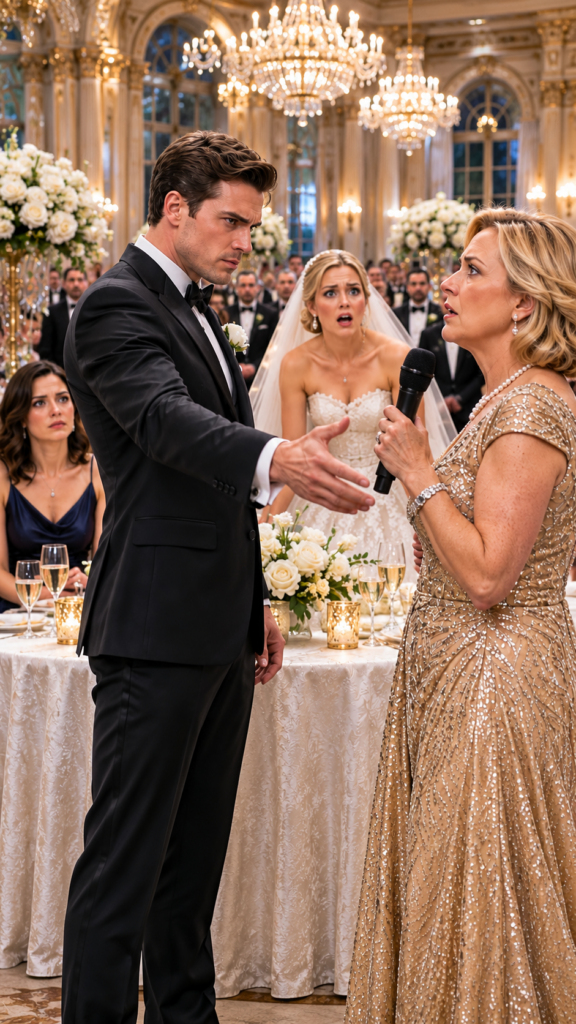
The first time my mother called me useless in front of two hundred people, I was sitting beneath a crystal chandelier at my younger sister’s $150,000 wedding, holding a glass of water so tightly that I thought it might crack between my fingers.
“My oldest daughter is thirty-four, single, and too useless to pay her own rent,” Mom announced into the microphone with the delighted confidence of someone delivering the funniest line of the night.
The ballroom exploded with laughter.
My father lowered his head and covered his mouth as though he were coughing, but his shaking shoulders told me he was laughing too.
At the bridal table, my sister Vanessa leaned toward one of her bridesmaids, whispered something behind her hand, and then threw her head back with the rest of them.
I sat alone near the back of the ballroom and watched my own family turn me into entertainment.
The room looked as though someone had emptied an entire luxury wedding catalog into one enormous space.
Towering arrangements of white roses stood on gold pedestals between tables covered in ivory linen, hundreds of candles flickered inside crystal holders, and chandeliers scattered warm light across champagne glasses and polished silverware.
Everything about the night had been designed to say that Vanessa had made it.
Her wedding gown alone looked expensive enough to pay a year of rent in some cities, and her veil spilled behind her chair like a river of white silk.
She looked beautiful.
That was the hardest part for me to admit.
No matter what had happened between us, she was still my younger sister, and for one brief moment during the ceremony I had remembered the little girl who used to climb into my bed during thunderstorms.
Then she had laughed when Mom called me useless.
That memory disappeared as quickly as it had come.
“Claire has always been our little free spirit,” Mom continued, lifting her champagne glass with one hand while keeping the microphone in the other.
By “free spirit,” she meant failure.
It had become one of those family expressions whose real meaning everybody understood.
Five years earlier, after our grandmother died, Vanessa had convinced our parents that I had squandered the inheritance Grandma left me.
Nobody ever asked to see evidence.
Nobody ever asked me what had actually happened.
Vanessa said I had wasted the money, and that was apparently enough.
From that point forward, every ordinary choice I made became proof of irresponsibility.
If I bought shoes on sale, I was broke.
If I drove my perfectly reliable older car instead of replacing it, I was struggling.
If I declined an expensive family vacation, I was pathetic.
If I refused to discuss my finances over Sunday dinner, that silence became confirmation that there was nothing worth discussing.
The strangest part was that my parents never showed any real curiosity about my work.
They knew I worked in an office connected to commercial properties, contracts, and event spaces, but somewhere along the way Vanessa began describing me as an office assistant, and my parents accepted the description without question.
I corrected them twice.
The first time, Dad nodded distractedly and changed the subject.
The second time, Mom said, “Whatever you call it, sweetheart,” in a tone that made it clear the conversation was already over.
After that, I stopped trying.
There was something deeply humiliating about begging people who claimed to love you to become interested enough in your life to know who you actually were.
I learned to let them think whatever was easiest for them.
Vanessa, on the other hand, loved being seen.
She loved expensive restaurants, carefully staged photographs, designer labels, destination weekends, and anything that could be described as exclusive.
Our mother adored that about her.
Mom had spent months talking about Vanessa’s wedding as though it were a national event.
She mentioned the floral budget to cashiers.
She told neighbors about the imported champagne.
She casually inserted the phrase “one hundred fifty thousand dollars” into conversations that had absolutely nothing to do with weddings.
Tonight was supposed to be the glorious proof that Vanessa had become everything Mom believed a daughter should be.
And apparently that proof required reminding everyone that I had become everything she believed a daughter should not be.
Mom pointed toward me from across the ballroom.
“Look at her,” she said with a laugh.
Several guests turned in their seats.
I forced myself not to shrink.
“She probably wants to know whether the centerpieces are returnable,” Mom added.
More laughter followed.
A woman at the table beside mine glanced at me, and for a moment I saw discomfort rather than amusement in her expression.
I appreciated that tiny act of humanity more than she could possibly have known.
I raised my water glass and took a slow sip.
I could have stood up.
I could have walked out.
I could have taken the microphone and explained that my mother knew almost nothing about my finances, my work, or my life.
Instead, I stayed seated.
I stayed because I knew something they did not.
Three months earlier, Vanessa had walked into the office building where I worked while looking into a luxury event property connected with her wedding plans.
She had moved through the lobby with the same confidence she displayed everywhere, speaking to the building manager as though everyone around her existed to help create the celebration she imagined.
She never noticed me.
At first, I had been grateful.
Then I heard Daniel Brooks’s business name.
Daniel was Vanessa’s fiancé, a successful businessman who had personally guaranteed a large portion of the wedding expenses.
His involvement was not a secret.
What I eventually discovered was.
Nearly $80,000 in costs had been properly approved.
Another $70,000 had not.
The additional vendor contracts carried Daniel’s business information, yet the supporting correspondence made it increasingly clear that Daniel had never been told about them.
I had spent weeks hoping I was misunderstanding what I was seeing.
That morning, before the ceremony, I had sent the relevant contracts, invoices, and emails to Daniel’s attorney.
I had expected the issue to be handled privately.
I had expected Vanessa to be spoken to quietly before the reception became complicated.
Instead, I was sitting beneath a chandelier while my mother mocked my supposed poverty in front of two hundred people.
Mom lifted her champagne glass again.
“And here’s something even funnier,” she said.
My stomach tightened because I recognized the expression on her face.
It was the expression she wore whenever she had saved her favorite insult for last.
“Claire actually thought she could help Vanessa with this wedding,” Mom announced.
The guests began laughing before she even finished.
I looked toward Vanessa.
She was smiling.
Then Mom leaned toward the microphone and said the sentence that made me realize she had no intention of stopping.
“Can you imagine someone who shops at discount stores trying to contribute to a $150,000 wedding?”
The laughter grew louder, and across the room, Daniel Brooks suddenly looked down at the phone beside his plate.
✓ Lynn R. Adams
The first time my mother called me useless in front of two hundred people, I was sitting beneath a crystal chandelier at my younger sister’s $150,000 wedding, holding a glass of water so tightly that …