Chapter 1: THE EMPTY PLATE 251
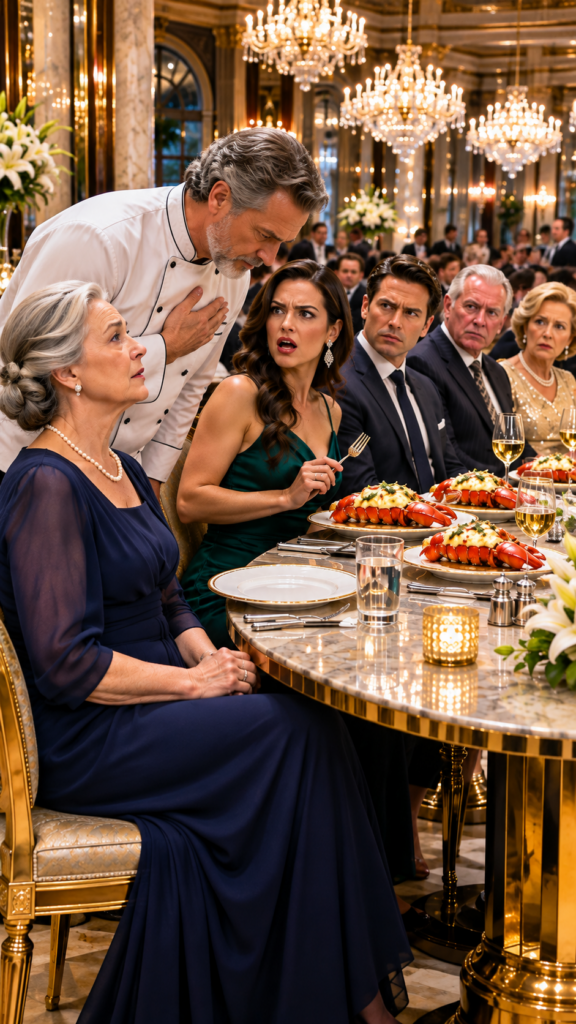
“Four lobster thermidors, and just a glass of water for her,” Marlene said loudly enough for every person at our table to hear.
The waiter stood beside her with his pen suspended above his order pad, and for one long second his professional expression slipped enough for me to see that even he could not believe what my daughter-in-law had just said.
“I’m sorry, ma’am, only water for the lady?” he asked.
“Exactly,” Marlene replied, gesturing toward me without bothering to turn her head.
“She doesn’t need anything else.”
I felt heat climb from the collar of my navy dress into my cheeks as Marlene closed her menu with the satisfied little smile she wore whenever she thought she had successfully established everyone’s position in her carefully ordered world.
Crystal chandeliers glittered above us, candlelight danced across polished marble, and white-gloved waiters moved between tables carrying silver platters as though this humiliation were happening on a stage built specifically for it.
I had been invited to one of the most exclusive restaurants in the city, but somehow I had become the only person at the table who was not considered worthy of dinner.
Marlene’s father lowered his gaze toward his wineglass.
Her mother shifted in her chair and touched her napkin as though she had suddenly discovered a wrinkle that urgently required her attention.
Neither of them said a word.
I looked at my son.
I whispered.
He did not immediately look at me.
He adjusted his napkin across his lap, glanced toward Marlene, and then leaned just close enough that no one beyond our table would hear him clearly.
“Please don’t embarrass us, Mom.”
I stared at him.
“You should know your place.”
There are sentences that hurt because they are cruel, and there are sentences that hurt because of who says them.
Michael’s words belonged to the second kind.
When he was five years old, his father walked away from us with a suitcase in one hand and a promise to call in the other, and after the first few weeks even the promises stopped coming.
From that day forward, everything in my life became a calculation involving Michael.
How much food could I stretch until Friday?
Could I postpone the electric bill long enough to buy his new school shoes?
How many extra hours could I work before exhaustion became dangerous?
Could I make one winter coat survive another year so he could have the textbooks his teacher said were necessary?
I worked three jobs for years, sometimes moving from one shift to another with only enough time to change shoes in a restroom and drink coffee from a paper cup.
There were nights when I came home after midnight and found Michael asleep at the kitchen table because he had tried to wait for me.
I would carry him to bed, pull the blanket over his shoulders, and stand there for a moment remembering why I had to wake up again before sunrise.
When tuition bills came, I found the money.
When textbooks cost more than I had expected, I found the money.
When his rent was short during college, I found the money.
Whenever life put a wall in front of my son, I had spent decades searching for a door.
Now that same boy was sitting beside me in a charcoal suit, eating dinner with people who discussed vacations, investments, and luxury purchases as casually as I once discussed grocery coupons, and apparently the price of belonging in his new world was pretending his mother did not deserve a meal.
Marlene watched me carefully.
She wanted a reaction.
I could see it in the slight upward curve at the corner of her mouth.
If I cried, she could call me dramatic.
If I argued, she could accuse me of ruining the evening.
If I left, she could tell everyone I had been unable to behave in a sophisticated restaurant.
So I did the one thing she had not prepared for.
I folded my hands in my lap.
“Noted,” I said.
Marlene gave a small laugh.
She lifted her wineglass.
“I’m glad we understand each other.”
The conversation moved on without me.
Her father mentioned a new investment opportunity.
Her mother described a resort they had visited the previous spring.
Marlene discussed a handbag she had ordered from Europe.
Michael nodded at appropriate moments while avoiding my eyes.
I stared at the glass of water in front of me and realized that humiliation had a strange physical weight, because my chest felt heavy enough that each breath required effort.
A few minutes later, the waiter returned with another server.
Four magnificent plates were lowered onto the table.
The lobster shells gleamed red beneath creamy sauce and golden cheese, and the scent of butter, seafood, herbs, and toasted breadcrumbs filled the air.
One plate went to Marlene.
One went to Michael.
Two went to her parents.
The space in front of me remained empty except for water.
The waiter’s eyes met mine briefly.
There was apology in them.
I gave him the smallest possible nod because I did not want him blamed for something he had not chosen.
Marlene picked up her fork.
Michael began eating.
Nobody offered me a bite.
Nobody asked whether I was hungry.
Nobody acknowledged the absurdity of five adults sitting at a dinner table while four ate a luxurious meal and the fifth was expected to watch.
I thought of all the meals I had skipped when Michael was young.
Back then, hunger had felt purposeful because every empty stomach meant my child had enough.
This hunger was different.
This one was designed to remind me that I no longer mattered.
I lifted my water and took one careful sip.
Then the heavy kitchen doors opened.
At first I barely noticed.
Restaurants like this operated with constant movement, but something about the sudden change in the room made me look up.
A distinguished man in a pristine white chef’s jacket stepped through the doors.
He was in his mid-fifties, with salt-and-pepper hair, a neatly trimmed beard, and the controlled confidence of someone who did not need to announce that he was important.
Several diners recognized him.
I saw heads turn.
One businessman raised a hand in greeting.
The chef did not stop.
He walked past the businessman.
He passed a table where an elegantly dressed couple smiled expectantly at him.
He passed another group whose conversation fell quiet as he approached.
He was coming toward us.
Marlene noticed.
Her fork slowed halfway to her mouth.
Michael looked up.
The chef stopped beside my chair.
For the first time that evening, I saw uncertainty cross Marlene’s face.
“Is something wrong?” she asked.
The chef ignored her.
He looked directly at me, and something in his expression changed from professional seriousness to unmistakable warmth.
Then, in front of my son, my daughter-in-law, her wealthy parents, the waiter, and half the dining room, the head chef inclined his head deeply toward me.
Helen,” he said, “would you please come with me?”
The room around us seemed to become quieter.
Marlene’s mouth parted.
Michael froze with his fork still raised.
“Wait,” Marlene said.
The chef straightened.
“Why are you addressing her?”
He looked at Marlene for the first time, then let his gaze travel slowly across the four lobster plates before settling on the empty place setting in front of me.
His face hardened.
“Before I explain anything,” he said, “I would like to know who decided Mrs.
Helen was not allowed to have dinner.”
Marlene’s fingers tightened around her fork.
Nobody answered.
The chef waited.
My son finally lowered his eyes.
Marlene drew in a breath as if preparing to defend herself, but before she could speak, the chef slipped one hand inside his white jacket.
Whatever he was reaching for, every person at our table suddenly wanted to see it.
✓ Lynn R. Adams
“Four lobster thermidors, and just a glass of water for her,” Marlene said loudly enough for every person at our table to hear. The waiter stood beside her with his pen suspended above his order pad,…