Chapter 1: THE DOOR AT THE END OF THE PRAIRIE 246
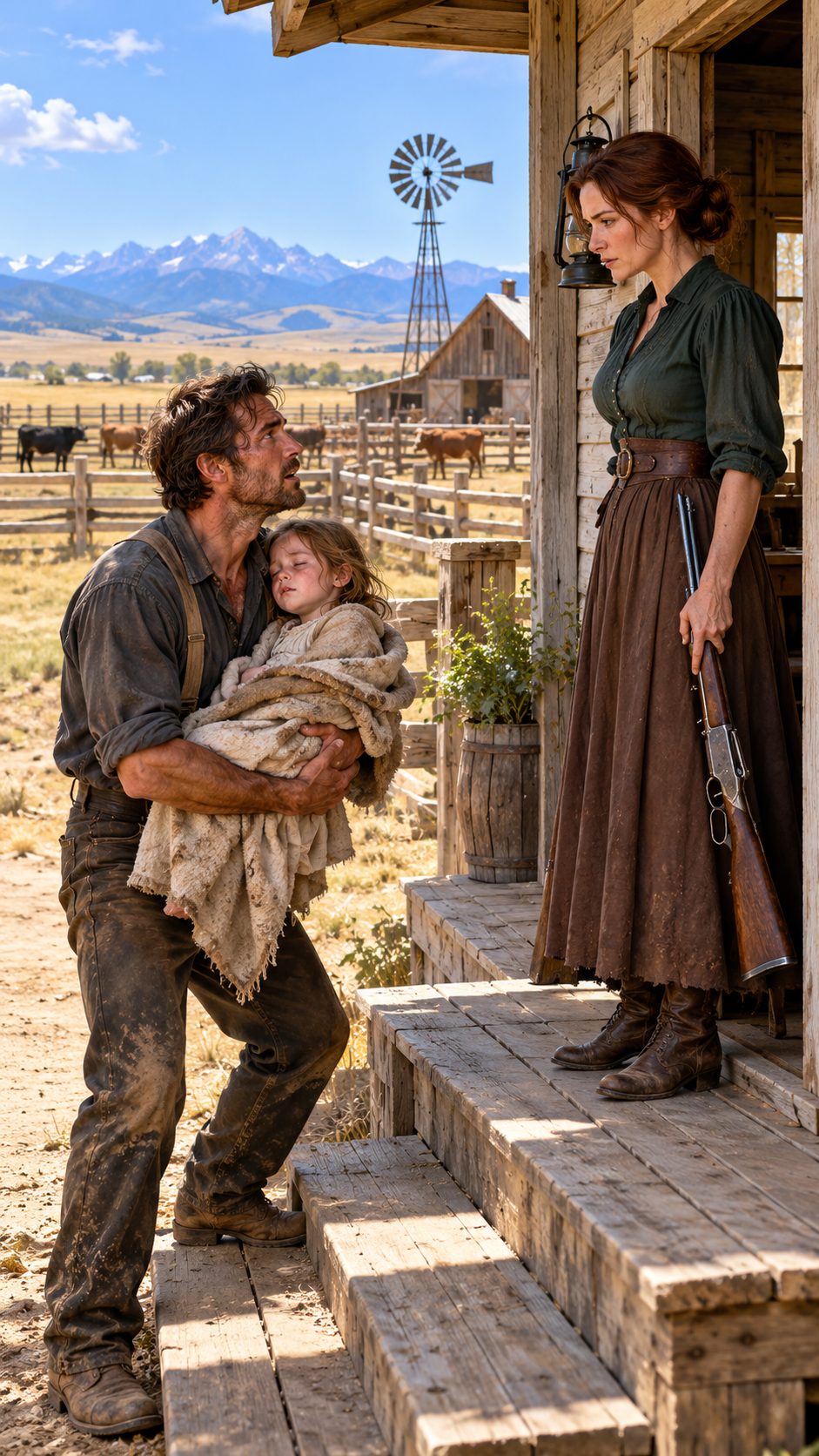
The Wyoming sun did not feel like sunlight that August morning in 1888, because it came down on my shoulders like punishment while I crossed mile after mile of bleached grass with my four-year-old daughter burning against my chest.
Lydia had stopped talking shortly after sunrise, and her silence frightened me more than the fever, more than the emptiness of my stomach, and even more than the certainty that my legs were beginning to fail beneath me.
“Still here, sweetheart.”
I pressed my mouth against her damp hair and kept walking because stopping meant admitting that I had finally run out of things I could do for her.
“You’re still here.”
She did not answer.
Ordinarily Lydia could turn three fence posts and a cloud into an hour-long conversation, and before sickness hollowed the color from her cheeks she had narrated nearly everything she saw as if the world had been created especially for her inspection.
“That rock looks like a frog, Papa.”
“Do you think Mama can see us from where she is?”
“Can dead people hear you when you whisper?”
Those questions had once exhausted me after a hard day’s work, but now I would have traded every acre I had ever owned to hear one of them again.
A year earlier I had been a six-foot-two-inch farmer with enough meat on my shoulders to sink a post by myself, enough strength to wrestle a stubborn calf into a chute, and enough pride to believe a man who worked hard could keep disaster outside his fence.
Four months had taken thirty pounds from me.
The farm was gone.
My wife was already buried.
Our savings had disappeared into seed, food, medicine, and one final doctor’s visit that had purchased only a warning.
“She’s fighting something.”
The doctor had listened to Lydia’s chest with his cold metal instrument while I stood beside him waiting for a solution he did not possess.
“Whether she wins depends mostly on what you can give her to fight with.”
I had given her everything I could find.
Everything had not been enough.
By late morning my shirt was stuck to my spine, my boots felt filled with stones, and every step sent a dull tremor through the muscles of my thighs.
Lydia weighed almost nothing, but after enough miles even nothing becomes heavy.
I shifted her against my chest and watched her head roll weakly toward my shoulder.
The word came out sharper than I intended because fear had started turning every thought inside me into anger.
“No, you stay with me.”
Her eyelashes fluttered once.
That tiny movement kept me going another mile.
Three people in the last settlement had mentioned Eleanor Cross when I asked whether anyone nearby might exchange food and shelter for labor.
The first had been a stable hand who said she owned one of the best-kept small cattle operations east of the foothills.
The second said she had buried her husband six years earlier and had run the ranch herself ever since.
The third, a storewoman with the careful voice of someone who disliked gossip but enjoyed accuracy, had looked me over before answering.
“She isn’t cruel.”
The woman had paused.
“But she doesn’t appreciate strangers showing up uninvited.”
Under ordinary circumstances I would have respected that warning.
Nothing about my circumstances was ordinary.
I had no money to offer Eleanor Cross.
I had no horse.
I had no wagon.
I had no possessions except the clothes on my body, the blanket around Lydia, and a few small things tucked inside the canvas bag hanging from my shoulder.
What I still had was a back that could work, hands hardened by years of labor, and the willingness to use both until I dropped.
When the ranch finally appeared beyond a low rise, I thought at first the heat had created it.
I smelled watered earth before I fully saw the buildings.
Then came cattle.
Then woodsmoke.
Then the creak of a windmill turning lazily above a fenced pasture.
The fence itself told me something about the person who owned the place because the wire was tight, the posts stood straight, and the gate did not sag.
The barn roof had been repaired recently.
A stack of cut wood stood under cover beside the house.
Someone here paid attention before little problems became expensive ones.
I nearly laughed when I saw the porch because it was the first sign of civilization I had encountered since yesterday morning.
My knees almost gave way at the gate.
Lydia stirred at the sudden change in my stride.
“Almost there.”
I could barely hear myself.
“Just a little farther.”
The farmhouse door opened before I reached the bottom porch step.
The woman standing there was not what I had imagined from the stories.
I had pictured someone older, perhaps gray-haired and hardened into permanent suspicion after six years of managing land alone, but Eleanor Cross looked somewhere in her mid-thirties, tall and straight-backed, with dark auburn hair pinned into a practical knot and a face that would have been beautiful even without softness in it.
She held a rifle.
It was not pointed at me.
She carried it the way I carried an ax when stepping outside to investigate a strange sound, as something familiar rather than theatrical.
Her eyes moved over my face once.
Then they dropped to Lydia.
My voice cracked from two days of speaking to nobody but my daughter.
Eleanor descended one porch step.
“What’s wrong with the child?”
There was no welcome in her voice, but there was no cruelty either.
I swallowed.
“Going on eleven days.”
Her attention sharpened.
“How much water has she had today?”
“Not enough.”
“She needs water, milk if she can hold it down, and food when she can manage it.”
Shame burned hotter than the sun because every necessity she named was something I had failed to provide.
“I haven’t got money.”
Eleanor said nothing.
“But I can work.”
I shifted Lydia higher.
“Fences, cattle, roofing, horses, wood, whatever you’ve got.”
Still she watched me.
“I’m not asking for charity.”
My voice came out harsher than I meant.
“I’m asking for work.”
Her gaze settled on my hands, then my boots, then my face.
“How long since she ate?”
“Yesterday morning.”
“How much?”
“A little biscuit soaked in water.”
Eleanor’s jaw tightened.
“How long since you ate?”
“That isn’t the concern.”
“I didn’t ask what the concern was.”
I looked at her.
“Day before yesterday.”
Something changed in her expression, though it was so slight I might have missed it if I had not been studying her for signs that she was about to close the door.
It was not pity.
I would have recognized pity and hated it.
It looked more like a person correcting an estimate after discovering the situation was worse than expected.
Eleanor stepped backward and pulled the door wider.
“Come inside.”
For a second I only stared at her.
“Now, Mr.—”
Hale, if you’re planning on collapsing, I’d rather you do it somewhere I can get water to you.”
My knees nearly folded from relief.
I climbed the porch.
The difference between the sun outside and the shadow of her kitchen made me dizzy.
Eleanor set the rifle against the wall and pointed toward a wooden chair.
“I’m dirty.”
“So is the floor.”
Lydia remained in my arms because I was not ready to surrender the weight of her to anyone.
Eleanor filled a cup from a pitcher, crouched beside us, and held it where Lydia could see it.
My daughter’s eyes barely opened.
“This lady has water.”
Eleanor did not pour it into her mouth or force her head back.
She touched the cup lightly to Lydia’s lower lip and waited.
After several seconds, Lydia swallowed.
My chest tightened so suddenly I had to look away.
“That’s it.”
Eleanor kept her voice low.
Lydia managed three small sips.
Eleanor stood, crossed to the stove, poured milk into a small pot, and added a spoonful of honey.
“You said Hale.”
“First name?”
“Where from?”
I told her.
She asked what happened to my farm.
I gave her the short version because the long version never changed the ending.
Bad weather.
Poor yield.
My wife’s death.
Medical expenses.
Then Lydia’s fever.
Eleanor listened without interruption while stirring the milk.
When it had warmed, she brought it over and helped Lydia take several small swallows.
For the first time in days, my daughter consumed something that felt like nourishment rather than a postponement.
I nearly cried.
I did not, because I had done enough failing in front of Lydia already.
Eleanor carried the pot back to the stove and stood there for several seconds with her back to me.
Then she crossed to the kitchen window.
Outside, the barn doors stood open.
A bay horse moved lazily inside the paddock.
The windmill turned.
Eleanor folded her arms.
“I have work.”
I straightened.
“I can start today.”
“You can start when you can stand without looking like a stiff breeze will finish you.”
“I’m stronger than I look.”
“That would be fortunate.”
Despite everything, a breath that might almost have been a laugh escaped me.
Eleanor glanced back.
“Standard wages.”
“Not generous.”
“I don’t need generous.”
“Room and board for both of you.”
I stopped breathing for a second.
“A proper bed for Lydia.”
My hand tightened around the blanket.
“There is something else.”
I looked up.
Eleanor’s expression had changed again.
For the first time since opening the door, she appeared uncertain.
“Whatever it is, if it’s work, I’ll do it.”
“It isn’t work.”
She came away from the window.
“What I’m about to say has no effect on the job, the room, the food, or anything I’ve already offered.”
“All right.”
“You can say no.”
“All right.”
“And if you do, I will not ask again.”
A strange tightness entered my chest.
Eleanor looked down at Lydia for several seconds, then lifted her eyes to mine.
“I want to be her mother.”
The stove gave one quiet metallic tick behind her as I stared at a woman I had known for exactly eleven minutes and realized I had no idea what she was asking me to do next.
✓ Lynn R. Adams
The Wyoming sun did not feel like sunlight that August morning in 1888, because it came down on my shoulders like punishment while I crossed mile after mile of bleached grass with my four-year-old dau…