Chapter 1: The Cry Before Sunrise 246
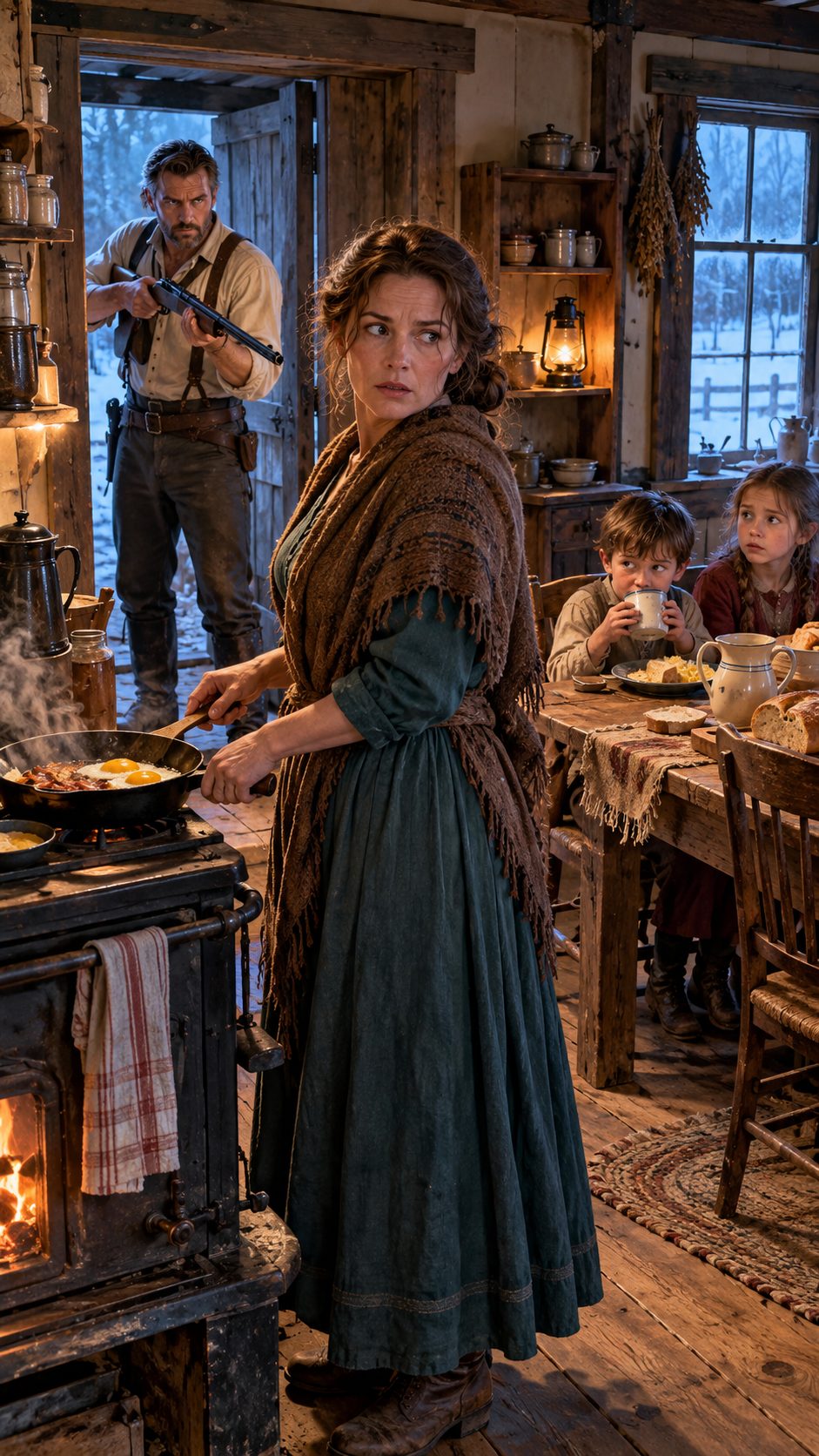
The first sound I heard before dawn was not the Montana wind clawing at the barn walls, but the muffled sob of a child who had already learned that crying loudly would not bring anyone running.
I opened my eyes beneath a horse blanket that smelled of hay and dust, and for several seconds I could not remember where I was or why my fingers had gone numb during the night.
Then I remembered everything.
I was Margaret Dawson, forty-three years old, widowed, nearly penniless, and sleeping without permission inside the barn of a rancher whose name I did not even know.
Everything I owned rested inside a battered carpetbag beside my boots, including two dresses, a hairbrush missing half its teeth, three dollars and twelve cents, and the faded photograph of the husband I had buried.
I had walked until darkness made the frozen road impossible to follow, and when I saw the barn through the snow, survival had mattered more than pride.
I had intended to leave before anyone discovered me.
Then I heard the crying again.
The sound came from the farmhouse.
I sat upright and listened until another small voice whispered something I could not understand, followed by the unmistakable sound of someone trying not to cry.
There are moments when a person can pretend she did not hear suffering, and there are moments when pretending would cost more than whatever punishment might follow.
I pulled on my boots, wrapped my brown shawl tightly around my shoulders, and stepped into the bitter January darkness.
The farmhouse stood less than fifty yards away, its windows faintly silver under the approaching dawn, and no smoke yet rose from the chimney.
I moved close enough to peer through the kitchen window.
Two children sat at a rough wooden table.
The boy looked perhaps nine, with messy brown hair and shoulders far too narrow beneath his worn shirt, while the younger girl beside him held her arms against her stomach and stared at an empty plate.
The boy pushed a cup toward her.
“There’s water left.”
“I’m hungry, Jacob.”
He looked away before saying the words that broke something open inside me.
“Daddy will get food later.”
There was no anger in his voice.
There was only the tired certainty of a child who had repeated the same promise too many times.
I tried the kitchen door.
I stood on the threshold for one heartbeat, fully aware that entering another person’s home without permission could get me arrested, beaten, or shot.
Then the girl’s stomach growled loudly enough for me to hear.
I stepped inside.
Both children stared at me.
“My name is Margaret Dawson.”
The boy immediately stood in front of his sister.
“Who are you?”
“A woman who slept in your barn because I had nowhere warmer to go.”
His eyes widened.
“Does Daddy know?”
That answer frightened him more than I intended.
“I’m not here to hurt anyone.”
The girl pointed toward my carpetbag.
“Are you leaving?”
I looked around the kitchen.
“First, I’m going to find you something to eat.”
The boy shook his head quickly.
“Daddy says we have to save things.”
“Then we’ll save what can be saved and cook what cannot.”
I searched carefully instead of rummaging, because poverty teaches a person how much one missing handful of flour can matter.
Behind a crock I found six eggs, while a cupboard held a strip of bacon wrapped in cloth, and a flour tin contained perhaps enough for one small loaf.
There was coffee as well.
I put two dollars from my purse on the shelf beside the window.
“That’s for whatever I use.”
The boy stared at the money.
“You don’t have to.”
“Yes, I do.”
Before lighting the stove, I remembered the leaning fence I had noticed near the barn while arriving the night before, so I told the children to remain inside and hurried outside with a hammer I found hanging by the back door.
The south fence post had nearly collapsed into the creek, and although my fingers ached from the cold, I reset it, tightened the wire, repaired the broken barn latch, and fastened a loose hinge with scrap metal from a pile beside the shed.
My husband had taught me to repair almost anything a ranch could break.
Grief had taken him from me, but it had not taken what he taught my hands.
By the time I returned to the kitchen, dawn was turning the windows blue.
I lit the stove.
Within minutes bacon began to hiss in the skillet.
The girl moved closer.
“What’s your name?”
“Margaret.”
“I’m Emma.”
She pointed at her brother.
“That’s Jacob.”
Jacob frowned at her.
“She knows.”
“I like saying it.”
For the first time, I almost smiled.
I mixed flour, water, salt, and the little fat I could spare into quick bread, then placed eggs in the skillet while coffee began steaming nearby.
Jacob watched every movement.
“Is there enough for Emma?”
I looked at him.
Not enough for himself, he meant.
Enough for Emma.
“There’s enough for both of you.”
Only then did his shoulders relax.
I put the first plate in front of Emma and the second in front of Jacob.
They ate too quickly.
Jacob stopped.
“There’s more.”
He stared at me as if I had spoken a foreign language.
Emma tore bread into tiny pieces, almost as though eating slowly might make it last forever.
I warmed milk for them and began preparing another egg when the floorboard behind me creaked.
One heavy footstep followed.
Then another.
Then a third.
I did not need to turn around.
The room had changed.
Children recognize danger before adults admit it, and both Jacob and Emma had gone perfectly still.
A man’s voice came from the doorway.
“Step away from that stove.”
I turned carefully.
Cole Harper stood several feet away, broad-shouldered and unshaven, one boot unlaced and a rifle pointed directly toward me.
His face looked like winter itself.
Unforgiving.
“Who the hell are you?”
“My name is Margaret Dawson.”
“What are you doing in my house?”
“Cooking breakfast.”
“I can see that.”
His eyes moved toward his children.
“Jacob, Emma, come here.”
Neither child obeyed.
That seemed to disturb him more than my presence.
“I slept in your barn last night.”
His grip tightened around the rifle.
“You broke into my property.”
“I took shelter.”
“And then you broke into my house.”
“The door wasn’t locked.”
His expression told me that distinction would not save me.
I nodded toward the window.
“I left two dollars for the food.”
“That doesn’t give you permission to take it.”
“Then why are you still standing there?”
I looked at Jacob.
Because if I was going to be thrown back into the cold, there was one truth this man needed to hear first.
“Your son didn’t eat supper last night, Mr.
Cole’s face changed.
Jacob immediately stared into his cup.
I continued before fear could silence me.
“He told his sister he wasn’t hungry so she could have the last piece of cornbread.”
No one moved.
Outside, the wind pressed against the windows.
Inside, Cole Harper held a rifle on me while the boy he thought he understood sat silently behind a half-empty cup.
“He’s nine years old.”
Cole looked at Jacob.
“Is that true?”
Jacob did not answer.
“Son, look at me.”
Slowly, Jacob raised his face.
That was when I saw Cole Harper’s anger falter for the first time, because whatever he found in his child’s eyes was something a father could not threaten away.
I set the spatula down.
“You can shoot me, throw me out, or call the sheriff when the roads clear, but first you need to understand what happened in this kitchen before sunrise.”
Cole’s rifle remained raised.
I drew a breath.
“Your children were hungry enough to cry quietly so you wouldn’t hear them.”
The barrel of the rifle lowered barely an inch.
And for the first time since entering his house, I understood that I was no longer the person Cole Harper feared most.
He was beginning to fear what kind of father he had become.
✓ Lynn R. Adams
The first sound I heard before dawn was not the Montana wind clawing at the barn walls, but the muffled sob of a child who had already learned that crying loudly would not bring anyone running. I ope…