Chapter 1: THE CHILD AT MY DOOR – 103
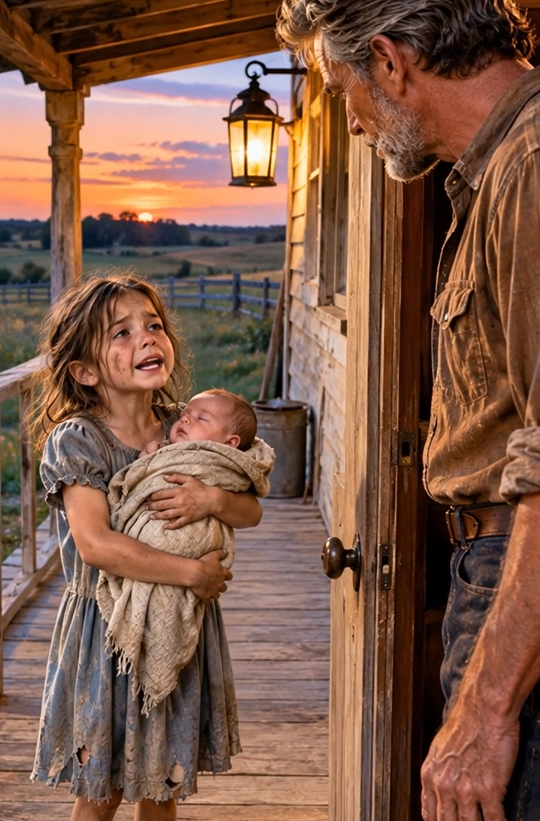
The six-year-old girl standing on my porch was carrying a baby who had nearly stopped breathing, but the first thing she asked me was whether I needed somebody to sweep my floors.
It was a Thursday evening in July, and the heat had settled over Holt County like a heavy wool blanket.
I had just finished washing my supper plate when three soft knocks reached me through the screen door.
Nobody came to my ranch after sundown unless something had gone terribly wrong.
My nearest neighbor lived four miles east, and the road leading to my property was little more than two wagon tracks carved through dry Nebraska soil.
I opened the door expecting a stranded traveler.
Instead, I found a little girl.
She stood beneath the porch light with bare feet coated in gray dust, a faded yellow dress hanging loosely from her shoulders, and a bundle wrapped in an old flour sack pressed against her chest.
Her brown hair had been gathered into two uneven braids, though one had nearly come undone.
She looked at me with enormous hazel eyes.
“Are you Mr.
“That’s what folks call me.”
She swallowed.
“My name’s Rose Kelly.”
Her voice was small but strangely formal, as though she had practiced introducing herself on the long walk to my house.
I glanced at the bundle.
“Rose, where are your people?”
She shifted her weight.
“I can work.”
I stared at her.
“I can sweep.
Gather eggs.
Carry kindling.
Pull weeds, too.”
She spoke quickly, desperate to list every useful thing she could do before I had a chance to turn her away.
“I don’t eat much,” she added.
“And Samuel doesn’t eat regular food yet.”
That was when I realized the bundle contained a baby.
I moved closer.
The infant’s face was pale beneath the flour sack, his tiny lips dry, his eyes closed.
“How old is he?”
“Two months.”
“Is he sleeping?”
Rose looked down.
Something cold moved through my stomach.
I had been a rancher long enough to recognize the difference between peaceful sleep and dangerous weakness.
A healthy two-month-old baby should have complained about the heat, the rough journey, or his empty stomach.
This one barely moved.
“How long has he been like that?”
“Since yesterday morning.”
“Has he eaten?”
Rose tightened her arms around him.
“Not proper.”
“How long?”
She lowered her eyes.
“Three days.”
I opened the door wider.
“Come inside.”
She didn’t move.
“How much?”
“How much what?”
“For food.”
“And milk for Samuel?”
“And sleeping?”
For a moment, I thought she might cry.
Instead, she stepped backward.
“Nothing always costs later.”
Those five words struck me harder than any punch I had ever taken.
I was fifty-eight years old, and I had lived alone on that ranch for fourteen years.
Fourteen years of quiet mornings, lonely suppers, and winters when the only voice I heard for days belonged to the radio.
My wife, Eleanor, had died after a sudden fever swept through our part of the county.
We never had children.
For years afterward, I had kept her blue sewing basket beside the fireplace because moving it felt too much like admitting she would never come home.
I had grown used to silence.
But I wasn’t prepared for the silence inside that little girl’s eyes.
I crouched until we were nearly face-to-face.
“Listen carefully, Rose.
You don’t owe me work, money, or anything else.
Not tonight.
Not tomorrow.
She searched my expression.
“Then why would you help?”
I had no clever answer.
“Because you need help.”
Her lips trembled.
Before she could respond, the baby made a faint, strained sound.
Rose looked down.
I reached toward him.
She hesitated, then carefully lifted the cloth.
The infant’s face frightened me.
His breathing was shallow, and he barely responded when I touched his cheek.
I gently placed two fingers against his tiny wrist.
His pulse was there, but weak.
“We need to get him to a doctor.”
Rose shook her head.
“No doctors.”
“Rose, he’s sick.”
“Martha said they take babies away.”
“Who’s Martha?”
“My mother’s cousin.”
“Martha Baines?”
She nodded.
I knew that name.
Everybody in Holt County knew Martha Baines.
She washed laundry for families in town, sold homemade remedies from glass bottles, and occasionally took in children whose relatives couldn’t care for them.
She attended church on Sundays and spoke loudly about Christian duty.
But there had always been whispers.
A missing payment here.
A child sent away there.
Nothing anybody had ever been willing to prove.
“Is Martha looking after you?”
Rose’s face became unreadable.
“Where’s your mother?”
“And your father?”
“Do you know where?”
She shook her head.
I had dozens of questions, but the baby mattered more.
I carried him into the kitchen while Rose followed so closely that her shoulder brushed my arm.
I laid Samuel on a folded towel near the lamp.
Rose watched every movement.
I found a clean cloth, cooled some boiled water, and carefully moistened his lips without forcing him to swallow.
Then I reached for the telephone.
Rose grabbed my sleeve.
“Please don’t call Martha.”
“I’m calling the doctor.”
“She’ll be angry.”
“Then she’ll have to be angry with me.”
Rose stared at me.
I picked up the receiver and dialed the number for Dr.
Henry Collins, who lived in town and still made house calls when emergencies demanded them.
His wife answered.
I explained what had happened.
Within moments, Henry was on the line.
“Two months.”
“How long without adequate feeding?”
“Possibly three days.”
There was a pause.
“Caleb, don’t wait for me.
Bring him into the clinic if you can do it safely.
I’ll meet you there.”
I looked toward the kitchen table.
Rose had placed one hand over Samuel’s chest.
“Henry, the baby’s barely responsive.”
“Then get moving.
I’ll prepare what I can.”
Rose immediately stepped between me and the door.
She was trembling.
“There’s something Martha told me never to tell anyone.”
“You can tell me.”
She looked toward the dark windows as though someone might be listening from outside.
“Sometimes she gave Samuel something.”
My blood turned cold.
“What kind of something?”
“From a little brown bottle.”
“Medicine?”
Rose shook her head.
“I don’t know.”
“Why did she give it to him?”
Rose’s voice broke.
“She said crying babies make people ask questions.”
I stared at her.
“How often?”
“When he cried too much.”
“What did it do?”
Rose looked at her brother.
“It made him sleep.”
The kitchen suddenly felt very still.
I remembered the way Samuel had barely moved in my arms.
“Did she give him some today?”
Rose nodded.
“Before I ran.”
I felt a sharp rush of fear.
“Rose, we have to leave now.”
She seized the edge of my shirt.
“But there’s something else.”
Her eyes filled with tears.
“She said if I ever told anybody about the bottle, Samuel wouldn’t wake up again.”
I didn’t answer immediately.
There are moments in a man’s life when anger comes so suddenly that he must hold it with both hands to keep it from doing damage.
That was one of them.
I lifted Samuel carefully.
“Get your shoes.”
Rose looked at her bare feet.
“I don’t have any.”
I fetched a small blanket and wrapped it around her shoulders.
“Then I’ll carry you to the truck.”
For the first time that evening, she looked confused.
“Both of us?”
“Both of you.”
I was reaching for the door when headlights swept across my kitchen windows.
A vehicle had turned into my driveway.
Rose saw the lights.
Every trace of color vanished from her face.
She grabbed my arm.
Mercer,” she whispered, “don’t let her take us.”
Outside, a car door slammed.
Then a woman’s voice called from the darkness.
“Caleb Mercer!
I know you’ve got those children!”
And the little girl who had walked miles to save her brother dropped to her knees and begged me not to open the door.
✓ Lynn R. Adams
The six-year-old girl standing on my porch was carrying a baby who had nearly stopped breathing, but the first thing she asked me was whether I needed somebody to sweep my floors. It was a Thursday e…