Chapter 1: THE BREAD THAT STOPPED ME COLD 246
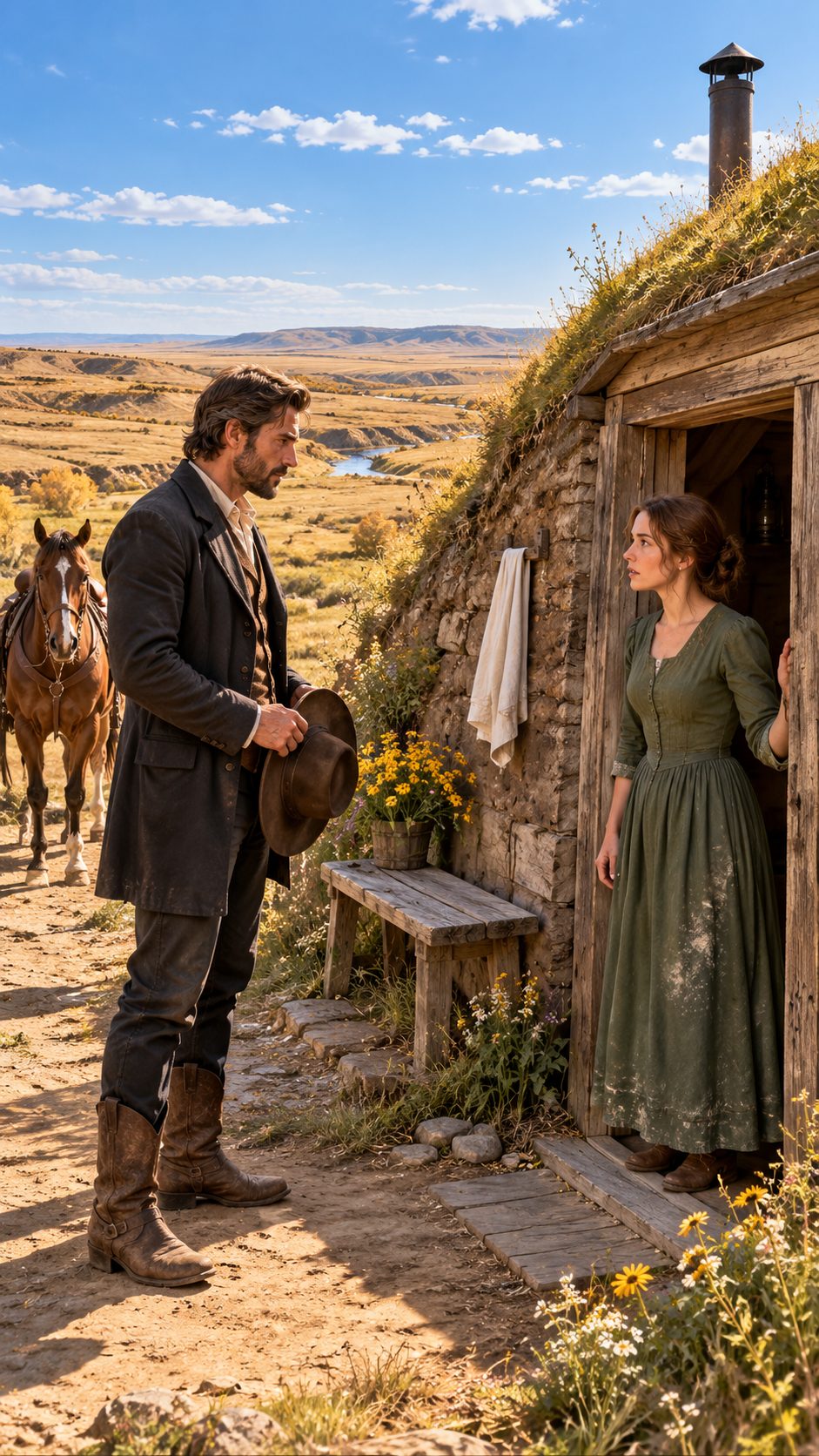
The first bite stopped me so completely that for several seconds I forgot the church hall was crowded, forgot the fiddler scraping away near the door, and forgot that I had spent forty-two years believing there was very little in Nebraska capable of surprising me anymore.
My name was Caleb Dawson, and in the autumn of 1888 most people in Cottonwood Creek knew me as the man who owned more cattle than he could count without a ledger, more pasture than he could cross in a day, and enough money to avoid worrying about the price of almost anything.
That description was accurate, although it left out the less impressive truth that I usually returned from a long day of work to a large house where the loudest sound after dark was the ticking clock in my dining room.
I had never considered myself lonely because loneliness seemed like one of those problems invented by people who had too much spare time, while I had cattle, fences, hired men, accounts, weather, markets, and thousands of acres demanding attention.
The annual harvest celebration at the Cottonwood Creek church was therefore something I attended from duty rather than anticipation, although the tables covered with apple pies, roasted chickens, preserves, cakes, vegetables, biscuits, and casseroles were enough to improve any rancher’s mood after ten hours in the saddle.
I arrived late that afternoon with dust on my coat and hunger sharpening every smell in the hall, and I moved along the food tables without expecting anything more memorable than a full stomach.
Then I saw the loaf.
It sat almost unnoticed beside a plate of sliced ham, darker than the pale bread most families brought, with a deep golden crust and a faint shine that caught the lamplight whenever somebody passed.
I cut myself a slice.
The crust cracked beneath the knife with a sound so clean that I paused before lifting it.
The inside was surprisingly soft, almost delicate, and the smell rising from it carried the warm earthiness of freshly ground wheat beneath a trace of honey.
I took one bite.
The crust was crisp without being hard, the center was tender without being heavy, and the honey did not make the bread sweet so much as reveal flavors in the grain that I had never noticed bread could possess.
I had eaten in respectable restaurants in Kansas City, Denver, and even Chicago, and I had paid ridiculous prices for meals presented under silver covers by men wearing cleaner coats than mine.
None of those meals had made me stop chewing.
This bread did.
I looked around the hall.
“Who made this bread?”
The woman nearest me glanced at the loaf and raised her shoulders.
“I wouldn’t know, Mr.
I held up the slice as though that should somehow improve her memory.
“Someone brought it.”
“I expect so.”
She laughed.
“You’re asking the wrong woman.”
I turned to the next table.
“Does anybody know who baked this?”
Three people looked at one another before shaking their heads.
A rancher I knew leaned back in his chair and grinned.
“Caleb, have you found a fortune inside that flour?”
“I’ve paid for things that cost twenty times as much and weren’t half as good.”
That drew enough laughter to attract attention from the other side of the room.
An older woman walked over and examined the loaf with theatrical seriousness.
“You planning to marry whoever baked it?”
The room erupted.
I smiled because refusing would have made the teasing worse.
“I’d settle for learning her name.”
Someone whistled.
Another man called out that Cottonwood Creek had finally discovered the one thing rich Caleb Dawson could not simply purchase.
I ignored them and cut another slice.
The second tasted as good as the first.
That bothered me for reasons I could not explain.
I had expected the surprise to disappear once I knew what was coming, but the flavor remained remarkable enough that I began asking questions with the persistence I normally reserved for missing cattle.
I spoke to the women who had arranged the food.
None remembered receiving the loaf directly.
One believed it had appeared beside the pies sometime shortly after noon.
Another remembered seeing a folded white cloth near it.
A third woman frowned for a moment and said she had noticed a red-haired boy carrying something wrapped against his chest before the hall became crowded.
“A red-haired boy?”
“I think so.”
“From town?”
“I didn’t recognize him.”
“Did he speak to anyone?”
“Not that I saw.”
It was not much, but it was the first clue I had.
For the remainder of the celebration, I carried that loaf from table to table while asking almost everyone whether they knew a red-haired boy who had brought bread.
By evening I had acquired several jokes, no name, and half a loaf that I wrapped carefully before riding home.
The bread sat on my kitchen table beneath the cloth while I removed my coat.
My house was warm.
The lamps were lit.
The rooms were large enough to impress guests I rarely invited.
I poured myself coffee, cut another slice, and tasted it again.
Fresh wheat.
A faint nuttiness from the darker grain.
I stared at the crust.
It was ridiculous to care this much about bread.
I knew that.
I also knew that somewhere near Cottonwood Creek was a person who had learned how to turn flour, water, honey, yeast, salt, and heat into something I could not forget.
The next morning I ate the final thick slice for breakfast.
By noon I had decided the mystery would fade.
It did not.
Three days later, when I rode into Cottonwood Creek to collect supplies, I asked the general-store clerk whether he knew a red-haired boy who occasionally sold eggs or carried food to church gatherings.
He knew three red-haired families and none matched the description.
I asked the blacksmith.
I asked the feed merchant.
A week passed.
Then another.
I continued checking fences, inspecting cattle, settling accounts, ordering winter feed, and handling all the ordinary responsibilities that had made my life predictable.
Still, every trip into Cottonwood Creek included the same question.
“Seen a red-haired boy selling eggs?”
People began teasing me before I could finish asking.
The older woman from the harvest celebration told me I was proving her marriage joke more accurate by the day.
I told her I was looking for a baker, not a wife.
She laughed as though I had said exactly what she expected.
Nearly two weeks after the celebration, I rode behind the general store because my horse had thrown mud on one boot and I wanted a quieter place to clean it.
That was when I saw him.
A red-haired boy sat beside the wall with a basket of brown and white eggs arranged carefully in straw near his boots.
His clothing was patched but clean.
His boots were so worn at the toes that another hard winter would probably finish them.
I forgot my muddy boot.
I walked toward him slowly enough not to frighten him.
He looked up.
“Good morning, sir.”
“How much for the eggs?”
He named a price.
“I’ll take all of them.”
His eyes widened.
“Every one.”
He studied me as though expecting a trick.
I paid him exactly what he asked.
He counted the coins twice before slipping them into a small cloth pouch.
I crouched so I would not tower over him.
“I want to ask you something.”
The delight vanished from his expression.
“Did you carry a loaf of bread into the harvest celebration?”
The boy went perfectly still.
His gaze shifted immediately toward the road.
The reaction was so sharp that I softened my voice.
“You’re not in trouble.”
He looked at me again.
“I only want to know who made it.”
He hesitated long enough that I wondered if he would refuse.
Then he nodded once.
“You brought it?”
Another nod.
My heartbeat quickened with an absurd excitement that embarrassed me.
“Who baked it?”
The boy lowered his eyes.
“My sister.”
“Your sister?”
“Yes, sir.”
“Then I would like to meet her.”
His head came up quickly.
The answer surprised me.
“She doesn’t like visitors.”
“I only want to thank her.”
He pressed his lips together.
I realized that whatever concern lived behind his expression mattered more than satisfying my curiosity.
“I won’t bother her.”
The boy searched my face.
“You promise?”
The word seemed to loosen something in him.
He pointed west.
“We live near Dry Creek.”
I knew the creek, although almost nobody I knew lived near it.
“What’s your sister’s name?”
“And your family name?”
He hesitated once more.
Emily Turner.
At last the mystery had a name.
I rose and thanked him.
As I turned toward my horse, his small hand caught my coat.
“She won’t understand why you came.”
I looked back at him.
“To be fair, I’m not certain I understand either.”
A reluctant smile touched his face.
I rode home with three dozen eggs tied behind my saddle and the name Emily Turner circling through my thoughts.
Before sunrise the following morning, I saddled my horse.
Dry Creek was nearly three hours west.
I told myself I was going there because extraordinary work deserved acknowledgment.
I told myself I was going because curiosity had become irritating.
I told myself a dozen sensible things.
Yet as I rode into the cold Nebraska dawn, one uncomfortable truth traveled with me.
For the first time in years, I was pursuing something without knowing whether money, influence, or hard work could guarantee that I would get it.
✓ Lynn R. Adams
The first bite stopped me so completely that for several seconds I forgot the church hall was crowded, forgot the fiddler scraping away near the door, and forgot that I had spent forty-two years belie…