Chapter 1: THE BREAD IN HER DRESS 251
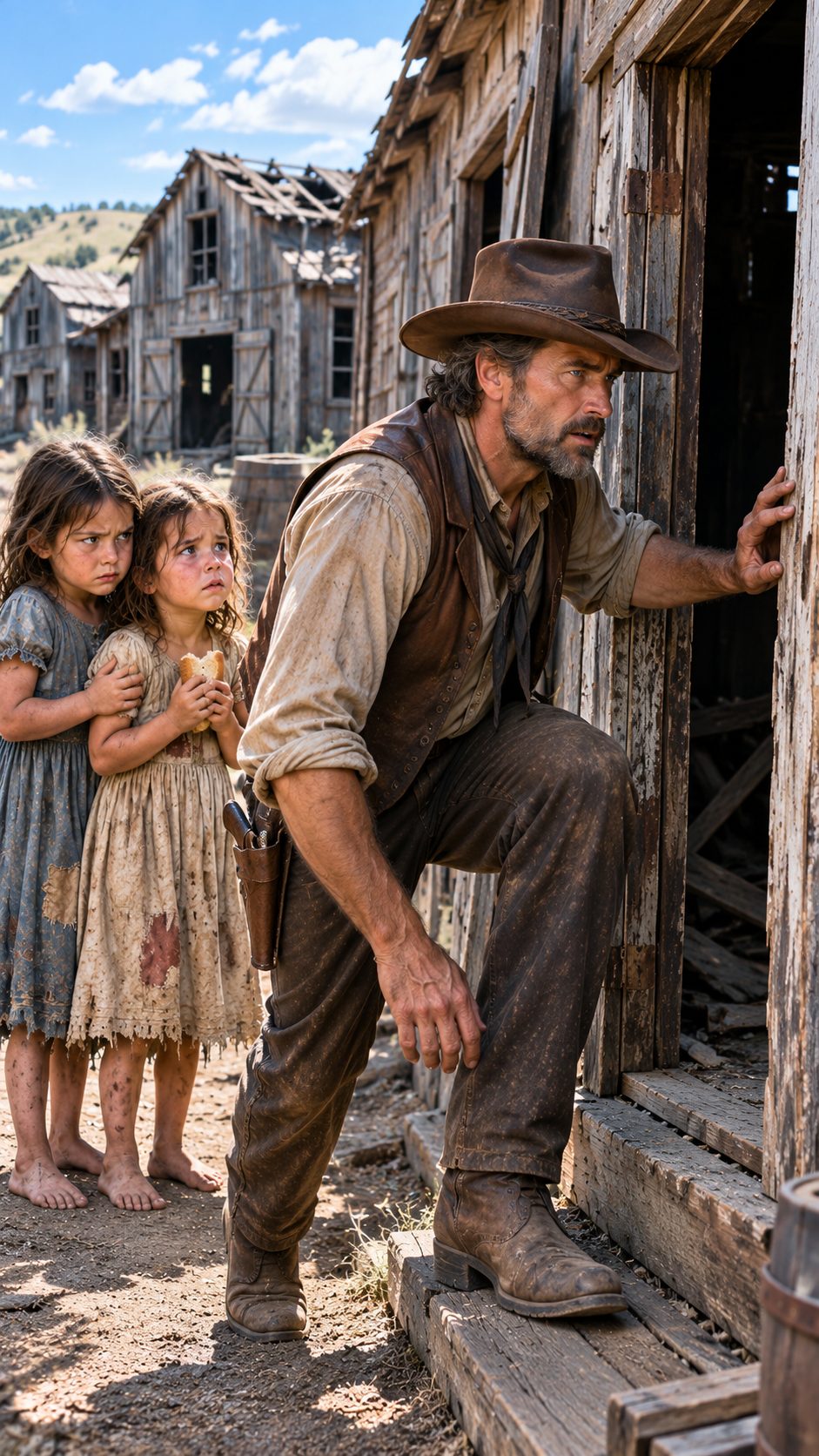
The first thing I noticed was not that the little girl was starving, but that she was hiding half of the only food she had as though somebody else needed it more than she did.
I stood behind the Black Horse saloon in Willow Bend that hot July morning of 1886 with a repaired saddle buckle in my pocket and dust on my boots, watching two children crouch beside a garbage barrel like frightened animals waiting for the world to pass them by.
For five years I had become good at passing people by.
After Margaret died during the worst winter I could remember, I buried my wife beneath the cottonwood on the hill behind our Wyoming ranch, walked back into the house we had built together, and decided that wanting nothing from anyone was safer than losing someone again.
Three bedrooms stayed empty after that.
Six chairs remained around a dining table where I ate alone.
The stove warmed the kitchen every winter, but there was no laughter to warm the rest of the house.
People called me quiet.
Some called me bitter.
I called myself sensible.
Three times a week I rode into Willow Bend for flour, coffee, mail, horseshoe nails, or whatever else could not be produced on my own land, and I always returned home before conversation had a chance to become friendship.
That morning should have been no different.
My saddle buckle had snapped before sunrise, so I left my horse at the hitching rail outside Amos Reed’s hardware store and waited while Amos hammered a replacement into place.
Amos tried to tell me about a church supper planned for Saturday.
I told him I had cattle to check.
He reminded me I always had cattle to check.
I paid him and left before he could say anything else.
The shortcut behind the Black Horse saved several minutes, which was the only reason I entered that narrow alley lined with weathered walls, broken crates, kitchen refuse, and barrels that smelled like sour beer.
Then I heard a rustling sound.
At first I thought it was a dog.
I turned and saw two little girls pressed against the wall beside a rubbish barrel.
They looked nearly identical, with dark tangled hair hanging around narrow faces, brown eyes too large for hollow cheeks, and thin arms extending from dresses repaired so many times that the patches had patches.
Neither wore shoes.
Their feet were coated in dirt, with small cuts across their heels and toes.
One girl held a piece of stale bread.
I could tell from the darkened crust and hardness of it that somebody from the saloon kitchen had thrown it away.
The taller child broke the bread carefully down the middle.
She handed half to her sister.
Then both girls ate.
They did not tear into the bread the way I expected hungry children to eat.
They took slow bites.
They chewed carefully.
They watched the alley while they ate, as if even eating required caution.
I had seen hungry calves fight over feed.
I had watched grown men empty plates after two days on the trail.
These children were different because hunger appeared ordinary to them.
That realization was worse than hearing them cry would have been.
The smaller girl stopped eating first.
She stared at the remaining piece in her hands, glanced at her sister, and slipped it into a small pocket sewn inside her faded cream-colored dress.
The taller girl tucked away her own bread as well.
I stepped closer before I had decided whether I should.
“Hello there.”
Both children froze.
The taller girl jumped in front of her sister and spread her skinny arms as if four years of life had somehow prepared her to fight a grown rancher.
I stopped immediately.
“Easy now.”
Her eyes remained fixed on me.
“I won’t hurt either of you.”
Neither child spoke.
“And I’m not taking your food.”
That seemed to matter, because the taller girl’s shoulders loosened slightly.
“My name’s Silas.”
I remembered the wedge of cheese inside my coat, wrapped in brown paper by the grocer less than an hour earlier.
I reached for it slowly.
Both girls retreated.
“It’s food.”
I removed the package and crouched.
“Fresh cheese.”
The taller girl looked at it.
I set the cheese on a wooden crate several feet away.
“You don’t have to come near me.”
I stepped backward.
For several seconds she simply stared.
Then she darted forward, snatched the package, and hurried back beside her sister.
I expected her to tear into it.
Instead, she opened the paper with astonishing care and divided the cheese into two pieces that were almost exactly the same size.
She gave one to the smaller girl.
Only after her sister had taken a bite did she eat.
Something inside my chest tightened.
Margaret had once told me that kindness was easiest to recognize when someone had very little to give.
I had not thought about those words in years.
I lowered myself onto an overturned box.
“What are your names?”
The taller girl said nothing.
Her sister glanced toward her before answering.
“She’s Lucy.”
I looked at the smaller child.
Her voice was barely more than air.
“Lucy and Mary.”
Saying their names made them feel suddenly less like two strange children in an alley and more like two people I could no longer pretend I had not seen.
“Where’s your family?”
Both stopped eating.
Their reaction was immediate enough to make me regret the question.
“Where do you live?”
Mary looked at Lucy.
“We’re fine.”
I looked at their bleeding feet.
Then I looked at their hollow cheeks.
Then I looked at the bread hidden inside Mary’s dress.
“No, sweetheart.”
I kept my voice gentle.
“I don’t believe you are.”
Lucy’s chin lifted.
There was pride in that small face, but there was fear underneath it.
I knew that expression because I had worn my own version of it for five years.
It was the look of someone determined not to need anything because needing something gave the world another way to hurt you.
I thought suddenly of my ranch twenty miles outside town.
I thought of the pantry shelves filled with beans, flour, dried beef, apples, oats, and jars of preserves Margaret had taught me to replace every autumn.
I thought of three bedrooms where dust gathered on unused furniture.
I had more food than one man required.
I had more space than one man could fill.
Until that moment I had considered those empty rooms proof that I needed nobody.
Looking at Lucy and Mary, they began to look like evidence of something else.
“Do you come here every day?”
Lucy hesitated.
Then she nodded.
I stood, and both girls backed against the wall.
“I won’t touch you.”
I pointed toward the crate.
“But I’ll bring food tomorrow.”
Lucy frowned as though the promise itself were suspicious.
“Because you need it.”
Her expression hardened.
“We didn’t ask.”
I almost smiled.
“You didn’t.”
I pointed again toward the crate.
“I’ll leave it there and walk away, so you won’t owe me anything.”
They exchanged a look only twins could understand.
I turned toward the street.
I had taken four steps when I heard Mary behind me.
She had pulled the stale piece of bread from the hidden pocket in her dress.
She held it between both hands like something precious.
I walked back a little, careful not to frighten her.
“You’re saving that for tomorrow?”
Mary shook her head.
“Then what’s it for?”
Lucy suddenly seized her sister’s arm.
“Mary, don’t.”
But Mary looked straight at me.
“It’s for Mama.”
The sounds of Willow Bend seemed to vanish.
I heard no wagon wheels.
No saloon piano.
“Your mama?”
Mary nodded.
“Where is she?”
Lucy looked down.
Mary clutched the bread.
Neither answered.
Then Lucy slowly turned her head toward the far end of the alley.
I followed her gaze.
Beyond three barrels and a leaning fence stood a group of buildings abandoned years earlier when a lumber company failed and disappeared from Willow Bend.
Their roofs sagged.
Their windows were shattered.
The summer wind pushed one crooked door back and forth on rusted hinges.
Nobody lived there.
At least nobody was supposed to.
I looked back at Lucy.
“Is your mama inside one of those buildings?”
Lucy squeezed Mary’s hand.
Her small knuckles turned white.
She did not say yes.
She did not say no.
Mary looked toward the darkest doorway and held that piece of bread tighter.
That was when I understood why two starving children had stopped eating before their food was gone.
They were not saving themselves from tomorrow’s hunger.
They were trying to keep someone else alive.
I stepped past them.
Lucy’s hand caught the edge of my sleeve.
Her face had gone pale.
She swallowed.
“Mama said not to tell anybody.”
I crouched until my eyes were level with hers.
“Is she hurt?”
Lucy looked at Mary.
“She’s sick.”
Those two words changed everything.
I rose and started toward the abandoned buildings.
Behind me, bare feet hurried across the dust.
When I reached the first broken doorway, the air inside smelled of old wood, damp earth, and something sourer that made uneasiness crawl along the back of my neck.
“Which one?”
Mary pointed toward a building farther down.
I crossed the yard between them.
The girls followed until Lucy stopped at the door.
I stepped onto a warped wooden threshold.
Inside, darkness swallowed the afternoon light after only a few feet.
Then I heard it.
A weak cough.
Not a child’s cough.
It came from somewhere beyond a collapsed wall.
I took one step into the darkness, and a voice so faint I nearly mistook it for the building settling whispered from the shadows.
I stopped breathing for a second.
Mary pressed against my leg.
And somewhere inside that ruined building, something heavy scraped across the floor.
✓ Lynn R. Adams
The first thing I noticed was not that the little girl was starving, but that she was hiding half of the only food she had as though somebody else needed it more than she did. I stood behind the Blac…