Chapter 1: THE BOY WITH THE BROKEN SHOES – 041
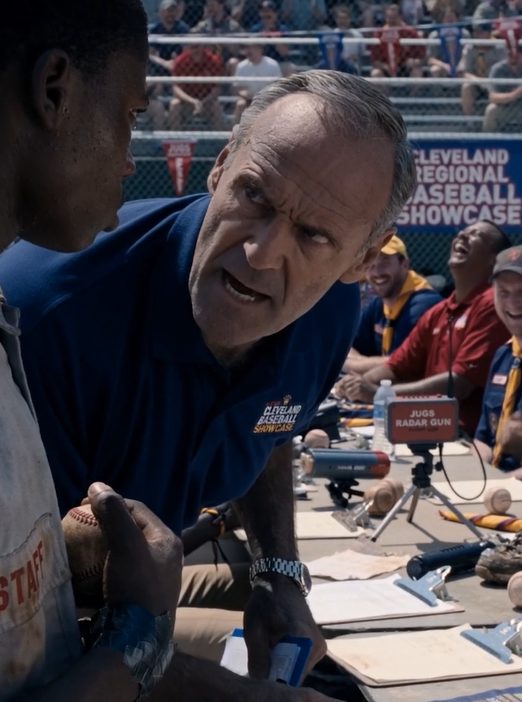
The first college scout laughed at my shoes.
The second laughed when I said I could pitch.
But the third man—the one who had been evaluating baseball players for nearly forty years—stopped laughing the moment he saw how I held a baseball.
By then, thirty college recruiters had already decided I didn’t belong on their field.
My name is Terrence Cole.
I was eighteen years old, and that Saturday morning, I stood in front of the most important people I had ever met, wearing an oversized gray staff uniform and a pair of sneakers that were literally falling apart.
Black athletic tape wrapped around my right shoe, holding together the leather that had separated from the sole.
My shirt was two sizes too large.
And the plastic badge clipped to my chest read:
BALL CREW — TERRANCE COLE.
They hadn’t even bothered to spell my name correctly.
The head evaluator, a broad-shouldered white man wearing an expensive silver watch, looked at my badge before finally raising his eyes to my face.
“What do you need, son?”
His voice carried the impatience of someone who had already decided my question wasn’t worth hearing.
I tightened my fingers around the baseball in my hand.
“Sir, if the last pitcher isn’t coming, could I throw instead?”
For one brief moment, nobody spoke.
Then a scout sitting three chairs away lowered his clipboard, looked at my damaged sneaker, and burst into laughter.
“We’re evaluating pitchers, not stadium workers.”
Several men chuckled.
Someone behind me whistled.
My ears burned.
I could feel the eyes of parents and athletes turning toward me from the bleachers.
Some looked amused.
Others seemed embarrassed on my behalf.
I wished I could disappear.
But I had spent too many years dreaming about standing in front of college recruiters to walk away simply because they thought I looked ridiculous.
“I pitch,” I answered quietly.
The scout leaned back.
“For what team?”
“Jefferson High.”
He frowned.
“Never heard of it.”
“It’s a public school on Cleveland’s east side.”
That seemed to explain everything to him.
He exchanged a glance with the evaluator beside him.
“What’s your velocity?”
I swallowed.
“I’m not sure, sir.”
Another scout laughed.
“You don’t know how fast you throw?”
“We don’t have a radar gun.”
The man looked down at my sneakers.
“That figures.”
I stared at the baseball in my palm.
The white leather was slightly worn.
One red stitch near the seam had started to fray.
It wasn’t an expensive ball.
But I knew every curve of it.
I knew the precise pressure my fingers needed to apply.
I knew how the seams felt when my hand was cold, when my skin was sweaty, and when I had been practicing so long that the tips of my fingers started to ache.
What I didn’t know was how to make those men understand that.
“You’re wasting our time,” the head evaluator said.
I looked up.
“I’m only asking for three pitches.”
His eyebrows lifted.
“Yes, sir.”
“And you think three pitches are going to tell us something that twenty-seven trained prospects haven’t?”
“I don’t know,” I admitted.
“But I’d like the chance to find out.”
A few more people laughed.
Because standing there, with my broken shoes and my misspelled name, I was thinking about my mother.
Denise Cole had spent the previous twelve years cleaning patient rooms at a hospital outside Cleveland.
She worked twelve-hour shifts whenever she could get them.
Sometimes she worked two days in a row with barely enough rest between them to shower and change clothes.
When I was little, she would come home after midnight and find me asleep over my homework.
Instead of carrying me to bed immediately, she would sit beside me and finish checking my answers.
I still remembered the way her fingers looked.
The skin around her knuckles was cracked from cleaning chemicals.
Her ankles were often swollen.
And whenever we went grocery shopping, she calculated the price of everything before placing it in our cart.
Some nights she told me she wasn’t hungry.
It took me years to understand that she was lying.
She always made sure I ate first.
When I was eleven, I found her sitting at our kitchen table with an electric bill in one hand and a grocery receipt in the other.
She was crying.
Not loudly.
Just quietly enough that she thought nobody would hear.
I went back to my bedroom without saying anything.
The next morning, I decided I would never ask her to buy me another piece of baseball equipment.
That was the year I started practicing with tennis balls.
Behind our apartment building stood an old brick wall that had probably been there longer than anyone living on our street.
I drew a strike zone with chalk.
Then I threw.
The first time I struck the middle of the square three times in a row, I celebrated like I had just won the World Series.
A woman from the second floor opened her window.
Some of us are trying to sleep!”
I apologized.
Twenty minutes later, I was throwing again.
Eventually, the complaints became so frequent that I moved my practice sessions behind Jefferson High School.
There was a damaged chain-link fence beyond the baseball field.
Nobody had repaired it in years.
I marked a strike zone with strips of white tape and began throwing real baseballs toward it.
I owned two.
One had a faded blue mark across the leather.
The other was missing part of its stitching.
When a ball slipped through a hole in the fence, I chased it across the empty parking lot.
When it bounced into the weeds, I searched until I found it.
Sometimes that took half an hour.
Once, I spent nearly two hours searching for a baseball in the dark because losing it meant asking my mother for money we didn’t have.
That night, I came home with muddy trousers and scratches across both arms.
Mom looked at me from the kitchen.
“What happened to you?”
“Lost a ball.”
“Did you find it?”
I held it up.
She smiled, but her eyes looked tired.
“Then I suppose it was worth it.”
Back then, I believed that if I practiced enough, someone would eventually notice.
High school taught me something different.
Talent mattered.
But opportunity mattered too.
Jefferson High’s baseball program had almost no money.
Our coach, Daniel Harris, taught mathematics during the week and drove a delivery truck on weekends.
We practiced on fields with uneven dirt and grass that sometimes reached our ankles.
Our equipment shed smelled like wet wood and old leather.
Several players shared gloves.
Our school van broke down so frequently that Coach Harris kept jumper cables beneath the driver’s seat.
Still, I loved that team.
I loved hearing my teammates shouting from the dugout.
I loved the sound of a baseball striking a catcher’s mitt.
And I loved the strange quiet that settled over me whenever I stepped onto a pitching mound.
On the mound, I wasn’t the kid whose mother cleaned hospital rooms.
I wasn’t the boy wearing secondhand clothes.
I was simply a pitcher.
Coach Harris noticed something unusual about my throwing motion during my sophomore year.
He watched me pitch three innings against a school from the western suburbs.
Afterward, he approached me near the dugout.
“Who taught you that grip?”
“Nobody, Coach.”
“I figured it out.”
He examined the baseball in my hand.
“Behind the school.”
He looked toward the broken fence.
Then he looked at me.
“Be careful with your arm, Terrence.
You’re doing things without anyone teaching you how to protect yourself.”
After that, Coach Harris tried to help.
He adjusted my foot placement and taught me how to balance my delivery.
He showed me stretches and insisted I take rest days.
But he was honest about his limitations.
“I’m a math teacher who loves baseball,” he told me once.
“I’m not a professional pitching coach.”
I appreciated him more for admitting it.
When I asked about attending a college showcase, he went quiet.
The registration alone cost more than I could afford.
Then there was transportation, equipment, and the expense of getting noticed among athletes who had trained privately for years.
“I’m sorry, son,” he said.
“Our program just doesn’t have that kind of money.”
I told him it was okay.
Every spring, I watched players from wealthy schools receive invitations to camps and tournaments.
Some were excellent.
Others were no better than boys I played with every week.
But they had something we didn’t.
I never hated them for it.
I only wondered what might happen if someone finally gave me the same chance.
Then I heard about the regional showcase.
Thirty college scouts.
Dozens of promising players.
Professional radar equipment.
And one temporary ball crew position available for the weekend.
I applied immediately.
The wages were small, but that wasn’t why I wanted the job.
I wanted to watch.
I wanted to see how pitchers trained at that level.
And maybe, if I was lucky, I could speak to someone who knew how a boy like me could find a way into college baseball.
I arrived before sunrise.
I carried water coolers.
Organized baseball buckets.
Dragged equipment across the dirt.
Prepared the bullpen mounds.
By nine o’clock, sweat had soaked through my gray shirt.
The tape around my sneaker had started peeling away.
But I barely noticed.
I was too busy studying every pitcher who stepped onto the mound.
I watched their grips.
Their balance.
Their shoulder rotation.
The way they transferred weight from their back legs.
I counted pitches silently.
I watched radar numbers rise and fall.
And whenever someone threw a particularly difficult pitch, I tried to understand why it moved the way it did.
Twenty-seven pitchers completed their evaluations.
Then a showcase coordinator hurried toward the scouting table.
The final scheduled prospect wasn’t coming.
The evaluator checked his watch.
The other scouts began closing their folders.
And something inside me refused to stay quiet.
Before I could lose my courage, I stepped forward.
That was how I ended up standing before thirty men who thought my shoes told them everything they needed to know about me.
The evaluator sighed.
“Listen, son.
This is a serious event.”
“I know, sir.”
“These athletes have spent years preparing for this.”
“So have I.”
His expression hardened.
“Don’t make this difficult.”
I looked toward the mound.
It was empty.
The catcher was still waiting behind home plate.
The radar gun remained positioned beside the evaluation table.
Everything I had dreamed about was right there.
Twenty-seven boys had already been allowed to show what they could do.
All I wanted was thirty seconds.
“Please,” I said.
“Just three pitches.”
The evaluator opened his mouth to refuse.
But before he could speak, a quiet voice came from the far end of the table.
“Let him hold the ball again.”
Everyone turned.
An elderly recruiter with thinning silver hair had been watching me for several minutes.
I raised the baseball.
“Like this, sir?”
He leaned forward.
“The way you were holding it before.”
I repositioned my fingers across the seams.
The old man’s expression changed.
His clipboard slipped slightly from his lap.
He stared at my hand.
Then he slowly stood.
And in a voice that made the entire scouting table go silent, he asked:
“Son… who taught you to throw that pitch?”
✓ Lynn R. Adams
The first college scout laughed at my shoes. The second laughed when I said I could pitch. But the third man—the one who had been evaluating baseball players for nearly forty years—stopped laughing …